
There are actually two very different things people mean when they search for "bird of paradise," and they look nothing alike. One is a real, living bird from the rainforests of New Guinea, famous for its outrageous plumes and colors. The other is a tropical plant with a striking orange-and-blue flower that looks so much like a bird's head it earned the same name. If you meant the plant look, a bird of paradise tree substitute is the Strelitzia plant, which can develop upright leaves and a tall, tree-like clump depending on the species tropical plant with a striking orange-and-blue flower. Figuring out which one you're thinking of takes about five seconds, and once you know what to look for in each, you'll never confuse them again.
What Does a Bird of Paradise Look Like Bird and Plant Guide

Marcus Whitley
18 May 2026
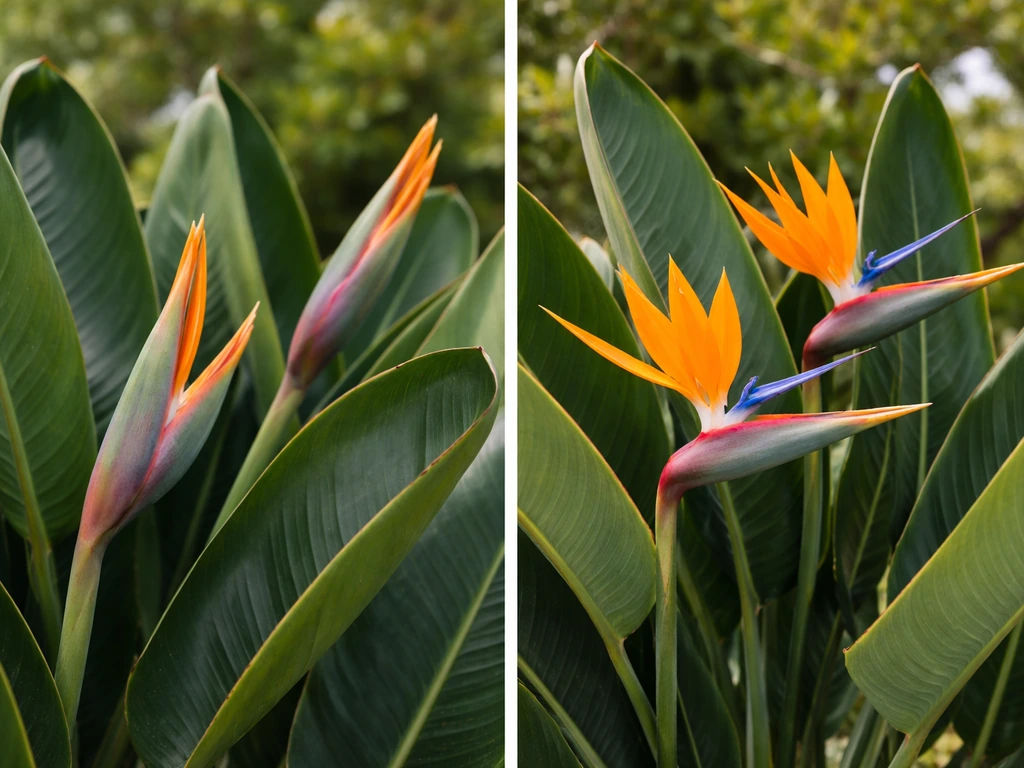
Bird or plant? How to tell which one you mean
If you saw something in a garden, a flower shop, or a houseplant photo, you're almost certainly looking at the plant, Strelitzia. If you saw something in a nature documentary, a birdwatching photo, or a rainforest image, you're probably looking at the actual bird from the family Paradisaeidae. The confusion is totally understandable because the plant's flower was deliberately named after the bird, and the resemblance is real. The flower's orange petals and blue tongue genuinely look like a bird's beak and crest. But beyond that one detail, the two things have nothing else in common visually. This article covers both, so wherever you landed, you're in the right place. And if you've ever been surprised by how different the real thing looks from what you expected, you're definitely not alone.
What the bird of paradise bird looks like
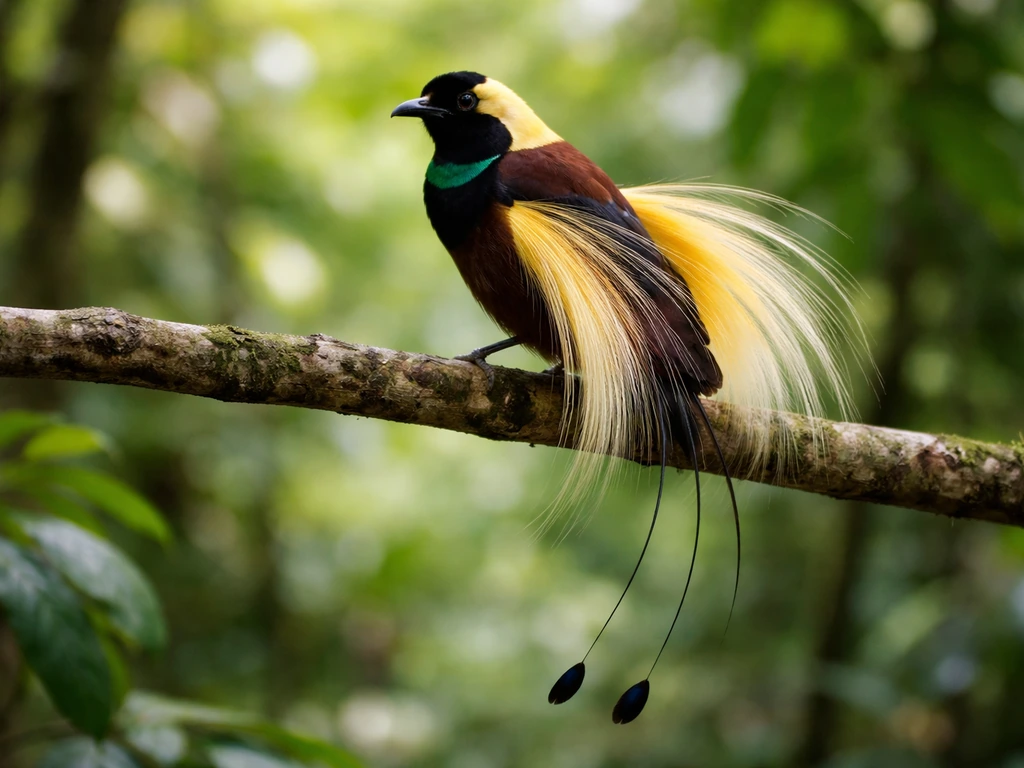
The birds of paradise (family Paradisaeidae) are medium-sized birds, roughly comparable in body size to a large starling or a small crow, but that body size is almost beside the point because the males are dressed in some of the most extreme plumage on Earth. Think of a crow-sized bird wrapped in cascading silk scarves, wire antennas, and iridescent patches, and you're getting close.
The single most recognizable feature on most male birds of paradise is the elongated flank plumes. These feathers grow out from beneath the wings and can extend well beyond the bird's body, fanning out into a soft, wispy cascade of color. In many species, the tail also carries long, wire-like feathers, sometimes called wires or streamers, that curve or twist outward from the tail tip. Some species, like the twelve-wired bird of paradise, have literally twelve blackish wire-like filaments shooting out from their plume feathers. When you see one, it looks almost artificial, like someone glued antenna wires to a bird.
Colors vary wildly between species, but you'll often see combinations of deep black with intense patches of yellow, red, green, or iridescent blue. Many males also have a feathered ruff or collar around the neck or chest that they can puff up during courtship. Females, by contrast, look nothing like this. They're typically brown and understated, built for camouflage rather than display.
Key things to look for when identifying the bird
- Elongated flank plumes flowing out from beneath the wings, often in gold, red, or orange tones
- Wire-like tail feathers that extend well beyond the body, sometimes twisted or curled
- A feathered ruff or collar on the chest or neck that can be flared during display
- Iridescent patches on the breast or head that shift color in different light
- Compact, sturdy body beneath all the ornamentation, similar in size to a large starling
- Females: plain brownish plumage with barring underneath, no long plumes or wires
What a healthy bird of paradise looks like
A healthy male bird of paradise in full condition is one of the most visually striking things in the natural world. The plumage looks full, clean, and glossy. The flank plumes should flow smoothly without gaps or matted clumps, and the wire feathers should be intact and straight rather than broken or bent. The iridescent patches on the breast will catch light and appear to shift color as the bird moves. In captive or photographed individuals, watch for dull or matted feather texture, bald patches, missing or broken wire feathers, and poor overall feather symmetry, as these are signs of stress, illness, or poor conditions. A bird in good health carries its plumage with a kind of effortless fullness, almost like the feathers are slightly inflated.
What the bird of paradise plant looks like
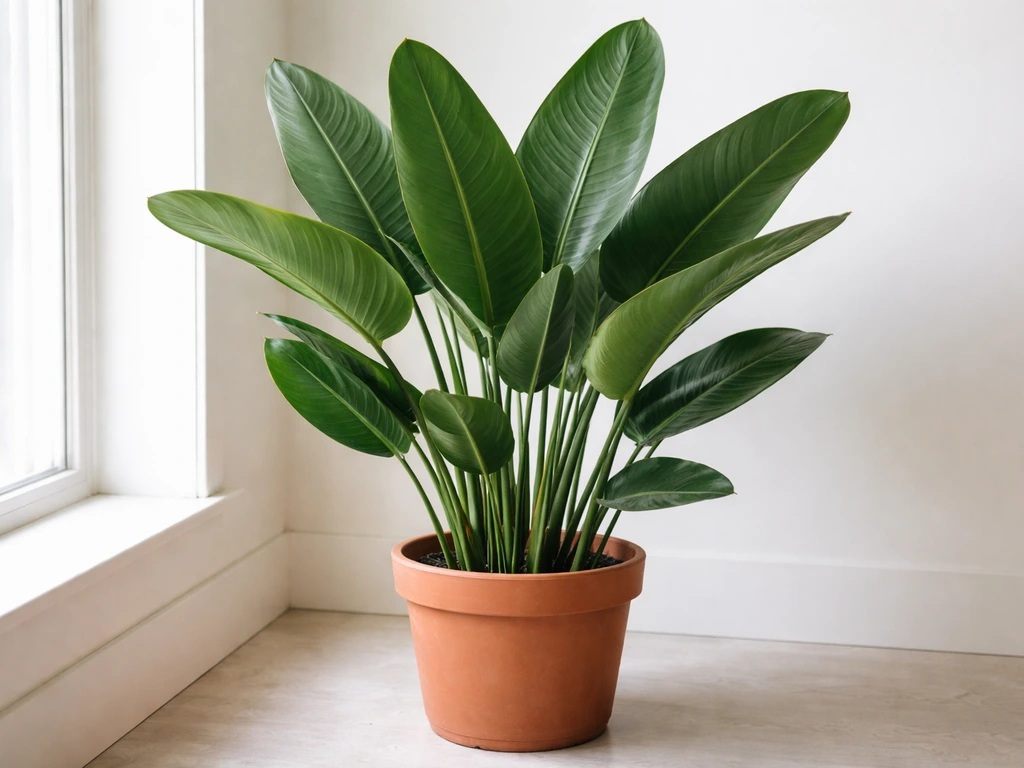
The most common garden and houseplant version is Strelitzia reginae, a compact evergreen perennial that grows to about 3 to 4 feet tall (roughly 1 to 1.5 meters). It forms a clump of long-stalked leaves that are stiff, oblong, and grey-green in color, a bit like smaller, thicker versions of banana leaves. The leaves grow upright on long stems and have a leathery, paddle-like look to them. The whole plant has a tidy, sculptural quality that makes it popular in landscaping and as an indoor statement plant.
There's also a much larger relative called Strelitzia nicolai, sometimes called the giant bird of paradise or the white bird of paradise. This one grows into something that genuinely looks like a small tree, reaching 7 to 8 meters tall with clumps spreading up to about 3.5 meters wide. It has massive grey-green leaf blades up to 1.5 meters long on leaf stalks that can reach 2 meters themselves, arranged in a fan-like crown at the top of stiff stems. If you're looking at what seems like a small palm or banana tree with oversized paddle leaves, that's likely S. nicolai.
What the bird of paradise flower looks like
This is the part that earns the plant its name, and it really does look like a bird's head poking out of a leaf. The flower emerges from a hard, stiff, boat-shaped sheath called the spathe, which is usually greenish-pink or reddish-green and sits at the top of a tall stem. This spathe is the "beak." From inside it, the actual flowers open one at a time. Each flower has three bright orange sepals that splay upward and outward like a crest, plus three purplish-blue petals. Two of those blue petals are fused together and folded to form an arrow-like tongue pointing sideways. The whole inflorescence holds four to six individual flowers that open in succession, so the bloom lasts a long time as each one takes its turn. Oxford’s Plants 400 describes the flower head as an inflorescence of four to six flowers that emerge successively from a stiff, horizontal, greenish-pink beak-like bract (a modified leaf) the whole inflorescence holds four to six individual flowers that open in succession.
Put it all together and you get something that looks like a bright tropical bird mid-squawk: orange crest, blue beak-tongue, green "beak" underneath. The orange-and-blue color combination against the grey-green leaves is vivid and unmistakable. UF/IFAS describes it perfectly: the inflorescence genuinely resembles the beak and plumage of a brightly colored bird. Strelitzia reginae flowers mainly from early fall through late winter, so you're most likely to see them in full bloom during those months.
The giant relative, Strelitzia nicolai, produces a different version of this same structure. Its spathe is dark blue-black rather than greenish-pink, the sepals are white rather than orange, and the fused petals form a bluish-purple tongue. The whole flower can measure up to 18 cm tall and 45 cm long. Same basic architecture, very different color palette.
| Feature | Strelitzia reginae (common) | Strelitzia nicolai (giant) |
|---|---|---|
| Plant height | About 3 to 4 feet (1 to 1.5 m) | Up to 25 feet (7 to 8 m) |
| Spathe (beak) color | Reddish-green or greenish-pink | Dark blue-black |
| Sepal color | Bright orange | White |
| Petal color | Purplish-blue | Bluish-purple |
| Leaf size | Oblong, moderate paddle | Up to 1.5 m blade on 2 m stalks |
| Overall look | Compact garden/houseplant | Tree-like, palm-like crown |
What bird of paradise flower buds look like before they open
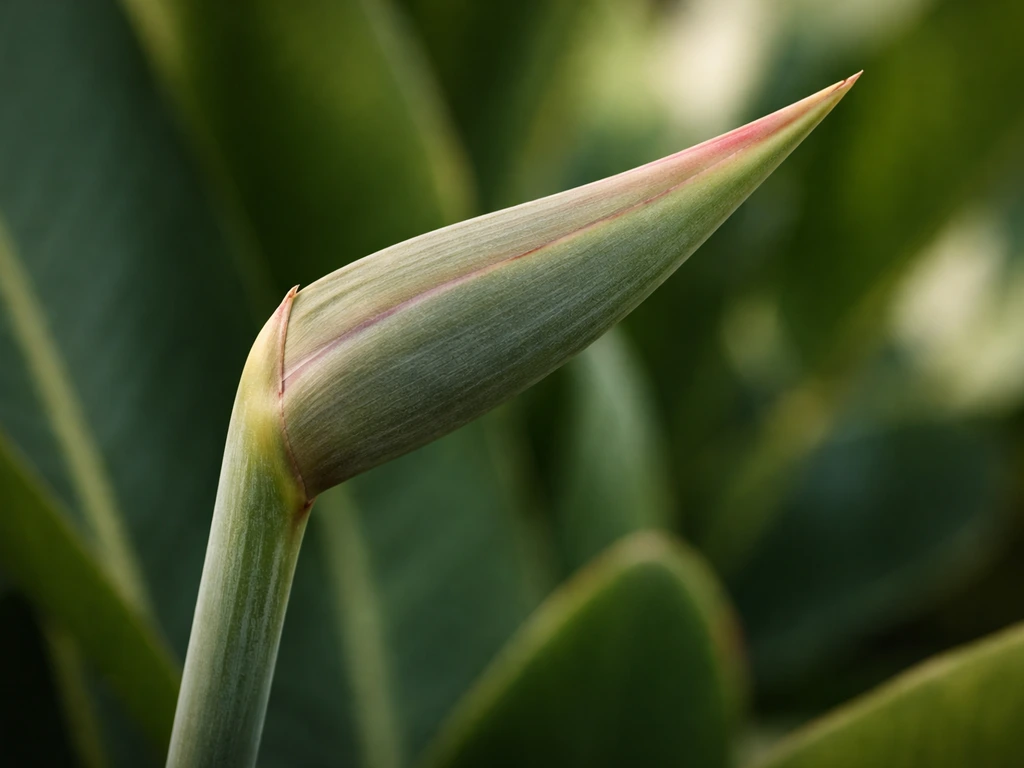
Before the flower opens, what you'll see is just the hard, boat-shaped spathe sitting at the tip of a long, stiff stem. It looks like a thick, slightly curved beak or a green-pink canoe pointing sideways. There's no hint yet of the orange or blue inside. The spathe can look almost waxy and sculptural at this stage, which is actually one of the reasons cut stems are sold in bud form, they're architectural even before they bloom. You might notice a slight darkening or softening at the tip of the spathe as the first flower prepares to push through. Once that first orange sepal starts to emerge, the transformation is fast. If you're watching a bud open, the first thing to appear is usually the tip of an orange sepal sliding upward out of the spathe like a flag being raised.
How to avoid mix-ups and nail the ID quickly
The most common mix-up is mistaking the Strelitzia plant for something else entirely. People sometimes confuse it with the traveller's tree (Ravenala madagascariensis), which has a structurally similar flower but with a green bract and white blooms. The fan-shaped leaf arrangement is also similar. If the flower bract is green rather than dark or pinkish, and the flowers are all-white, you're probably looking at Ravenala, not Strelitzia. The Mexican bird of paradise is a completely different plant (a flowering shrub, not Strelitzia at all), so if you're trying to identify something that looks more shrub-like with ferny leaves and yellow flowers, that's its own category worth looking into separately. If you mean the Mexican bird of paradise, look for its distinct shrub-like form and yellow, ferny-looking foliage, which gives away the ID what does a Mexican bird of paradise look like.
For the bird itself, the biggest mistake people make is expecting all birds of paradise to look the same. They don't. There are dozens of species, and some of them look almost nothing like the classic plumed image most people have in mind. If you've ever seen a photo and thought "that doesn't look like what I imagined," you're probably looking at one of the less-decorated species or a female. The rule of thumb: if it's a male in display condition, it will have at least one obviously exaggerated feature, whether that's long wire feathers, a dramatic ruff, intense iridescent patches, or all of the above.
Here's a quick visual checklist you can run through right now to figure out what you're looking at:
- Is it a living plant or an animal? If it's stationary, rooted, and has leaves, it's the plant.
- Does the flower have a stiff, beak-like green or pink sheath at the base? That's the Strelitzia spathe. You've got the plant.
- Are the flower colors orange and blue? Almost certainly Strelitzia reginae.
- Are the flower colors white and blue-purple on a very tall plant? You're looking at Strelitzia nicolai.
- Are you looking at a bird with impossibly long feathers flowing from its sides or tail? That's the real bird of paradise.
- Is the bird plain brown with subtle barring? That's likely a female bird of paradise, not a different species.
Whether you came here trying to identify a flower in someone's garden or a bird in a nature video, the visual cues are distinct enough that a quick look at the right features will settle it fast. The plant's orange-and-blue flower emerging from a hard green beak is unlike anything else in the garden world. If you are trying to identify the flower that looks like a bird, the Strelitzia (bird of paradise) plant is the classic match orange-and-blue flower. And the bird's elongated wires and flowing plumes are unlike anything else in the bird world. Once you've seen either one described clearly, you won't mix them up again.
FAQ
How can I tell in one glance whether a photo is the plant or the real bird?
If it looks like an orange-and-blue “crest” coming out of a hard, boat-shaped greenish-pink (or dark blue-black for the giant type) sheath, it is almost certainly the plant (Strelitzia). If you do not see that spathe structure and instead you see a crow-sized bird with cascading flank plumes or wire-like “streamers,” it is the bird.
What if the “bird of paradise” I see looks plain or brown, does that mean it is not real?
Bird-of-paradise males usually show at least one standout exaggerated feature, but females and non-display angles can look plain brown. If the “bird of paradise” in your photo looks uniformly brown with no wires or ruffs, treat it as possibly a female or a less-decorated species rather than assuming the photo is wrong.
What does a bird of paradise look like before it blooms?
For Strelitzia, the earliest stage is the unopened spathe, which can look like a thick canoe or curved beak with no visible orange or blue yet. When it is in bud form, the plant can look architectural and may be mistaken for a different tropical with a lone bract.
Why do the orange and blue shades look different in different photos of Strelitzia?
Colors shift by species, but also by how the flower is angled and how light hits it. In some views the blue tongue looks more purplish, and the orange sepals can appear deeper or paler. Use the structure (spathe as the “beak,” three orange sepals as the crest, fused blue tongue) rather than relying on color alone.
What signs should I look for to judge whether a Strelitzia plant is healthy when identifying it?
A healthy Strelitzia spathe and opened flowers should look firm and intact, not collapsed. Watch for signs of stress like brown tips on leaves, streaky or mushy spots on stems, or flowers that brown quickly after opening, which can indicate inconsistent watering or stress from cold drafts.
How do I avoid confusing Strelitzia with traveller’s tree when identifying the flower?
If the plant has a fan of paddle-like leaves but the flowers are white and the bract is green, it may be traveller’s tree (Ravenala), not Strelitzia. The quickest tell is the bloom palette and the “bird-like” orange-and-blue architecture, which Ravenala does not share.
Why do different bird-of-paradise species look so different from the famous plumed image?
If you are identifying the bird, don’t expect every species to match the classic “silk scarf with antennas” look. Different species can have different plume lengths, ruff emphasis, and wire-like structures, so compare the body size plus the presence of elongated flank plumes or tail streamers, not just the overall color.
Should I use leaves or flowers first when trying to identify a bird of paradise plant?
A useful approach for plant identification is to separate leaf clues from flower clues. Leaves can suggest “big tropical fan palms,” but the decisive feature is the flower’s spathe-as-beak plus the orange crest and blue tongue. If the leaves match but the flower structure does not, the plant is probably not Strelitzia.
Next Articles
What Does a Herring Bird Look Like? Herring Gull ID Guide
Learn what a herring bird likely is: clear herring gull ID guide with key marks, plumage differences, and lookalike comp
What Does a Hawk Bird Look Like? Key Field Marks to Spot
Learn key field marks for spotting hawks, compare to eagles falcons buzzards, and confirm with photos and angles.
What Does a Seahawk Bird Look Like? Osprey ID Guide
See hawk meaning Osprey ID: size, flight posture, plumage patterns, bill/eye marks, and lookalike confusion cues.