A black bird is any bird that appears mostly or entirely black, but that description covers a surprisingly wide range of species, from the familiar American Crow to glossy grackles, speckled starlings, and even cowbirds whose brown heads can look black in low light. The key to telling them apart is not just color, it is shape, size, eye color, tail form, and the way the plumage catches the light. Once you know what to look for, most of these birds are actually pretty easy to separate.
What Does a Black Bird Look Like? Identify Key Field Marks

Marcus Whitley
7 Jun 2026
"Black bird" vs. a true black bird, why the difference matters
When most people say they saw a "black bird," they usually mean a bird that looked black to them in the field. That is not the same as a bird with scientifically all-black plumage. Many species that read as black are actually very dark brown, charcoal gray, or glossy black that shifts to purple, blue, or green when the sun hits them at the right angle. A Common Grackle, for example, looks solid black from a distance but is actually iridescent bluish-purple on its head and neck. A Brown-headed Cowbird can look entirely black in shade, even though the male has a warm chocolate-brown head in good light. Separating true black plumage from near-black plumage is one of the first things to sort out when you are trying to nail down an ID.
The other thing worth knowing is that "blackbird" (one word) sometimes refers to a specific group of birds, particularly in North America, the Icterid family, which includes grackles, cowbirds, and Red-winged Blackbirds. In Europe, "the blackbird" often means the Common Blackbird, a thrush with a bright orange bill. This article covers the broader category: any bird that looks predominantly black, whatever species it turns out to be.
Start here: five field marks to check the moment you see a black bird
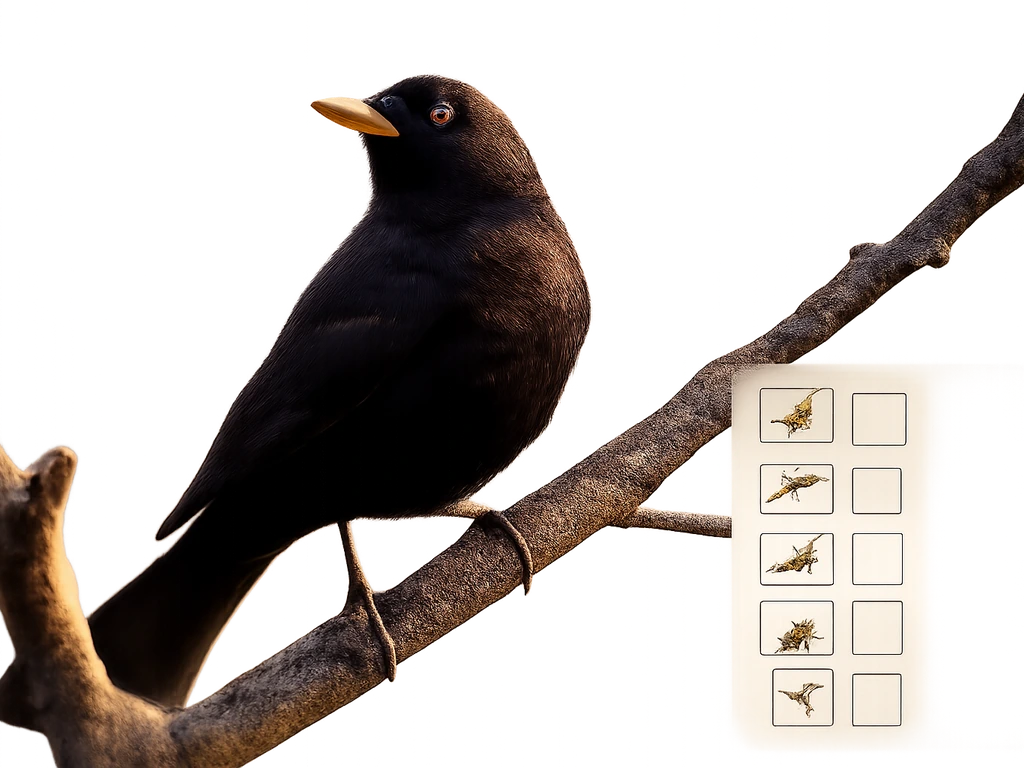
Before you even reach for a field guide, train your eyes on these five things. They will narrow your options down fast.
- Size: Is it roughly sparrow-sized, robin-sized, or crow-sized? A starling is closer to a robin. A grackle is noticeably bigger. A raven is almost the size of a Red-tailed Hawk.
- Tail shape: Is the tail short and squared off, long and graduated, or wedge-shaped? This is one of the fastest ways to separate crows from ravens, and grackles from other blackbirds.
- Bill shape and color: Is the bill thick and heavy, thin and pointed, or somewhere in between? Does it look yellow, orange, black, or gray? A bright yellow bill on a black body is a major clue.
- Eye color: Many black birds have strikingly pale or yellow eyes that pop against dark plumage. If you can see the eye color, use it.
- Sheen and iridescence: Does the black plumage look flat and matte, slightly glossy, or is there obvious iridescent color shifting? And where on the body does that sheen show up — the head, the body, or both?
The most common black birds and what they actually look like
American Crow
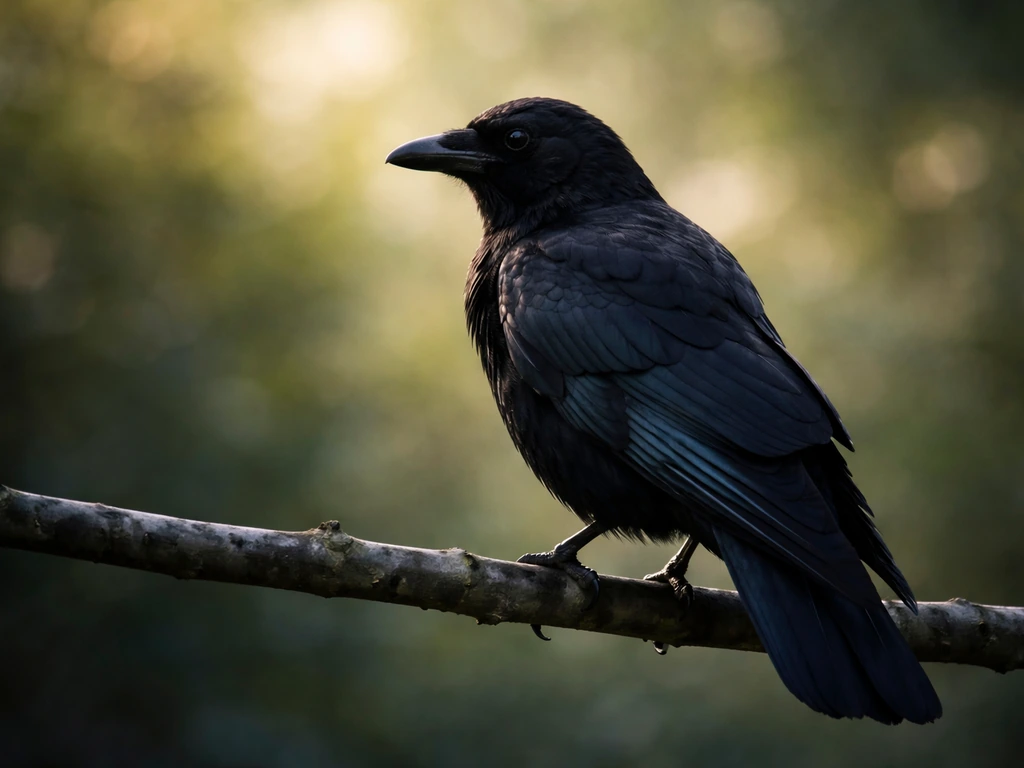
The American Crow is the bird most people picture when they think "black bird." It is a large, all-black bird, about 20 inches from bill tip to tail, with a slight gloss to its plumage rather than a strong iridescent shimmer. Its bill is thick and fairly long, its wings are rounded, and its tail is short and squared off at the end. In flight that squared tail is one of the easiest things to spot. Crows are confident, loud, and often seen in groups, foraging on the ground or perching on telephone wires and fence posts.
Common Raven
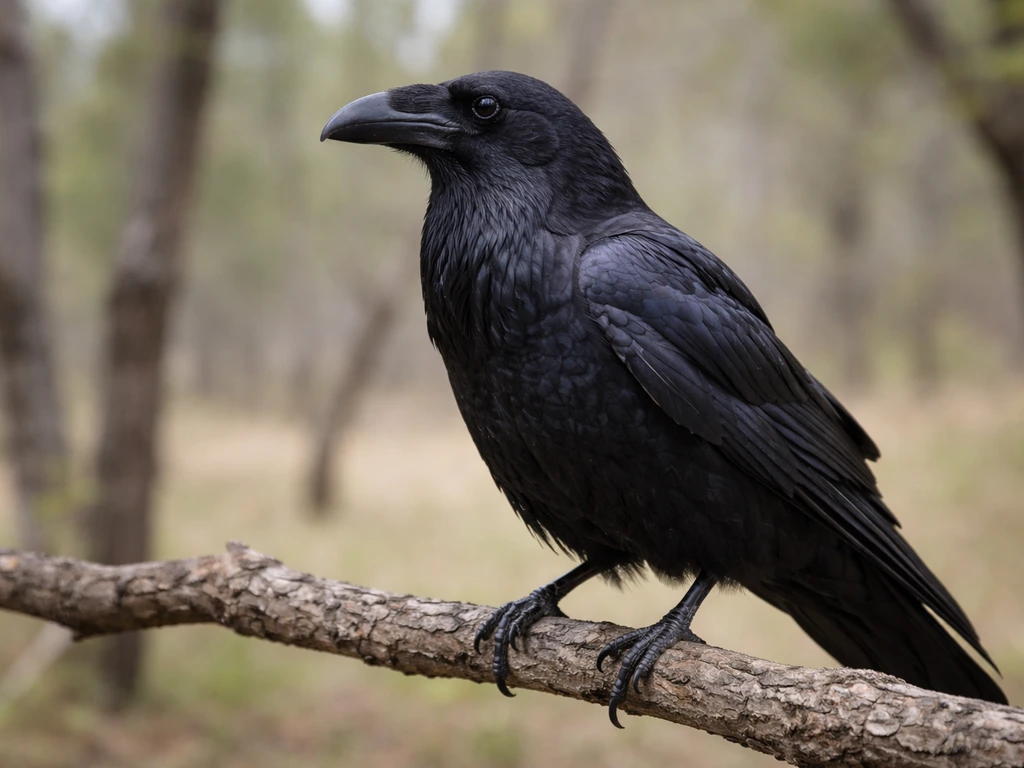
The Common Raven looks like a crow that went to the gym. At around 27 inches long, it is noticeably larger, roughly the size of a hawk, with a much heavier, more curved bill and a distinctly different tail. In flight, a raven's tail comes to a wedge or diamond shape, which is one of the clearest ways to separate it from a crow at a distance. Ravens also have shaggy throat feathers called hackles that you can sometimes see when they are calling or displaying. Their flight style tends to be more soaring and effortless, often mixing in long glides, while crows flap more steadily.
Common Grackle
The Common Grackle is a large blackbird, bigger than a robin, slimmer than a crow, with one of the most distinctive tails of any black bird. Males hold their long, graduated tails in a deep V or keel shape during the breeding season, which makes them look almost boat-tailed from the side. The plumage appears black overall, but in good light the head and neck flash iridescent blue or purple while the body can show a bronzy or greenish sheen. The eyes are a bright, pale yellow that really stands out against the dark face, a detail worth looking for even in quick glances.
European Starling
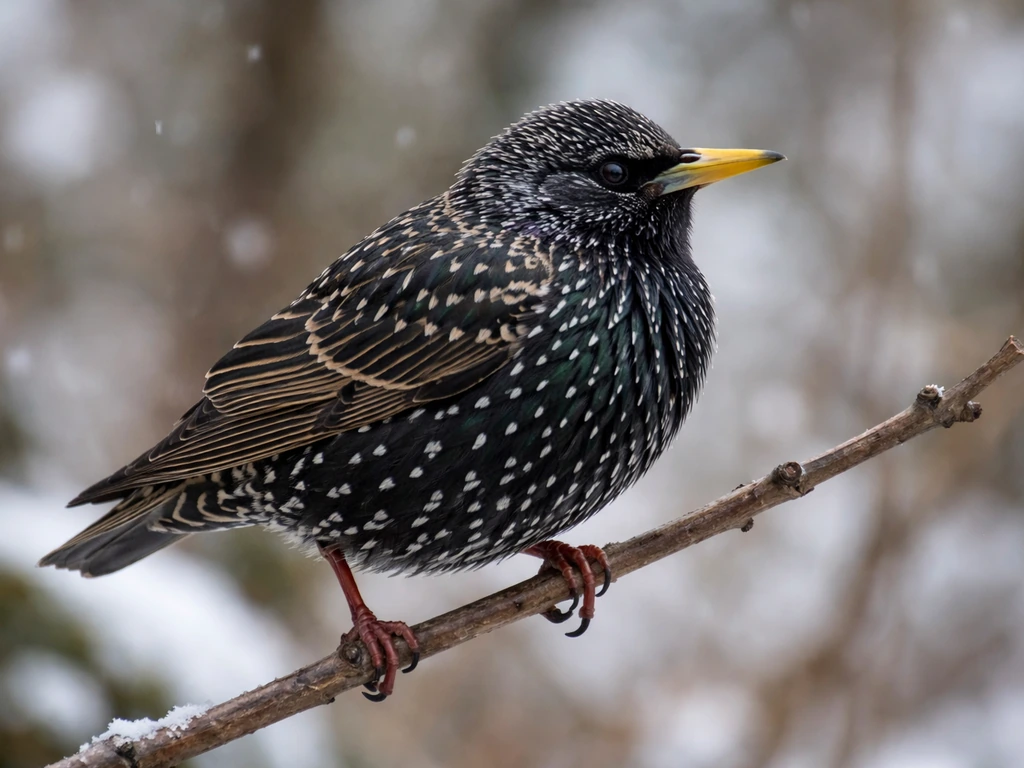
Starlings are stocky, short-tailed birds about the size of a robin but chunkier and with a longer, pointed bill. Outside of breeding season, their black plumage is covered in small white or buff spots, giving them a speckled look that makes them fairly easy to identify. By spring and into breeding season, those spots wear away and the plumage becomes glossy black with flashes of iridescent pink, green, and amber, and the bill turns bright yellow. In the air, starlings have short triangular wings and fly fast and direct. They are also famous for forming massive, swirling flocks called murmurations.
Brewer's Blackbird
Brewer's Blackbird is a medium-sized blackbird that is all glossy black with a specific two-tone iridescence: a blue sheen on the head that shifts to a greenish iridescence on the body. The combination of that color separation and a staring, pale yellow eye makes the male Brewer's Blackbird one of the more striking "black" birds once you see it in good light. They tend to walk confidently on the ground, often in parking lots, parks, and open grassy areas.
Brown-headed Cowbird
The male Brown-headed Cowbird is a medium-sized bird with a glossy black body and a warm chocolate-brown head. In decent light that brown head is obvious, but in shade or poor light the whole bird can look uniformly black. It has a shorter, thicker bill than most blackbirds and a stocky, hunched posture. Females are plain brownish-gray with fine streaking, they look nothing like the male. Cowbirds often mix into flocks of other blackbirds, so if you are looking at a group and one bird seems slightly different in head color or posture, it may well be a cowbird.
Lookalikes: how to tell similar black birds apart
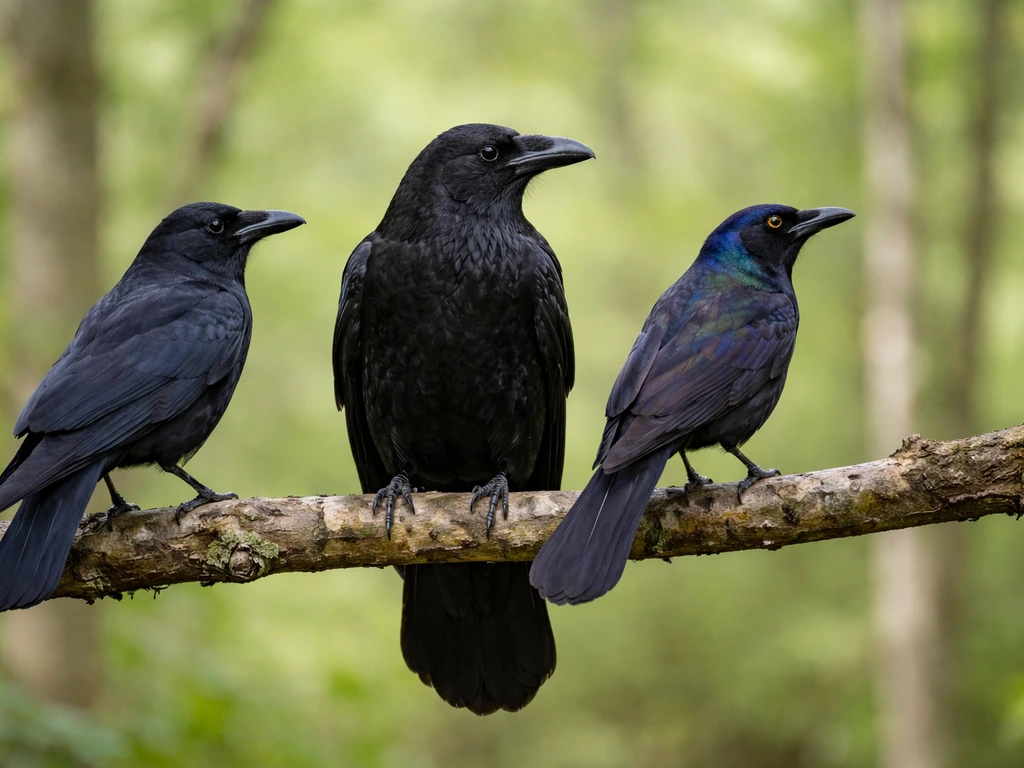
When you have a black bird in front of you and you are not sure which species it is, these comparison points will help you work through the most common confusions.
| Species | Size | Tail shape | Eye color | Iridescence | Standout mark |
|---|---|---|---|---|---|
| American Crow | Large (~20 in) | Short, squared | Dark | Slight gloss only | Thick bill, rounded wings |
| Common Raven | Very large (~27 in) | Wedge/diamond in flight | Dark | Slight gloss only | Massive curved bill, throat hackles |
| Common Grackle | Medium-large | Long, keeled/V-shape | Bright yellow | Blue/purple head, bronzy body | Keeled tail posture |
| Brewer's Blackbird | Medium | Medium, flat | Pale yellow | Blue head, green body | Two-tone iridescence |
| European Starling | Medium (robin-sized) | Short, squared | Dark | Pink/green/amber sheen (spring) | Spotted in fall/winter; yellow bill in spring |
| Brown-headed Cowbird | Medium | Short, rounded | Dark | Glossy black body only | Brown head (can look black in poor light) |
Crow vs. raven is the comparison people get stuck on most often. The short answer is: if the bird looks noticeably large, has a thick curved bill, and the tail fans into a diamond or wedge shape in flight, it is almost certainly a raven. If it is crow-sized with a squared tail and a moderate bill, it is probably a crow. Sound is also a surprisingly easy shortcut, crows give a familiar "caw," while ravens produce a much deeper, hollow croaking sound. Similarly, grackle vs. Brewer's Blackbird comes down to tail shape and size: grackles are larger with that distinctive keeled tail, while Brewer's are smaller and sleeker with the two-tone blue-green sheen.
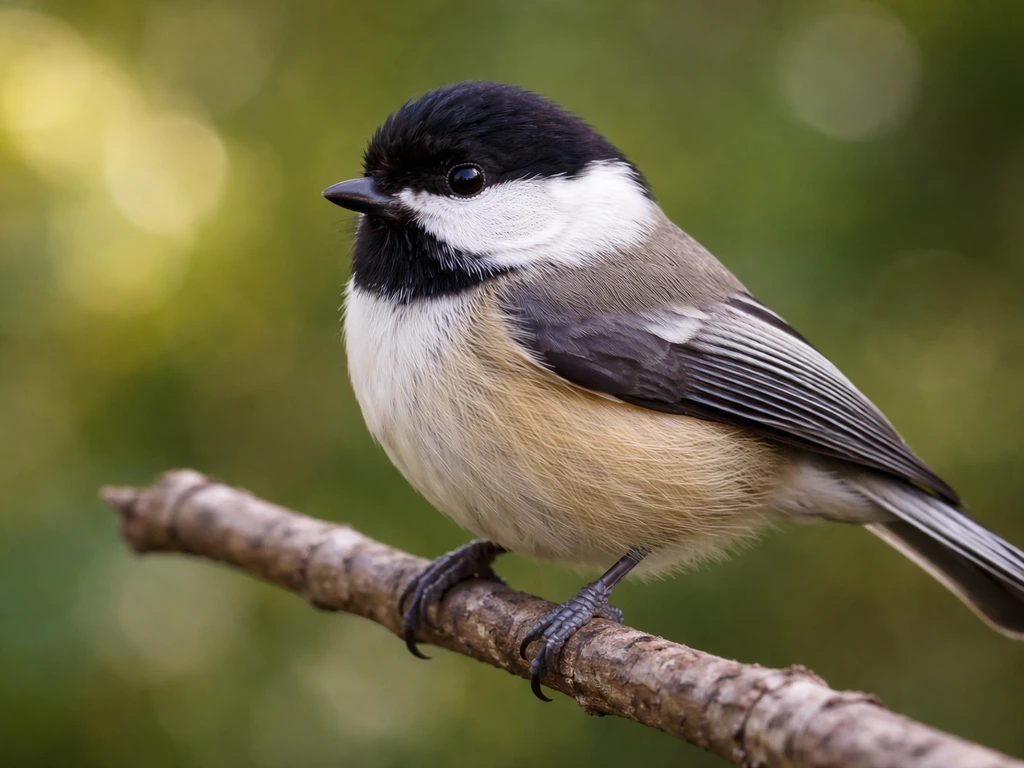
If you are curious about species with partial black plumage, like birds with black caps or black-and-white patterning, those involve a different set of field marks entirely. If you are wondering what a black-capped bird looks like, focus on cap shape and contrast with the rest of the body what does a black cap bird look like. Birds like the Black-capped Chickadee, for example, combine a black cap and bib with white cheeks and a gray body, a very different look from the all-dark birds covered here.
Why a black bird might not look black (and how to see past it)
Light is the biggest source of confusion when you are trying to identify black birds. A bird that looks flat black in shade can explode into blue, purple, green, or amber the moment it steps into full sun. This iridescence is not just decorative, it is a key field mark. A grackle's head flashing purple-blue in sunlight tells you something a crow's slight gloss does not. If you only see a bird in shadow, you may completely miss that iridescent sheen and misidentify the species.
The opposite problem is glare. In bright, harsh light, a glossy black bird can look washed out or even brownish on its highlights. Cameras especially struggle here: overexposed photos of black birds often blow out the shiny feathers into a flat, detail-less blob, erasing the very sheen you need to see for ID. If highlights clip so pixels bunch to the right in the histogram, you can lose feather sheen details, so it helps to aim for exposure that preserves texture rather than turning black plumage into a “black blob.” histogram highlights clipping when pixels bunch to the right. If you are reviewing a photo and the black bird looks uniformly dark with no texture, the image is probably underexposed. If bright patches on the bird look gray or white, it may be overexposed. The sweet spot is an exposure that preserves feather texture and shows you whether those feathers have a sheen and what color that sheen is.
Posture and angle matter too. A bird that is hunched or backlit can look bigger or smaller than it really is, and its tail shape can change dramatically depending on whether it is fanned, folded, or cocked. Audubon's identification guidance specifically flags posture as something that can mislead even experienced birders. Try to get a look at the bird from the side and from behind if you can, since that gives you the clearest read on both tail shape and overall body size.
How to identify your black bird right now
Use location and behavior as clues
Where you are and what the bird is doing narrows things down fast. If you are really trying to nail down a chickadee at a glance, start by comparing silhouette and markings, since this kind of look-alike thinking also helps for birds like chickadees chickadee bird look. A large black bird soaring on thermals over a forested ridge is far more likely to be a raven than a crow. A stocky, short-tailed black bird strutting across a parking lot and picking at food scraps is probably a starling. A black bird following cattle or horses in a field and perching on their backs is almost certainly a Brown-headed Cowbird. A flock of black birds wheeling overhead in a massive, synchronized mass is a starling murmuration. Habitat and behavior are free, instant clues that do not require any equipment.
What photos to take if you want a confirmed ID later
If you have a phone or camera, try to capture these angles before the bird leaves: a side profile showing the full silhouette including the tail, a face shot to get the bill shape and eye color, and at least one shot in direct sunlight to reveal any iridescence. Even a mediocre photo that shows these details is more useful for ID than a perfectly composed shot of the bird's back in shade. If the bird is in a group, photograph a few individuals, size comparisons to nearby birds in the same frame are genuinely helpful.
Tools to use today
- Merlin Bird ID (free app by Cornell Lab): photograph the bird or answer a few quick questions about size, color, and behavior. Merlin uses your location and the current date to prioritize the most likely species in your area. It also has an offline mode if you download regional data in advance.
- eBird: check what black bird species have been reported in your exact location recently. If grackles are showing up on every checklist this week and ravens are rare in your county, that matters.
- Local bird checklists: most parks and nature reserves have a species list. If you know you are in a suburban park in the eastern U.S. in summer, your "black bird" is much more likely to be a grackle or starling than a raven.
- Sound: if the bird called or sang, try to describe or hum the sound into a voice note immediately. Crow calls, raven croaks, grackle squeaks, and starling whistles are all very different and can clinch an ID by themselves.
The more of these clues you can combine, size, tail shape, eye color, iridescence location, habitat, behavior, and sound, the faster and more confidently you will land on the right species. Black plumage on its own tells you almost nothing. Merlin Bird ID works in your location and also has an offline mode that depends on downloaded regional data Merlin works in your location and has an offline mode. Everything else tells you everything.
FAQ
If a black bird looks different in sun versus shade, does that mean it is the same species or a different one?
Look for sheen color and where it shows up. True “black” plumage often stays matte or shows a very subtle gloss, while near-black birds like grackles and Brewer’s blackbirds show distinct iridescence that appears blue, purple, green, or amber at specific angles (head and neck are common hotspots).
What’s the fastest way to tell apart two birds that both look uniformly black to me?
Yes, but use eye color and bill plus posture, not overall darkness. For example, Common Grackles have pale yellow eyes and a very distinctive long, keeled tail, while crows tend to have a less dramatic eye contrast and a squared tail in flight.
How can I tell a Common Grackle from Brewer’s blackbird when both look very dark?
Try to confirm with silhouette, not just color. If the bird looks crow-sized but has a long, graduated tail held in a deep V or keel (often boat-tailed from the side during breeding season), you are likely seeing a grackle rather than Brewer’s blackbird.
Why do my photos of black birds look like a flat dark silhouette, and how can I fix that?
In photo ID, don’t trust “black as a solid blob.” If the bird’s head and body lose feather texture, the image is likely overexposed or underexposed. Aim for one shot that shows detail in the shiny feathers (not blown highlights) plus one side-profile shot that clearly shows tail shape.
Can behavior help if I cannot see iridescence clearly?
If the bird is feeding and it is stocky with a short, thick-looking bill and short tail, starling becomes more likely. If it has a distinctive long keel tail or a very specific perched behavior tied to cattle or horses, switch your focus to grackle or cowbird, respectively.
When someone says “blackbird,” do they always mean the same type of bird as in this article?
Be careful with “blackbird” terminology. In North America, “blackbird” is often used for the Icterid group (grackles, cowbirds, and red-winged blackbirds), while in Europe it commonly refers to a specific thrush species. Always treat local usage as shorthand, then confirm with field marks.
How does posture or backlighting change what a black bird looks like?
Yes. Backlighting and hunched posture can make a bird look smaller and change the perceived tail shape. If possible, reposition yourself to view the bird from the side and from behind, because tail form and body size read more reliably from those angles.
I think I saw a bird with a black cap, but this article is about all-dark birds. What should I focus on instead?
If you suspect a black-capped or black-and-white pattern bird, switch the question from “does it look black?” to “where is the black patch and how sharp is the boundary?” Cap shape, contrast, and surrounding markings matter more than any overall sheen.
How do I spot a Brown-headed Cowbird among other blackbirds in the same flock?
In mixed flocks, the simplest clue is head tone and bill plus posture. A brown-headed cowbird can appear uniformly black in shade, so check for the shorter, thicker bill and whether one bird’s head shows warmer brown when light allows.
When I see a dark bird gliding overhead, how can I decide between crow and raven quickly?
If the bird is soaring and looks large with a wedge/diamond tail shape plus a heavy, curved bill, prioritize raven. If it stays more crow-sized with a squared tail end and a more moderate bill, prioritize crow.
Next Article
What Does a Chickadee Bird Look Like? Key ID Features
See chickadee ID features fast: cap and cheek markings, wing bars, tail shape, size, plus common lookalikes and differen