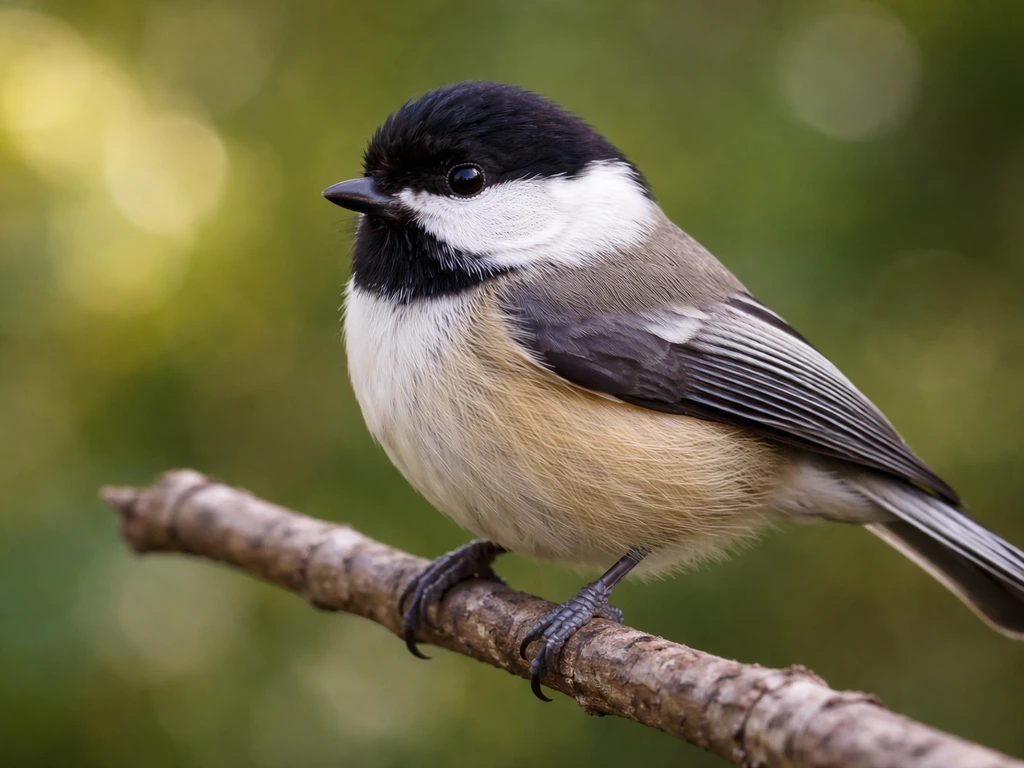
A chickadee is a small, round-bodied bird about the size of a ping-pong ball with wings, roughly 5 to 6 inches long. The feature you'll notice first and remember forever is the bold black cap on top of the head and a matching black bib under the chin, sandwiched between a clean, bright white cheek patch. The back and wings are soft gray, the belly is whitish, and the sides have a warm buffy or pinkish wash. Once you've seen that cap-and-bib combination with the white cheek, you'll never misidentify one again.
What Does a Chickadee Bird Look Like? Key ID Features

Marcus Whitley
31 May 2026
Chickadee look in one quick description
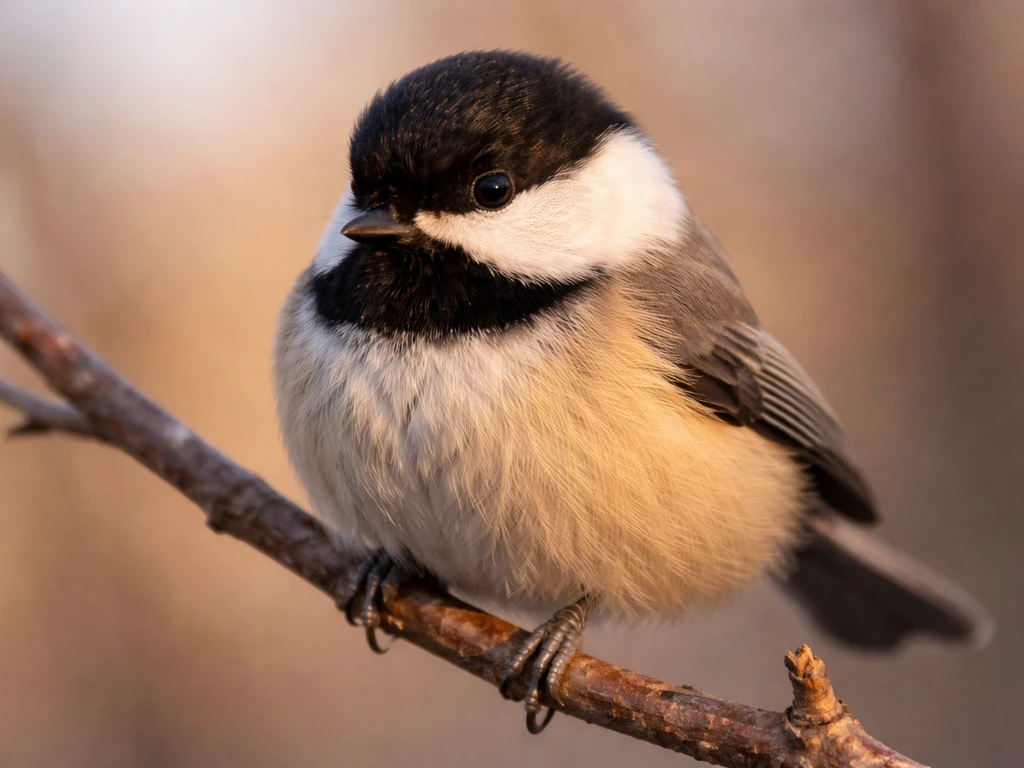
Think of a chickadee as a tiny bird wearing a black ski cap pulled low and a black scarf tucked under its chin, with a white face squeezed in between. The body is almost perfectly round, with a large head and a short neck that gives it that adorable spherical look. The tail is narrow and noticeably long compared to the body, which adds a slight bowtie shape when the bird is perched. The bill is short and stout, somewhere between a warbler's thin needle and a finch's thick seed-cracker. Everything about the shape says 'small, chunky, big-headed.' The color pattern says 'black cap, white cheek, gray back, warm sides.'
Key identifying features to check (face, cap, body)
When you spot a small bird and want to confirm it's a chickadee, work through the bird from the top of the head down. Here's what to focus on:
- Cap: Solid, deep black covering the entire top of the head, from the bill base right down the back of the skull. It looks painted on, not streaked or speckled.
- Face: A large, clearly defined white cheek patch sits just below and behind the eye. The white is bright and clean, not dingy or cream-colored.
- Bib: A black patch covers the chin and throat, connecting to the underside of the bill. It's roughly triangular and clearly bordered by the white cheeks on either side.
- Back and wings: Soft medium gray across the back, wings, and rump. In fall and winter, look for crisp white edging along the wing feathers, giving the wings a slightly frosted look.
- Tail: Long and narrow for the bird's size, often with white edging on the outer feathers.
- Belly and sides: The belly is whitish, but the sides (flanks) show a noticeable buffy or pinkish-tan wash. This warm color fades and wears down by late spring.
- Bill: Short, thick-ish, and pointed. Not as fine as a warbler's bill, not as heavy as a finch's.
- Overall shape: Round body, oversized-looking head, short neck. Perched birds often look like a fluffy ball with a long tail attached.
Color pattern and markings: what 'typical' looks like
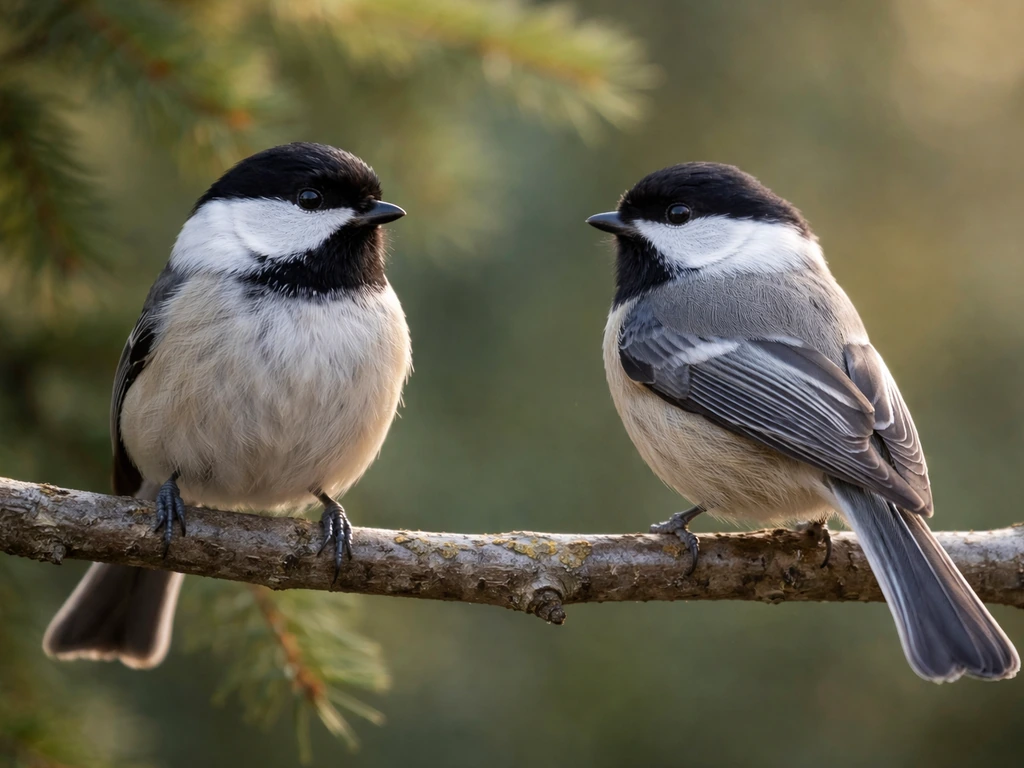
The black-capped chickadee is the species most people in North America encounter, and its color pattern is one of the most cleanly defined of any small bird. The black of the cap and bib is true, flat black, not dark brown or very dark gray. That matters because light and distance can make dark colors look ambiguous on other species. The white cheek is large and almost rectangular, taking up most of the face between the eye and the throat. There's no stripe through the eye, no streaking on the cheek, and no eyebrow line, just a wide, unbroken white patch.
Below the bib, the underparts shift to off-white or pale gray toward the center of the belly, then warm up noticeably on the flanks into a buffy or peachy tone. This isn't a dramatic rust color or a bright yellow, just a soft warmth that you'd describe as 'tan-ish' or 'peachy.' blank" rel="noopener noreferrer">The wings are gray with white edging on the flight feathers, which can look particularly crisp and fresh in autumn when the feathers are newly grown. The tail is similar gray with white edges on the outer feathers, visible when the bird fans or pumps its tail.
Male and female black-capped chickadees look essentially identical to the naked eye, which simplifies identification. Female blackbirds can look quite different depending on the species, so compare the overall body size and pattern against your field guide. Juveniles look very similar to adults by the time they leave the nest. What you will notice across seasons is that the buffy flank color and the white wing edging look cleanest in fall and winter, and get more worn and muted by late spring and summer.
Common chickadee lookalikes and how to tell them apart
Several small birds share enough traits with chickadees to cause genuine confusion, especially at a quick glance or in poor lighting. Here are the ones you're most likely to mix up, with the specific features that settle the question.
| Bird | Looks like a chickadee because... | Key difference to check |
|---|---|---|
| Carolina Chickadee | Nearly identical cap-and-bib pattern, same size and shape | Less white wing edging, slightly smaller; range is southern and eastern US, overlaps with black-capped in a narrow band |
| Mountain Chickadee | Same black cap and bib, similar gray body | Has a white eyebrow stripe cutting through the black cap, which black-capped lacks entirely |
| Black-and-white Warbler | Black and white patterned head, similar small size | Heavily streaked all over, no solid black cap or clear white cheek patch, longer and thinner bill |
| White-breasted Nuthatch | Black cap, white face, gray back | Much larger, stocky with almost no neck, long pointed bill, climbs down tree trunks headfirst, no black bib |
| Dark-eyed Junco | Small, round, often seen with chickadees at feeders | Slate-gray or brown overall with a pale pink bill and white outer tail feathers, no black bib or white cheek |
| Tufted Titmouse | Round body, gray upperparts, similar feeder behavior | Has a prominent pointed crest on top of the head, no black cap, peach flanks but also a rusty wash on the sides, larger overall |
The two most frequent mix-ups are the Carolina chickadee (almost a carbon copy if you're in the right range) and the mountain chickadee (same cap-and-bib template, different detail). For the Carolina, the honest answer is that range is your best clue unless you can clearly see that the wing edging is much less prominent. For the mountain chickadee, look for the white eyebrow stripe running through the black cap. That stripe makes it look almost like the cap is split. No stripe means black-capped. If you're curious about other black-capped lookalikes in more detail, that comparison is worth a closer look on its own. If you are also wondering what a black bird look like in general, it helps to use these same kind of pattern checks.
How to confirm in the field (what to observe and note)
When you see a small bird you think might be a chickadee, run through this quick mental checklist before the bird moves on. You don't need binoculars for all of these, but they help:
- Check the cap first. Is it solid black, covering the full top of the head? If it's brown, streaked, or has a stripe through it, it's not a standard black-capped chickadee.
- Find the white cheek. It should be large, bright, and unbroken, sitting clearly between the black cap above and the black bib below. No streaks, no eye stripe cutting through it.
- Confirm the bib. There should be a clean black patch under the chin, clearly separated from the white cheeks on both sides.
- Look at the back and wings. Plain gray, possibly with white feather edging if it's fall or winter. No streaking, no strong brown tones.
- Glance at the flanks. If the sides show a warm buffy or peachy wash against a whiter belly, that matches chickadee well.
- Note the body shape. Round, big-headed, short-necked, with a tail that looks long for the body. If the bird looks lean or long-necked, reconsider.
- Watch the behavior. Chickadees are acrobatic and restless, often hanging upside down from branches or feeders, picking at food then darting away. This active, bouncy style is a good supporting clue.
- Listen if you can. The classic 'chick-a-dee-dee-dee' call is one of the most recognizable sounds in North American bird life. If you hear it, you've almost certainly got your bird.
If you want to go further, note your location and habitat. Chickadees thrive in deciduous and mixed forests, suburban yards, and parks with mature trees. If you're seeing the bird at a feeder or in a wooded backyard, chickadee is a very reasonable first guess. Jotting down even a rough sketch of the head pattern, or snapping a photo with your phone, gives you something to compare against a field guide or an online photo reference later. Focus your notes on the cap color, cheek pattern, presence or absence of a bib, and any wing markings. If you're wondering what a different black cap bird looks like, use these same cap, bib, and cheek checks as a comparison cap color, cheek pattern, presence or absence of a bib. Those four details will get you to a confident ID most of the time.
FAQ
Do chickadees have a black bib, or is it sometimes missing?
For black-capped chickadees, the black bib is a consistent part of the pattern (black under the chin between the white cheek and the pale belly). If it looks missing, it is usually because the bird is facing away, the neck feathers are fluffed, or the lighting makes the dark areas blend into the gray. Try to confirm the cap plus cheek first, then look for the bib when the bird turns.
What should I look for if the bird is far away or the light is poor?
In low light, rely on the high-contrast elements: the black cap and the large white cheek patch. The warm buff on the flanks can fade with distance, and tail edging can be hard to see unless it pumps its tail. If you can only see one feature, make it the cap-and-cheek pairing before deciding.
How can I tell a chickadee from a nuthatch when they are both small and gray?
A chickadee’s face pattern is the key, it shows a black cap and black bib around a bold white cheek patch, with no obvious facial stripe line through the eye. Many nuthatches have different face markings and a longer-looking bill. If you see a clear cap plus bib with a wide white cheek, that strongly favors chickadee.
Are chickadees larger or smaller than similar birds at feeders?
Chickadees are very small, about the size of a ping-pong ball, roughly 5 to 6 inches long. If the bird you are watching is clearly larger (or has a much longer, more pointed look), it may be a sparrow, finch, or another seed-eater rather than a chickadee.
Do male and female chickadees look different?
For black-capped chickadees, males and females appear essentially identical from normal viewing distance. If you are trying to sex a chickadee by looks alone, you will usually not be able to do it reliably without specialized measurements or close, controlled conditions.
Do juveniles look the same as adults?
Juvenile black-capped chickadees are similar to adults once they leave the nest, but the overall pattern may look slightly less crisp. The easiest approach is still the top-down checks, black cap, bold white cheek, and the bib under the chin, then compare how worn the flank and wing edges look.
When are chickadee colors easiest to see?
The black-and-white face usually stays clear year-round, but the wing edging and the warm buffy flank tone are typically cleanest soon after new feather growth. In many places, that means fall and winter look sharper than late spring and summer, when wear can mute the highlights.
What if the bird looks like it might be a mountain or Carolina chickadee instead of black-capped?
Use range first, then one high-value detail. For mountain chickadee, look for a white eyebrow stripe running through the black cap, which can make the cap look split. For Carolina chickadee, the identification often comes down to subtle wing-edge contrast plus your location being within the expected range.
Can I identify a chickadee just from a photo?
Yes, but aim for the face and head orientation. A photo that shows the cap and whether the cheek patch is wide and solid is often enough. If the photo is blurry or taken when the bird is facing away, the bib and wing edging may be impossible to confirm, so wait for a clearer angle or capture a second shot.
What habitat clue is most helpful if I’m unsure at a feeder?
Chickadees are common around deciduous and mixed forests, plus parks and suburban yards with mature trees. If the feeder area is in a more open habitat with few trees, look more carefully at face markings, because other small seed and insect birds can show up and look similar at a glance.