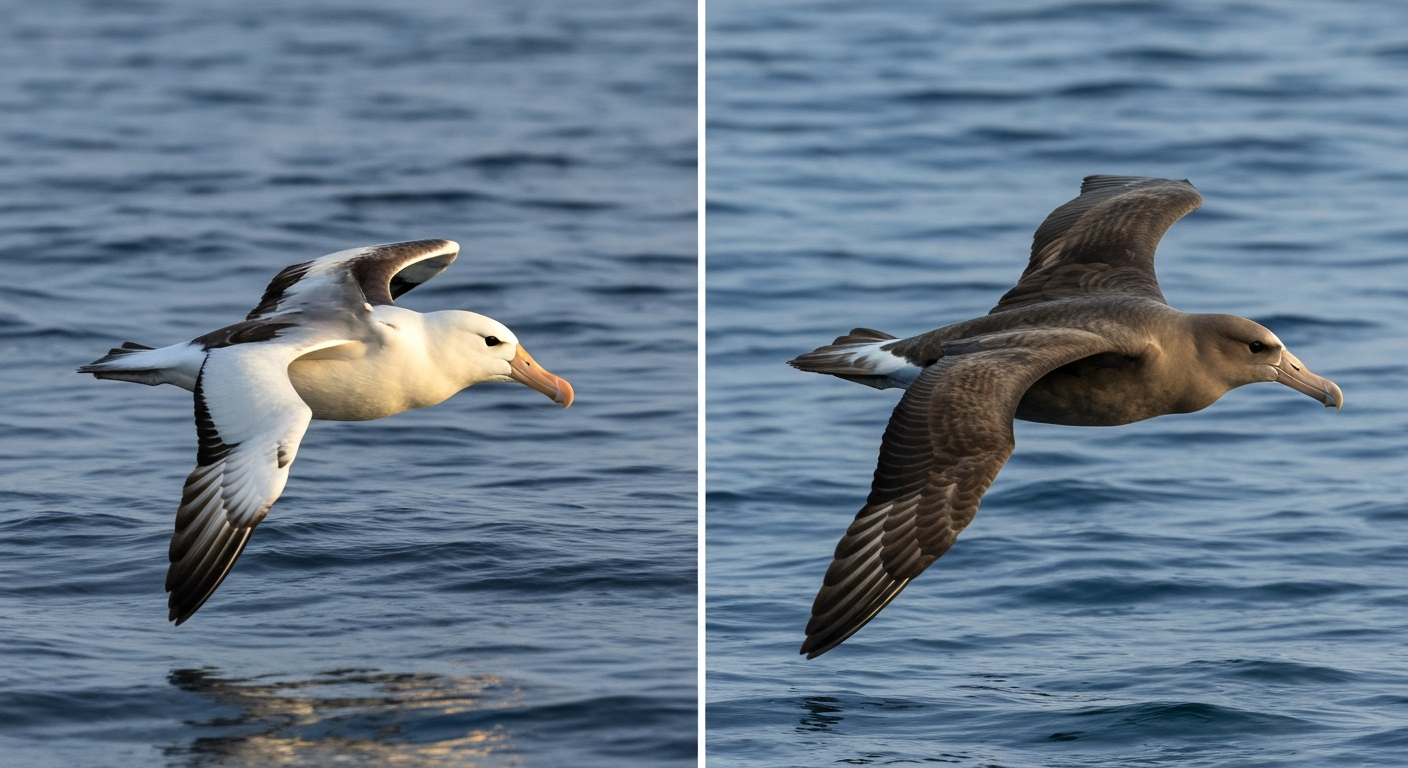
A gooney bird is a large seabird with long, narrow wings that seem almost absurdly out of proportion to its body. Black‑footed Albatross (Phoebastria nigripes), U.S. Fish & Wildlife Service species profile (plumage description) notes that Plumage, adult Black‑footed: uniformly dark/dusky brown above and below in adults (appearing almost ‘‘smoky’’ brown all over at sea), with paler area at base of bill and sometimes a faint pale patch around the eye or lores; juveniles and some immatures can be slightly paler and may show variation but remain much darker overall than Laysan Black‑footed Albatross (Phoebastria nigripes) — U.S. Fish & Wildlife Service species profile (plumage description). The most commonly called gooney birds are the Laysan albatross and the Black-footed albatross, two closely related species that spend most of their lives gliding over the North Pacific. The Laysan is the easier one to picture: white head, white belly, dark chocolate-brown back and upperwings, and a pale yellowish-pink bill with a dark tip. The Black-footed is harder to miss for different reasons, it is nearly all-over smoky brown, like someone dipped a large seagull in dark coffee. Both have that same unforgettable silhouette: enormous wingspan, short tail, and a slow, banked glide that looks effortless even in strong wind.
What Does a Gooney Bird Look Like: Visual ID Guide - Field ID

Quick ID: the one thing to look for
Look for a very large, long-winged seabird gliding low over ocean waves without flapping, if the bird is white below with a dark back, it is almost certainly a Laysan albatross (gooney bird); if it is uniformly dark brown all over with just a pale patch at the base of the bill, it is a Black-footed albatross (also a gooney bird).
Which birds are actually called "gooney birds"?
The word "gooney" (sometimes spelled "goony") was coined by sailors working the North Pacific, who used it as a catch-all nickname for albatrosses. The name stuck partly because of the bird's clumsy, almost comedic behavior on land, they waddle, trip over their own feet during takeoff runs, and crash-land in ways that look spectacularly undignified for such graceful flyers. The term appears in dictionaries as a colloquial name for albatrosses broadly, but in everyday use it almost always means one of the two North Pacific species: the Laysan albatross (Phoebastria immutabilis) or the Black-footed albatross (Phoebastria nigripes).
If someone says "gooney bird" at Midway Atoll or along the Hawaiian island chain, they are almost certainly talking about one of these two. The Laysan is the more abundant of the pair and the one most people picture when they hear the name. The Black-footed is slightly less common at shared breeding sites but shows up alongside Laysan birds regularly enough that you will often see both in the same colony. A third species, the Short-tailed albatross, also occasionally visits the same range but is rare and is not typically called a gooney bird.
Field checklist for fast recognition
| Feature | Laysan Albatross | Black-footed Albatross |
|---|---|---|
| Overall color (adult) | White below, dark brown above | Uniformly smoky dark brown |
| Head color | Clean white | Dark brown, paler at bill base |
| Bill color | Pale yellow to pinkish, dark tip | Darker overall, paler at base/lores |
| Underwing | White with narrow dark leading edge and variable dark smudging | Dark/dusky throughout |
| Leg and foot color | Bluish-gray to pale (variable) | Blackish (diagnostic) |
| Tail | Short, dark | Short, dark brown |
| Wingspan | ~195–210 cm (~6.4–6.9 ft) | ~190–230 cm (~6.2–7.5 ft) |
| Flight impression | Pale flashing underneath as it banks | Dark silhouette top and bottom |
Measurements and what that actually looks like in the field
The Laysan albatross measures roughly 79 to 89 cm from bill tip to tail (about 31 to 35 inches), and its wingspan stretches somewhere between 195 and 210 cm, which works out to around 6. Measurements per Laysan Albatross, Audubon Field Guide (measurements summary) list total length about 79–89 cm, wingspan about 195–210 cm, and mass commonly 2.2–3.3 kg Laysan Albatross — Audubon Field Guide (measurements summary). 4 to 6.9 feet. Adults typically weigh between 2.2 and 3.3 kg (about 4.8 to 7.3 lb). The Black-footed albatross is in a similar ballpark: body length around 68 to 84 cm, wingspan reaching 190 to 230 cm (roughly 6.2 to 7.5 ft), and weight commonly ranging from 2.6 to over 3.5 kg. In both species, males tend to run slightly larger than females, but the difference is subtle enough that you cannot reliably tell the sexes apart by eye in the field.
To put those numbers in perspective: a gooney bird's wingspan is longer than most adult humans are tall. When one banks past you on a ship crossing the North Pacific, it feels like watching a small aircraft tilting its wings. The body itself looks surprisingly compact relative to that enormous wingspan, which is exactly the engineering point, these birds are built to glide, not to carry bulk.
If you are trying to photograph gooney birds, here are the shot types most useful for identification: (1) a broadside gliding shot showing the full wingspan and the contrast between upper and underside coloring; (2) a head-on approach shot emphasizing the long narrow wing shape and bill profile; (3) a close-up of the bill, showing the tip color, groove lines, and any color break between base and tip; (4) a feet-and-leg shot for confirming the dark feet of the Black-footed vs. the paler feet of the Laysan; (5) a bird sitting on calm water showing the body shape, resting posture, and facial detail.
Overall plumage and color patterns
An adult Laysan albatross is basically a study in clean contrast. The entire head, neck, and underparts are white, while the mantle, back, upperwings, and tail are a rich dark dusky brown to blackish. One feature worth looking for is a dark U-shaped mark that often wraps across the lower mantle and upper rump area, it is not always obvious, but in good light it gives the impression of a dark hood or saddle draped over the upper back. The underwing is white with a narrow dark border along the leading edge and sometimes a darker smudge or streaking in the middle covert area. From below and at a distance, the bird flashes white as it banks.
The Black-footed albatross looks like it was painted a single flat color by comparison. Juveniles and adults are uniformly dark dusky brown on the body, wings, head, and tail. The only real break in that darkness is a paler area at the base of the bill and sometimes a faint pale crescent around the lores (the area just in front of the eyes). Some older adults and birds in worn plumage can show a bit of whitish on the face or rump, but you should not count on seeing it. If you spot a large, all-dark seabird with a huge wingspan gliding over the open Pacific, Black-footed albatross is your first call.
How plumage changes with age
Young Laysan albatrosses look messier than adults. Juveniles have darker fringes on their feathers and tend to show heavier dark markings on the underwing coverts, giving that area a blotchier, less clean appearance. They gradually sort themselves out over several years, reaching something close to adult plumage before their first breeding attempt at around 8 to 9 years old. Young Black-footed albatrosses resemble adults fairly closely but often have less white at the bill base and can appear slightly paler overall, the differences are subtle and require experience to read reliably. Both species hold onto their juvenile primary feathers for years, and tracking the molt pattern is one of the ways specialist researchers age individual birds.
Head and bill: what to look for up close
The bill is one of the most reliable identification features if you can get close enough to see it. On a Laysan albatross, the bill is pale yellow to pinkish with a noticeably darker (usually brownish to blackish) tip. It is a large, hooked bill, properly heavy and tube-like, with visible groove lines running along the length of the upper mandible. Those grooves are actually external tubes (a feature of all tubenose seabirds) and give the bill a slightly segmented look that you would not see on a gull or booby.
On the Black-footed albatross, the bill is darker overall, less obviously pale and yellowish, but you can still pick out a paler area right at the base and around the lores. The hook at the tip is just as pronounced, and the tubenose structure is the same. In both species, the bill looks almost too big and solid for the head, which sits on a fairly thick, strong neck.
Eyes and facial features
On the Laysan, the eye is dark and sits cleanly in the white head, which makes it easy to spot. You might notice a subtle darker smudge around the eye or behind it, giving a mild masked or shadowed look in some individuals. The orbital skin (the bare skin immediately around the eye) is usually dark. The overall head shape is broad and rounded with a relatively flat crown, and the forehead runs in a fairly straight line down to the bill base without a sharp angle.
On the Black-footed albatross, the eye can be harder to pick out against the dark face, but it is also dark. The paler loral patch (that small pale crescent in front of the eye) is the main facial feature that breaks up the uniformly brown head and gives you something to focus on. In bright light, adults sometimes show a slightly paler ring around the eye as well. Neither species has a brightly colored orbital ring like some tropical seabirds, the gooney bird eye-area is understated and relies on contrast rather than color for visibility.
Legs and feet
The Black-footed albatross earns its name from its feet: the legs and feet are distinctly dark to blackish, and this is one of the more useful features if you get a bird on the ground or resting on the water. The Laysan albatross, by contrast, tends to have bluish-gray to pale legs and feet, though the color can be variable and is harder to judge at distance or in poor light. Both species have fully webbed feet, as you would expect from seabirds that spend years on the open ocean.
Foot and leg color becomes most useful when you are watching birds at a breeding colony, where birds are standing and walking. At sea, you will rarely see the feet at all since the birds are either flying or sitting low on the water with feet tucked under. At a colony like Midway Atoll, where both species breed together, foot color is a quick way to confirm which species you are looking at when the plumage contrast is less obvious in shade or at an angle.
Flight silhouette and behavior cues
The flight style of a gooney bird is one of the most memorable things about it. Both Laysan and Black-footed albatrosses are expert dynamic soarers, they exploit the wind gradient just above ocean waves to travel enormous distances with almost no wing flapping. You will watch one for minutes at a time and see it bank, wheel, dip close to the wave surface, and climb again without a single wingbeat. When they do flap, the beats are slow and heavy, nothing like the quick strokes of a booby or gannet.
The silhouette itself is distinctive: very long, narrow, swept-back wings with long primary tips, attached to a body that looks short by comparison, with a small rounded tail. Think of an archer's bow bent and held at the tips, the wings have a slight downward droop at the wrist when gliding that is characteristic of albatrosses and different from the straighter-held wings of large gulls. In calm conditions, gooney birds have to work harder and will sometimes sit on the water and wait for wind rather than battle the air without assistance.
On land at colonies, the gooney bird's terrestrial awkwardness is endearing. They need a running takeoff into a headwind, they stumble on landings, and their elaborate courtship dances (bill-touching, calling, wing-spreading) make them one of the most watchable birds at any colony. Laysan albatrosses breed primarily on the Northwestern Hawaiian Islands, Midway Atoll is the most famous colony, with the breeding season running roughly November through July, which is when you are most likely to see them on the ground.
How gooney birds compare to look-alikes
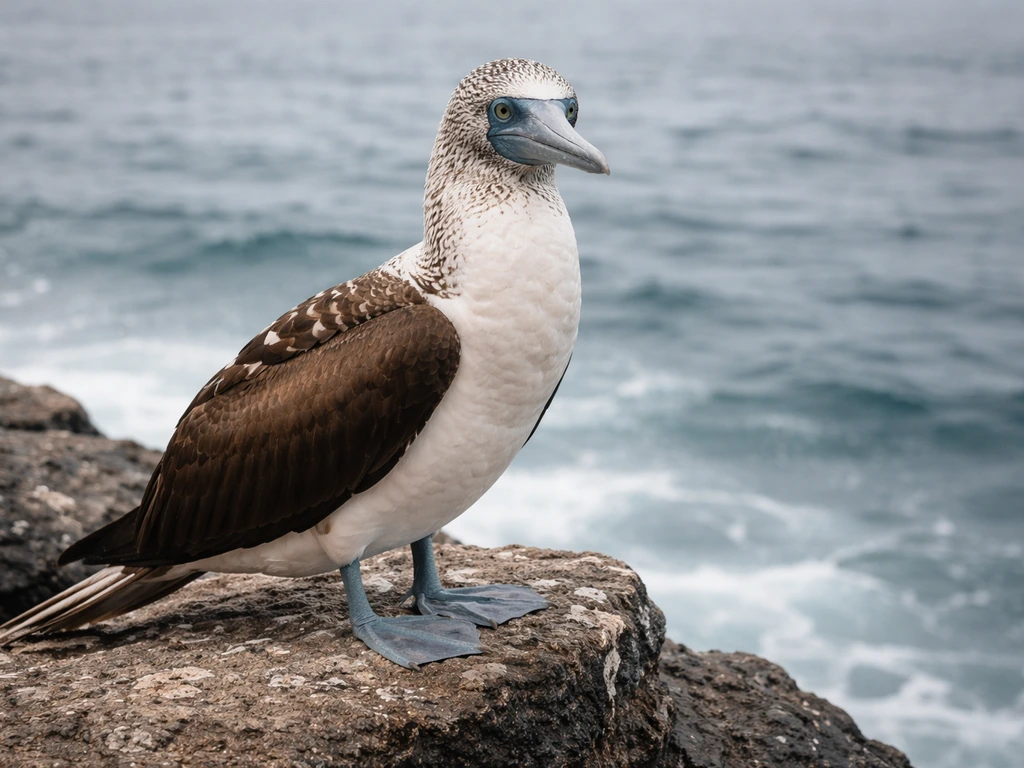
The bird most commonly confused with the Black-footed albatross at sea is a booby, particularly dark-morph boobies. But the size difference is significant, gooney birds are considerably larger, with that proportionally much longer and narrower wing shape. Boobies also have a more pointed tail and a faster, more flapping flight style. If you are interested in booby identification, the booby bird page on this site covers those distinguishing features in detail. See the article “what does a booby bird look like” for detailed identification tips and photos.
Against other albatross species, the Short-tailed albatross (rare in the same range) is larger still than a Laysan, and adults have a pink bill and more extensive white on the upperwing. Black-browed albatross, a Southern Ocean species occasionally seen far off its usual range, has a yellow-orange bill and a thick dark leading edge to the underwing that is broader than the Laysan's narrower dark border.
It is also worth mentioning that several unrelated birds share "bird" names that can cause confusion in searches, myna birds, maleo birds, miner birds, and bluebirds are entirely different families from entirely different parts of the world, and none of them share any meaningful resemblance to an albatross. If you instead meant the maleo, see the what does maleo bird look like page (bd0d9dce-130a-4a23-abb7-0aadb666c60d) for a full description. A myna bird is a small dark starling-like bird from Southeast Asia and South Asia; a miner bird is a medium-sized honeyeater from Australia; a maleo is a megapode from Sulawesi with a distinctive casque on its head; and bluebirds are small, colorful thrushes from North America. The only thing connecting them to gooney birds is that people sometimes search for all these names together. If you landed here looking for one of those species, each has its own dedicated identification page on this site. If you meant the miner specifically, see the identification page titled “what does a miner bird look like” for details on its appearance and distinguishing features. If you are wondering what does a male blue bird look like, see the male bluebird identification page on this site for photos and field marks. If you were actually searching for bluebirds and want nesting-site details, see the page on what does a blue bird house look like for guidance on house design and placement.
Where and when to see them
Your best chance of seeing a gooney bird on the ground is at Midway Atoll National Wildlife Refuge between November and July. Midway hosts the world's largest Laysan albatross colony, with hundreds of thousands of birds present during breeding season. Black-footed albatrosses nest there too, so you can often compare both species side by side. At sea, both species range widely across the North Pacific and can occasionally turn up as vagrants off the west coast of North America, especially during pelagic boat trips.
FAQ
Quick ID: What does a “gooney bird” look like at a glance?
Concise field ID: "Gooney bird" usually refers to North‑Pacific albatrosses—especially Laysan and Black‑footed. Laysan: white head, neck and underparts with dark upperwing, mantle and rump; pale yellow/pinkish bill with darker tip. Black‑footed: uniformly dusky to dark brown all over with a darker bill and blackish legs/feet. Both have very long, narrow wings and a large wingspan—so seen at sea they are large, slow‑winged, gliding seabirds.
Detailed head and bill features—how to tell species from the face and bill?
Laysan: clean white head and neck; bill pale yellow to pinkish often with a darker tip; sometimes a faint dark patch at the bill base/lores. Black‑footed: face and head are dusky like the body; bill darker overall but often paler at the base/lores creating a subtle crescent; feet and tarsi usually blackish (hence the name). At close range bill color and the white vs. dark head are the most reliable face traits.
Plumage—what are the key patterns for Laysan vs. Black‑footed?
Laysan: striking contrast—white head/underparts and dark (dusky to blackish) upperparts (mantle, back, upperwing, tail). Underwing is mainly white with a narrow dark leading edge and variable dark smudging on the greater coverts. Black‑footed: overall smoky/dusky brown above and below; may show slightly paler bill base or faint lores patch, but lacks the white head/underparts of Laysan.
Size and measurements—how big are gooney birds?
Laysan: total length ~79–89 cm (31–35 in); wingspan ≈195–210 cm (6.4–6.9 ft); mass commonly 2.2–3.3 kg. Black‑footed: length ~68–84 cm; wingspan ≈190–230 cm (6.2–7.5 ft); mass typically 2.6–3.5+ kg. Both sexes similar in plumage; males slightly larger on average.
Legs, feet and eye color—are these useful identification points?
Feet: Black‑footed usually shows blackish tarsi and feet—visible at close range or in good photos. Laysan feet range pale bluish‑gray to paler tones but can appear dark when wet or shadowed, so foot color is supplemental. Eyes are dark in both species and not strongly diagnostic at a distance.
Tail and wing silhouette—what to watch for in flight?
Both species: long, narrow, high‑aspect wings with long primaries and a relatively short tail. Silhouette: very long wings relative to the body, pointed wingtips, and a straight leading edge—ideal for dynamic soaring. Laysan in flight usually shows paler underparts with dark wing margins; Black‑footed appears darker overall from below and above.
What Does a Booby Bird Look Like? Key Field Marks
Learn booby field marks: size, color, bill and face patterns, wings, tail, and feet, plus lookalike seabird comparisons.