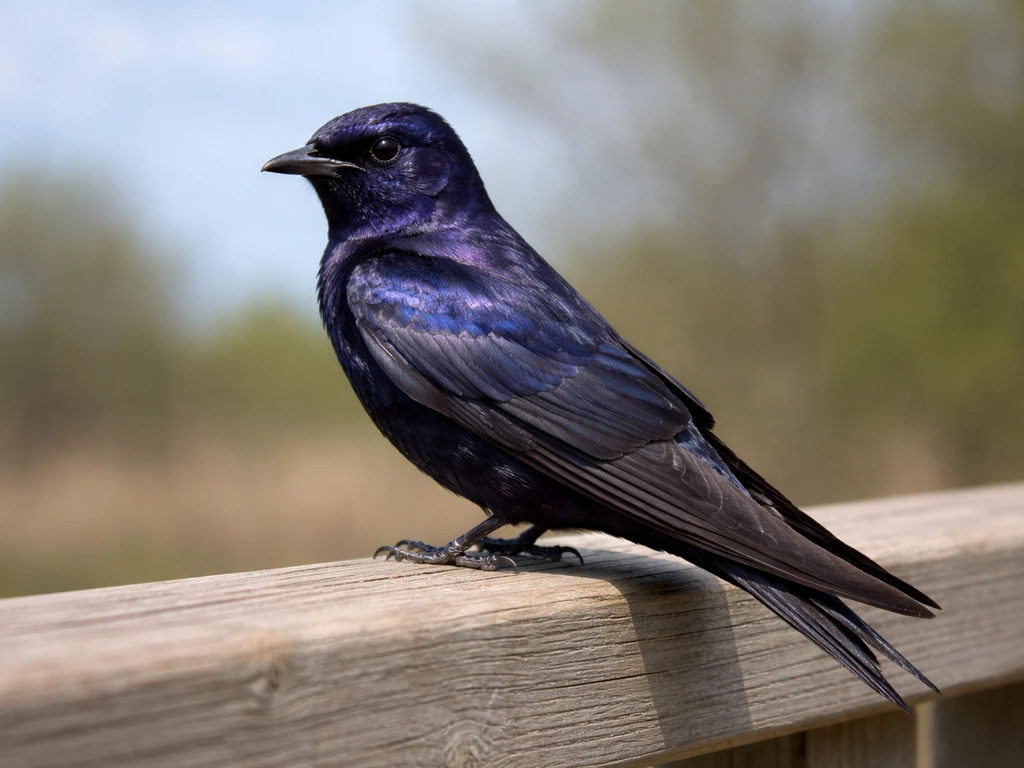
A purple martin is a large, broad-shouldered swallow with long, swept-back wings, a notched tail, and, in adult males, a stunning all-dark blue-black body that glows deep purple or navy in good light. When you are identifying a budgie, note how its overall shape and posture compare to common cage-bird forms what does a budgie bird look like. Adult females are duller, with grayish-white undersides and a dark, iridescent back. If you spot a chunky, dark swallow-like bird wheeling overhead with pointed wings and a slightly forked tail, you're probably looking at a purple martin.
What Does a Purple Martin Bird Look Like? ID Guide

Marcus Whitley
26 Apr 2026
What Kind of Bird Is a Purple Martin?
Purple martins are the largest swallows in North America, roughly the size of a small starling but with a swallow's aerodynamic build. They're songbirds, not raptors or shorebirds, and they spend almost their entire life on the wing, hunting flying insects over open fields, lakes, and neighborhoods. You'll find them breeding across most of the eastern United States and into southern Canada during summer, with some populations in the west nesting in natural tree cavities. The eastern birds have become famous for colonizing human-supplied birdhouses and apartment-style martin houses, so if you've ever seen a cluster of big dark swallows swooping around a multi-unit birdhouse on a pole, there's a very good chance you were already watching purple martins.
One thing worth knowing upfront: the 'purple' in the name comes from the iridescent sheen on their feathers, not a true solid purple color. In flat or low light, these birds look plain dark, almost black. In bright sunlight, that darkness shifts into a rich blue-purple or blue-black gloss depending on the angle. It's the same optical effect you see on starlings or grackles, and it's the single most striking feature you'll notice when a male flies overhead on a sunny day.
Adult Male vs. Adult Female: What to Look For
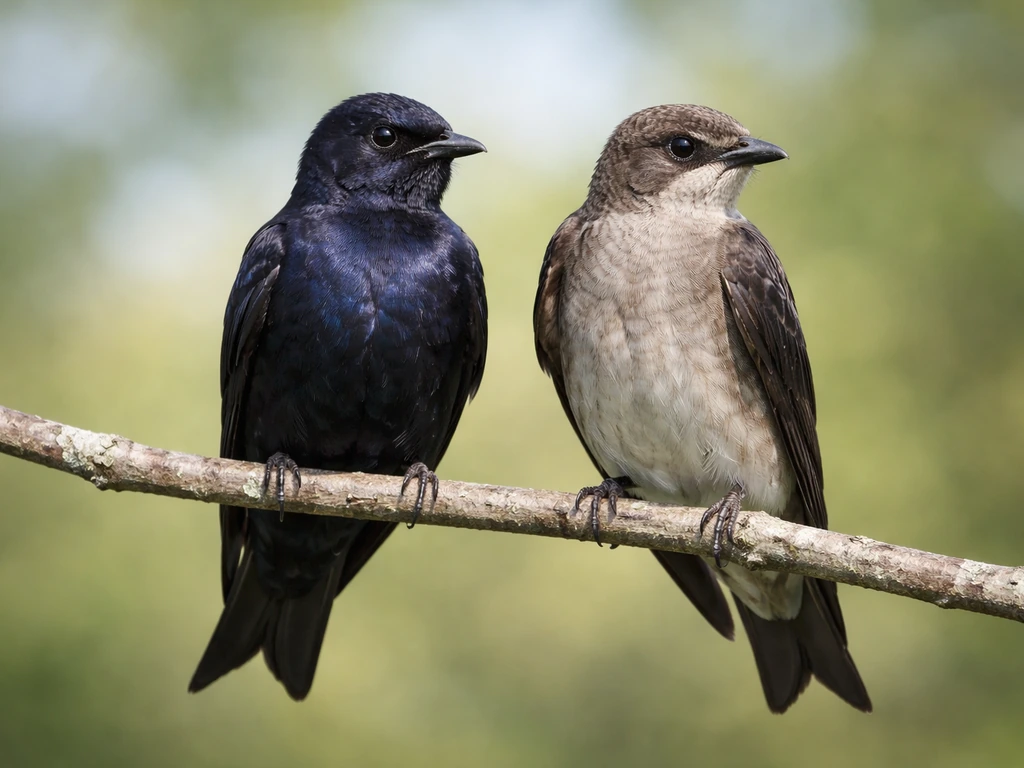
The male and female purple martin look so different that beginners sometimes think they're two separate species. Once you know what to expect, though, the differences are easy to lock in.
Adult Male
The adult male is entirely dark, head to tail. There's no white belly, no pale throat, no wing bars, just a uniform, glossy blue-black covering his whole body, including his underparts. In bright sunlight, that blue-black becomes a vivid iridescent blue-purple, almost metallic. His wings and tail are slightly duller (more brown-black than blue), which gives a subtle contrast when the light catches him just right. The solid dark belly is actually your best quick field mark: no other common swallow has a fully dark underside like this.
It takes two full years for male purple martins to reach this adult look. Before that, younger males (called subadult males) resemble females but often show scattered purple feathers on the chin, throat, belly, or undertail, like a patchwork of adult plumage coming in. Seeing a bird that's mostly pale below but has some dark purple spotting is a sure sign you're looking at a young male in his first or second year.
Adult Female
The female is a completely different picture. Her back and wings still carry some of that dark iridescent blue-black, but it's duller and less glossy than the male's. Her head is grayish with a pale forehead and a grayish collar around the back of the neck. Adult female purple martins have a gray collar and forehead, with blue-black on top and a lighter gray-brown below, as described by Mass.gov. Her throat and chest are grayish-white, often with dusky streaking or mottling, and her lower belly is dingy whitish. Look closely at the undertail area and you'll see it's dusky rather than white. She's essentially a two-toned bird: dark and somewhat glossy on top, pale and washed-out below, with a gray-and-white face that softens her overall look compared to the all-dark male.
Immature birds of both sexes look similar to adult females, which can make separating young males from females tricky. The key clue with immatures is that scattered purple spotting on the underparts pointing to a young male.
| Feature | Adult Male | Adult Female / Immature |
|---|---|---|
| Overall body color | Glossy blue-black / iridescent blue-purple | Dark back, pale grayish-white below |
| Belly | Solid dark (same as back) | Pale, dingy whitish with grayish wash |
| Head | Entirely dark and glossy | Grayish with pale forehead and collar |
| Throat | Dark iridescent | Grayish-white, sometimes lightly streaked |
| Undertail coverts | Solid dark purple-black | Dusky, not solid dark |
| Wings and tail | Brown-black, slightly duller than body | Brown-black, similar to body color |
| Iridescence | Strong, vivid in good light | Present but muted on back only |
Color Pattern and Key Markings, Head to Tail
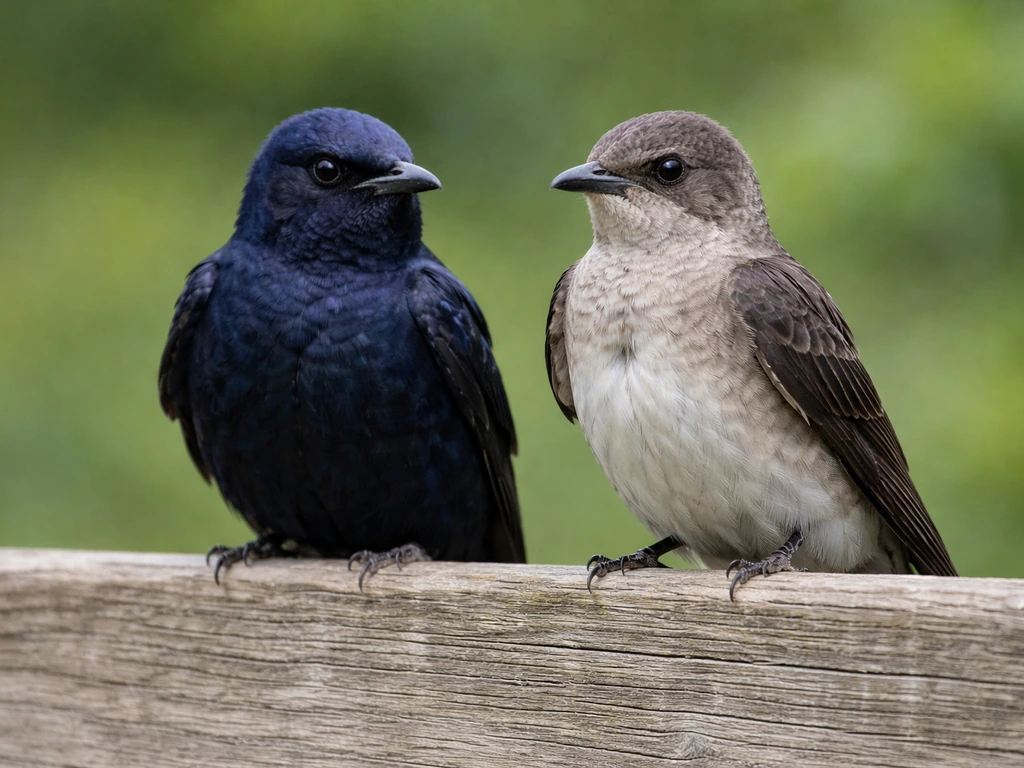
If you get a decent look at a perched purple martin or a good photo, here's exactly what you're seeing from head to tail:
- Head: On males, entirely dark and glossy, no eye stripe, no crown stripe, no pale supercilium. On females, gray on the crown and face with a slightly paler forehead — subtle but visible.
- Throat and chest: Males are all dark here too, which is unusual for swallows. Females have a grayish-white throat and upper chest, often with faint dusky streaking.
- Belly and flanks: The male's belly is solid dark matching his back — this is the feature that makes experienced birders stop and take notice. Females have a dingy, off-white belly that can look dirty or washed-out.
- Back and wings: Both sexes have dark, iridescent upper parts, though the male's glow much more brilliantly. The wings are long, pointed, and slightly swept back, giving a crescent or anchor-like silhouette.
- Tail: Slightly forked or notched — not deeply forked like a barn swallow's long streamers, but noticeably indented compared to a flat-tipped tail. The outer tail feathers are a bit longer than the central ones.
- Bill: Short and slightly hooked at the tip, typical of insect-catching swallows. It's small relative to the bird's broad head.
The iridescence is worth emphasizing one more time because it can genuinely fool you. On a cloudy day or in a shaded spot, a male purple martin looks almost plain black. Get the sun behind you with the bird in front of you and that same bird suddenly blazes with deep purple and blue. It's the same feather, just different light angles activating the iridescent diffraction. Don't write a bird off as 'too dark' just because the light isn't cooperating.
What Purple Martins Look Like in Flight
Flight is honestly where purple martins are easiest to identify, especially once you've seen them a few times. To get a better sense of what a martin bird looks like, pay attention to the iridescent sheen and the overall shape in flight what a martin bird look like. They have a very distinctive style: long, swept-back, pointed wings that look almost like a crescent or boomerang from below, alternating between quick flaps and long, flat glides. All About Birds notes that purple martins show a “dark body, long wings, and notched tail” that are all easily visible in flight “long wings” and “notched tail” are easily visible in flight. They don't flutter constantly like some smaller swallows, they have a heavier, more assured wingbeat followed by gliding arcs.
The notched tail is visible in flight, especially when the bird banks and turns. It's not the exaggerated fork of a barn swallow, just a clean V-shaped notch that's obvious if you're looking for it. When the tail fans out fully in a tight turn, the notch can look shallower, but the longer outer feathers still give the tail a slightly pointed or curved-out appearance compared to a square-tipped tail.
Size matters a lot in flight ID. Purple martins are noticeably bigger than tree swallows, barn swallows, or cliff swallows, about the size of a small starling. If you see a large, dark, swallow-shaped bird gliding confidently over an open field or lake, size alone should put purple martin near the top of your list. They also tend to fly higher than many swallows, especially in good weather when insects are up high.
Context helps enormously. If you see a group of large dark swallows circling a colony box or gathering in late summer on power lines before migration, you're almost certainly looking at purple martins. They're sociable birds that gather in big flocks, and their colonial nesting behavior means you rarely see just one.
Purple Martin Look-Alikes: How to Tell Them Apart
A few other birds can cause real confusion with purple martins, especially in flight or when light conditions aren't ideal. Here are the ones that trip people up most often.
Tree Swallow
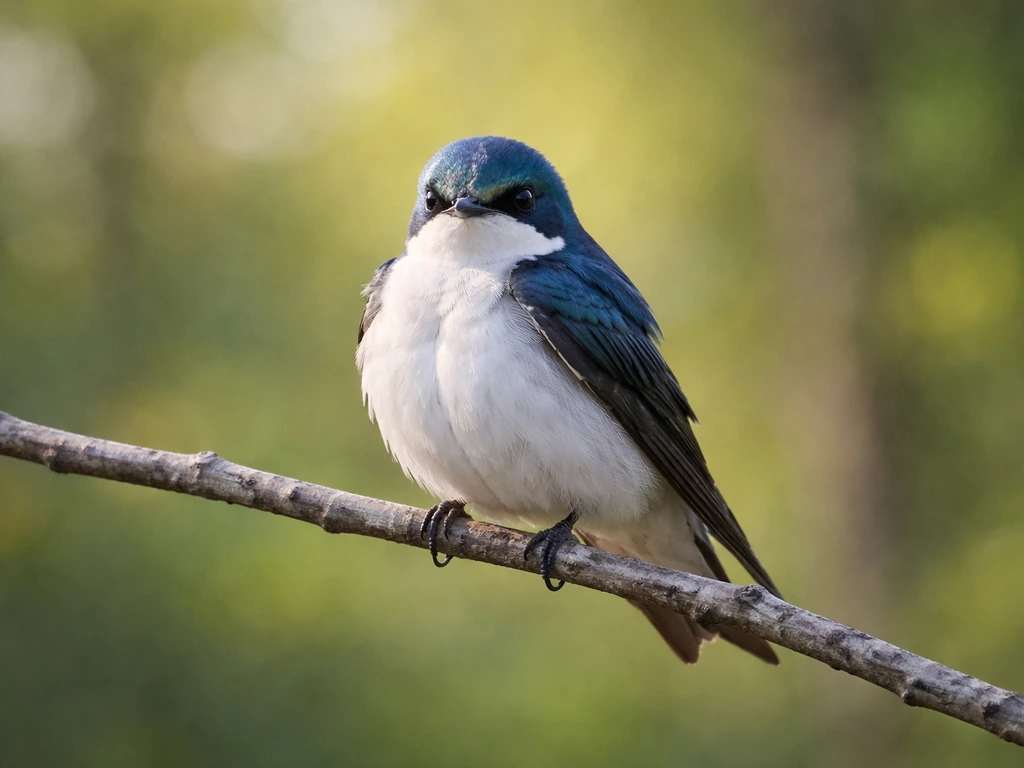
Tree swallows have iridescent blue-green upperparts and brilliant white underparts. Adult males are striking and don't look much like purple martins once you're used to both species, but at a distance a tree swallow overhead can look 'dark on top, pale below' and cause a moment of confusion with female martins. The size difference usually settles it, tree swallows are noticeably smaller, and that clean white belly has no gray or dingy tones.
Barn Swallow
Barn swallows have rusty-orange throats and pale bellies, plus that unmistakable long, deeply forked tail with tail streamers. Once you've seen a barn swallow's tail, you'll never confuse it with the moderate notch of a purple martin. Barn swallows are also smaller and show a blue back with warm buff or orange tones below, a very different color scheme from any age or sex of purple martin.
Northern Rough-Winged Swallow
This is probably the closest look-alike to a female purple martin for casual observers. The rough-winged swallow is brownish above with a dusky gray throat, superficially similar to a female martin's pale, washed-out look. The key differences: rough-winged swallows are much smaller, their tail is not notched (it's more squared), and their overall shape is stockier and less angular in flight. A side-by-side comparison makes the size gap obvious.
Chimney Swift
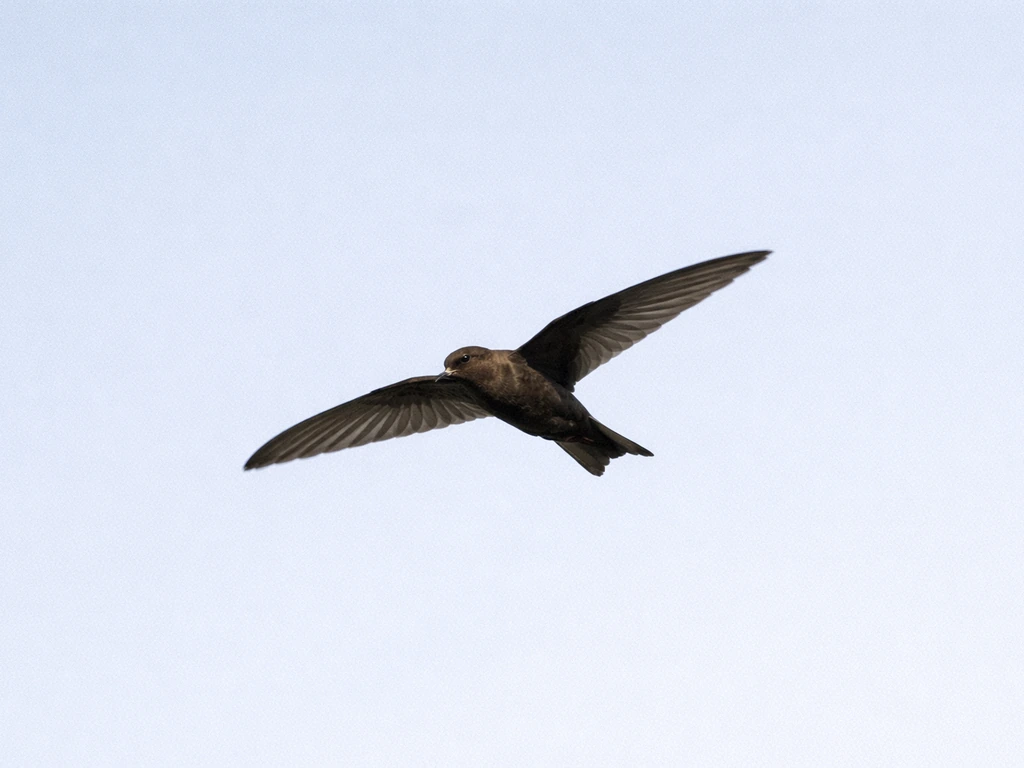
Chimney swifts get confused with purple martins more than you'd expect, because both are dark aerial birds that look somewhat similar at a glance. But chimney swifts have a very different silhouette: tiny, cigar-shaped body, no visible tail to speak of, and stiff, bat-like wingbeats that are unmistakably different from a martin's smooth gliding. Swifts also tend to fly in twittery, erratic circles over cities and chimneys, while martins glide more gracefully. Once you've seen both, they're surprisingly easy to separate.
European Starling
In non-breeding plumage, starlings are speckled black birds with iridescent feathers that can look vaguely purple-martin-ish in flight. But starlings have a completely different wing shape (triangular, not swept-back and pointed), a different flight style (direct and fast with no long glides), and a longer bill. Perched, there's no confusion at all. In the air, the pointed crescent wings of a martin versus the triangular wings of a starling are the easiest separator.
| Species | Size vs. Purple Martin | Key Difference | Belly Color |
|---|---|---|---|
| Tree Swallow | Smaller | Brilliant white belly, blue-green back | Clean white |
| Barn Swallow | Smaller | Long forked tail streamers, rusty throat | Pale buff/orange |
| N. Rough-winged Swallow | Much smaller | Square tail (not notched), dusky throat | Dingy white |
| Chimney Swift | Smaller | Cigar shape, stiff bat-like wingbeats, no visible tail | Dusky gray |
| European Starling | Similar | Triangular wings, direct flight, long bill | Dark with spots |
Your Quick Purple Martin ID Checklist
Whether you're looking at a bird in the field or working through a photo, run through these features in order. They'll get you to a confident ID faster than anything else:
- Size first: Is it noticeably larger than other swallows in the area? Purple martins are the biggest swallow in North America and that size difference is your first green light.
- Belly check: All dark below? That's almost certainly an adult male purple martin — no other common swallow is fully dark underneath. Pale and washed-out below with a dark back? You're looking at a female or immature.
- Tail shape: Look for a notched or forked tail — not the deep streamers of a barn swallow, just a clean notch. Square tail rules out a purple martin.
- Wing shape in flight: Long, pointed, swept-back wings that create a crescent or anchor silhouette, combined with smooth gliding between wingbeats.
- Iridescence: In good light, does the dark color shift to vivid blue-purple or blue-black? That metallic sheen is a strong supporting mark, especially on males.
- Context: Are you near a martin house, an open field, a lake, or a late-summer roost? Purple martins are colonial and social — if other large dark swallows are present, you're likely in the right place.
If you enjoy identifying birds by their iridescent coloring and subtle plumage differences, purple martins share some of that same satisfying complexity with other visually striking species like painted buntings, indigo buntings, and scarlet tanagers, where lighting plays a big role in what colors you actually see in the field. In the same kind of good light, a scarlet tanager typically shows bright red and orange tones that look vivid rather than plain dark. A blue bunting’s look can also shift with the light, but it’s typically the cool blue tones on the body that stand out most blue bunting bird look. A painted bunting is especially known for its bright colors and distinctive look in good light painted buntings, indigo buntings, and scarlet tanagers. Building an eye for iridescence and light-dependent color is a skill that pays off across a lot of bird families.
FAQ
Why does a purple martin look almost black sometimes?
No. The “purple” look depends on iridescence, so in shade or cloudy light a male can appear nearly solid black. For a clearer read, change your viewing angle so the sun is behind you (bird in front of you), since the blue-purple sheen shows up only when the light hits the feathers correctly.
How can I tell a male from a female purple martin if I only see the lower body?
Use underparts and the overall “dark underside” rule. Adult males have a uniformly dark belly with no pale throat or belly and no wing-bar pattern. Female and immature birds have washed-out, grayish or dingy whitish underparts, so a pale underside is a strong counter-signal to an adult male.
What does a young purple martin look like compared with an adult?
Spot subadult males by mixed coloring, not by overall darkness. A younger male often looks mostly like a female below but includes scattered purple patches or spotting on the chin, throat, belly, or undertail. That patchwork is a practical “age clue” when the bird is not fully adult-plumaged yet.
How do I confirm I’m seeing a female purple martin (not a dark bird) in dull weather?
It can, especially when the bird is in flat light or the undertail area is hard to see. If the bird’s undertail looks dusky rather than crisp white, that favors a female. Also, females tend to show a grayish face with a pale forehead and a grayish “collar” on the back of the neck, instead of the male’s all-dark head-to-tail look.
What’s the quickest way to avoid confusing a purple martin with a tree swallow?
From a distance, size and flight silhouette help more than color. Purple martins are larger than tree swallows and typically fly higher with long glides. Tree swallows can look “dark above, pale below” at times, but they are noticeably smaller and have a clean, bright white underside rather than grayish or dingy tones.
Can a barn swallow be mistaken for a purple martin, and how do I separate them fast?
If you see obvious tail streamers and a strongly forked tail, you’re probably looking at a barn swallow instead. Purple martins have a cleaner notched tail (a moderate V-notch), and their wing pattern tends to be swept-back and pointed with longer gliding arcs rather than constant flutter.
What are the field marks to tell a female purple martin from a rough-winged swallow?
Yes, especially for females and immatures, because rough-winged swallows can look washed-out below. The key separators are size, tail shape (notched in martins, more squared in rough-winged), and overall flight shape (martins look more angular and “swept” in their glide).
How can I tell a purple martin apart from a chimney swift when both are dark aerial birds?
If the bird looks like a tiny cigar with a nearly missing or imperceptible tail, and it beats its wings in a stiff, bat-like way, it’s more likely a chimney swift. Purple martins have swept, pointed wings and a smoother glide-and-flap rhythm, with a tail notch that becomes noticeable during turns.
Why do starlings sometimes look purple-martin-like in flight?
Yes, perched starlings are usually easier, because they don’t match the swallow shape and wing form. In the air, rely on wing shape and flight style: martins show the swept-back pointed “crescent or boomerang” look and longer glides, while starlings fly more directly and quickly with more triangular-looking wings and no long gliding arcs.
What should I check if I see a purple martin perched rather than flying?
A clear perched view is less consistent than flight ID, because many of the most useful cues are shape and lighting on the wing and belly. If you do get a perch, check for the male’s fully dark head-to-tail uniformity and lack of pale throat or belly. If the bird is mostly pale below with dusky undertail, that points to a female or immature bird.
Is it possible to identify whether a purple martin is an immature male or a female from limited views?
Yes, because adult females and immatures can look very similar to each other. Your best practical “decision point” is whether you see scattered purple spotting that suggests a subadult male. If there’s no purple spotting and the bird has the typical grayish face and two-toned washed appearance, it leans female.
What photo angle or framing works best for identifying purple martins?
If you’re photographing, take the shot with the sun behind you when possible, since the male’s iridescence can vanish in poor angles. Also try for an image that captures the belly and undertail area, because undertail brightness (dusky vs white) and the presence of patchy purple spotting are key for separating females from subadult males.
Next Article
What Does a Herring Bird Look Like? Herring Gull ID Guide
Learn what a herring bird likely is: clear herring gull ID guide with key marks, plumage differences, and lookalike comp