Falcons are medium to small raptors with a very specific look once you know what to search for: long, pointed wings, a compact or streamlined body, a shortish rounded head, and (in most species) a bold dark mark on the cheek that birders call a moustache or malar stripe. That combination of pointed wings and facial marking is your fastest shortcut to saying 'that's a falcon' rather than a hawk or other bird of prey. But 'falcon' is a whole group of birds, not a single species, so what you see will vary quite a bit depending on exactly which falcon you're looking at.
What Does a Falcon Bird Look Like? Field Guide to Key Traits

Marcus Whitley
13 Apr 2026
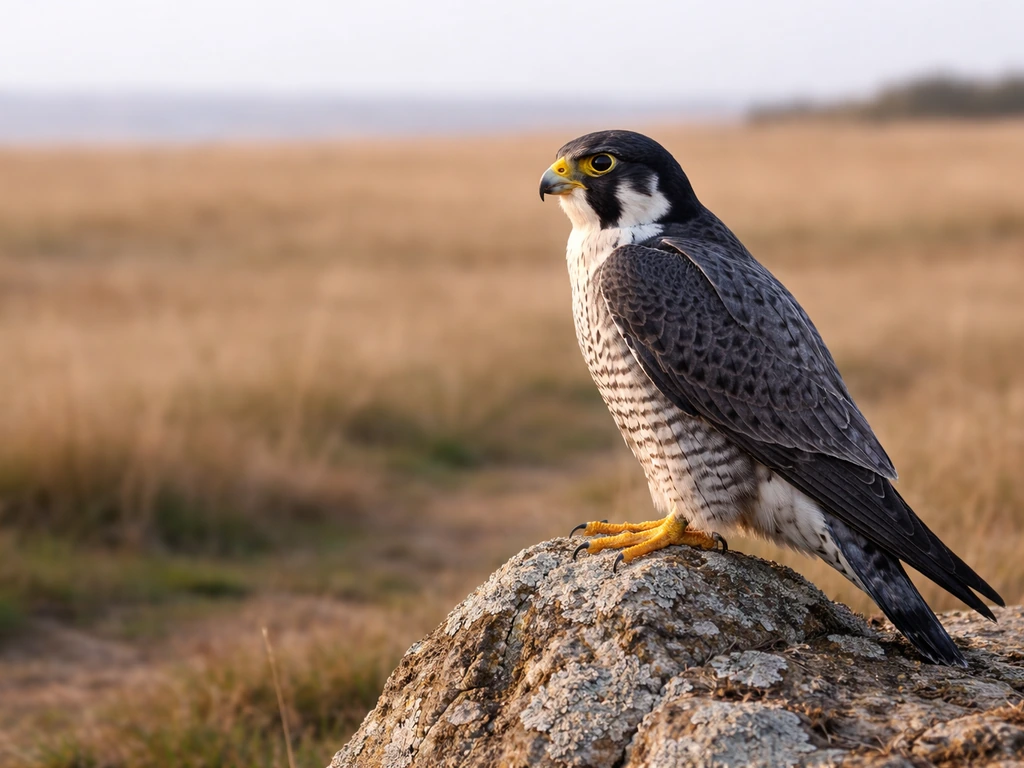
The quick answer: the 'classic falcon' look
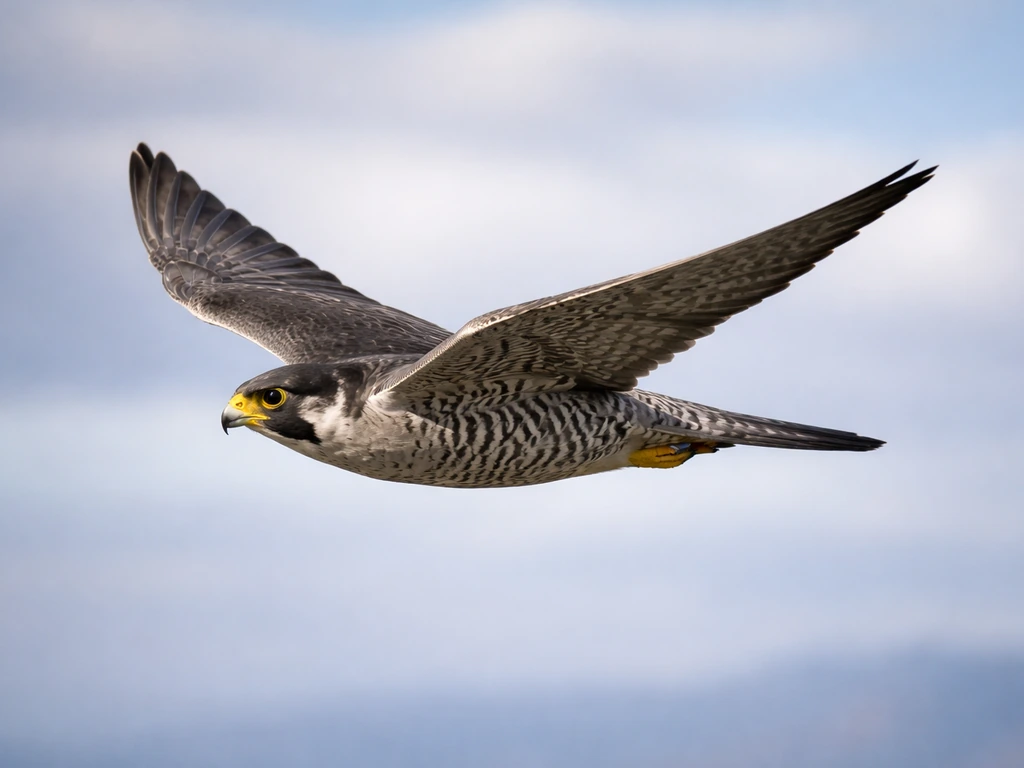
Think of a falcon as a raptor built for speed. The silhouette is the first thing to lock onto: long, narrow, pointed wingtips that look almost blade-like compared to the broader, rounded wingtips of a hawk. The body is streamlined front to back, the tail is relatively long and narrow, and the head looks a bit small and rounded for the body size. Most falcons also have a strong anchor-like or comma-shaped dark mark sweeping down from beneath the eye toward the chin. That's the moustache stripe (sometimes called a malar stripe), and it shows up in nearly every falcon species to some degree. If you see a pointed-winged raptor with a dark face slash and quick, stiff wingbeats, you're almost certainly looking at a falcon.
Body shape, head, and facial markings to check
Starting at the top: a falcon's head is shorter and more rounded than a hawk's, which tends to look more angular or wedge-shaped. The beak is hooked but short, and in most species you'll notice a bright yellow or orange cere (the fleshy patch at the base of the bill). On the Peregrine Falcon, for example, a bright yellow cere and yellow eye ring surround a dark eye, and the dark helmet-like cap plus the broad moustache mark gives the face a hooded appearance that's instantly recognizable once you've seen it. On a Gyrfalcon, the face tends to be paler than the rest of the body, with a thinner moustache stripe, making the head look less dramatically marked.
The body itself is stocky to slender depending on species. A Merlin is a small but powerfully built falcon with a compact body and a long tail, almost like someone squeezed a larger falcon down to sparrow-hawk size. An American Kestrel is closer in size to a Mourning Dove but has a distinctively larger head and those long, narrow wings. When you're scanning a bird perched on a wire or fence post, look for an upright, alert posture with the tail hanging straight down and the wingtips reaching close to (but usually not past) the tail tip.
Facial markings are where falcons really stand out. The American Kestrel actually has two black moustache-style marks on each side of the face (sometimes described as one moustache stripe and one sideburn-type slash), set against a white or pale cheek. That double-slash pattern is unique to kestrels and makes them easy to ID up close. The Peregrine has one broad, solid moustache mark on each side, giving the face that bold dark-helmeted appearance. Learning to look at the face systematically (cap color, cheek color, moustache present or absent, eye ring color) makes falcon ID much more reliable.
Wing and tail features that stand out in flight
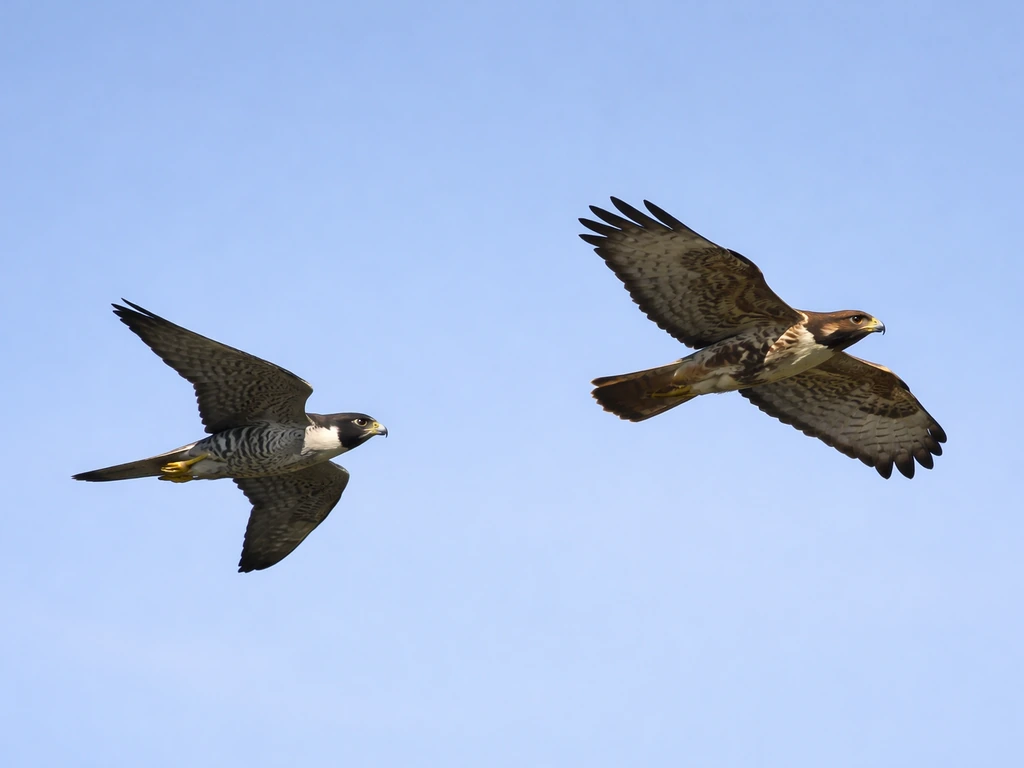
In flight, the pointed wingtips are the signature. While a hawk bird typically shows broad, rounded wings with visible finger-like primary feathers spread at the tips, a falcon's wings taper to a clean point. The RSPB notes that a falcon's wingtips are more pointed than even a Sparrowhawk's, which itself is considered a fairly sharp-winged raptor. This makes falcons look sleek and almost arrow-shaped when they're soaring or gliding.
Wingbeat style is another huge clue. Falcons beat their wings quickly and stiffly, almost mechanically, without the loose, floppy quality you might see in a larger hawk. A Merlin's wingbeats are described as stiff, powerful, and fast, and that choppy tempo is very different from the slow, deep wingbeats of a Buteo hawk. Peregrines fly with strong, shallow wingbeats and occasionally glide with their wings slightly drooped at the tips, and they can roll into rapid acceleration that makes them look like they're shifting gears. If a bird of prey rockets past with shallow, rapid beats and pointed wings, falcons should be your first thought.
Tail shape also helps. Most falcons have a relatively long, narrow tail compared to broader-tailed hawks. The American Kestrel has a notably long, square-tipped tail, while the Gyrfalcon sports a long, banded tail with dark barring across the full length. From below, look for banding or barring on the tail feathers as an additional field mark to note once you've confirmed the pointed wing shape.
Color and pattern variations across falcon species
This is where beginners sometimes get frustrated, because falcons are not all brown-and-white birds that look alike. The range is genuinely wide. Here's a quick look at the main species you're likely to encounter and their standout colors:
| Species | Overall Color | Key Markings | Size Reference |
|---|---|---|---|
| American Kestrel (male) | Slate-blue head and wings, rusty-red back and tail | Two black moustache slashes on pale face, rust tail with dark bars and white terminal band | Mourning Dove-sized |
| American Kestrel (female) | Warm reddish-brown on wings, back, and tail | Same double moustache marks, brown barring on wings and back | Same size as male |
| Merlin | Dark blue-gray to brown above, streaked below | Faint moustache, streaked underparts, long banded tail | Compact, slightly larger than kestrel |
| Peregrine Falcon (adult) | Blue-gray above, white to pale orange narrowly barred below | Broad black moustache, dark helmet cap, yellow cere and eye ring | Crow-sized |
| Peregrine Falcon (juvenile) | Browner above, heavily streaked (not barred) below | Same moustache pattern, but duller overall | Same size as adult |
| Gyrfalcon | Ranges from nearly all-white to dark brown | Variable mustache stripe, pale face relative to body, spotted or lightly marked underparts | Largest falcon; larger than a crow |
The American Kestrel shows the sharpest difference between males and females of any North American falcon. Males have that striking slate-blue wing and head color contrasting with the rusty-red back, while females are a warmer reddish-brown across the wings, back, and tail. Juveniles of most species tend to be browner and more streaked below than adults, which can throw off a beginner who has learned to expect the crisp barred pattern of an adult. The Gyrfalcon is worth special mention because its color range is extraordinary: some individuals are nearly pure white (common in Arctic populations), others are medium gray, and the darkest birds are a rich brown. All of them, though, share the basic falcon shape and the relatively pale face with a subtle moustache mark.
How to avoid common mix-ups with hawks and other raptors
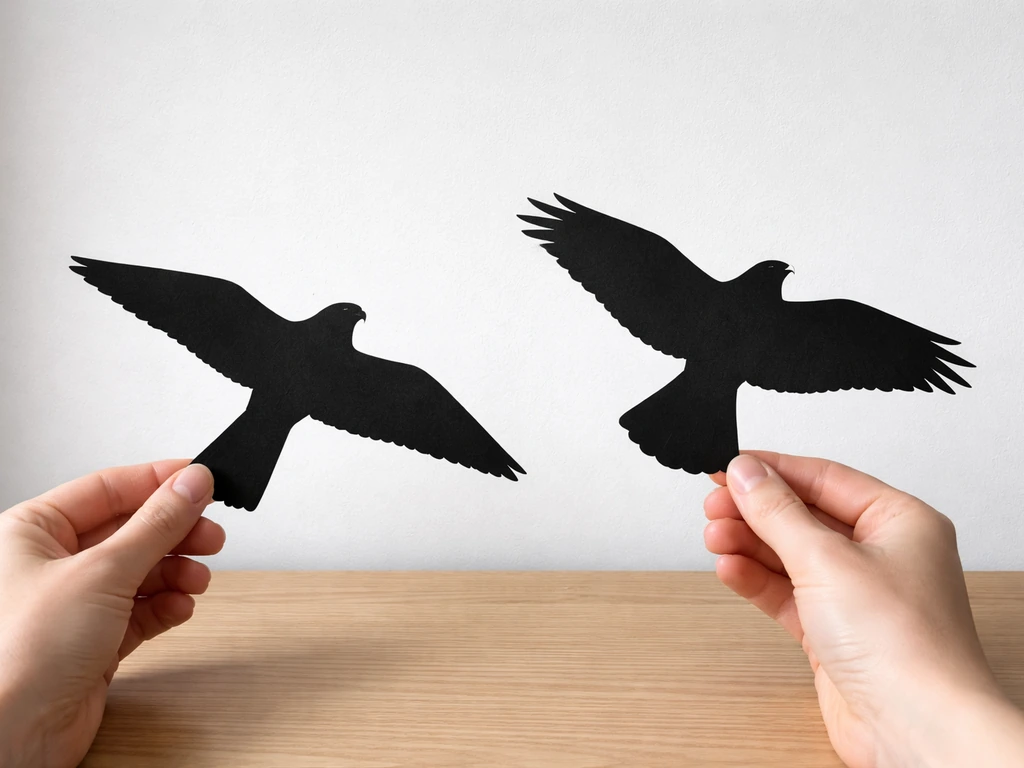
The most frequent confusion is falcon vs. hawk, and the good news is that the silhouette alone usually settles it. Hawks (especially Accipiters like the Sharp-shinned or Cooper's) have broader, more rounded wings and typically show those spread 'finger' primaries at the wingtips. Falcons have clean, pointed wingtips with no visible finger separation. When you're watching something fly away from you and you can see the wing outline clearly, that pointed vs. rounded tip difference is the single most reliable quick separator.
Buteo hawks (Red-tailed, Red-shouldered, etc.) are bigger and broader-winged still, and they tend to soar in wide circles using rising thermals. Falcons do soar occasionally, but they usually power through with those fast, stiff wingbeats or glide briefly between bursts of flapping. If a bird is lazily circling on flat wings for minutes at a time, it's much more likely a Buteo than a falcon. Eagles are even larger and longer-winged, with a distinctive broad plank-like wing silhouette nothing like a falcon's tapered shape.
One bird that trips people up is the seahawk (Osprey), which has a similar bent-wing glide profile. What a seahawk bird looks like is quite different up close, with a white head and belly, a distinctive dark wrist patch, and a habit of hovering over water before plunging feet-first for fish. Falcons almost never do that fish-plunge behavior, so habitat and hunting style can help confirm your ID when the bird is too far away to see plumage detail.
Herons sometimes get called 'hawks' or 'falcons' by beginners because they fly with slow wingbeats and look large and dramatic. But a heron bird has a completely different shape: long legs trailing behind, a long neck folded into an S-curve in flight, and broad, arched wings. Nothing like a falcon's silhouette. Similarly, a blue heron might share blue-gray coloring with an adult Peregrine at a glance, but the body proportions are so different that a second look clears up the confusion immediately.
Age and sex variation within falcons also causes mix-ups. A juvenile Peregrine, for instance, is heavily streaked brown below and can look surprisingly different from the crisp, barred adult. When you see a brown, streaky raptor and can't place it, go back to the core shape checks: pointed wings, compact head, long narrow tail, and if you can see the face, look for that moustache mark. Those features stay consistent even when plumage colors shift with age or between sexes.
It's also easy to confuse a falcon with certain kites or even large shorebirds at long range. Kites tend to have more buoyant, floppy flight styles and their wings are often more angled than pointed. If you want a deeper comparison between broader-winged raptors that people mix up with falcons, checking out what a herring bird looks like can help you rule out other large, pale-and-gray birds you might encounter near coasts or open water where falcons also hunt.
A simple field checklist and next steps
The best approach is to work through a bird systematically from head to tail rather than trying to take in everything at once. Organizing your observations by body region (head, back, wings, underparts, tail) keeps you from missing key marks in the excitement of a quick sighting. Here's a checklist you can run through in about 30 seconds whenever you spot a suspected falcon:
- Wing shape: Are the wingtips long and pointed, or broad and rounded? Pointed = falcon-likely.
- Wingbeat style: Fast and stiff with quick, shallow beats? Or slower and more fluid? Stiff and fast = falcon.
- Size: Roughly Dove-sized (kestrel), slightly larger and stockier (Merlin), Crow-sized (Peregrine), or larger than a crow (Gyrfalcon)?
- Head/face: Is there a dark moustache stripe on a paler cheek? One stripe or two? Is there a yellow cere or eye ring?
- Overall color above: Gray-blue, brown, or nearly white? Any rusty-red tones on the back or tail?
- Underparts: Barred (adult Peregrine), streaked (juvenile Peregrine or Merlin), or plain pale (Gyrfalcon light morph)?
- Tail: Long and narrow? Banded or plain? Square-tipped or slightly rounded?
Once you've run through that checklist, your next move is to compare what you've noted against a field guide or photo gallery focused on falcons in your region. If you managed to get a photo, even a blurry phone shot, zoom in on the face and wingtip shape. Those two areas carry the most ID weight. If you heard the bird call, a high-pitched, rapid 'klee-klee-klee' or similar sharp series almost certainly means kestrel. A loud, complaining 'kak-kak-kak' is typical of larger falcons like a Peregrine defending territory.
For narrowing down the exact species, the most useful next step is to note your location and habitat. Kestrels love open fields and roadsides and you'll often spot them hovering in place over a patch of grass. Merlins tend to appear at woodland edges, coastlines, and during migration. Peregrines favor cliffs, tall city buildings, and areas near water with good hunting. Gyrfalcons are rare visitors from the Arctic and show up mainly in winter, usually in open tundra-like terrain or along coastlines. Habitat is not a substitute for checking the actual field marks, but it's a great way to calibrate your expectations before the bird even flies.
If you're building your raptor ID skills more broadly and want to understand where falcons fit in the bigger picture of birds of prey, spending some time learning what a hawk bird looks like in detail is the single best complement to this guide. Getting those two groups clearly separated in your mind (pointed wings and stiff beats for falcons, broad wings and soaring for most hawks) will make everything else click into place much faster in the field.
FAQ
What if I can’t see the face clearly, what does a falcon bird look like then?
Look for the combination that stays consistent even when color changes with light: pointed, blade-like wingtips, a compact head, a long narrow tail, and (if you can see the face) a dark moustache or malar stripe. If you cannot see facial markings, wingbeat style plus tail shape usually still separates falcons from hawks.
Do all falcons have that moustache or malar stripe on the face?
Not all falcons show the moustache stripe as strongly, but the “cheek slash” is still a useful cue when visible. If the facial mark is faint, use secondary checks, such as the short, rounded head, hooked short beak with a bright cere in many species, and stiff, quick wingbeats rather than slow, deep flapping.
How can I tell a falcon from an osprey (seahawk) if I only get a quick look?
Seabirds and shoreline birds can distract you at distance, but falcons generally keep a raptor-like silhouette. Watch for pointed wingtips, a streamlined body, and fast, stiff wingbeats, and then confirm habitat behavior: an osprey typically hunts by hovering and plunging feet-first, while falcons rarely do that fish-plunge routine.
Why does a young falcon sometimes look different from the adults in photos?
Yes. Juveniles and immature birds can look browner and more streaked below, which can hide the crisp pattern you expect from adults. When that happens, ignore plumage “color stories” and re-check the structure marks first (pointed wings, head shape, long narrow tail), then use any visible facial mark as a bonus.
What’s the quickest visual feature to confirm falcon vs hawk when they’re far away?
Falcons are easiest to identify when you catch the wingtip outline, not just the bird’s overall color. If the wingtips look clean and pointed with no obvious finger separation, that is strongly suggestive. If you can see fingers at the tips and the wings feel broader and more rounded, you are more likely dealing with a hawk.
Could small falcons be confused with other birds that aren’t raptors, and how do I avoid that mistake?
Mallards, doves, and other non-raptors can sometimes be mistaken at speed, especially if the bird is silhouetted against sky. However, falcons usually read as “raptor-built” with narrow, pointed wings, a compact head held alert, and quick, mechanical wingbeats, rather than the smoother, more continuous flapping and body posture of songbirds.
Is habitat enough to identify the falcon species I’m seeing?
Yes, context can help, but it is not enough on its own. A kestrel hovering over open ground is typical, merlins favor edges and migration corridors, peregrines are often on cliffs or tall buildings, and gyrfalcons are rare and winter-associated. Always pair habitat with at least one strong field mark like wingtip shape or wingbeat style.
What should I check first when I only have a few seconds to identify a falcon?
Use a rapid checklist focused on what you can actually observe: (1) pointed wingtips, (2) compact or rounded head, (3) long narrow tail, (4) tail position on perches (often straight down), (5) wingbeat tempo (fast, stiff), and (6) face marks only if visible. Recording these in order reduces “panic scanning” and makes your photo comparison more reliable later.