A bird skeleton looks like a compact, lightweight framework built around a deep chest, a fused spine, and long slender limb bones. The overall shape is narrower and more streamlined than a mammal's, with a prominent blade-like ridge running down the breastbone, wings that mirror a human arm but with fused wrist and finger bones, and legs that seem oddly long because much of what looks like a "shin" is actually a fused foot bone. You can find it labeled in textbooks and museum collections as the avian skeleton, and the formal study of it is called avian osteology.
What Does a Bird Skeleton Look Like? Visual Guide

Marcus Whitley
1 Jul 2026
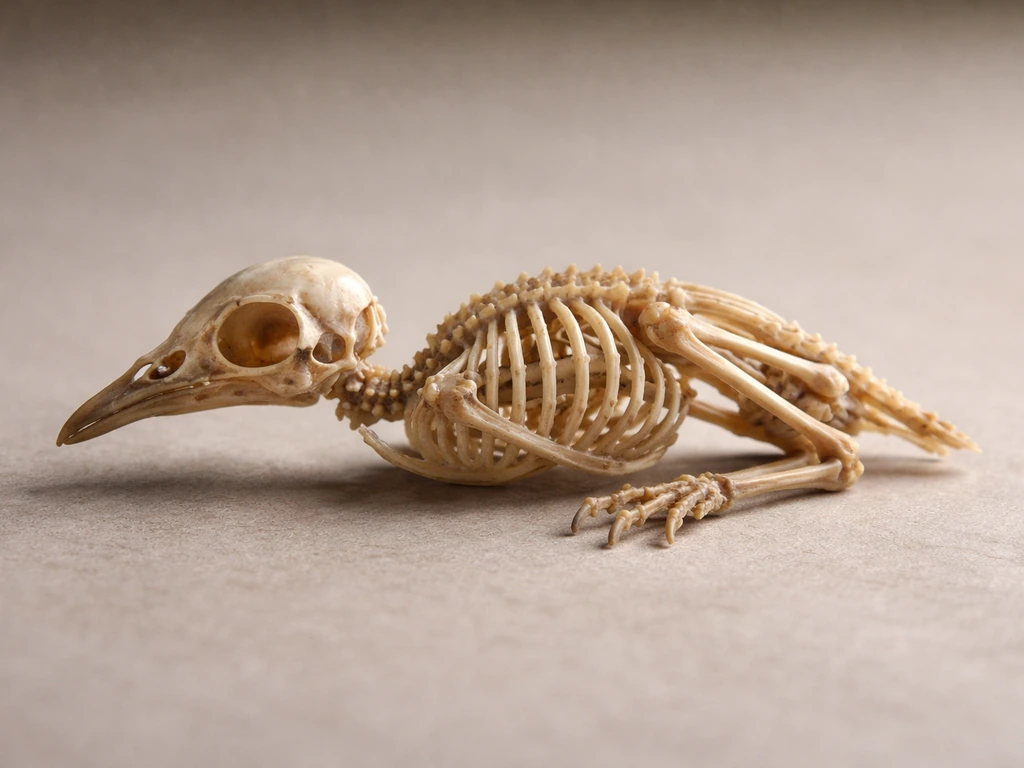
What a bird skeleton is called
The casual everyday term is simply "bird skeleton" or "avian skeleton," and those labels are what you'll see on educational diagrams and museum displays. If you're searching a natural history museum's database, they often file their specimens under "avian osteology collection" (osteology just means the study of bones). For school projects or identification guides, "avian skeleton" or "typical bird skeleton" is the phrase used in most labeled diagrams, so either version will get you what you're looking for. Don't worry about hunting for a single fancy alternate name because there isn't one that's universally used the way "cranium" is for skulls.
The big picture: what a bird skeleton looks like overall
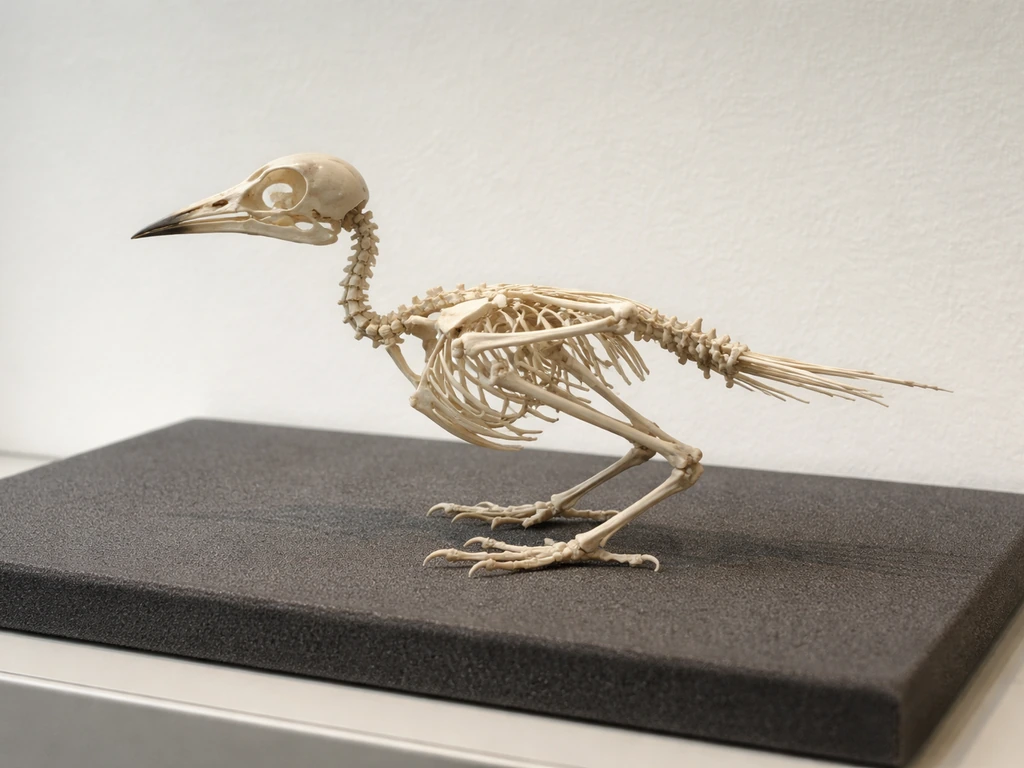
Stand back and look at a bird skeleton as a whole, and the first thing you'll notice is how delicate it appears. The bones look almost impossibly thin for an animal that size. That's not an illusion. Bird bones are pneumatized, meaning they're partly hollow and connected to the bird's respiratory air sac system, which makes them genuinely lightweight. The total skeleton of a flying bird can account for as little as 5 percent of its body weight. Even so, the bones are strong because of their internal structure, not dense like a cat's or dog's.
The silhouette is also very different from a four-legged animal. A bird skeleton has a short, rigid torso rather than a long flexible spine. Much of the back and hip region is fused into a single solid block. The ribcage is deep and barrel-shaped toward the front, anchoring a large breastbone underneath. The head sits on a flexible neck (birds have more neck vertebrae than mammals), the wings extend from the shoulder region, and the legs hang beneath the pelvis pointing downward and slightly forward.
The skull, beak area, and how the head bones sit
A bird skull looks rounded and relatively large compared to the body, with enormous eye sockets that take up most of the side of the head. The bone around the eye is thin and almost paper-like in small birds. The beak is not a separate structure bolted onto the skull; it's formed by the front extension of the upper and lower jaw bones themselves. In a skeleton photo, you'll see the upper jaw (premaxilla) projecting forward from the front of the skull, and the lower jaw (mandible) hanging beneath it.
The hinge that lets birds move their upper beak (yes, the upper beak moves independently in most birds) involves a small but important bone called the quadrate. You might spot it labeled as "os quadratum" on detailed skull diagrams. It sits at the jaw joint and connects the upper jaw to the braincase. In labeled diagrams, this is usually pointed out as the "beak attachment area" beginners ask about. The overall skull looks like a smooth dome with a forward-pointing beak, two large circular eye holes, and a rounded back end where the skull meets the neck.
Chest and wings: the keel, ribs, and wing bones
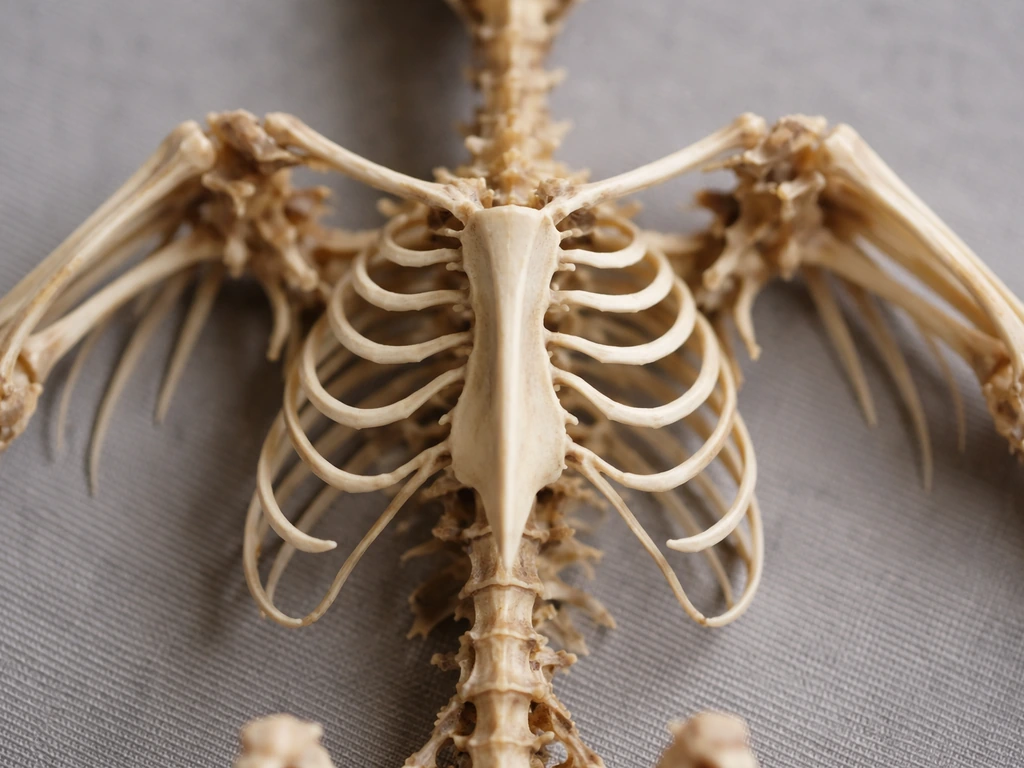
The keeled sternum
The most distinctive feature of a flying bird's skeleton is the keeled sternum, also called the carina. It's the breastbone, but instead of being flat like yours, it has a deep fin or blade shape projecting downward from the middle. This keel is where the massive flight muscles attach. In a diagram or photo, it's hard to miss: it looks like the hull of a boat running along the underside of the chest. The bigger and more prominent the keel, the more powerful the flier. Flightless birds like ostriches and emus actually lack this keel entirely, which is one of the fastest ways to tell a flightless bird skeleton from a flying one.
Ribs and the shoulder girdle
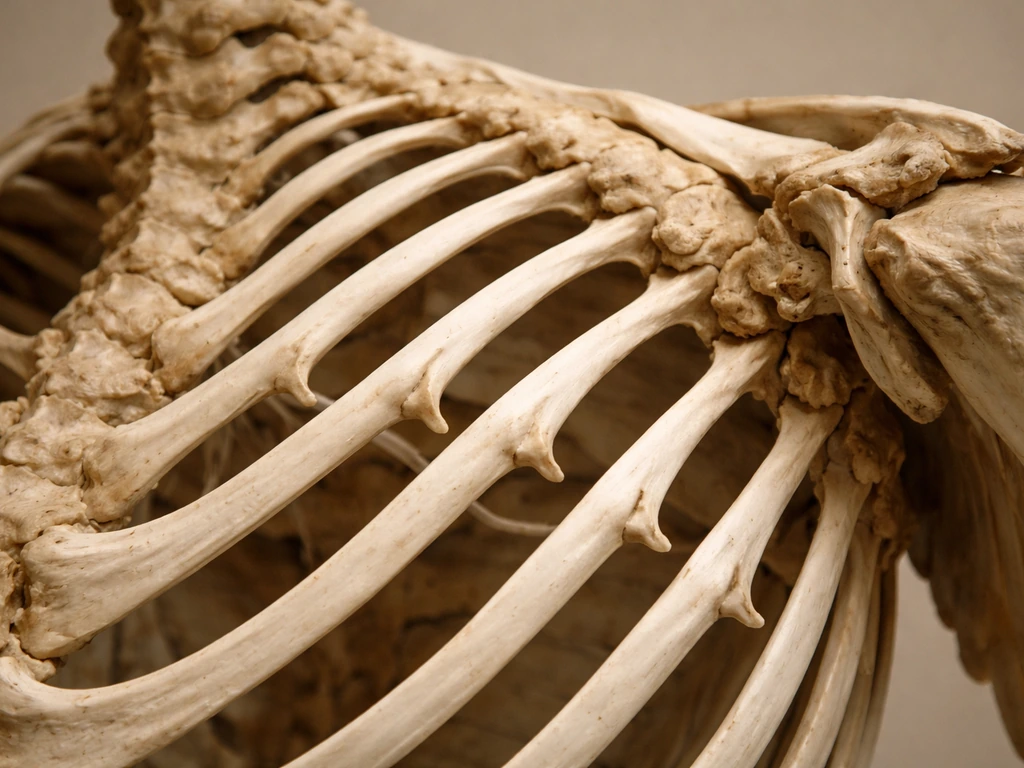
The ribs curve around from the spine to meet the sternum, and if you look closely you'll notice small bony projections sticking backward from each rib. These are called uncinate processes, and they overlap the next rib to stiffen the chest during flight. They look like little hooks or tabs on the back edge of each rib. The shoulder region connects to the wing via three bones you'll see labeled on every diagram: the coracoid (a short strut running from shoulder to sternum), the scapula (a long thin blade lying along the back), and the furcula, which is the wishbone. These three form a tripod-like support around the joint where the wing attaches.
Wing bones
A bird's wing is anatomically a modified arm, and once you see that, diagrams make a lot more sense. Working from the shoulder outward, you'll find the humerus (upper arm), then the radius and ulna (forearm, running parallel), and then the wrist and hand region. This is where birds differ most obviously from mammals: the wrist and most of the finger bones are fused together into a single bone called the carpometacarpus. Only a couple of small digit stubs remain. The whole wing from shoulder to wingtip is typically labeled as humerus, radius/ulna, carpometacarpus, and digits. In a small perching bird, each of these bones can look as thin as a matchstick.
Legs, pelvis, and feet
The pelvis of a bird is fused to the spine and forms a wide, open cradle shape. Unlike a mammal's pelvis, it's open at the bottom (no symphysis), which is thought to allow egg-laying. The fused block of vertebrae that includes the lower back, pelvis, and sacral region is called the synsacrum, and it's one of the most distinctive features you'll see labeled on any bird skeleton diagram. In the avian skeleton, the posterior part of the vertebral column includes a synsacrum formed by fusion of thoracic, lumbar, and sacral vertebrae, with species variation the fused block of vertebrae that includes the lower back, pelvis, and sacral region is called the synsacrum. It looks like a single solid bone connecting the spine to the hip region, rather than a series of separate vertebrae.
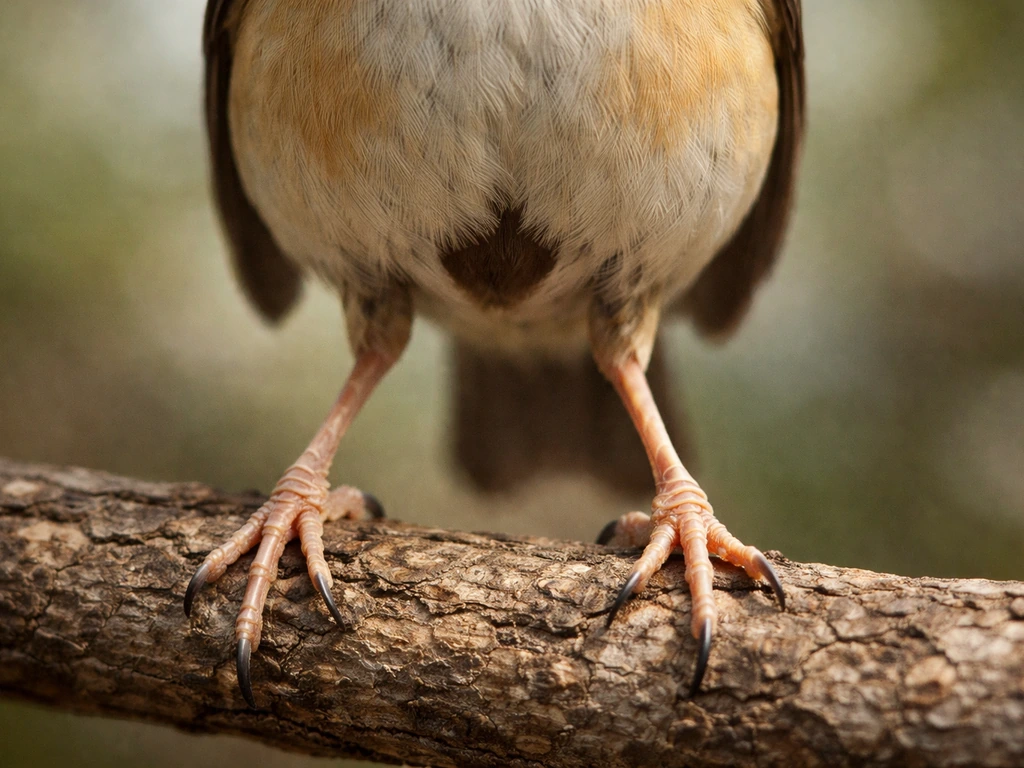
Bird legs confuse a lot of beginners because what looks like a backward-bending "knee" is actually the ankle. Birds walk on their toes (they're digitigrade), so the long lower-leg segment you can see is not a shin but rather a fused foot bone. Here's how the leg breaks down from top to bottom: the femur (thigh) is usually short and hidden under feathers in a live bird; the tibiotarsus is the long upper shin bone; and below that is the tarsometatarsus, which is a fused structure made of ankle and foot bones that only exists in birds. Finally, the toes and their small phalanges project from the bottom. In diagrams, the tibiotarsus and tarsometatarsus are almost always labeled because they're the most distinctively bird-like bones in the whole skeleton.
How to read a bird skeleton photo or diagram
Most bird skeleton diagrams show a side view (lateral view) with the bird oriented beak-left and tail-right, or beak-right and tail-left. The spine runs horizontally across the top of the image. The keel of the sternum points downward. If you see a deep blade-like projection hanging below the ribcage, you're looking at the front/belly side of the bird. The large fused block in the middle-back area is the synsacrum. The neck curves upward from the shoulder end of the spine.
When you first open a diagram, orient yourself with these four landmarks in this order: find the skull (rounded dome with a beak), find the keel (deep fin below the chest), find the synsacrum (fused block mid-back), and find the long paired lower-leg bones (tibiotarsus and tarsometatarsus). Once those four are locked in, everything else falls into place around them. If you're looking at a photo of a real specimen rather than a clean diagram, the bones may be disarticulated or arranged flat, so look for the distinctive keel shape first as your anchor point. It's the most recognizable bone in the whole skeleton.
To tell bird bones from similar small animals, the tarsometatarsus is your best friend. No other vertebrate group has this specific fused foot bone. If you see a long, slightly ridged bone with three or four small toe bones spreading from one end, you're almost certainly looking at a bird. A good next step is to compare the bird’s general body and skull features to photos or guides that describe what a female catbird looks like female catbird look like. The pneumatized (hollow-walled) texture of bird bones also differs from reptile or small mammal bones, which tend to feel denser and heavier for their size.
How bird skeletons differ across bird types
Once you know the basic blueprint, you can start noticing how different groups of birds tweak it. The core structure is the same, but the proportions tell you a lot about how a bird lives.
| Bird type | Keel size | Wing bones | Leg bones | Notable feature |
|---|---|---|---|---|
| Perching birds (sparrows, robins, finches) | Moderate, clearly visible | Slender, moderate length | Moderate tibiotarsus and tarsometatarsus | Curved toe bones for gripping perches |
| Raptors (hawks, falcons, eagles) | Large, prominent keel | Longer humerus, powerful shoulder girdle | Strong femur, shorter tarsometatarsus | Large furcula and coracoid; broad shoulder tripod |
| Waterfowl (ducks, geese) | Wide, flat sternum with keel | Broad wings, sturdy radius/ulna | Short tarsometatarsus, wide-set legs | Flat bill visible in skull; wider pelvis |
| Flightless birds (ostriches, emus) | No keel (flat sternum) | Reduced, stubby wing bones | Extremely long and heavy leg bones | Dense, non-pneumatized bones; open flat sternum |
Raptors have the most visually impressive chest region because the shoulder tripod (furcula, coracoid, scapula) and the keel are all large and well-defined. If you're looking at a falcon or hawk skeleton diagram, the trunk region with those bones labeled is where most of the visual drama is. Perching birds follow the same plan but are scaled down and look more delicate overall. Waterfowl have a slightly wider, flatter body shape, which you can see in the broader sternum and the wider-set leg attachment in the pelvis. Flightless birds are the easiest to spot at a glance because that flat, keel-less sternum immediately stands out.
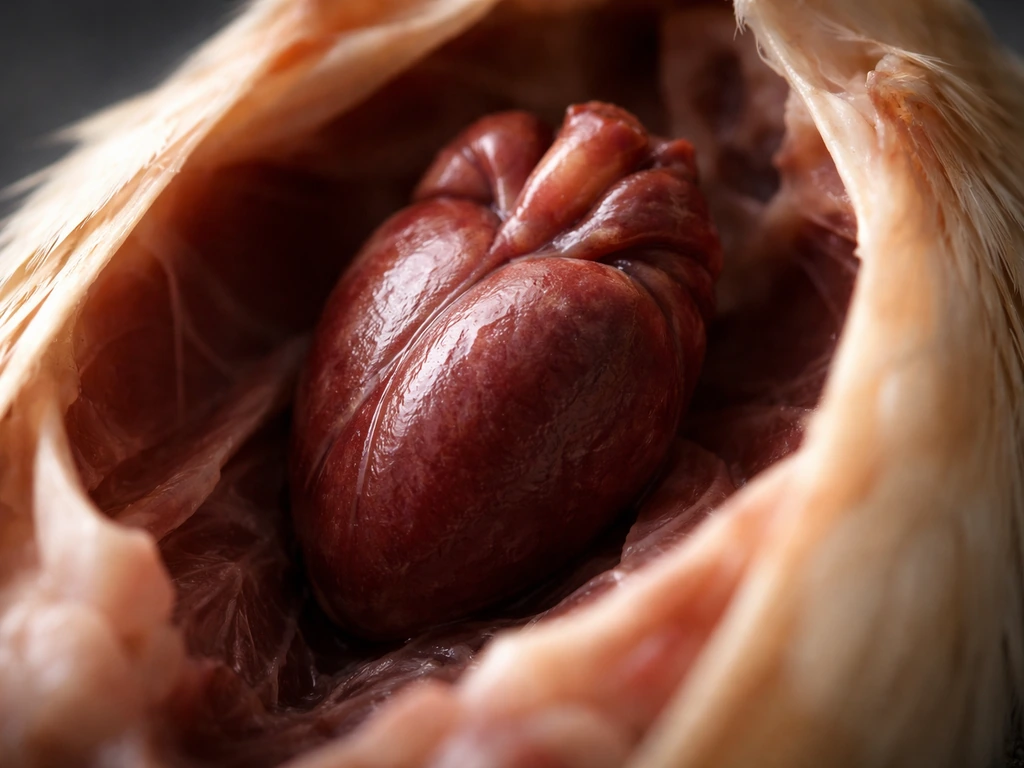
If you're interested in other aspects of bird anatomy beyond the skeleton, the internal layout of a bird is just as fascinating, and understanding how the skeleton supports soft structures like the heart can add a lot of context to what you're seeing in diagrams. What a bird heart looks like is tied to the chest layout and the way the sternum and air sac system make room for the organs what does a bird heart look like. The skeleton is really just the starting point for understanding how differently built birds actually are from any other animal group.
FAQ
Why does a real bird skeleton sometimes look different from a clean diagram?
A bird skeleton in museum photos may look “messier” because specimens are sometimes cleaned and disarticulated or arranged flat. In those cases, use the keel (carina), the synsacrum (fused mid-back block), and the tarsometatarsus (fused ankle-foot bone) as your three anchors, rather than relying on the exact pose of the bones.
Do all bird skeletons look the same, or do some differ a lot?
Yes. Many species have obvious skeletal modifications, especially in the keel (flight vs. limited flight), the neck length and number of vertebrae visible in the artwork, and the relative proportions of the wing bones. If you are comparing images, look for whether the diagram is labeled as a specific group (raptor, waterfowl, perching) because the “typical” blueprint shifts with lifestyle.
How can I tell if the bird skeleton is from a flightless species?
The keeled sternum is the easiest quick check for a flying bird skeleton, but it is not the only one. A true flightless bird usually shows a sternum without the pronounced fin-like keel, and the overall chest profile looks flatter. If the keel looks reduced rather than absent, the bird may be a weak flier or have different muscle adaptations.
What bone am I mistaking for the bird’s shin or knee?
Birds are digitigrade, so the long lower “leg” in a skeleton is largely the tibiotarsus plus the tarsometatarsus (fused ankle and foot). The “knee” region is actually the ankle joint, so avoid interpreting a backward bend as a mammal-like knee.
Why do bird bones look so thin in pictures, and are juveniles different?
Birds have hollow, air-connected bone cavities (pneumatization), which makes bones look delicate. However, photo lighting can make bones appear thinner or thicker, and in juvenile birds some bones may fuse later than in adults. If you can, compare the bone labels or check whether the specimen is described as adult or subadult.
Is the beak a separate bone in a bird skeleton?
Yes, the upper beak is not a separate “bolt-on” piece in the skeleton. You should see the premaxilla projecting forward from the skull, and the mandible hanging below. If you only see one piece labeled as “beak” without those jaw bones, the image may be a conceptual illustration rather than a literal skeletal view.
How do I confirm it is a bird skeleton and not a reptile or small mammal?
Two look-alike clues are the deep chest keel and the fused foot bone, but a tighter test is the tarsometatarsus. Most non-bird small vertebrates will not show that distinct fused ankle-foot element with toe phalanges attached at one end, and the overall bird-like limb proportions usually match the leg layout.
How should I orient a bird skeleton diagram so the labels make sense?
A lateral diagram’s orientation matters. If the keel projects downward, you are likely seeing the belly-front side, and the synsacrum should appear as the fused mid-back block. Before naming bones, first align the skull (beak and large eye sockets) and then verify that the keel direction matches the diagram’s stated left-right orientation.
Next Article
What Does a Bird Heart Look Like? Size, Shape, and Location
Learn what a bird heart looks like by size, shape, color, and location, plus how to verify it in diagrams or specimens.