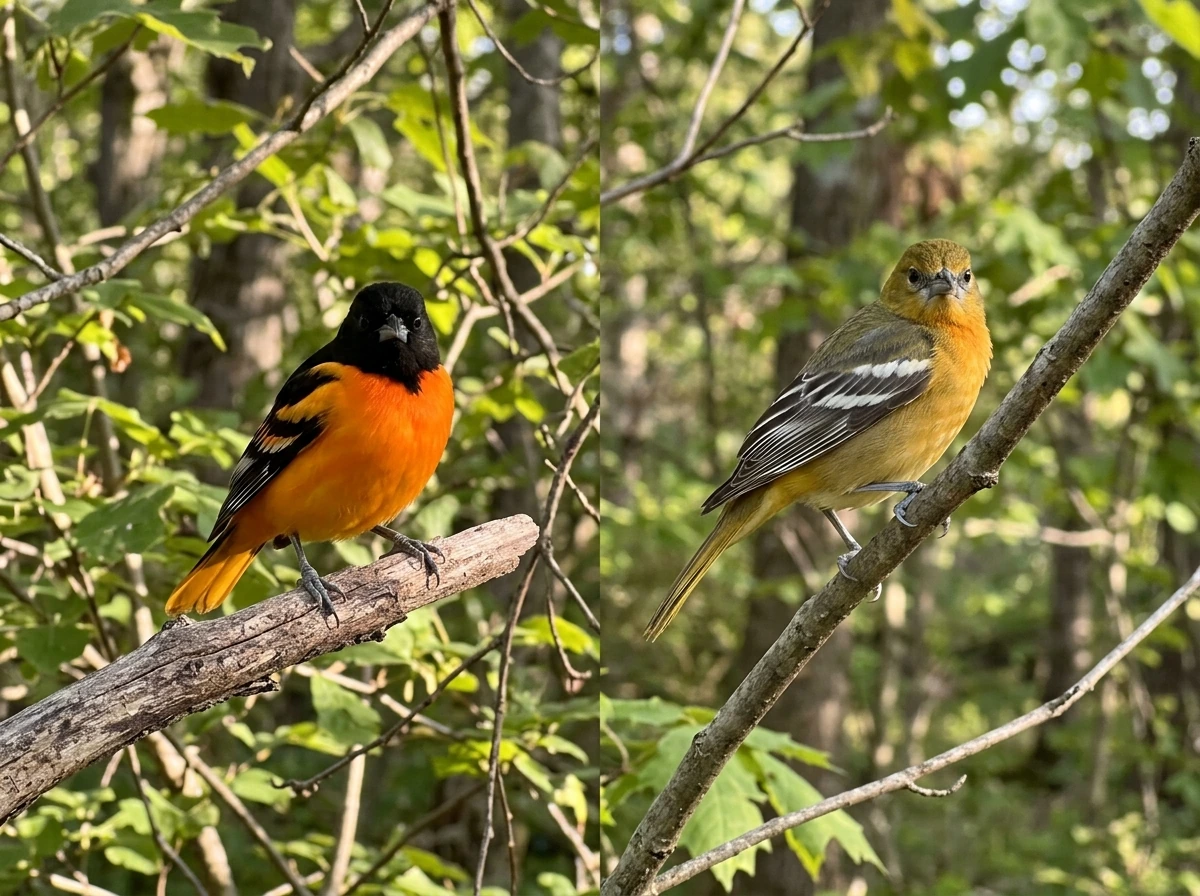
A Baltimore Oriole is a medium-sized songbird about the size of a robin, and the adult male is one of the most striking birds you'll ever see in a backyard: a deep flame-orange body with a jet-black hood, black back, and a single white wingbar on each black wing. Once you see one, you won't forget it. To get the full description, compare the overall shape, head markings, and color pattern of what does an ibis bird look like. Females and young birds are softer in color, showing yellowish-orange on the breast and grayish-brown on the back, but they're still noticeably vivid compared to most backyard visitors.
What Does a Baltimore Oriole Bird Look Like? Key Traits

Marcus Whitley
27 Apr 2026
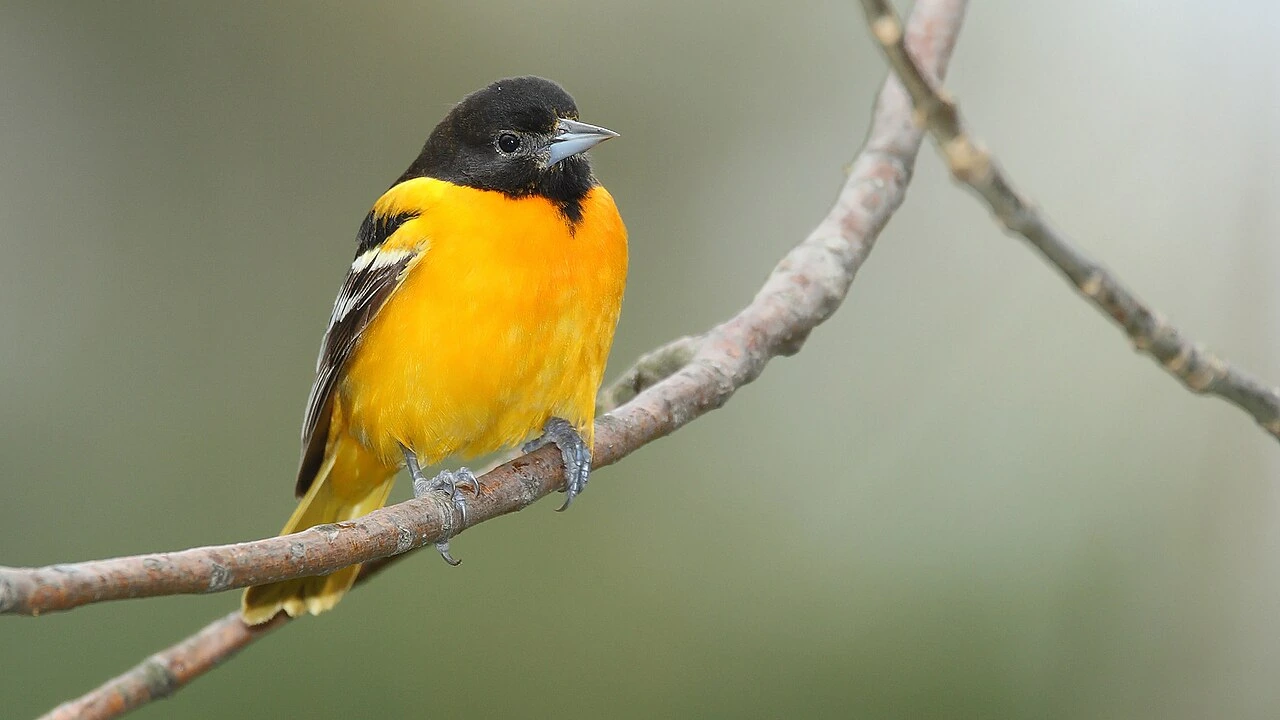
Is 'Baltimore Oriole' a real bird species?
Yes, absolutely. The Baltimore Oriole (scientific name Icterus galbula) is a fully recognized, distinct bird species documented by Cornell Lab of Ornithology and field guides worldwide. It's not a color variation of another bird or a regional nickname, it's its own species with its own range map, breeding behavior, and identification profile. You might also hear it called the Northern Oriole in older references, but today it's firmly classified as the Baltimore Oriole. If you're comparing notes with someone who mentions orioles broadly, the Baltimore Oriole is the species most people in eastern North America are talking about.
At-a-glance ID: the quick version
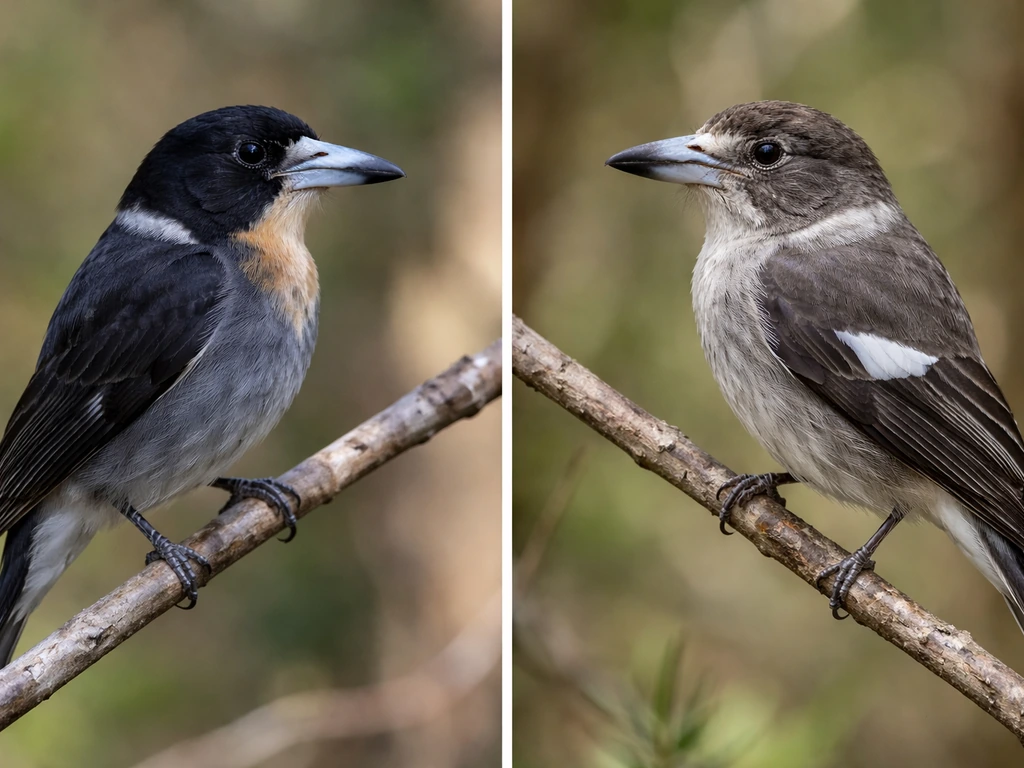
If you need a fast mental snapshot before diving into the details, here's what to lock in first. A butcher bird has its own distinctive look, so it helps to know what to expect when comparing species what does a butcher bird look like. Adult males are flame-orange and black, full stop. All About Birds describes adult male Baltimore Orioles as having brilliant orange and black plumage, including an orange shoulder patch and a broad white wingbar blank" rel="noopener noreferrer">Adult males are flame-orange and black, full stop.. Females and juveniles are yellowy-orange and brownish-gray with two white wingbars. All ages are medium-sized birds, measuring roughly 6.7 to 7.5 inches long with a wingspan of about 9 to 12 inches, which puts them in the same general ballpark as an American Robin but a little slimmer and more elongated in shape.
| Feature | Adult Male | Female / Juvenile |
|---|---|---|
| Head color | Solid black hood | Grayish to brownish, sometimes with patchy black |
| Back color | Black | Grayish-brown |
| Breast/underparts | Flame-orange | Yellow-orange |
| Rump | Orange | Yellowish-orange |
| Wingbars | One white bar on black wing | Two bold white wingbars |
| Overall impression | Bold, high-contrast black and orange | Softer, warmer yellowish tones |
What the adult male looks like
The adult male Baltimore Oriole is genuinely hard to mistake once you've seen one. The whole head and most of the back are solid, deep black, like the bird is wearing a hood that extends down to the shoulders. Then, right where that black ends, it explodes into a rich flame-orange on the rump, belly, and outer tail feathers. You'll also notice an orange shoulder patch right where the wing meets the body. The wings themselves are black with a single bright white bar cutting across them.
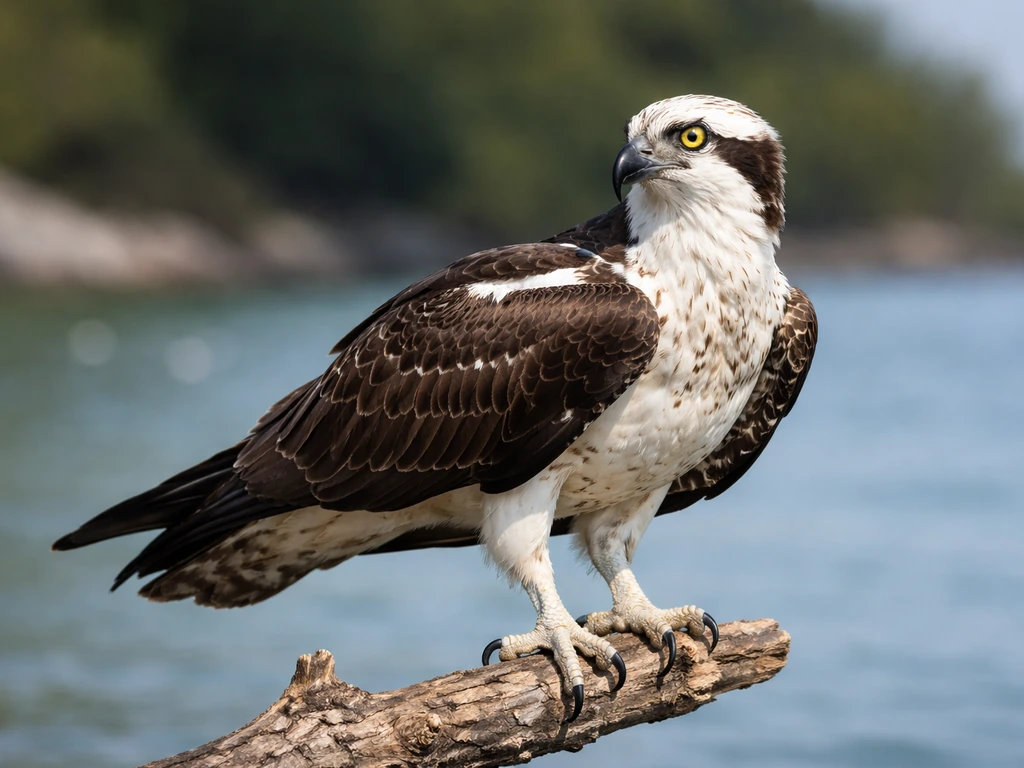
The contrast is the key thing. This isn't a subtle orange-ish bird, it's genuinely bold. The flame-orange is warm and saturated, not pale or washed out. In good light, a male perched in a tree almost seems to glow. The bill is fairly long and pointed, slightly curved, which gives the bird a slightly more angular look than a sparrow or finch. If you want to know what an osprey bird look like, focus on its dark cap, pale underside, and fish-catching stance near water. An ostrich-like bird, the ostrich is a large flightless species with long legs and a fast, ground-based way of moving what is an ostrich like bird. If you're curious about a very different seabird, what does an albatross bird look like is a great comparison point for size, shape, and plumage.
What females and juveniles look like
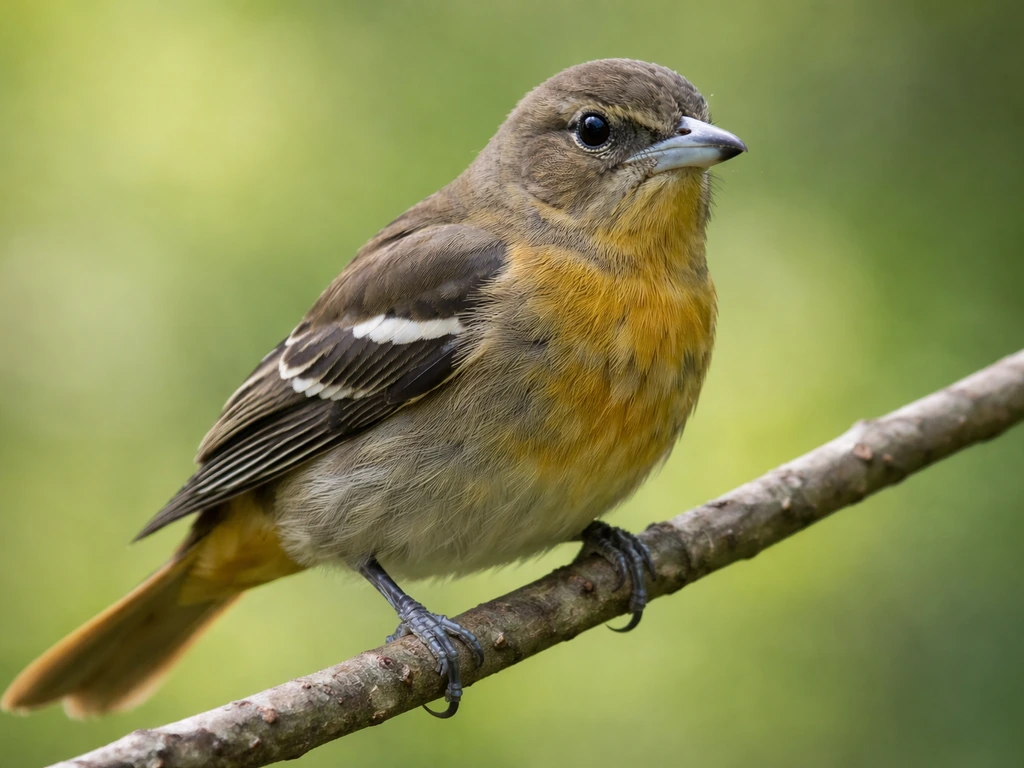
Female and juvenile Baltimore Orioles get overlooked more often because they don't have that flashy black-and-orange pattern, but they're still quite attractive birds once you know what to look for. The head and back are grayish to brownish, sometimes with a hint of olive, and the breast shades into a warm yellow-orange rather than the deep flame you see on males. Some females show a small amount of dark patterning on the head, but it's variable and usually patchy rather than the clean black hood of the male.
The most reliable field mark for females and immatures is the two bold white wingbars. That's actually one of the quickest ways to separate a female Baltimore Oriole from a male: males have one white bar on the wing, females and juveniles have two. Juveniles look very similar to females, and young males take a year or more to develop the full adult plumage, so you'll often see first-year males that are somewhere in between, showing partial black on the head or a slightly deeper orange than a typical female.
How to tell it apart from similar birds
A few species can trip you up, especially if you're newer to bird ID or you're somewhere where ranges overlap. The two most common mix-ups are the Bullock's Oriole and the Orchard Oriole.
Baltimore vs. Bullock's Oriole
Bullock's Orioles live primarily in western North America, but their range overlaps with Baltimore Orioles in the Great Plains, and hybrids exist, which makes things interesting. On a male Bullock's, the biggest visual difference is the face: Bullock's males have a bold black eyeline running through the eye on an otherwise orange face, while Baltimore males have a fully black hood covering the entire head. Also look at the wings: a male Bullock's Oriole shows a large white wing patch (a big block of white), whereas a Baltimore Oriole has a narrower white wingbar. If you're looking at a female or immature, the same general principle applies, but it gets trickier, so location is a helpful secondary check.
Baltimore vs. Orchard Oriole
Orchard Orioles are smaller and darker. An adult male Orchard Oriole replaces orange with a deep chestnut-brick red, so while it's still a black-and-warm-color bird, the color is unmistakably darker and more rusty. Female Orchard Orioles are yellowish-green overall, which can look a bit like a female Baltimore at a glance, but the Orchard is noticeably smaller and greener rather than warm orange. If you're unsure, size and the overall color temperature (warm orange vs. cool yellow-green) are the fastest separators. The broader general oriole look is worth getting familiar with, and knowing the Baltimore well gives you a solid baseline for comparing other oriole species.
Where and when you're likely to spot one
Baltimore Orioles are migratory songbirds that spend the breeding season in eastern and central North America. From early April through late May, they arrive in good numbers from Louisiana all the way up through central Canada, and they stay through summer to breed before heading back south. If you're in the eastern US or Canada and you spot an orange-and-black bird in late April through August, the Baltimore Oriole is absolutely a top candidate. If you want to know exactly what an oven bird looks like, focus on its streaked brown body and warm, rusty head markings orange-and-black bird.
They're especially fond of tall, open deciduous trees, particularly elms and cottonwoods, where they weave their distinctive hanging basket nests at the tips of branches. You'll often hear the male before you see him: Baltimore Orioles have a rich, flute-like whistling song that carries well. They're also reliably attracted to backyard feeders stocked with orange halves or grape jelly, which makes them easier to get a good look at than many other species. If you're trying to confirm a sighting, check that your location and time of year line up with the breeding or migration window, that's often the final piece that locks in a confident ID.
Your ID checklist for a confident confirmation
When you're looking at a photo or watching a bird in the yard and trying to confirm it's a Baltimore Oriole, run through these quick checks:
- Head color: is it a solid black hood (male) or grayish-brown with possible patchy black (female/juvenile)?
- Breast color: flame-orange (male) or yellow-orange (female/juvenile)?
- Wingbars: count them. One white bar on a black wing means adult male. Two white bars means female or immature.
- Size: roughly robin-sized, about 6.7 to 7.5 inches long. If the bird is noticeably smaller, consider Orchard Oriole.
- Location and season: are you in eastern or central North America between April and August? That's prime Baltimore Oriole territory and timing.
- Face pattern: if you can see the face clearly, a fully black hood with no eyeline separates Baltimore from Bullock's Oriole.
Getting comfortable with the Baltimore Oriole also sets you up well for identifying other bold, patterned birds. The same attention to head color, wingbar count, and breast tone that works here applies to many other species, so every time you nail a Baltimore Oriole ID, you're sharpening skills you'll use again and again.
FAQ
How can I tell a male vs a female Baltimore Oriole at a feeder or in a quick photo?
Look for the black hood that covers most of the head on adult males, and count the white wingbars. Females and juveniles typically show two bold wingbars (not one), and their head is grayish-brown rather than solid black. Also note the overall color warmth, males are warm flame-orange and females are warmer yellow-orange rather than the richer, darker tones seen in some other orioles.
What if the orange looks washed out in my photo, can I still confirm it?
If the lighting is harsh or the bird is slightly sun-bleached, the orange may look paler, but the male’s contrast usually still holds, jet-black head and back plus warm orange below. In dim shade, prioritize structure and pattern, single white wingbar on males, two wingbars on females, and the male’s hood that extends down toward the shoulders.
Can a Baltimore Oriole be confused with a different bird besides other orioles?
A good starting point is to separate “oriole-like” from “not-oriole” by body shape and the wing pattern. Baltimore Orioles have a slender, robin-sized shape with a fairly pointed, slightly curved bill and a clean, high-contrast wingbar pattern. If you see a single orange-and-black bird but the wing markings are unclear, use the wingbar count when you can get a better angle or a second frame.
If I’m in an overlap region, how do I avoid mistaking Bullock’s Oriole for a Baltimore Oriole?
Location helps but is not enough by itself. If you are in the Great Plains during overlap areas, Bullock’s and Baltimore Orioles become more plausible, and hybrids have been reported. To reduce error, check the male face pattern (Bullock’s often has a bold black eyeline rather than a fully hooded head) and compare the wing white marking, Bullock’s tends to show a larger white patch, Baltimore a narrower wingbar.
What are the best field marks to tell an Orchard Oriole from a female Baltimore Oriole?
If the bird is small and the male’s orange is replaced by deep chestnut-brick red, think Orchard Oriole. For females, pay attention to overall color temperature, Orchard females tend to look greener and less warm-yellow than Baltimore females. Size and the warm orange versus cool yellow-green look are usually the fastest separators.
How do I identify a young Baltimore Oriole that doesn’t look fully adult yet?
Juveniles and first-year birds can look intermediate, with partial black on the head and orange that is not fully developed. Do not rely on the black intensity alone. Instead, use the wingbar count as your primary clue, males are typically one wingbar, females and immatures usually show two.
What should I look for if I only get a brief or distant view, or the bird is in flight?
A perched male is easier than a bird in flight. In flight, the wingbar and the overall black-and-orange layout still help, but the hood detail may be harder to see. Try to get a side or semi-side view where the white wingbar(s) and bill shape can be seen clearly.
How can I confirm my sighting is a Baltimore Oriole and not wishful thinking?
Use timing and feeding preferences to confirm. Baltimore Orioles are typically most likely in eastern North America around spring arrival through summer, and they often come to feeders with orange halves or grape jelly. If your sighting is far outside the expected seasonal window, treat the ID as provisional and double-check the wingbar and head pattern.
Can song or calls alone confirm a Baltimore Oriole?
If the bird is singing or calling, that can support your ID but not fully confirm it. A Baltimore Oriole’s flute-like whistling is distinctive, however other birds can produce similar whistles. Combine vocal cues with a visual check, especially the wingbar count and the male’s hood-and-orange contrast.