An osprey is a large, striking raptor that looks like it was designed with contrast in mind: dark brown on top, bright white underneath, and a bold dark stripe cutting across each side of its pale face like a mask. Once you know what to look for, you won't mix it up with anything else. It's one of those birds where the field marks are so consistent and so visible that even a first-time birder can nail the ID from a distance.
What Does an Osprey Bird Look Like A Visual ID Guide

Marcus Whitley
15 Apr 2026
Big-picture look and size impression
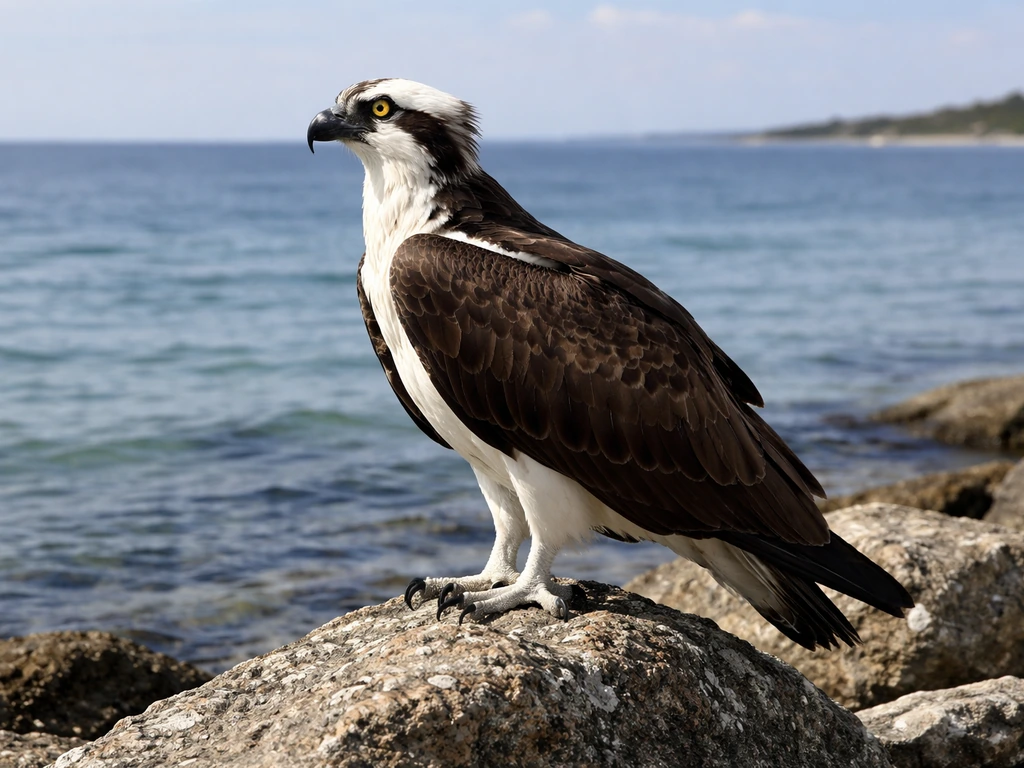
The first thing you'll notice about an osprey is that it's big. We're talking about a bird that measures roughly 21 to 23 inches from beak to tail (about the length of a large crow stretched out) with a wingspan that can reach anywhere from 59 to nearly 71 inches (150 to 180 cm). Some rough field guides simplify it to about 2 feet long with a 6-foot wingspan, and honestly that's a useful mental image. When one flies over, it fills the sky in a way that immediately registers as 'large raptor.'
Females are noticeably larger than males when you get two birds side by side. They weigh about 15 to 20 percent more and are measurably longer in the wing, tail, bill, and claw. In practice you won't often be comparing the two directly, but if you're watching a nest or a pair hunting together, the female is the bigger bird.
The overall body shape is stocky but aerodynamic. Think broad chest, compact body, and very long wings that angle backward at the wrist when in flight, giving the bird a distinctive crooked or gull-like silhouette. That crooked wing shape is actually one of the fastest visual cues in the field.
Head and face pattern field marks
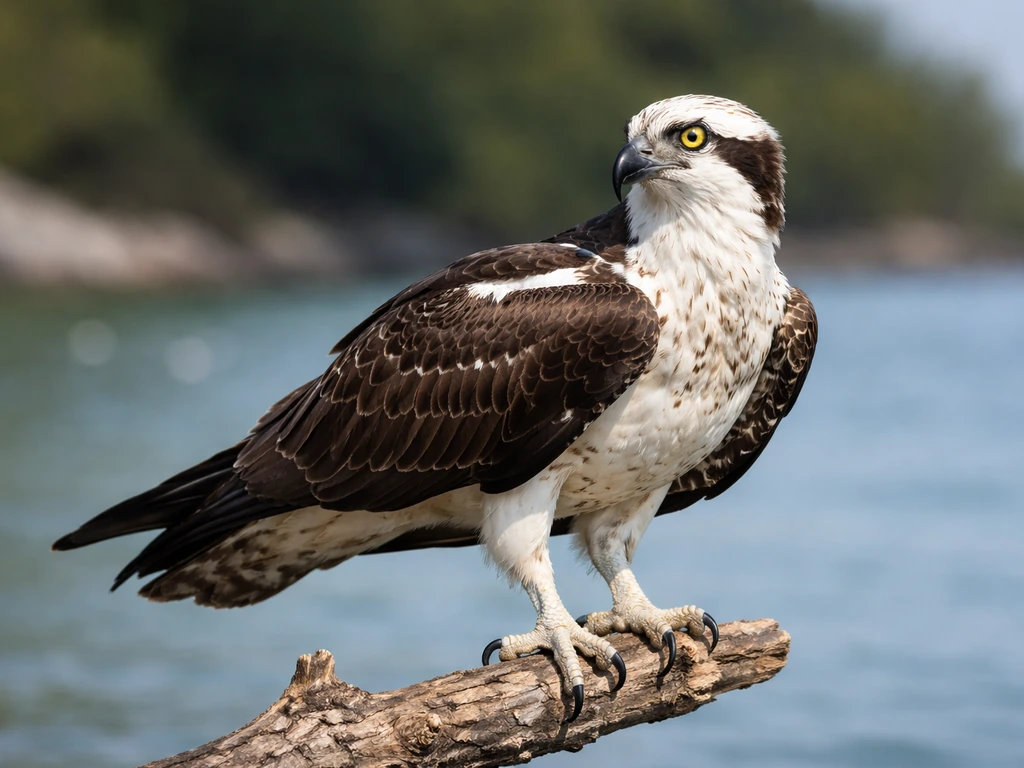
The face is where osprey ID really locks in. The crown and most of the head are white or very pale, almost like the bird is wearing a white cap. Running from the eye back toward the neck and shoulders is a thick, dark brown stripe, sometimes described as an eye stripe or a mask. It's bold enough to see from a surprising distance, and it gives the osprey a slightly fierce, concentrated expression.
Adult ospreys have yellow eyes, which pop against the pale face and dark eye stripe. Juveniles, on the other hand, have orange eyes and a slightly warmer, buffy tone to the head and breast overall. The dark eye stripe is present at all ages, so it's a reliable mark no matter what time of year you're looking.
The throat is white and clean. There may be a little brown mottling across the upper breast, but the underparts are largely white. Some females show more of a brown 'necklace' band across the breast than males do, which can be a subtle clue if you get a good look.
Wings and body coloring (upperwing and underwing)
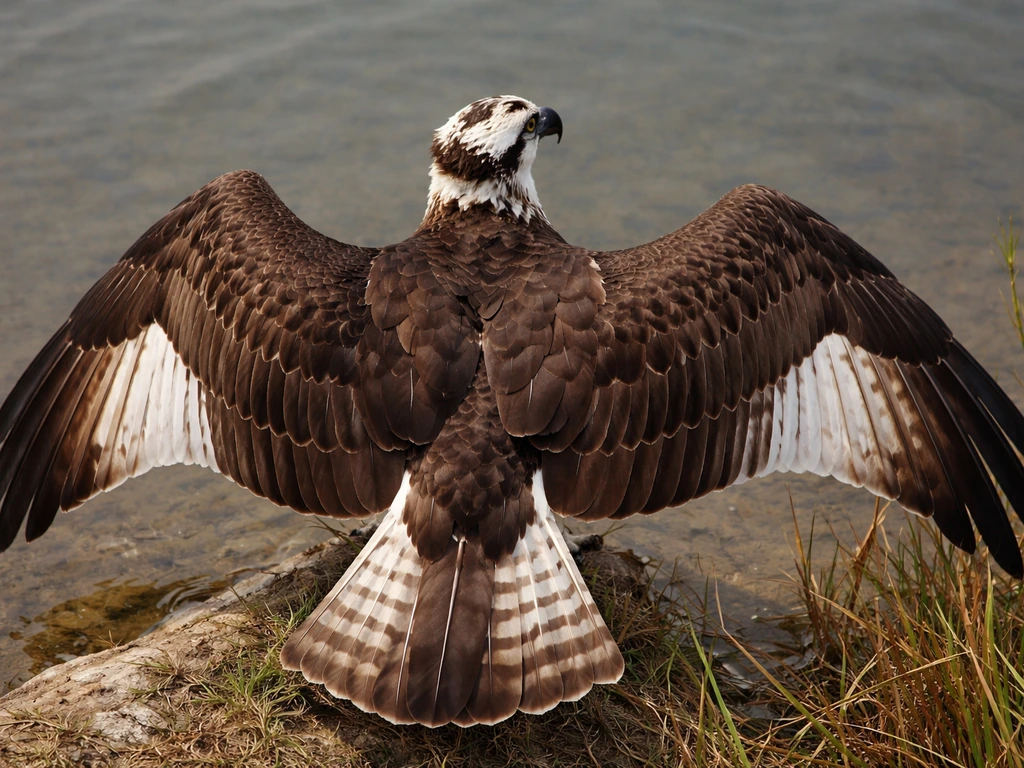
From above, the osprey is dark brown. The back, the top of the wings, and the back of the head and neck are all that same rich dark brown, making the white head and underside stand out even more by contrast. Juveniles have white edging on those brown upperpart feathers, giving them a slightly scaly or spotted look from above.
The underwing is where things get really specific and really useful. When you see an osprey flying overhead, look at the underside of the wings. The flight feathers (the long ones at the wing tip and trailing edge) are white with dark brown barring across them. The secondary coverts (the inner part of the underwing closer to the body) are also mostly white.
But the primary coverts, the patch near the wrist or bend of the wing, are dark brown. That dark rectangular patch at the wrist is called the carpal patch, and it's one of the clearest ID marks on the whole bird. The U. S.
Geological Survey and Patuxent Wildlife Research Center also identify this underwing wrist patch as the carpal patch, a key field mark for recognizing osprey in flight [dark rectangular patch at the wrist](https://www. mbr-pwrc. usgs. gov/id/framlst/Idtips/h3640id.
html).
Put it all together from below: white barred flight feathers, white secondary coverts, and a rectangular dark wrist patch. Combined with the unmarked white belly, this underwing pattern makes the osprey, as one guide puts it, 'instantly recognizable even at a distance.' If you want to compare this kind of dramatic wingspan to another large seabird, the albatross offers an interesting contrast in sheer scale, but the underwing patterns are completely different.
Tail, legs, and bill details
The tail is medium length and banded. From above, it's dark brown with paler bands running across it. From below, it's barred with gray. The banding is consistent enough that if you get a tail-on view, you should be able to count several distinct bands. It's not a tail with a bold terminal band like some hawks, but the striping is noticeable.
The legs are pale bluish-gray, which is a surprisingly specific and useful detail if you get a perched bird in good light. The talons are black and sharply curved, built for gripping slippery fish. The feet are actually adapted with a reversible outer toe, which you won't see in the field but explains why ospreys can carry fish facing forward so efficiently.
The bill is short, black, and strongly hooked. It's set in that pale face and gives the osprey a compact, purposeful look compared to the longer beaks of gulls or herons. The combination of short hooked bill, stocky body, and long crooked wings makes for a silhouette that's quite distinctive even when you can't see color detail.
How to spot an osprey in flight
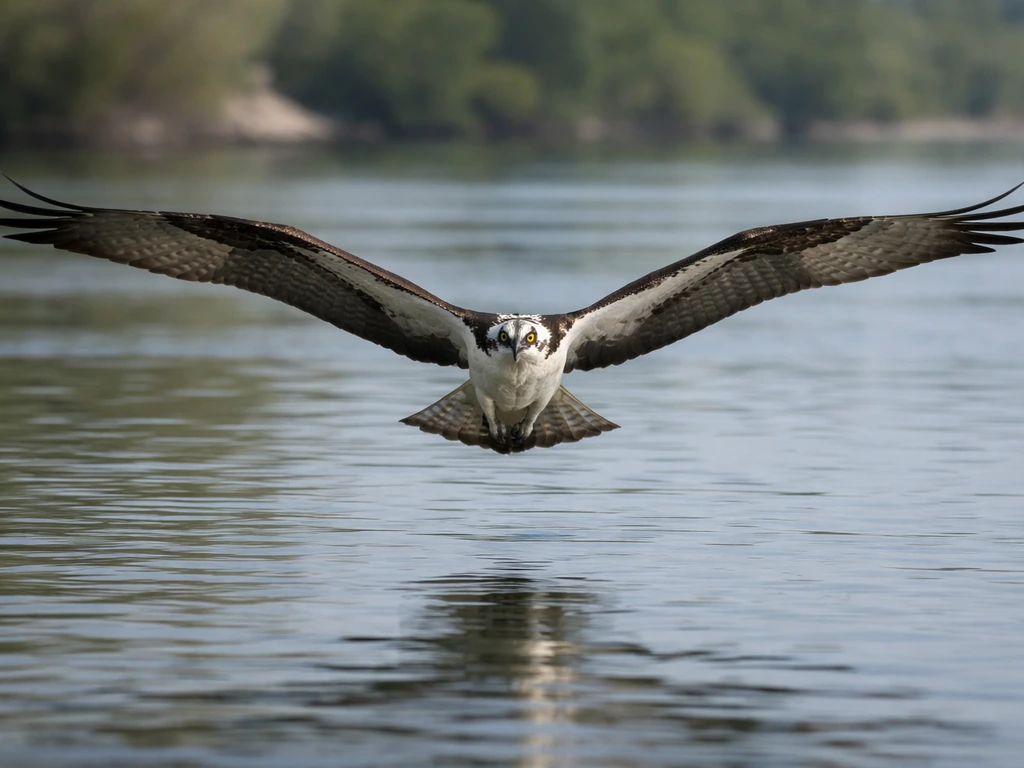
In flight, the osprey's silhouette is your first clue. Those long wings have a pronounced bend at the wrist, creating an M-shape or crook when you view the bird head-on or from below. This wing posture is characteristic and different from the flat, board-like wing posture of a bald eagle or the more tapered wings of a falcon.
From below, run through the three key visual checkpoints quickly: the unmarked white belly, the dark carpal wrist patch, and the barred white flight feathers. All three together confirm osprey. If any of those are missing or look very different, you may be looking at something else.
Ospreys often fly with slow, steady wingbeats, sometimes circling or hovering as they scan below. The overall impression in the air is of a large, powerful bird that's more graceful and deliberate than a gull but less stocky and heavy-looking than an eagle. The white underneath and the bold face stripe are visible even at significant distance if light is good.
Quick confusion check vs similar birds
The two most common mix-ups are bald eagles and large gulls, particularly the Great Black-backed Gull. Let's sort them out quickly.
| Feature | Osprey | Bald Eagle (adult) | Great Black-backed Gull |
|---|---|---|---|
| Head color | White with bold dark eye stripe | All white, no eye stripe | All white, no eye stripe |
| Body/upperparts | Dark brown | Dark brown/black body | Black back and wings |
| Underwing | White with dark carpal wrist patch and barred flight feathers | Mostly dark with white wing lining patches | White with black wingtips |
| Wing shape in flight | Crooked/bent at wrist (M-shape) | Flat, board-like, very broad | Straight, more even taper |
| Tail | Brown with pale bands | White (adults) | White |
| Bill | Short, strongly hooked, black | Large yellow hooked bill | Large, yellow with red spot |
| Size | 21–23 inches, 5–6 ft wingspan | 28–40 inches, 6–8 ft wingspan | 25–31 inches, 5–6 ft wingspan |
The bald eagle is larger and heavier looking, with a completely white tail and head (in adults) but no dark eye stripe at all. Its underwing is much darker overall, with white patches in the wing lining rather than the osprey's barred white flight feathers. If you need a reference point for another bird that shares bold head coloring, checking out what a Baltimore oriole looks like shows how dramatically different even bold patterns can be when the scale changes.
The Great Black-backed Gull can fool you at distance over water, mostly because it's also a big bird with white underneath. But look for what the osprey has that the gull doesn't: the dark eye stripe, the bent wrist wing shape, and that rectangular carpal wrist patch. Oven birds are smaller than ospreys and have a very different look, but you can narrow it down by focusing on their key field marks. The gull has an all-white head and tail with no stripe, a longer bill with a red spot, and wings with a clean white trailing edge rather than barring. Once you've got those differences locked in, the two birds look nothing alike.
You might occasionally wonder about other raptors too. Some butcher birds and predatory species share the concept of a bold face mask, but if you're curious what a butcher bird looks like in comparison, the size and body plan are so different that confusion is unlikely in the field. Similarly, birds like the ibis share wetland habitat with ospreys but have such a different silhouette and coloration that the main thing they have in common is being large wading or water birds.
For anyone curious about other striking birds with bold patterns, learning what an oriole bird looks like is a fun contrast in how differently bold coloring works at songbird scale versus raptor scale. And if you want to compare size impressions across large distinctive birds, reading about what an ostrich-like bird looks like puts the osprey's 6-foot wingspan in an interesting perspective. Even understanding what an ovenbird looks like can help reinforce how dramatically field marks differ across bird families.
Photo and field-mark checklist to confirm your ID
If you're in the field and want to nail the ID quickly, run through these marks in order. The first three alone are usually enough. The rest are confirmation.
- Dark brown eye stripe: a wide, bold stripe running from the eye back along the side of the neck on an otherwise pale white head. This is your fastest single field mark.
- White underparts: belly, throat, and breast are white, sometimes with light brown mottling across the upper breast.
- Dark rectangular carpal wrist patch: look at the underwing when the bird is flying toward you or overhead. There should be a clearly defined dark brown rectangular block near the wrist/bend of the wing.
- Barred flight feathers on the underwing: the long wing feathers visible from below are white with dark brown bars across them, not solid dark.
- Crooked wing posture in flight: wings bend noticeably at the wrist, creating an M-shape from the front rather than a flat straight line.
- Banded tail: the tail shows several pale bands across a dark brown background from above; from below it appears barred with gray.
- Short black hooked bill: compact and sharply curved, set in a pale face.
- Pale bluish-gray legs: visible on perched birds, especially in good light.
Best photo angles to capture for confirmation
- Underwing shot from directly below: captures the carpal wrist patch, barred flight feathers, and white belly all at once. This is the single most useful angle for ID.
- Head-on or frontal flight view: shows the M-shaped wing crook and gives you a look at the face stripe.
- Perched side view: lets you confirm the bill shape, leg color, tail banding, and overall size impression.
- From above or behind: shows the dark brown upperparts and banded tail pattern.
If you can get even a decent phone photo of the bird flying overhead, the carpal wrist patch and white belly should be visible enough to confirm the ID later. The eye stripe is clear in any reasonable head shot. Between those two marks, you really can't go wrong. Ospreys are one of the more beginner-friendly large raptors precisely because their field marks are so consistent and so visible, even in less-than-perfect light.
FAQ
How can I tell an osprey from a distance when light is poor or the head stripe is hard to see?
Rely on the underwing and belly. Look for the unmarked white underside, barred white flight feathers, and the dark rectangular carpal patch at the wrist. These features remain easier to spot even when the face is in shadow or the bird is angled away.
Are ospreys ever mistaken for juveniles or other raptors because the eye color changes?
Eye color does vary with age, adults having yellow eyes and juveniles having orange. However, the dark eye stripe or mask and the underwing pattern (white secondaries, barred primaries, and the carpal patch) should still match. Don’t use eye color alone if the wing view is available.
What should I check if I only get a perched view of the osprey?
Even perched, use the hooked bill, stocky look, pale bluish-gray legs, and the contrasting dark upperparts versus white underparts. The underwing pattern is hardest from the ground, so prioritize the bill shape and the overall contrast, then confirm if the wings open.
Can the ‘crooked’ wing shape vary by angle, and how do I avoid misreading it?
Yes, the wrist bend is most obvious when the bird is head-on or viewed from below. If you see a side profile and the wing bend is less distinct, use the other two key checkpoints together (white belly and the dark carpal patch) rather than trying to judge only the silhouette.
What’s the quickest identification order if the bird is far away and moving quickly?
Use a 3-step scan: first confirm the large raptor size and overall stark white underside, then look for the bent-wing look or underwing barring, and finally verify the dark rectangular carpal patch on the underwing. If you can only catch one mark, the carpal patch plus white belly is the strongest combo.
Do ospreys have a “necklace” band like other birds, and does it matter for ID?
Some females show extra brown mottling across the upper breast and a more noticeable band-like ‘necklace’ effect. It can support your ID, but it is not as reliable as the underwing carpal patch and the bold dark eye stripe, since lighting and feather condition can change how much you see.
What if the tail looks confusing, for example if I can’t count clear bands?
Tail banding can be subtle when the tail is fanned partially or when the bird is distant. Don’t let unclear tail stripes override the underwing and facial pattern. A better fallback is the underwing barring on the flight feathers plus the dark wrist patch.
Could a Great Black-backed Gull ever show a similar wing patch or stripe?
They can look similar over water at distance, but the osprey’s combination is specific: dark eye stripe, pronounced wrist bend, and a distinct rectangular dark carpal patch with white barred flight feathers below. If the gull’s wing doesn’t show that osprey-style rectangular wrist patch and barring pattern, it’s likely not an osprey.
If I see a bald eagle nearby, what’s the most reliable “no dark stripe” check?
Check the face stripe first: bald eagles do not show the consistent dark eye mask. Then compare the underwing overall darkness and the tail being fully white in adults. Even if the bird is partially obscured, the lack of a dark eye stripe is a strong negative clue.
How good does my photo need to be to confirm an osprey later at home?
A sharp shot of the bird in flight from below or at an angle is ideal, but you can often confirm with less. Focus on capturing the underside when possible, since the carpal wrist patch and barred white flight feathers are usually visible in even moderately clear phone images. If the photo is only of the side or back, you may need extra observations (bill shape, underparts contrast, and eye stripe).