The earliest known bird looked something like a crow-sized, what does a raptor bird look like with broad wings, a long bony tail, and a mouth full of small teeth. what does a raptor bird look like what bird looks like a dragon Picture a magpie crossed with a small raptor, covered in dark pennaceous feathers, with clawed fingers poking out from the leading edge of each wing. That's the closest mental image you can build from the fossil evidence we have today, and it's a genuinely fascinating one once you start breaking down each feature.
What Did the First Bird Look Like? Fossil-Based Description

Marcus Whitley
22 Mar 2026
What most people mean when they ask about the "first bird"
When people search for what the first bird looked like, they usually mean one of two things: the earliest creature in the fossil record that scientists call a bird, or the first animal that could actually fly in a bird-like way. Those two things are not always the same creature, which is why you'll get slightly different answers depending on where you look.
The name that comes up most often is Archaeopteryx. It has held the "first bird" title for over 150 years, partly because the name stuck historically and partly because it really does sit right at the boundary between non-avian dinosaurs and true birds. But scientists at places like the Natural History Museum in London are quick to point out that "first bird" is a definition problem as much as a fossil problem. Different bird-defining features, things like feathers, a wishbone, hollow bones, and flight, appeared at different times in different lineages. So when you ask what the first bird looked like, Archaeopteryx is still your best starting point, but it helps to understand why the answer isn't completely clean-cut.
How scientists figure out what early birds looked like from fossils
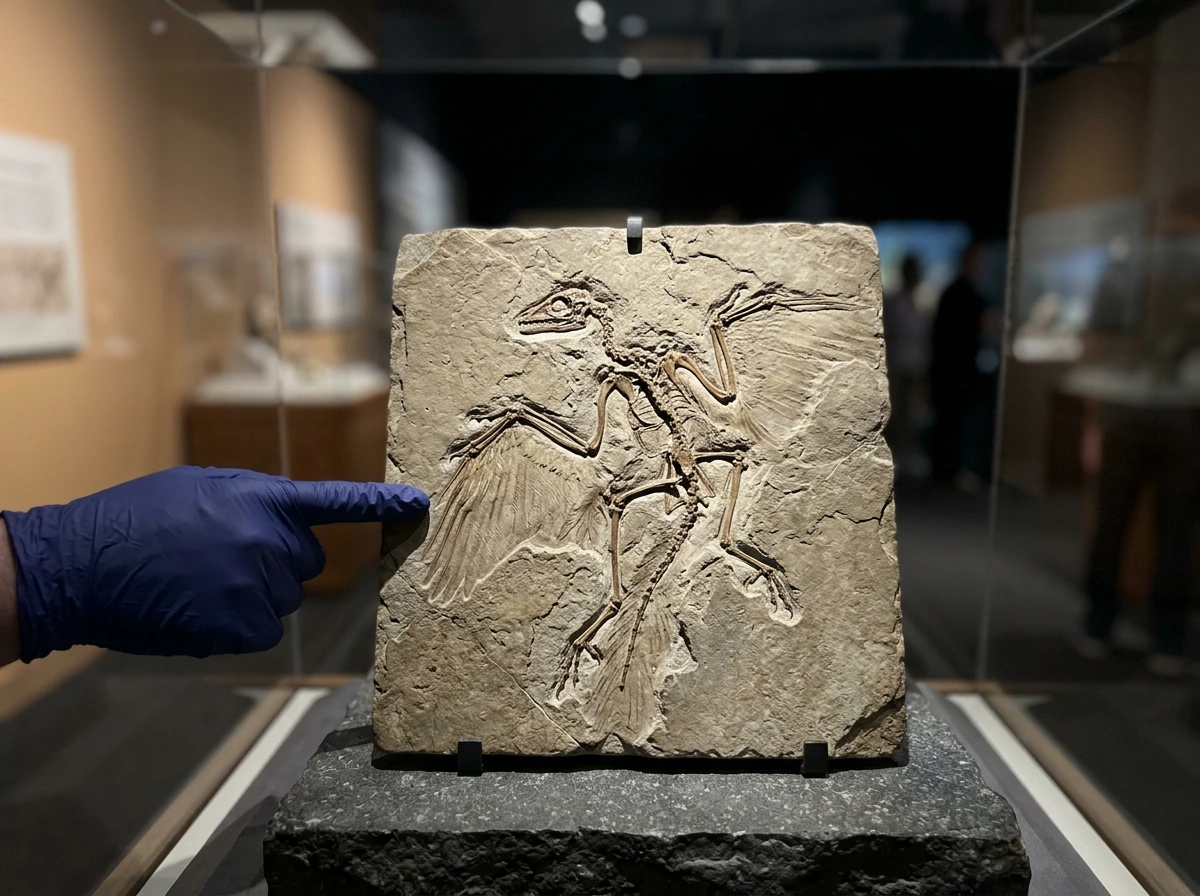
Fossils don't come with color photographs, but paleontologists are remarkably good at reading the details they do preserve. The key sources of visual information for early birds are skeletal structure, feather impressions in fine-grained limestone, and increasingly, UV light and CT scanning, which reveal soft-tissue traces that are invisible under normal light.
Feather impressions are especially valuable. When a well-preserved Archaeopteryx specimen is examined, you can see the actual outlines of individual feathers along the wings, tail, and even parts of the body and legs. One study published in Nature described a specimen with extensive feather preservation not just on the wings and tail, but also covering the body and hindlimbs, which means reconstructions showing a heavily feathered, almost fluffy body are grounded in real evidence rather than artistic guesswork.
Skeletal traits matter just as much. The shape of wing bones, the length of tail vertebrae, the presence or absence of a wishbone (furcula), and the structure of the feet all feed into a reconstruction. A 2018 study in Nature Communications actually used the geometry of wing bones from multiple Archaeopteryx specimens to infer that these animals were capable of active wing flapping, not just gliding. That kind of biomechanical inference shapes how artists and scientists imagine the posture and proportions of these animals in motion.
The best candidates for the earliest known bird
Archaeopteryx is still the most widely recognized answer. It lived roughly 150 million years ago during the Late Jurassic and has been confirmed as the "earliest known bird" multiple times, including after a reanalysis that temporarily suggested other contenders might take the title. The Field Museum in Chicago describes its key traits as feathers, hollow bones, clawed wings, approximately 50 tiny teeth, and a long bony tail. That combination is your visual shorthand for what "first bird" means.
That said, a few other species are worth knowing about because they come up in books, museums, and online sources. Aurornis xui, described in a 2013 Nature study, was proposed as an even earlier member of the avian family tree, pushing the lineage back further than Archaeopteryx. Anchiornis is another feathered dinosaur that sits very close to the bird branch. Jeholornis, at around 120 million years old, is one of the oldest birds with solid fossil evidence and had an unusual long tail with what appears to be a second feather frond. And Confuciusornis, roughly crow-sized and from the same broad time window, retained three free fingers on its hand, showing that early birds kept dinosaur-like hand anatomy long after they developed flight feathers.
None of these replace Archaeopteryx as the go-to reference, but if you see a different name cited somewhere as the "first bird," one of these is probably what's being discussed. The underlying visual picture across all of them is similar: small, feathered, with a mix of bird-like and clearly dinosaur-like features.
What the earliest birds actually looked like
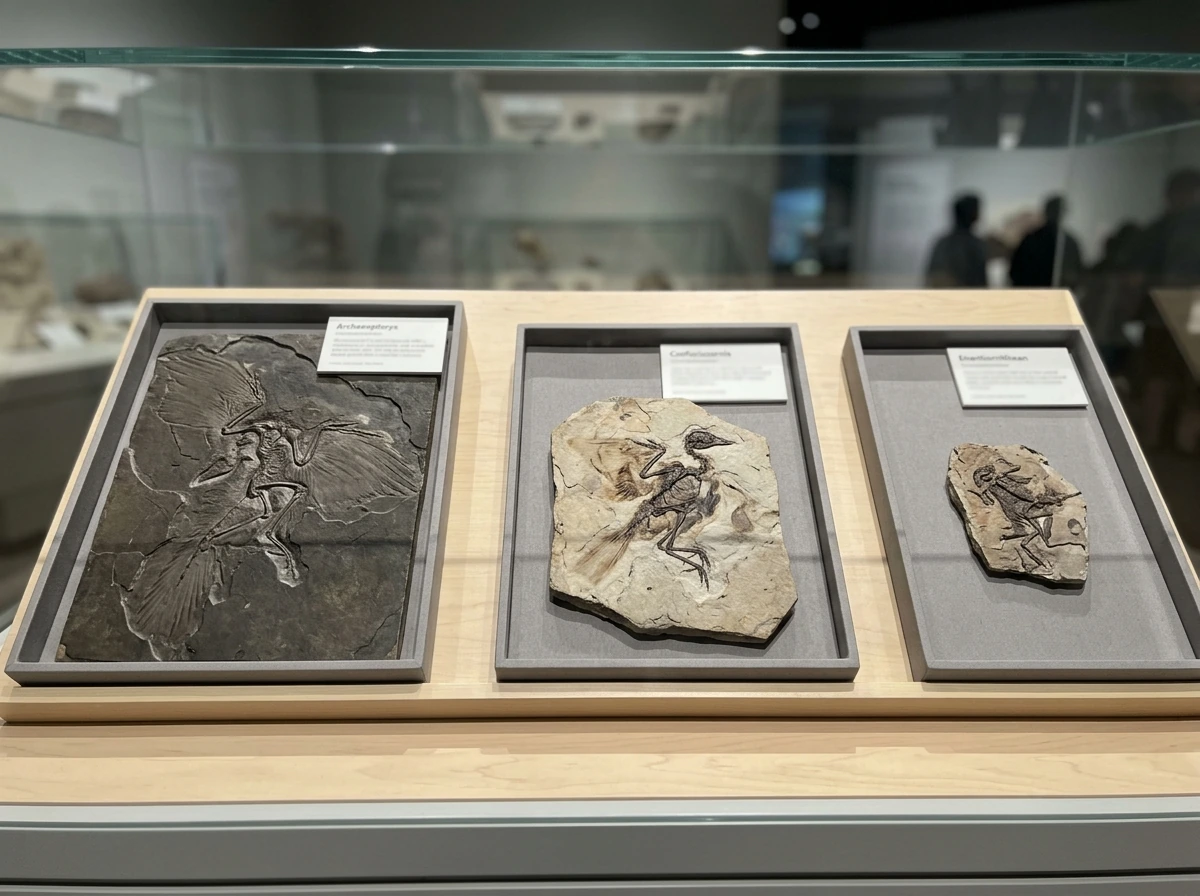
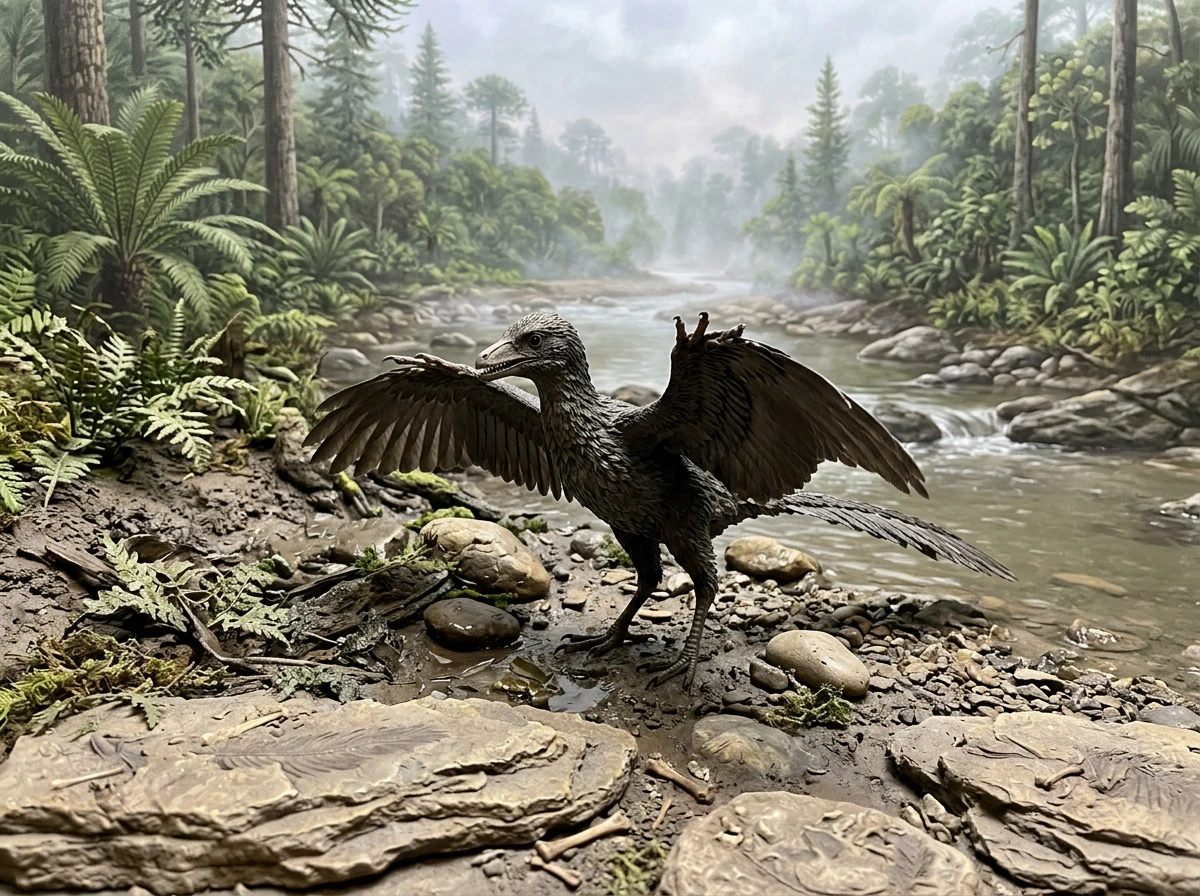
Think of a bird roughly the size of <a data-article-id="104FDA67-04A6-4D9F-A89B-D9E54EA4E0F2">a raven or a large crow</a>. Body mass estimates from different Archaeopteryx specimens range from about 158 grams on the lighter end up to around 456 grams for the largest, so somewhere in the size range of a pigeon to a small chicken, depending on the individual. The body shape was more elongated and less compact than a modern bird, with a longer neck, a relatively flat chest compared to today's deep-keeled flying birds, and limbs that sat differently because of the animal's partially terrestrial posture.
The wings were broad and feathered, with long pennaceous feathers arranged along the arm and hand. Crucially, you'd also see three small clawed fingers projecting from the leading edge of each wing, which is one of the most striking visual differences from any modern bird. The tail was long and bony, extending well behind the body like a lizard's tail, and it was fringed along both sides with rows of feathers. Some research suggests at least 35 pairs of tail feathers fanned out from that bony core, creating a feathered frond rather than the short fan of feathers you see on modern birds.
The head was small and lightly built, with a jaw that looked more like a snout than a beak. Inside that jaw were around 50 small, pointed teeth, another obviously dinosaur-like trait. There was no true bill. The eyes were large relative to the head, as you'd expect from an animal that was likely at least partly active in lower light conditions. Overall, the silhouette was longer and more stretched than a modern bird, with the tail accounting for a significant portion of the total body length.
As for feather coloring, we genuinely don't know for certain. Some studies of fossil melanosomes in other feathered dinosaurs have suggested dark, iridescent coloring in some species, but direct color evidence for Archaeopteryx specifically is not firmly established. Most scientific reconstructions use dark plumage, often blackish or dark brown, but treat that as an educated inference rather than a confirmed fact.
Key features to look for when comparing reconstructions
If you're looking at multiple reconstructions of Archaeopteryx or other early birds and wondering which ones are most accurate, here's a practical checklist of the features that should match the fossil evidence.
| Feature | What the fossils show | Red flag in a reconstruction |
|---|---|---|
| Tail | Long, bony, with feathers fringing both sides | A short pygostyle fan like a modern bird |
| Wings/hands | Broad feathered wings with three clawed fingers visible at the leading edge | Clean modern wing with no visible claws |
| Jaws/head | Small-toothed snout, no beak | A beak or bill of any kind |
| Body feathers | Feathers covering body and upper legs, not just wings and tail | A scaly or bare-skinned body |
| Size | Roughly pigeon to small-chicken sized | Sparrow-tiny or eagle-large |
| Wishbone | Present (furcula well-preserved in some specimens) | Often omitted but should be there internally |
| Flight posture | Active flapper, not just a glider | A purely gliding posture with fixed wings |
The tail is honestly the quickest way to tell a well-researched reconstruction from a lazy one. If the image shows Archaeopteryx with a short, modern-style fan tail, that's not accurate. The long bony tail fringed with rows of feathers is one of the most defining visual traits of the earliest birds, and it should be obvious in any good reconstruction.
Why different sources describe it differently
If you've read three different books or websites and gotten three slightly different descriptions, that's completely normal and not a sign that anyone is wrong. There are a few reasons for the variation.
First, there are multiple Archaeopteryx specimens, and they differ in preservation quality and completeness. Some show detailed feather traces, others preserve mostly bones, and a few are so fragmentary that key body parts have to be inferred. One Guardian report on a newly described specimen noted that its skull was found dislocated and rotated, giving it a completely different appearance from the famous "death pose" seen in older specimens. That famous pose, with the head thrown back and tail curved, turns out to reflect how the body settled after death rather than how the animal actually looked alive did t rex look like a bird, which means early artistic reconstructions based on that pose needed to be revised.
Second, the definition of "first bird" keeps shifting slightly as new fossils are found. When Aurornis xui was described in 2013, headlines briefly declared it the new first bird. Then further analysis reaffirmed Archaeopteryx's position. These debates don't mean scientists are confused; they mean the field is actively working with incomplete data and refining its understanding. Each new fossil adds a piece to the picture.
Third, artists and reconstructors make different interpretive choices about things like skin color, exact feather density, and posture, because the fossils don't specify these directly. Two reconstructions can both be faithful to the fossil evidence and still look noticeably different from each other. That's not a flaw in either one; it's an honest reflection of the limits of what stone can preserve.
Where to find reliable visual comparisons
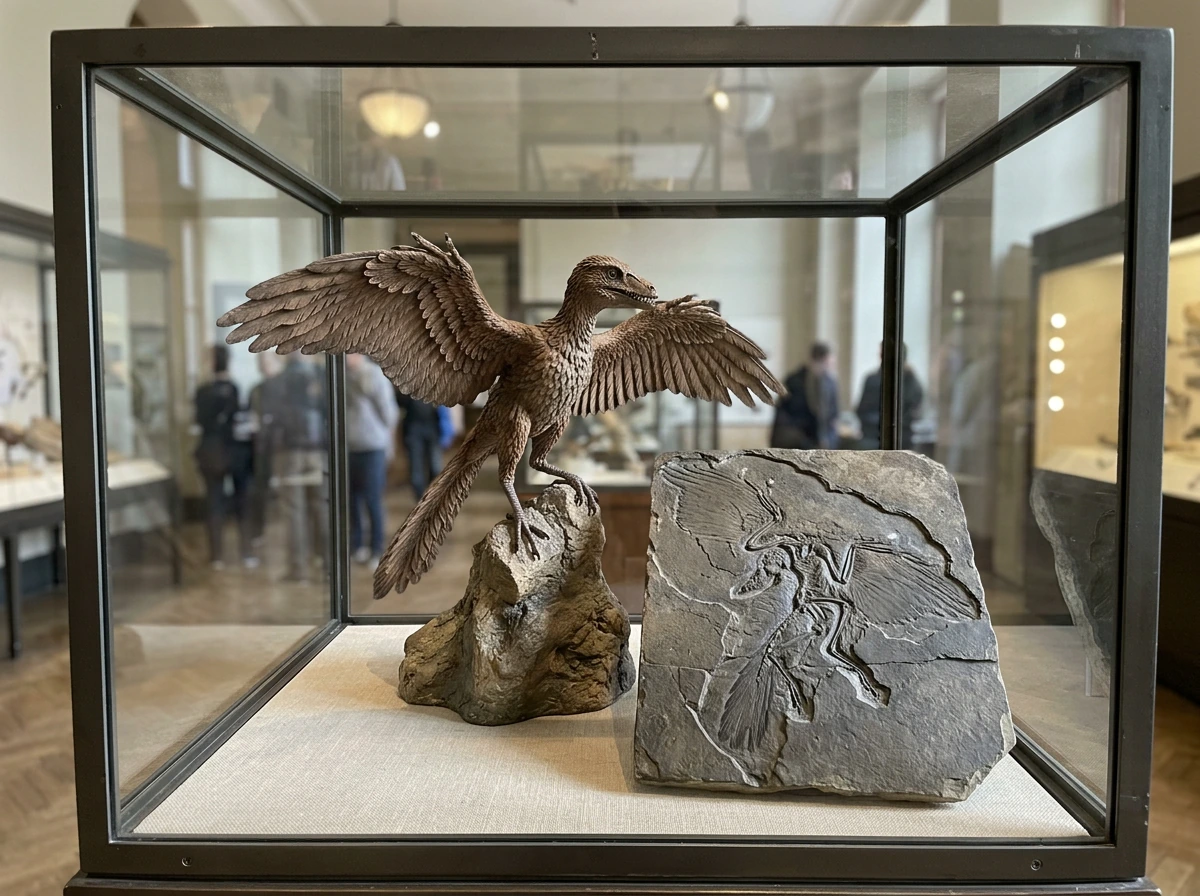
The best place to start is with museum sources rather than general image searches. The Natural History Museum in London, the Field Museum in Chicago, and the Smithsonian all have detailed pages on Archaeopteryx with descriptions tied directly to fossil evidence. These institutions update their content as new research comes in, so what you read there is much more likely to reflect current understanding than a textbook from ten or fifteen years ago.
When you look at a reconstruction image, cross-check it against the checklist above. Does it show a long bony tail with side feathers? Clawed fingers on the wings? A toothed snout instead of a beak? Feathers on the body and legs, not just the wings? If yes to all of those, you're looking at something grounded in the evidence. If the image looks basically like a modern bird with slightly odd wings, it's probably outdated or oversimplified.
For a broader perspective, it's also worth looking at reconstructions of related early birds like Confuciusornis or Jeholornis alongside Archaeopteryx. Seeing them side by side makes it much easier to understand which features were unique to the very earliest birds and which ones were retained further into avian evolution. If you're already curious about how modern birds connect back to these ancient relatives, it's worth exploring how birds that look like dinosaurs today, such as cassowaries and herons, echo some of these ancient body plans in surprising ways.
Your mental picture, locked in
Here's the simple version you can hold onto: imagine a dark, crow-to-pigeon-sized animal with broad feathered wings, but with three small clawed fingers sticking out at the bend of each wing. { a raven bird look like (or a raven-like silhouette) for comparison. This is also why people often ask what bird looks like a dinosaur. If you’re specifically trying to picture a dove bird, the overall look is very different from these earliest bird reconstructions what does a dove bird look like. Behind it trails a long lizard-like tail, fringed on each side with rows of feathers rather than ending in a fan. Some people wonder what bird looks like a pterodactyl, but the “first bird” style silhouette is more like a feathered, long-tailed dinosaur than a flying reptile. Its face is small and snouty, with tiny teeth instead of a beak. Its body and upper legs are covered in feathers, not scales. It flaps actively rather than just gliding, and it moves in a way that sits somewhere between a ground-running dinosaur and a modern bird in flight.
That picture won't be identical to every reconstruction you encounter, but it's built from what the best-preserved fossils actually show. Use it as your baseline, compare it against any image you come across, and you'll have a much easier time judging whether what you're looking at is grounded in evidence or just someone's artistic interpretation.
FAQ
If I want the most accurate image of what the first bird looked like, which parts should I trust most and least?
For a “what it looked like alive” answer, focus on traits that fossils preserve well: feather outline patterns, the long bony tail with side rows of feathers, and the three clawed fingers at the wing bend. Details like overall posture, skin covering, and exact feather fluff level are more interpretive and can vary between reconstructions even when the core anatomy is correct.
Does “first bird” mean the oldest bird in fossils, or the earliest one that could fly?
It depends on which “first” you mean. If you mean the earliest animal that is classified as a bird, the answer is often Archaeopteryx. If you mean the earliest animal that could actually fly in a bird-like way, some earlier relatives may come up, but the definition relies on how much active flight they likely had, which is harder to prove than having feathers.
Why do some Archaeopteryx images look wrong, like they’re posed strangely?
The classic Archaeopteryx “death pose” can mislead your expectations. A good rule is to ignore dramatic head-tucked or tail-curled positions from older museum displays and instead judge the silhouette by the structural cues (tail length and feather fringes, snout-and-teeth jaw shape, and wing-finger claws).
What visual mistakes should I watch for when comparing different reconstructions?
You can get misled by reconstructions that copy modern bird anatomy, especially the tail. If you see a short tail that ends in a rounded fan like a pigeon or songbird, that usually signals an outdated model. The long bony tail extending well behind the body with feather rows along the sides is one of the easiest red flags.
Did Archaeopteryx have black feathers, brown feathers, or something else? Can we know the color for sure?
Color is the biggest uncertainty. Even when reconstructions use dark plumage as a best guess, you should treat it as inference unless the evidence is directly tied to pigment traces in the specific specimen. Many “brown versus black” debates reflect different assumptions rather than confirmed measurements for that animal.
Why do different sources give different sizes for Archaeopteryx (or other early birds)?
Yes, estimates of size and mass can shift because specimens differ in completeness and preservation, and measurements depend on which bones researchers include. Instead of trusting a single “official weight,” compare whether the reconstruction falls in the crow-to-pigeon range described from multiple specimens, and check whether the tail length and body proportions still match the fossil geometry.
How can I tell quickly whether a reconstruction gets the head and mouth right?
If an image shows Archaeopteryx with a beak, it is likely oversimplified. Archaeopteryx had a toothed jaw that reads as snout-like, with teeth rather than a true bill. The “no beak, lots of tiny teeth” feature is a strong checkpoint for whether the reconstruction is grounded.
Do early birds like Archaeopteryx have feathers only on wings and tail, or also on the body and legs?
When reconstructions show feathers on only the wings and tail, they may be incomplete. Well-preserved specimens can show feather traces on body and hindlimbs too, so a more complete feathered silhouette (including upper legs) is usually closer to the best evidence.
How do the look and features of Archaeopteryx compare with other early bird candidates like Aurornis, Anchiornis, or Confuciusornis?
If you want to compare the “first bird” with close alternatives, look for consistency in a few signature traits (toothed snout, feathered wings with clawed fingers at the wing leading edge, and an extended bony tail). Differences among species are often about how long the tail feathers were, how bird-like the body proportions look, and how much of the lineage retains dinosaur-like hand anatomy.
Next Article
What Did the Dodo Bird Look Like? Bird and Egg Details
Dodo bird looks and egg details: bulky ground bird, hooked beak, bare head, tiny wings; no living photos, reconstruction