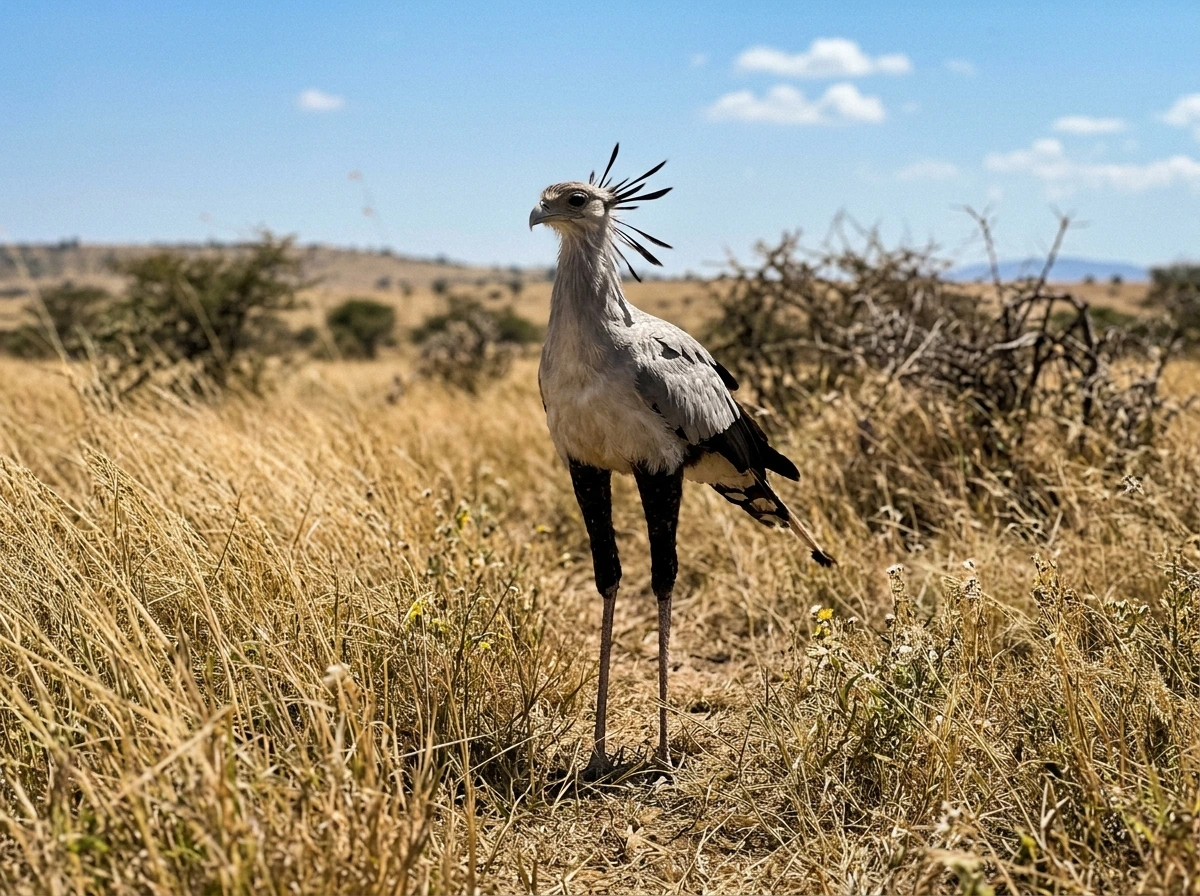
Yes, T. rex did look somewhat like a bird, but probably not in the way most people picture. It wasn't covered in bright plumage like a parrot or sleek feathers like a hawk. The honest answer is that T. rex shared a real evolutionary family tree with modern birds, and you can spot genuine visual similarities if you know where to look. But there are also some glaring differences that would have made it look nothing like the birds you'd see at a feeder or in the sky. Let's break down exactly what those similarities and differences look like, and what the current science actually tells us.
Did T. rex Look Like a Bird? Similarities vs Differences

Marcus Whitley
22 Mar 2026
How bird-like did T. rex actually look?
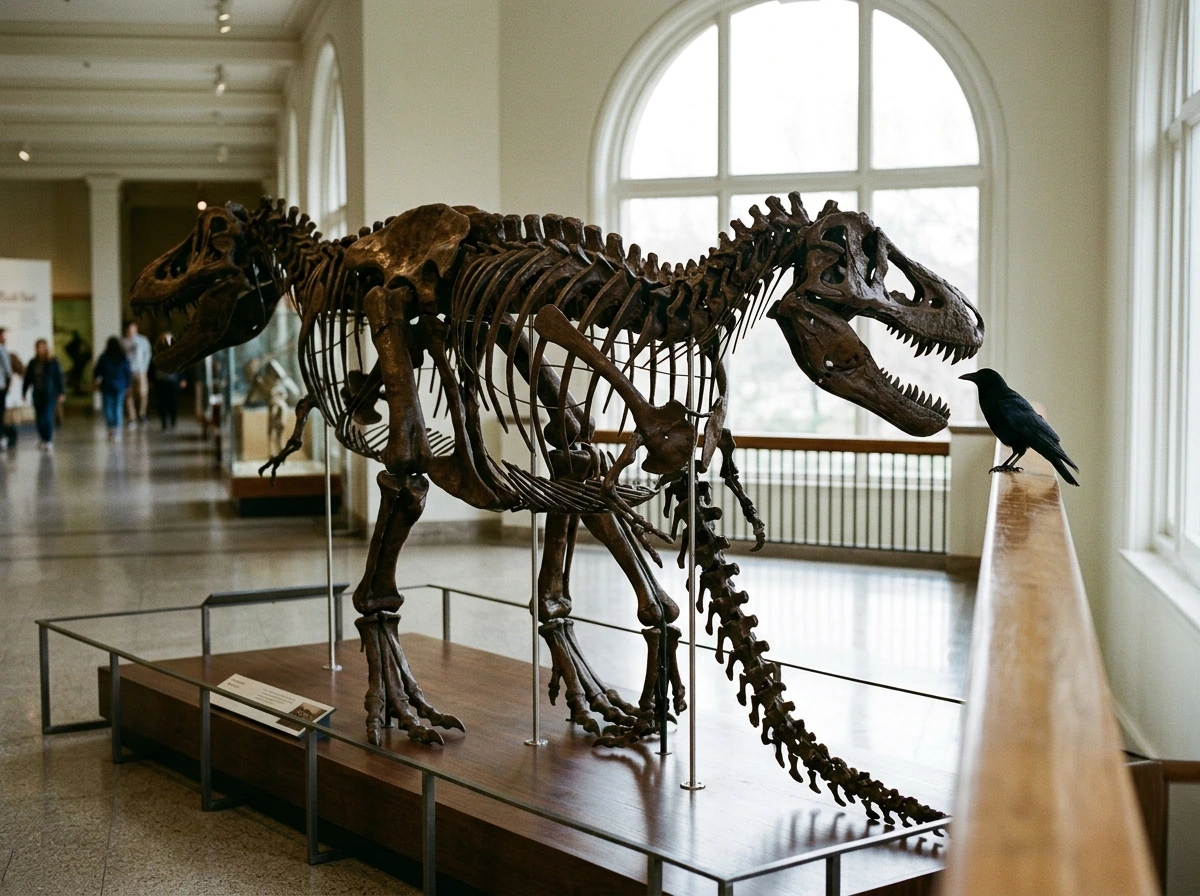
The short answer: somewhat bird-like in structure, probably not much in surface appearance. If you are also wondering what a dove bird looks like, compare the body shape, beak style, and overall plumage you see in real doves to what fossils suggest about T. To compare that kind of silhouette and appearance from a real bird you can picture in your head, also see what does a raven bird look like. rex what does a dove bird look like. T. rex was a theropod dinosaur, which is the same broad group that gave rise to all modern birds. If you look at a T. rex skeleton next to a bird skeleton, you'd notice surprisingly similar hip structures, a similar upright two-legged stance, and foot bones arranged in ways you'd recognize in a large bird like an ostrich or emu. But in terms of what you'd actually see on the outside, the picture is murkier. Based on current fossil evidence, T. rex most likely had scaly, reptilian-looking skin on much of its body, not a coat of feathers. It would have looked more like a scaled-up version of a very large, two-legged reptile than a giant feathered bird, with some bird-like features mixed in if you looked closely.
Why birds and T. rex are related (and what that looks like visually)
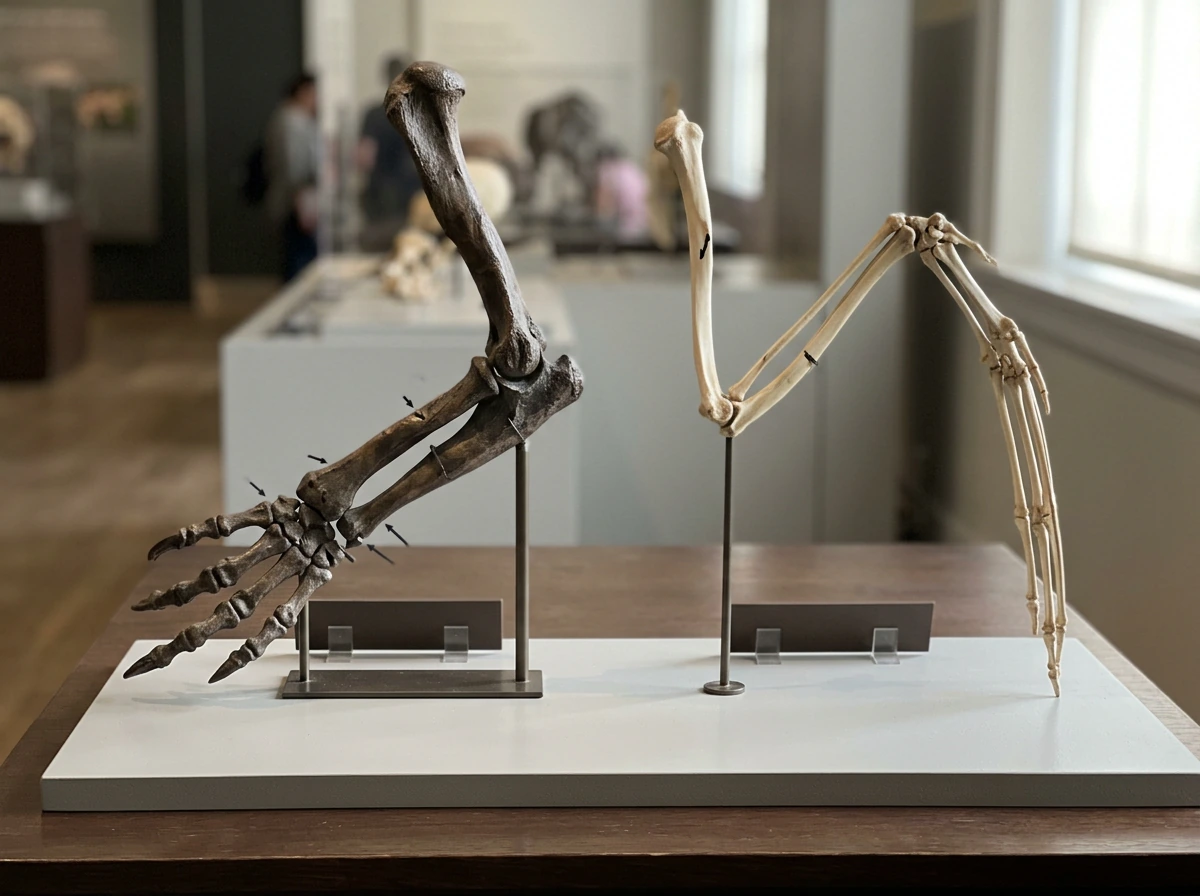
Birds are, technically, living theropod dinosaurs. This isn't a loose metaphor. The evolutionary lineage from theropods to birds is one of the best-documented transitions in paleontology. Theropods like T. rex walked on two legs, had hollow bones, three-toed feet, and wishbones (fused clavicles), which are all features you can see in modern birds today. If you've ever looked at the scaly legs of a chicken, a heron, or any large bird up close, you're actually looking at a texture that's very similar to what paleontologists think covered much of T. rex's body.
One of the most useful visual comparisons you can make is to look at the legs of a large ground bird like an ostrich or a cassowary. The scaled, leathery texture, the three powerful forward-facing toes, the thick tendons visible under the skin: that's a direct visual echo of the theropod body plan. T. rex sat much further back on the evolutionary tree than these birds, but the structural blueprint is clearly shared. Think of it like recognizing a family resemblance across generations.
Feathers on T. rex: what's likely and what's still uncertain
This is the question everyone wants answered, and the honest answer is: probably not many, if any at all. A landmark 2017 study published in Biology Letters (Bell et al.) examined fossil skin impressions from T. rex and several close relatives, including Albertosaurus, Daspletosaurus, Gorgosaurus, and Tarbosaurus. What they found was scaly, reptilian-looking skin, not feathers or feather-like filaments. This directly challenged the popular image of a fully feathered T. rex and suggested that large-bodied tyrannosaurids likely had scaly skin covering much of their bodies.
It's worth noting what the evidence does and doesn't tell us. Soft tissues like feathers rarely preserve as fossils, so we can't be 100% certain that T. rex had zero feathery structures anywhere on its body. Some earlier, smaller tyrannosauroids (more distant relatives of T. rex) did have evidence of filamentous, proto-feather-like coverings. So it's possible that T. rex retained some feathery patches in places where we haven't yet found skin impressions, such as the top of the head, the back, or along the tail. But based on what we actually have in the fossil record, the working picture is a mostly scaly animal, not a feathered one. National Geographic and BBC Science Focus both reflect this position: no direct fossil evidence of feathers on T. rex, and the large body size likely made a full feather coat unnecessary or even a disadvantage for heat regulation.
If you're used to spotting birds by their feather patterns, this is a key reality check: If you're used to spotting birds by their feather patterns, this is a key reality check: you couldn't have identified T. rex by plumage the way you'd pick out a red-tailed hawk or a dodo. The integument (the outer covering) was almost certainly more crocodilian than avian for most of the body.. The integument (the outer covering) was almost certainly more crocodilian than avian for most of the body. what bird looks like a pterodactyl
Head, jaws, and teeth: where bird and T. rex really part ways
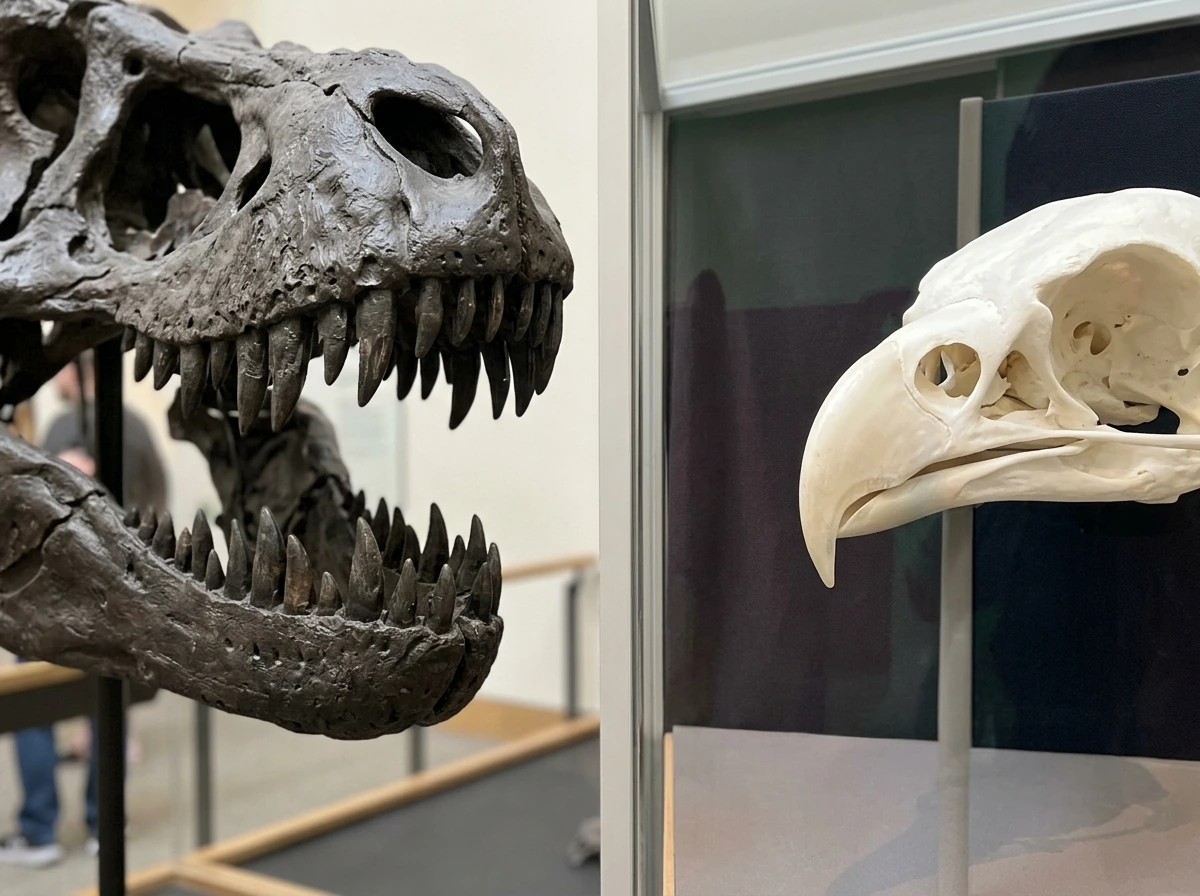
This is where the bird resemblance breaks down most dramatically. Modern birds have beaks, no teeth, and relatively lightweight skulls. T. rex had none of that. Its skull was massive, roughly 5 feet long in adult animals, and filled with banana-shaped, serrated teeth designed for crushing bone. The jaw muscles alone were enormously powerful, nothing like the lightweight bill you'd see on even the largest living bird.
That said, there are some structural echoes if you look at the overall skull shape. T. rex had large eye sockets positioned forward on the skull, giving it some degree of binocular vision, which is a trait you associate strongly with predatory birds like owls and hawks. The American Museum of Natural History (AMNH) has compared the skin texture around a T. rex's head to the skin of crocodilian heads, rough and scaly, not feathered or smooth. So if you looked at the T. rex head, you'd likely think "scaled reptile" before you thought "bird," even though the eye placement might remind you of a raptor.
Body build and posture: where the bird resemblance actually shows up
Here's where the comparison gets genuinely interesting. T. rex held its body horizontally, with its spine roughly parallel to the ground and its heavy tail extending straight back as a counterbalance. This is actually quite different from how we used to picture dinosaurs in old movies, where T. rex stood nearly upright like a kangaroo with its tail dragging. Modern reconstructions show the horizontal posture clearly, and if you look at a large flightless bird like a cassowary or an emu walking, you'll see that same forward-leaning, horizontal body axis. The posture is strikingly similar.
The arms, on the other hand, are one of T. rex's most distinctly non-bird-like features visually. Birds have wings, which evolved from the forelimbs of their theropod ancestors. T. rex had tiny, two-fingered forelimbs that were almost comically small relative to its body. They weren't wings, they weren't much of anything you'd recognize from birds today. So while the overall body posture echoes what you'd see in large ground birds, the arm situation is uniquely T. rex.
Feet, claws, and how T. rex moved
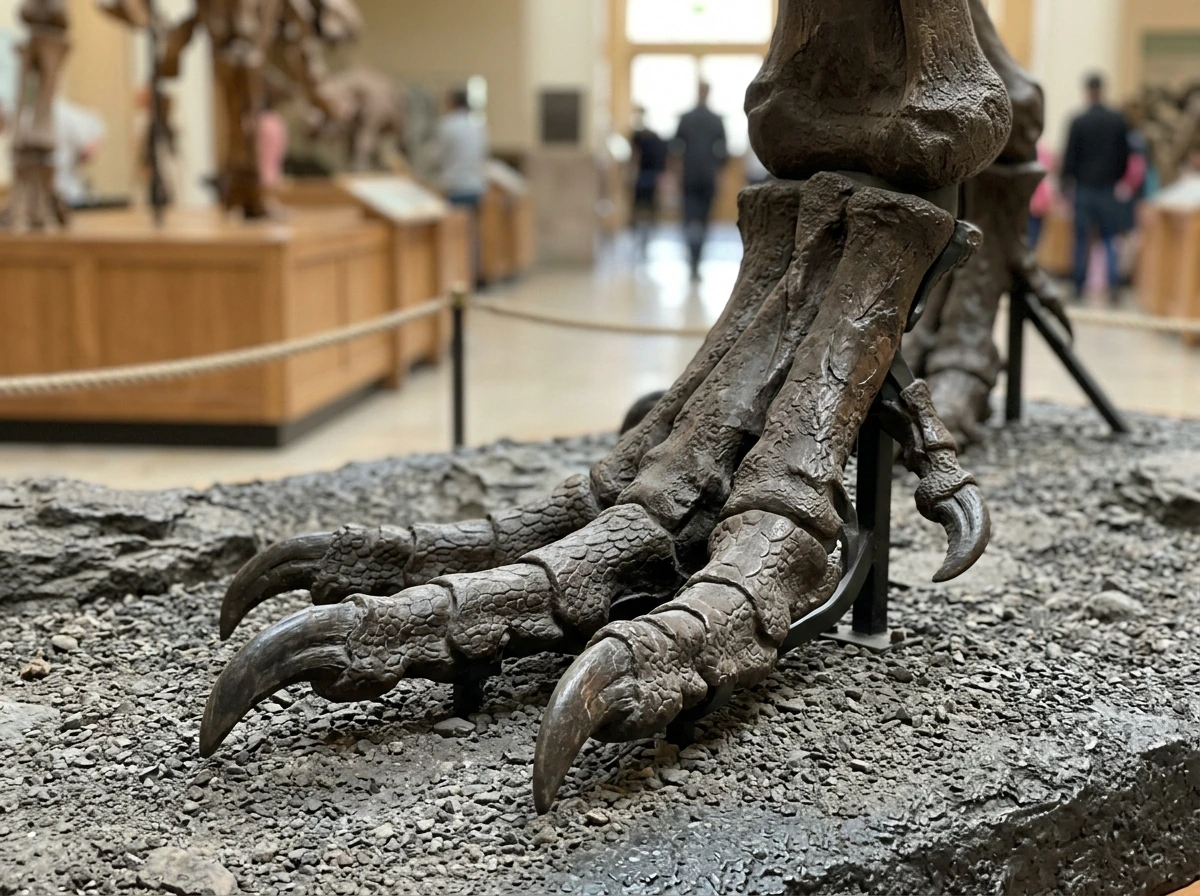
This is actually one of the strongest visual connections to birds. T. rex had three large, forward-facing toes on each foot, each ending in a robust curved claw, plus a small vestigial toe (the dewclaw equivalent) set higher up on the leg. If you've ever watched a large bird of prey grip a branch or a large ground bird like an ostrich walk, you've seen a very similar arrangement. Three main toes forward, powerful claws, a digitigrade stance meaning T. rex walked on its toes rather than flat-footed, just like birds do.
The AMNH has specifically drawn comparisons between T. The American Museum of Natural History presents T. rex reconstructions based on fossil bones and emphasizes close-up fossil-skin context in its exhibit materials The AMNH has specifically drawn comparisons between T. rex foot and leg skin impressions and the scaly legs of modern birds. rex foot and leg skin impressions and the scaly legs of modern birds, and it's a genuinely useful visual comparison. The overall foot structure is one of the places where a bird watcher might look at a T. rex reconstruction and say, 'I recognize that.' Movement-wise, T. rex was almost certainly a walker rather than a sprinter despite its size, and its gait would have had that rocking, purposeful stride you see in large ground birds. Think less "charging predator from a movie" and more "very large, determined cassowary."
Bird-like vs not: a quick comparison
| Feature | T. rex | Modern Birds | Similarity Level |
|---|---|---|---|
| Skin/covering | Scaly (fossil evidence), possibly limited feathery patches | Feathered (most species) | Low |
| Posture | Horizontal, bipedal, tail as counterbalance | Horizontal to upright, bipedal | High |
| Feet | Three forward toes, curved claws, digitigrade | Three or four toes, claws, digitigrade | High |
| Skull/jaw | Massive, toothy, heavy | Lightweight, toothless beak | Very low |
| Eye placement | Forward-facing, large orbits | Forward-facing (predators) or side-facing | Moderate |
| Forelimbs | Tiny, two-fingered, non-functional wings | Wings (functional or vestigial) | Low |
| Bone structure | Hollow bones, wishbone present | Hollow bones, wishbone present | High |
| Hip structure | Open acetabulum (bird-hipped type) | Similar open hip socket | High |
How to read a dinosaur reconstruction (and spot the choices artists make)
Dinosaur reconstructions, whether in museums, documentaries, or artwork, involve a lot of interpretation. Bones tell us about structure and size, but skin color, texture, and feathering are educated guesses. When you're looking at any T. rex image, here's how to evaluate how scientifically grounded it is:
- Check the posture: is the body held horizontally with the tail up? That's the modern, evidence-based reconstruction. A kangaroo-like upright stance is outdated.
- Look at the skin texture: scaly skin on the body is more consistent with the 2017 fossil evidence. A fully feathered T. rex is speculative and goes beyond what fossils currently support.
- Look at the feet: three forward toes with robust curved claws is accurate. Anything drastically different is a creative choice.
- Check the arms: tiny, two-fingered forelimbs are correct for T. rex specifically. Don't confuse it with feathered raptors like Velociraptor, which had very different arm and hand anatomy.
- Look at the head: large skull, forward-facing eyes, and no beak or feathers on the snout are all consistent with current evidence. A fully feathered face is speculative.
- Notice if the artist distinguishes between T. rex and smaller theropods: some closely related but smaller dinosaurs (like Dilong paradoxus) have actual feather evidence. T. rex is a different, much larger animal.
Common misconceptions worth clearing up
One of the most common mistakes is assuming that because birds evolved from theropods, all theropod dinosaurs looked like birds. That's like saying because humans and chimpanzees share a common ancestor, they look identical. T. rex was on a different branch of the theropod family tree than the ancestors of birds, and it had been evolving independently for millions of years. The bird lineage comes from much smaller theropods, not from giant tyrannosaurids.
Another common assumption is that because some theropods had feathers, T. rex definitely had them too. The fossil record is more specific than that. Smaller early tyrannosauroids do show filamentous coverings, but T. rex itself, and its large relatives, show scaly skin impressions in the fossil record. Scaling up to a massive body likely changed the heat regulation equation entirely, making a full feather coat unnecessary or even harmful.
Visual comparisons to try right now
If you want to really internalize what the T. rex-bird connection looks like, here are some direct visual comparisons worth seeking out. Look up a cassowary walking: the horizontal body posture, the scaled legs, the powerful three-toed feet, and the forward stride are all genuinely T. rex-like. Look at a close-up photo of a large bird of prey's feet and legs. That scaled, leathery texture and three-clawed grip is your best real-world visual anchor for what a T. rex foot probably looked like. If you're curious about which living birds look most like dinosaurs, there's a good comparison to explore around birds like herons, cassowaries, and secretary birds that carry obvious theropod echoes in their build and posture. exploring what the very first birds looked like is a great next step, since those early birds (like Archaeopteryx) are where the visible transition from theropod to bird really starts to show up.
The bottom line is that T. rex was a real relative of modern birds, and you can see genuine family resemblances in posture, foot structure, and skeletal anatomy. But it was not a big feathered bird. It was a scaled, massive predator that happened to share a common ancestor with the birds you watch today. Knowing which features to look for makes the comparison genuinely rewarding, whether you're looking at a museum reconstruction, a nature documentary, or a photo of an ostrich.
FAQ
If T. rex is related to birds, why do reconstructions sometimes show feathers on it?
Most feather-inclusive T. rex images are speculative, because the strongest direct evidence for T. rex skin impressions points to scales. Some earlier, smaller tyrannosauroid relatives had filamentous coverings, so artists sometimes extrapolate that idea up to T. rex, but fossil skin data for large tyrannosaurids does not confirm a full feather coat.
Could T. rex have had feathers in certain body areas even if most of it was scaly?
Yes. The lack of preserved feathers does not automatically mean “zero feathery structures everywhere,” it means we have no direct fossil impressions showing them. A cautious model is that any feathery or proto-feather patches, if they existed, were localized (for example, certain head or tail regions), while the majority of the body remained scaly.
What would a “bird-like” T. rex appearance actually come from, posture or anatomy?
Primarily anatomy and proportions. The bird resemblance shows up in things like the upright-to-horizontal body axis used in modern reconstructions, three-toed forward-facing feet, and digitigrade walking, rather than in feather pattern or a bird-style head covering.
Could you identify T. rex from fossil remains as a bird, or are the differences too strong?
You would not reliably identify it as a bird based on appearance alone. The skull and dentition are a major giveaway, T. rex had a massive cranium and serrated teeth for crushing bone, whereas birds have beaks and toothless jaws. The shared traits are mostly skeletal and evolutionary, not surface look-alike.
Do large flightless birds (like emus) give the best visual comparison for how T. rex looked?
They’re helpful for posture and leg/foot cues, but they are not perfect stand-ins. Use them mainly as a reference for the horizontal stance and the three-forward-toe, clawed foot plan. For head and body covering, real birds can mislead because living birds have feathers and bird-type skulls.
Were T. rex arms basically unusable, and does that affect the “bird” comparison?
T. rex forelimbs were tiny compared with its body and were not functional like wings. That is one of the clearest non-bird traits visually. Even if some bird-like behavior existed, the anatomy does not support “wing-like” motion.
Does the “bird-like” description change depending on which Tyrannosaur you compare to?
Yes. Feather evidence and skin impressions appear to differ among related tyrannosaurs, smaller early relatives show more filamentous hints, while large tyrannosaurids like T. rex have skin impression evidence leaning toward scales. So the more “T. rex-specific” comparison you want, the more you should treat it as mostly scaly in reconstructions.
How should I judge whether a T. rex picture is scientifically grounded?
Check whether the image claims a specific fossil basis for skin and coverings. If it shows a full feather coat with no mention of skin-impression evidence for tyrannosaurids, treat it as artistic extrapolation. A more evidence-aligned reconstruction usually emphasizes scaly integument with bird-like skeletal and posture similarities.
Next Article
What Bird Looks Like a Dinosaur How to Identify It Fast
Spot dinosaur-like birds fast with visual traits, habitat clues, and look-alike comparisons plus an easy ID checklist.