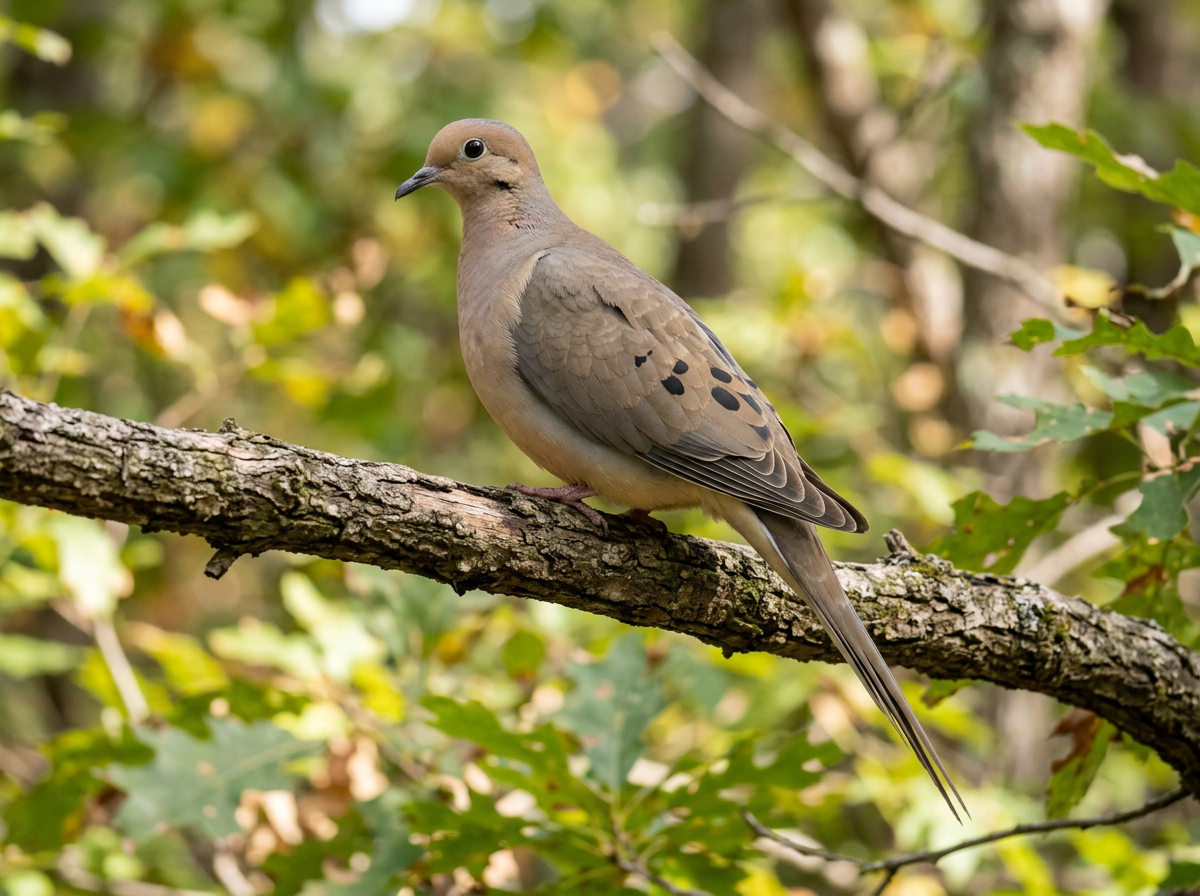
A dove is one of those birds most people have seen hundreds of times without really looking closely. If you spotted a medium-sized, soft brownish-gray bird with a small head, a long pointed tail, and a gentle perched posture, there's a very good chance you were looking at a [Mourning Dove](/red-and-distinctive-birds/what-bird-looks-like-a-dinosaur). That's the bird most people in North America mean when they say 'dove,' and it's a great starting point for pinning down exactly what you saw, especially if you’re also asking what does a raven bird look like or [what does a raptor bird look like](/red-and-distinctive-birds/what-does-a-raptor-bird-look-like). did t rex look like a bird
What Does a Dove Bird Look Like? Key Traits and Lookalikes

Marcus Whitley
22 Mar 2026
Quick field-check: what 'dove' usually means
The word 'dove' covers a surprisingly wide group of birds, and technically, doves and pigeons belong to the same family. The bird you almost certainly mean, especially in the U.S. or Canada, is the Mourning Dove (Zenaida macroura). It's one of the most widespread and abundant birds on the continent, showing up in backyards, parks, farm fields, and roadsides throughout the year. When people ask what a dove looks like, this is the bird that comes to mind first, and it's a fair default to start with.
That said, a couple of other species share the 'dove' label in everyday conversation. The Eurasian Collared-Dove has spread across most of North America over the past few decades and is now a very common backyard bird. The White-winged Dove is common in the southern U.S. and Mexico. And of course, the chunky feral pigeon people see in cities is actually a Rock Pigeon, a close relative that gets lumped in with 'doves' in casual talk. Knowing which one you're dealing with usually comes down to a few key visual details.
Key dove appearance traits: size, shape, and color
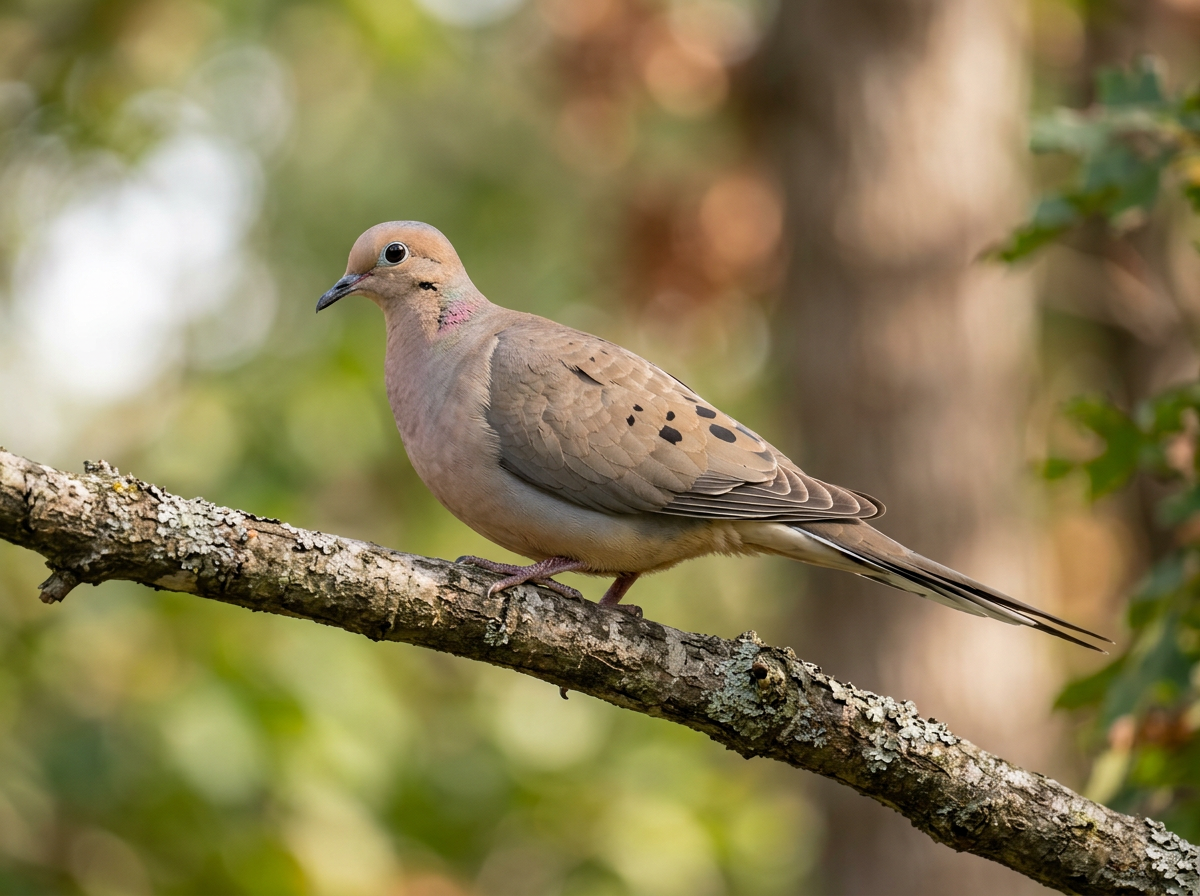
The Mourning Dove has a very recognizable silhouette once you know what to look for. It's a slender, plump-bodied bird that measures roughly 9 to 13 inches long (about 23 to 33 cm), with a wingspan around 17 inches (43 cm) and a weight of 3 to 6 ounces (85 to 170 g). Think of it as slightly larger than a robin but noticeably more streamlined, almost torpedo-shaped. The body looks plump through the chest, but the long, tapered tail stretches out behind and makes the whole bird feel elongated and graceful.
The overall color is a warm grayish-brown, sometimes described as fawn or sandy tan, with a soft peachy-pink wash on the underside. There's nothing flashy about it at first glance. The tone is muted and gentle, which actually makes it harder to spot when it's sitting quietly on the ground or a low branch. When you see one, your first instinct is often 'plain brownish bird,' but once you look closer, the details get more interesting.
Plumage and pattern details to match
Look at the folded wings when the bird is perched. You'll notice a scattering of large, distinct black spots on the wing coverts, those feathers that cover the base of the wing. They're not tiny specks; they're bold, clear dots that stand out against the brown background. This is one of the most reliable marks for Mourning Dove and something you can pick out even from a moderate distance.
The tail is the other big clue. Mourning Doves have a long, thin, pointed tail, and when the bird takes off or fans its tail, you'll see the outer feathers flash white. Those white-edged outer tail feathers against the darker inner feathers create a distinctive two-tone effect in flight that's very easy to catch even briefly. No white wing bars at all, which is worth noting because it helps separate the Mourning Dove from a couple of common lookalikes.
Juveniles look noticeably different from adults. Young birds have a scaly pattern to their feathers rather than the clean, plain tones of adults, and they can briefly look like a different species altogether. If you see what looks like a 'scruffy dove,' it's often just a juvenile. The longer neck and pointed tail with white edges are still there, and there's no cinnamon coloring in the wingtips, which helps rule out smaller ground dove species.
Distinctive head, neck, and bill features
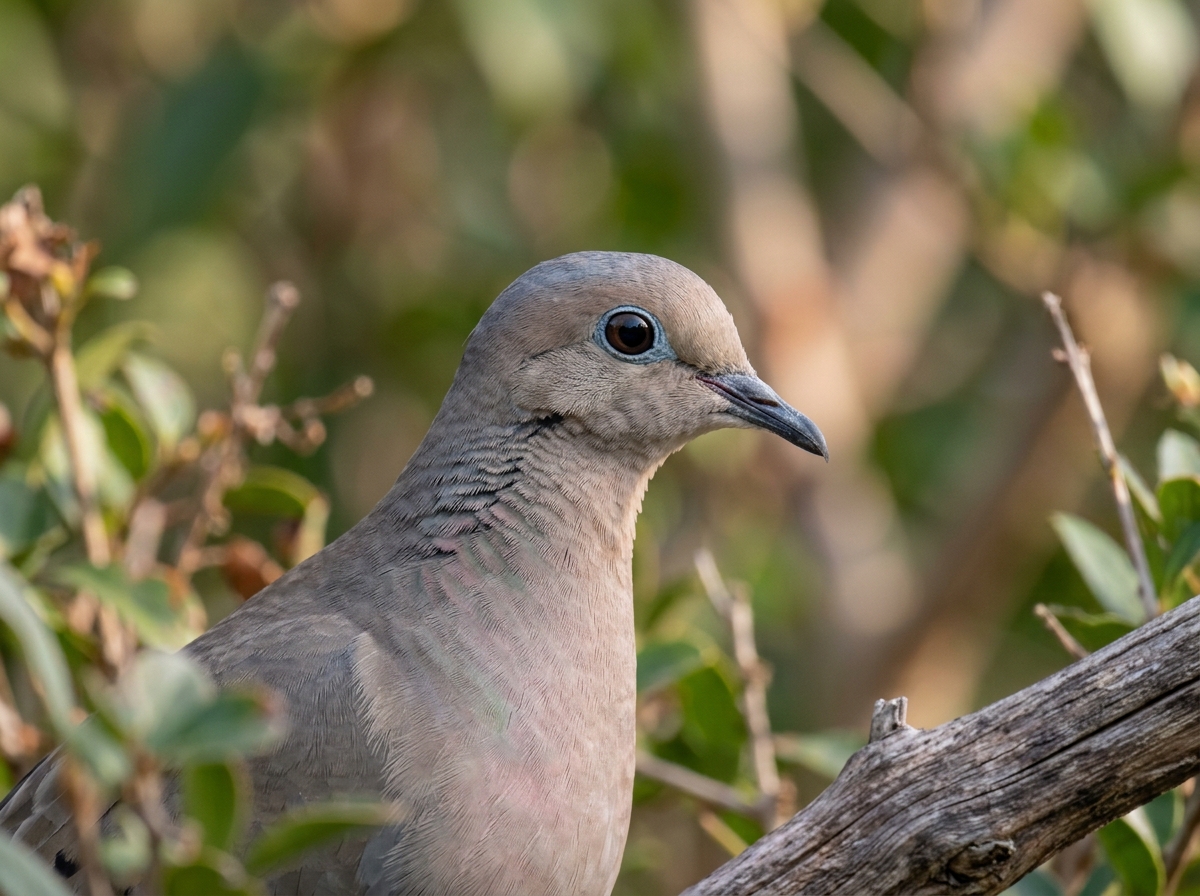
The head of a Mourning Dove is small and round, noticeably undersized compared to the plump body. That small-headed look is actually one of the most useful shape cues, because it gives the bird a very specific 'jizz' (that's birder shorthand for overall impression or feel) that you start to recognize automatically after seeing a few. The neck is slender but proportional, and if you catch the bird in good light at close range, adult males show a beautiful iridescent pink-and-blue sheen on the side of the neck. It's subtle but striking when the angle is right.
The bill is straight and thin, much more delicate than you'd expect from a bird this size. It's a beginner-friendly contrast point against chunkier pigeons, which have a noticeably heavier bill with a fleshy cere at the base. On a Mourning Dove, the face looks clean and almost delicate. If you get close enough, look for the dark eye surrounded by a patch of light blue-gray bare skin. That ring of blue skin around the eye is a lovely little detail that confirms you're looking at a Mourning Dove when conditions allow.
Common lookalikes and how to tell them apart
A few birds come up regularly when people try to figure out 'is this a dove?' Here's a straightforward comparison of the most common ones you might encounter.
| Bird | Size/Shape | Key Color/Pattern | Tail Shape | Top ID Clue |
|---|---|---|---|---|
| Mourning Dove | Slender, long-tailed, small-headed | Grayish-brown above, peachy below, black wing spots | Long and pointed, white outer edges | Pointed tail, no neck collar, no white wing bars |
| Eurasian Collared-Dove | Slightly chunkier, shorter tail | Pale gray overall, less warm tone | Square-tipped, broad white tail patches | Black crescent collar on nape, squared tail |
| White-winged Dove | Similar size to Mourning Dove | Brown overall, bold white wing patch | Shorter, more rounded than Mourning | Visible white wing patch when perched or in flight |
| Rock Pigeon (feral) | Much chunkier, shorter tail | Variable: gray, white, brown, speckled | Short and fan-shaped | Chunky body, heavy bill with fleshy cere, iridescent neck |
| European Starling | Compact, short-tailed | Dark with speckles (winter), glossy (summer) | Very short, squared | Short tail, sharp pointed bill, fast direct flight |
The Eurasian Collared-Dove is the trickiest one because it's now everywhere and it's genuinely similar to the Mourning Dove at a glance. The two fastest ways to separate them: check the nape for a narrow black crescent collar (Collared-Dove has one, Mourning Dove does not), and check the tail tip. The Collared-Dove's tail is square at the end, while the Mourning Dove's is distinctly pointed. Those two features together will sort it out almost every time.
The White-winged Dove is mostly a concern in the southern U.S. and Mexico, but it's been spreading northward. The name gives it away: look for a bold white patch along the wing edge, visible even when the bird is just sitting there. Mourning Doves won't have that white bar. Rock Pigeons are easy once you know the size difference and the heavier build, though at a distance a lone pigeon can fool you briefly. Starlings are compact with a very short tail, so the silhouette alone usually rules them out once you get a decent look.
When to use location, season, and behavior to confirm
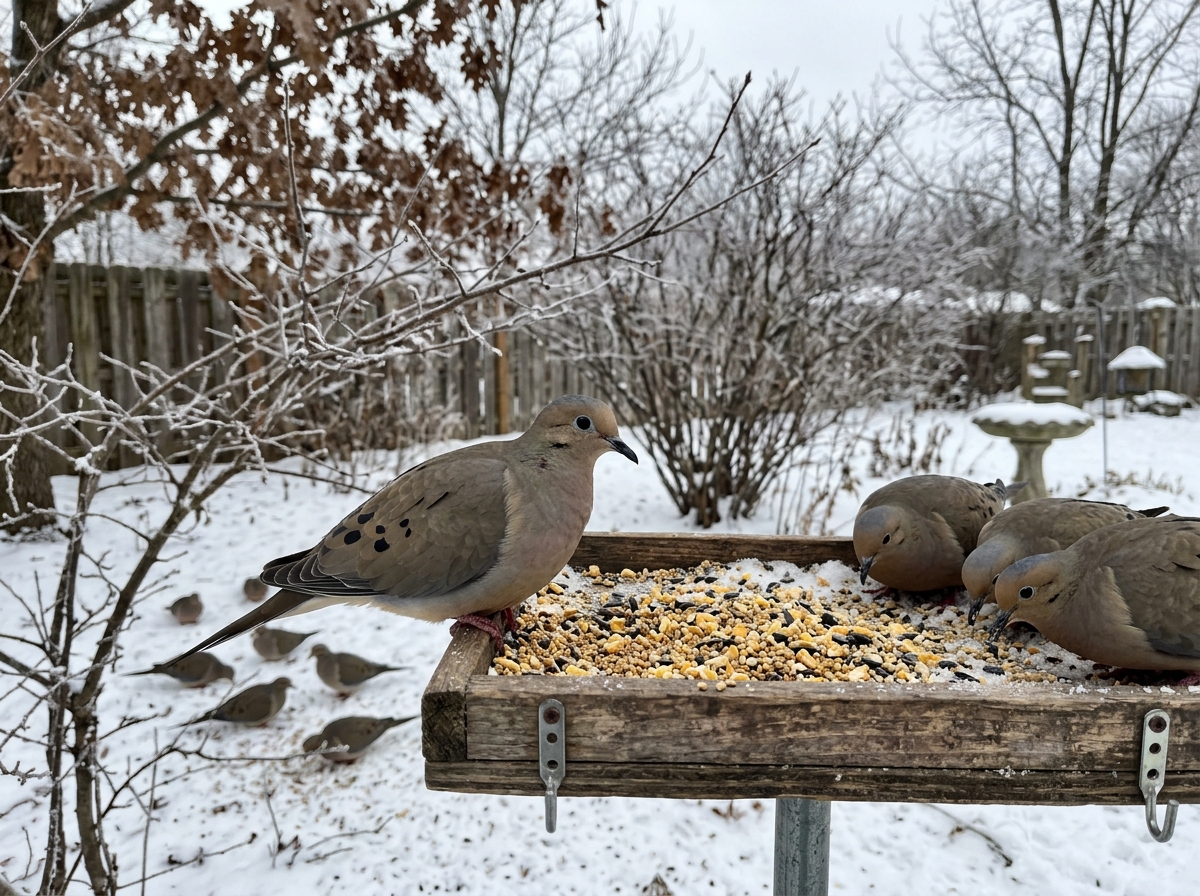
If you're still on the fence after checking the field marks, context clues can push you to a confident ID. Mourning Dove is year-round residents across most of the U.S. and are especially visible in open country, along woodland edges, and in suburban backyards. They love open or semi-open ground with scattered trees and avoid dense cover. If you see a soft brownish dove walking around on a lawn, a gravel driveway, or along the edge of a parking lot, Mourning Dove is the first bet.
In winter, Mourning Doves often gather in loose flocks at feeders or roosting in woodlots. Seeing a group of slender, long-tailed doves clustered on a wire or foraging on the ground together is a classic Mourning Dove scene. They walk rather than hop, which is a subtle but consistent behavior cue. They're also notoriously comfortable around people and buildings, sometimes nesting on gutters, eaves, or even abandoned outdoor equipment. If you find a flimsy, flat twig-nest on a window ledge or porch light with a pair of soft brown doves nearby, that's almost certainly Mourning Doves.
Sound is worth mentioning too, even though this is a visual ID guide. The Mourning Dove's call is that familiar, soft, mournful cooing that most people have heard without connecting it to a specific bird. Sound is worth mentioning too, even though this is a visual ID guide. Once you pair the visual with that sound, you'll never mistake it again. The Eurasian Collared-Dove has a similar repetitive coo but with a distinctly different rhythm, usually described as a three-note phrase that sounds more mechanical. Behavior during spring can also help: Mourning Doves do a long, circular gliding display flight with wings spread and slightly bowed downward, which is distinctive and easy to notice once you're watching for it.
Your quick Mourning Dove checklist
Run through these in order and you'll have a confident ID in most cases:
- Body shape: slender and plump-chested with a small, round head and a noticeably long tail
- Size: roughly robin-sized but more elongated, about 9 to 13 inches from bill to tail tip
- Overall color: warm grayish-brown above, soft peachy-pink below
- Wing coverts: look for scattered bold black spots on the folded wing
- Tail: long, pointed, with white outer feathers that flash in flight (no white wing bars)
- Head/neck: small round head, thin straight bill, possible iridescent neck sheen in good light on males
- Eye: dark eye with light blue-gray bare skin forming a ring around it
- No black neck collar (that's the Collared-Dove)
- Location: open ground, woodland edges, suburban yards, feeders
Most of those marks are visible from a normal viewing distance with bare eyes or basic binoculars. If you can check the tail shape and spot the absence of a neck collar, you're already most of the way there. The Mourning Dove is one of the more rewarding birds to really learn to see properly, because once you know what to look for, you'll realize just how often it shows up in everyday life.
FAQ
What does a dove look like when it is sitting on the ground, not in flight?
Look for the overall elongated silhouette, plump chest, and long pointed tail held behind. The folded wing spots on the coverts (bold black dots) can still be visible when perched, but the white outer tail feathers are easiest to confirm if it fans or takes off.
How can I tell if it is a Mourning Dove or a pigeon if the bird looks “chunky” to me?
Focus on the head and bill proportions. Mourning Doves usually have a smaller, rounder head with a thinner, more delicate straight bill, while pigeons typically look bulkier overall and have a heavier bill with a more fleshy cere at the base.
Do Mourning Doves have wing bars like some other birds?
No, Mourning Doves do not show obvious white wing bars. If you see a distinct white bar or patch along the wing edge, that points more toward a White-winged Dove than a Mourning Dove.
How do I identify an immature dove that looks “scaly” or scruffy?
Check whether the bird still has the long, pointed tail and the white-edged outer tail feathers in motion. Juveniles often look scaly or mottled, so use shape cues first, then verify with the wing-coverlet spots and tail pattern.
What is the easiest visual trick to separate an Eurasian Collared-Dove from a Mourning Dove?
Check the nape for a narrow black crescent collar and then compare tail shape at the tip. The Collared-Dove’s tail ends more squarely, while the Mourning Dove’s tail is distinctly pointed.
If I cannot see the tail or wing spots, what other traits can help confirm a dove?
Try to confirm the small, round head relative to the body (a “small-headed” look), the warm grayish-brown overall color, and the thin straight bill. If you get close enough, the light blue-gray bare skin ring around the eye is a helpful detail.
Are there dove lookalikes that I should worry about in cities?
Rock Pigeons can be confused at a distance due to size and general color. Use build and bill thickness to separate them, and remember that starlings usually have a compact body with a noticeably short tail, which changes the silhouette quickly.
What should I do if the bird seems to “hop” instead of walking?
Mourning Doves are more likely to walk than hop, especially during foraging on lawns and driveways. If it is actively hopping with a short tail and a very different body shape, it is less likely a mourning dove, so reassess with silhouette first.
Can I use behavior like nesting location to confirm what kind of dove I’m seeing?
Yes. Mourning Doves commonly nest in or near human structures like gutters, eaves, and sheltered outdoor ledges. If you see a flimsy twig nest in those spots alongside similar birds nearby, it strongly supports Mourning Dove identification.
How reliable is sound compared to visual cues?
Sound helps, especially for distinguishing it from Eurasian Collared-Dove by call rhythm, but visuals are still crucial. Use sound as a secondary confirmation when you cannot get a good look at tail shape or wing coverts.
Next Article
What Does an Oriole Bird Look Like? Males vs Females
See what orioles look like: male vs female colors, wing and face markings, bill cues, and lookalikes to tell apart.