Swallows are small, sleek, aerobatic birds built almost entirely around flying fast and catching insects mid-air. At a glance, you're looking for a streamlined body, long pointed wings, a notched or forked tail, and a tiny flat bill. Most species are dark on top and pale underneath, and they spend the vast majority of their time in the air rather than sitting still. Once you know what shape to look for, swallows are actually one of the easier bird families to recognize, even at a distance.
What Does a Swallow Bird Look Like? ID Guide

Marcus Whitley
22 Apr 2026
Swallow basics: the quick 'at-a-glance' look
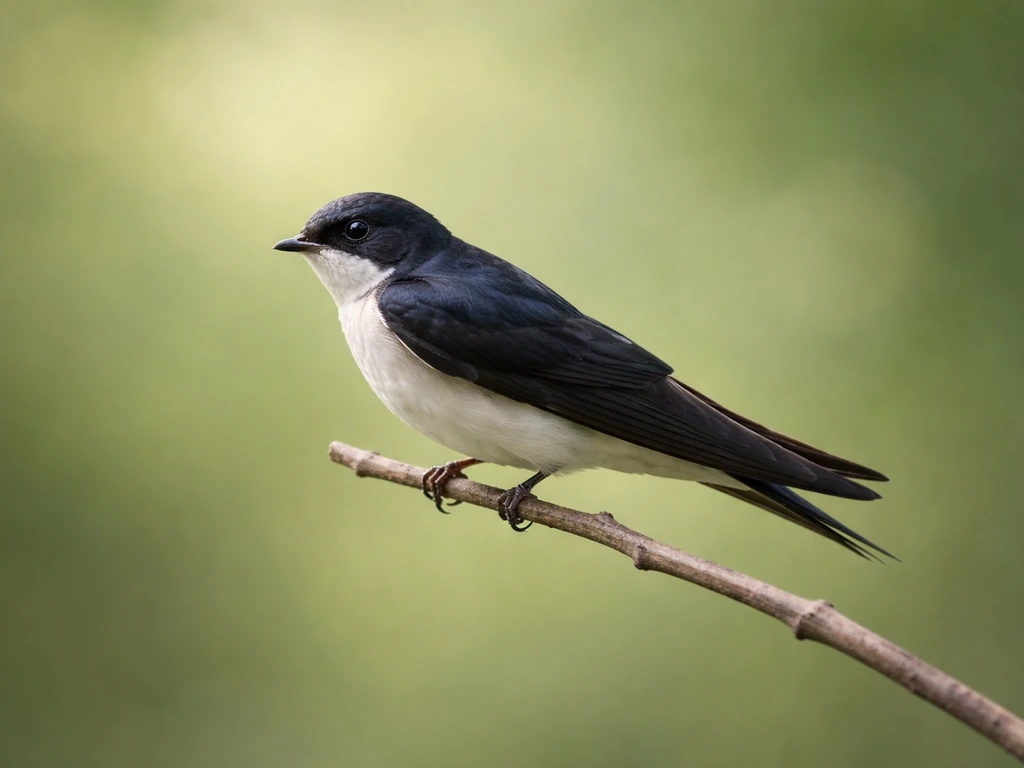
Think of a swallow as a bird that's been optimized for speed and agility. The body is compact and torpedo-shaped, roughly sparrow-sized (Bank Swallows are actually close to that size), with a broad chest that tapers toward the tail. The head is small and rounded, and the bill is short and flat, almost like a tiny scoop. You won't see a big, prominent beak here. The wings are the most obvious feature: long, pointed, and swept back, giving the bird a crescent or anchor silhouette in flight. The tail varies by species but usually has at least a slight fork or notch. When a swallow glides overhead, it looks effortlessly fluid compared to most small birds.
Color-wise, most swallows follow a similar basic template: dark, often glossy upperparts (blue, green, or brown depending on species) and pale or white underparts. Some species add splashes of rust, chestnut, or buff around the face and throat. A few, like the Purple Martin, break from this pattern entirely with an all-dark body. But that dark-above, light-below arrangement is a reliable starting assumption when you spot something zipping over a field or river.
Key field marks to check (wings, tail, body shape, colors)
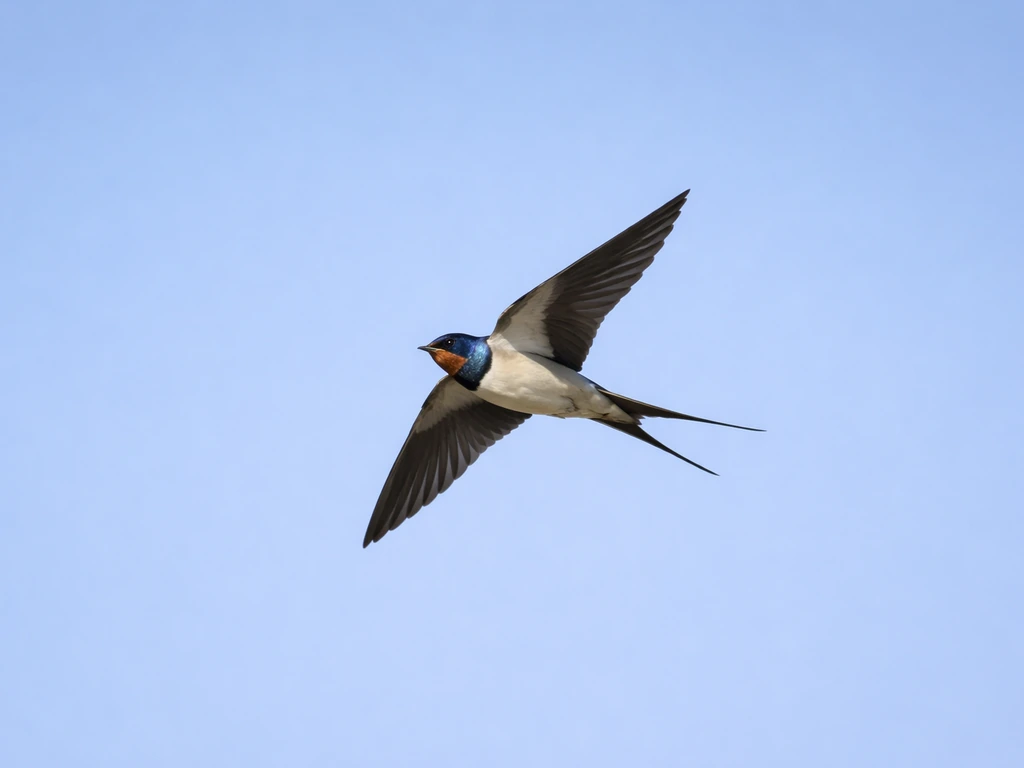
When you're trying to pin down a swallow ID, there are four things worth checking in roughly this order: tail shape, rump and back color, throat and breast color, and overall size. Tail shape is probably the single most useful quick separator. You'll see three basic types across common species: blank" rel="noopener noreferrer">square-tipped (Cliff Swallow), shallowly notched or slightly forked (Tree Swallow, Bank Swallow), and deeply forked with long outer 'streamer' feathers (Barn Swallow). That deep fork on a Barn Swallow is essentially unique, and if you can see it clearly, you've got your ID.
Rump color is worth a look whenever the bird banks or turns. Cliff Swallows show a pale, buff-colored rump patch that practically glows against their darker back, especially as they curve in flight. Barn Swallows and Tree Swallows don't have this feature. For the body itself, check the throat first: a Barn Swallow has a rich chestnut-rufous throat contrasting against steel-blue upperparts. Tree Swallows are clean blue-green on top with a completely white belly and throat. Bank Swallows are brown above with a distinctive brown chest band across an otherwise pale belly.
- Wings: long, pointed, swept-back on all species; broader-based and triangular on Tree Swallow
- Tail: square (Cliff Swallow), slightly notched (Tree Swallow, Bank Swallow), deeply forked with streamers (Barn Swallow)
- Rump: pale buff patch on Cliff Swallow; no obvious rump patch on most others
- Throat and breast: chestnut on Barn Swallow; clean white on Tree Swallow; brown chest band on Bank Swallow; brick-red face plus buff forehead on Cliff Swallow
- Overall size: all are small, but Purple Martin is noticeably larger and broad-chested compared to the others
- Bill: tiny, short, and flat across all species
In-flight vs perched: what you'll notice from each view
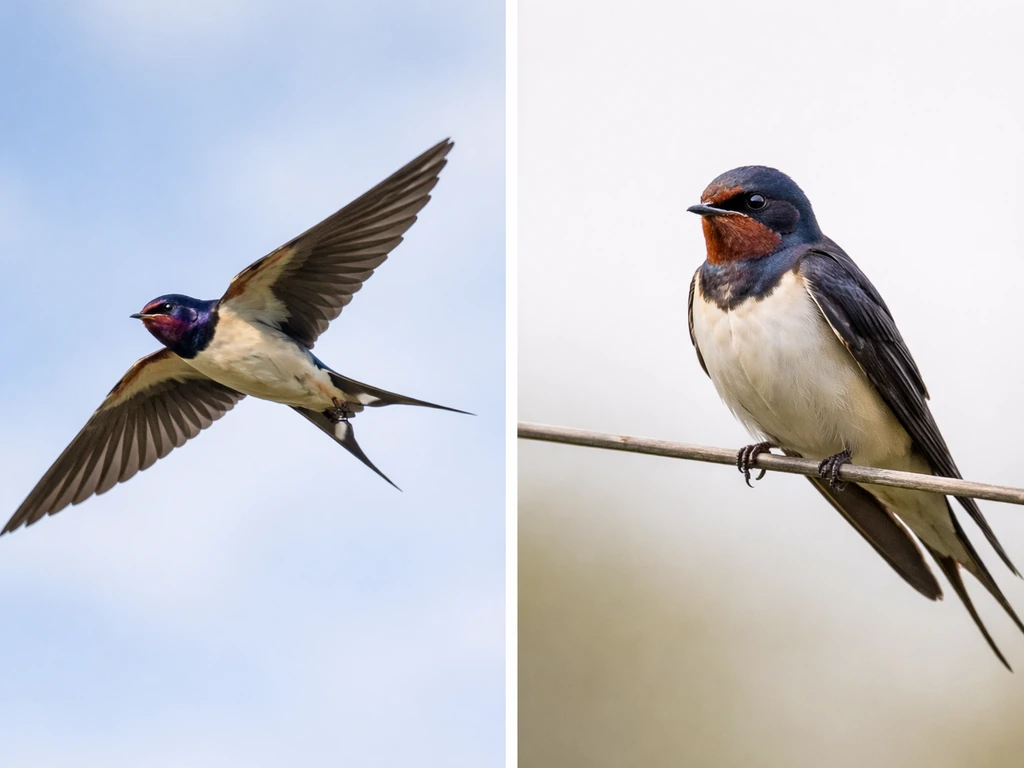
Swallows in flight look very different from swallows sitting on a wire, so it helps to know what to prioritize for each scenario. Most of the time you'll see them flying, so that's usually your primary opportunity. In flight, focus on the tail shape and rump first since those are the widest, most visible parts of the bird as it wheels and turns. Pay attention to the flight style too: Tree Swallows have a relatively steady, smooth flight with slower wingbeats, while most other swallows are bouncier and more erratic in direction. Barn Swallows often skim low over open fields with a graceful, flowing style. When a Cliff Swallow banks, that pale rump patch flashes clearly, even from a distance.
One thing to watch with tails in flight: a forked tail can look almost square when the bird fans it out to maneuver. Don't let that fool you. Even when fanned, a Barn Swallow's outer tail feathers remain longer and more pointed, creating a different shape than a truly square-tailed Cliff Swallow. If you can catch the bird gliding in a straight line, the fork will be obvious again.
When a swallow is perched, you get a much better look at colors, face markings, and body proportions. This is when you can really appreciate the Barn Swallow's steel-blue back and chestnut throat, or notice the Tree Swallow's crisp white underside and the thin black eye mask that frames its face. Adult male Tree Swallows are strikingly blue-green on top, while juveniles are duller and brownish, which can trip up a new birder. Perched birds also let you see the tiny bill clearly and appreciate just how compact the head is relative to the body.
Common swallow species appearance differences (what changes and where)
Across North America's most common swallow species, the differences come down to a handful of features: face pattern, breast color, tail shape, and rump. Here's how the most frequently seen species compare side by side.
| Species | Upperparts | Throat/Face | Breast/Belly | Tail Shape | Stand-Out Mark |
|---|---|---|---|---|---|
| Barn Swallow | Steel-blue | Chestnut/rufous | Pale buff to white | Deeply forked with long streamers | Long tail streamers, chestnut throat |
| Tree Swallow | Blue-green (adult male) / brown (juvenile) | White | Clean white | Slightly notched | Crisp white underside, thin black eye mask |
| Cliff Swallow | Blue-black and brown | Brick-red face, buff-white forehead patch | Pale | Square | Pale rump patch, 'headlamp' forehead spot |
| Bank Swallow | Brown | White with brown chest band | White | Slightly forked | Brown chest band across pale belly |
| Purple Martin | Dark blue-black (male) / grayish-brown (female) | Dark (male) / pale with streaking (female) | Dark (male) / pale (female) | Slightly notched | Largest swallow; all-dark on adult male |
If you're birding in the western U.S., you may also encounter the Violet-green Swallow, which looks superficially like a Tree Swallow but has a white cheek patch that extends behind and above the eye, plus white patches on the sides of the rump. That facial pattern is the quickest way to separate the two when you get a good look.
How to tell swallows apart from lookalikes (martins and others)
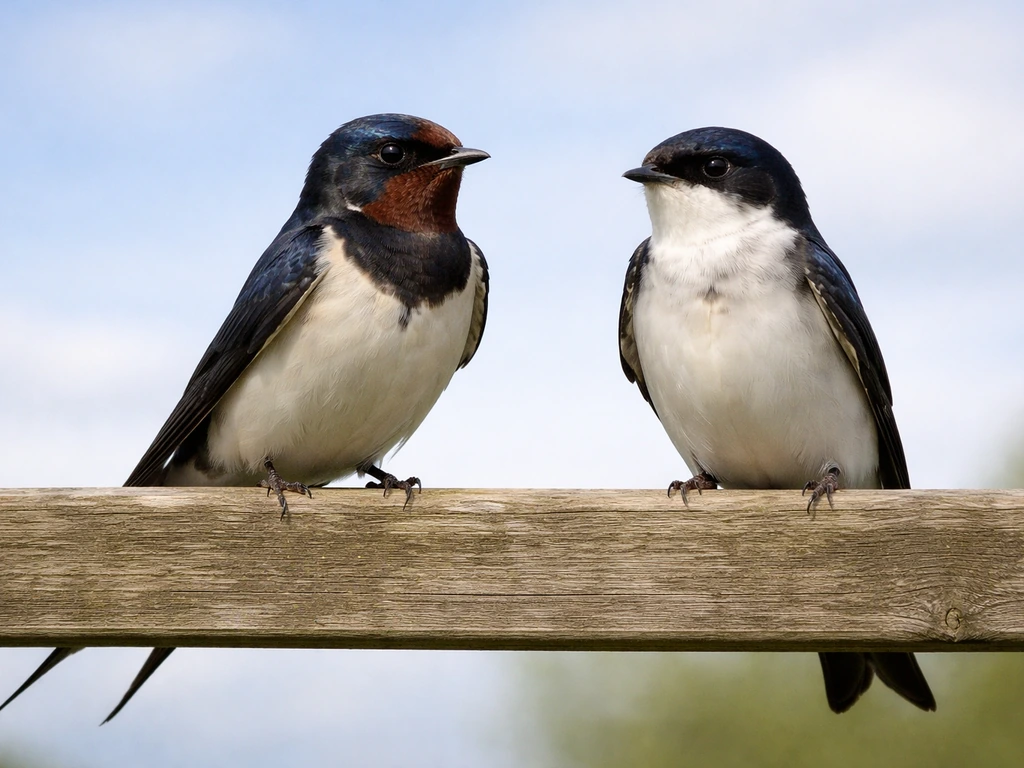
The biggest source of confusion with swallows is usually other aerial insectivores: martins, swifts, and occasionally flycatchers. Martins are actually part of the swallow family, so they share the same basic body plan, which can make the separation trickier. The Purple Martin is the main one to know in North America. It's noticeably larger than any of the other swallows, with a broad chest, long tapered wings, and a slightly notched (not deeply forked) tail.
The adult male is entirely dark blue-black, which makes it look more like a starling at a distance than a typical swallow. In fact, Purple Martins have a smooth 'rowing' flight style that's quite different from a European Starling's choppy, direct wingbeats. The adult male Barn Swallow is smaller than a Purple Martin, so if your 'swallow' looks big and dark all over, lean toward Martin.
In the UK and Europe, the common confusion is between swallows, house martins, and swifts. Swifts are the easiest to rule out: they have dark undersides (not pale), and their wings are longer and more scythe-like, almost like a boomerang shape. Swallows and house martins both have pale bellies, but the house martin is chunkier with a more compact body, a short forked tail (not as long-streamered as a swallow), and a very obvious white rump. The RSPB’s ID guide also notes that swallows have a distinctive long, forked tail with thin streamers and longer wings than martins. The swallow has that longer, more elegant tail and the rusty-orange throat that the house martin lacks.
Flycatchers are a completely different family and don't usually cause confusion once you know what to look for, but if you're new to birding you might see a small bird hawking insects and wonder. If you want the quick answer, check what does a flycatcher bird look like for the most reliable visual clues.
If you are looking at a different bird besides swallows, you can use this guide to see what does a sapsucker bird look like and compare key field marks. Flycatchers perch upright and dart out for insects rather than staying airborne continuously. Their wings are shorter and rounder, and they lack the long, swept-back wing silhouette that makes swallows so recognizable.
Similarly, birds like the nuthatch or brown thrasher operate in very different habitats and postures, so context alone usually rules them out quickly. If you’re looking for a brown thrasher, focus on its long tail, heavily streaked brown body, and a warm brown color overall what does a brown thrasher bird look like. If you’re wondering what a thrasher bird looks like in general, look for a long tail, heavy streaking, and an overall warm brown tone.
If you're wondering what a nuthatch bird looks like, the best clues are its chunky head, strong bill, and bold markings as it moves along tree trunks. A quick way to confirm it is to compare the nuthatch's chunky head and bold body pattern directly to reference photos what a nuthatch bird looks like.
The Cliff Swallow versus Purple Martin comparison is worth a specific mention because both can appear around similar colonial nesting sites (bridges, buildings). Remember: Cliff Swallow is compact and short with a square tail and that distinctive pale rump and forehead patch. Purple Martin is much larger, with a longer profile, angular pointed wings, and a notched tail without any pale rump.
Fast identification checklist and next steps to confirm the species
When you spot a swallow and want to lock down the species, work through this quick sequence while the bird is still visible. To help you match the right species, also use “what does a thrasher bird look like” as a quick reference for the key field marks you should look for. You don't need to check every point; often two or three are enough to get to a confident ID.
- Check the tail shape first: square (Cliff Swallow), slightly forked or notched (Tree Swallow, Bank Swallow, Purple Martin), or deeply forked with long outer streamers (Barn Swallow)
- Look at the rump as the bird turns: a pale buff patch instantly points you toward Cliff Swallow
- Note overall size: if it's noticeably bigger than the others in the group, consider Purple Martin
- Check the throat and face: chestnut throat is Barn Swallow; brick-red face plus pale forehead 'headlamp' is Cliff Swallow; clean white is Tree Swallow
- Look for a chest band: a brown band across a pale belly is the Bank Swallow's signature mark
- Note the flight style: steady and slower-wingbeated (Tree Swallow), low and graceful skimming (Barn Swallow), or larger rowing flight (Purple Martin)
- Factor in habitat: Bank Swallows nest in sandy embankments and quarry cuts; Cliff Swallows cluster under bridge overhangs and building eaves; Barn Swallows favor open farmland, barns, and bridges
Once you've noted those field marks, the next step is to compare against reference photos for the two or three species that match your observations. Pull up a field guide app or a visual reference and go straight to the species whose tail shape and throat color match what you saw. If you're still uncertain, note the location, date, and any habitat details (over water, near cliffs, open farmland) because habitat narrows things down fast. Many swallow mix-flocks occur during migration, so it's also worth scanning the whole group: you might find several species together, and having a comparison right in front of you makes the differences pop.
Getting a photo, even a blurry one with your phone, can be a huge help for reviewing details at your own pace afterward. Zoom in on the tail base, rump, and face in the image. Those three areas hold most of the ID information you need. With a bit of practice, swallows become one of those rewarding bird families where you can confidently call a species from a moving bird at distance, which feels genuinely satisfying once it clicks.
FAQ
What does a swallow bird look like when it’s far away or silhouetted?
Focus on shape rather than small color details. In distance, swallows usually read as a compact, torpedo-shaped bird with long pointed wings and a tail that looks clearly not square. If the bird shows an obvious crescent or anchor-like outline in flight and dark upperparts with a paler belly, that’s a strong swallow cue.
Can a swallow look like it has a square tail in flight?
Yes, a forked tail can seem almost square when the bird fans it out during fast turns. The better check is to watch whether the outer tail feathers stay longer and more pointed than the inner ones, or catch the bird gliding where the fork or notch becomes obvious again.
How do I tell a swallow from a swift when the bird is only briefly visible?
Use underside color first. Swifts typically show dark undersides overall, while swallows usually have pale underparts. Then confirm the wing silhouette, swifts look more like a scythe or boomerang shape, swallows have longer pointed wings that look swept back with a more streamlined “crescent” look.
Do juvenile swallows look different from adults?
Often yes, especially for some species like Tree Swallow, where juveniles tend to be duller and more brownish on top and can lose the crisp adult contrast. If you see an overall brownish bird with less “blue-green” shine, still prioritize tail shape, rump pattern, and underside coloration to keep the ID on track.
What should I check first if I can only see one feature clearly?
Tail shape is usually the fastest single field mark. Next best quick checks are rump color (for example, a pale buff rump in Cliff Swallow) and throat or breast contrast (for example, the chestnut throat in Barn Swallow). One or two of these, plus your best guess on size, is often enough.
How can I estimate size accurately enough to separate a swallow from a Purple Martin?
Compare the bird to nearby known objects like a person, railing, or the apparent size of other birds in the same frame, and note whether it looks noticeably larger than typical local swallows. Purple Martins usually appear bulkier with a longer profile and all-dark adult males, so if it looks “big and dark” compared with other swallows at the same site, that points toward Martin.
What’s the quickest way to separate a Tree Swallow from a Violet-green Swallow?
Look for the facial pattern when you get a decent look at the head. Violet-green Swallows have a white cheek patch that extends behind and above the eye, plus additional white on the sides of the rump. Tree Swallows generally have a cleaner face pattern and lack that extended cheek patch.
Are house martins and swallows easy to mix up on the same day?
They can be, because both have pale bellies and are aerial insect eaters. The practical difference is tail elegance and rump visibility, house martins look chunkier and have a shorter forked tail with a very noticeable white rump, while swallows usually have a longer, more streamlined tail and often show a rusty throat in the right species.
What if I’m not seeing the bird perched, only flying over water or open fields?
You can still get to a confident call by using the widest visible marks. In flight, prioritize tail shape and rump flashes during banking, then use flight style as a tie breaker (Tree Swallows often look steadier, Barn Swallows can skim low in open areas). If possible, wait for a bank because rump color is harder to misread than throat when the bird is distant.
If I get a blurry photo, where should I zoom to identify the swallow?
Zoom to the tail base and the rump area first, then the throat or face pattern if the head is in frame. Even a blurry image often preserves tail outline and whether the rump is pale or notched, those are usually more reliable than exact wing color when focus is off.
Can habitat help if I’m seeing a lot of swallow species together during migration?
Yes, but use it as a narrowing tool, not the only proof. If you know whether you’re near bridges or cliffs, open farmland, or river edges, you can predict which swallows are more likely. Then confirm with at least one structural mark (tail shape or rump color) from the mixed group, because similar-looking species can still occur together.
Next Article
What Does a Herring Bird Look Like? Herring Gull ID Guide
Learn what a herring bird likely is: clear herring gull ID guide with key marks, plumage differences, and lookalike comp