If the bird of paradise in your head looks like a blaze of crimson feathers, impossibly long tail wires, and a male doing something that looks more like a magic trick than a bird display, you're not wrong. But there are over 40 species in the family, and the one you're picturing almost certainly doesn't match the quiet brown female sitting on a branch right next to it. The gap between what people expect and what they actually see is real, and it comes down to species differences, sex differences, lighting, and whether the bird is actively showing off or just sitting there.
Bird of Paradise: What It Really Looks Like vs Your Guess

Marcus Whitley
11 Jul 2026
What a bird of paradise actually is (and why it can look "different")
Birds of paradise are a family of birds (Paradisaeidae) found primarily in New Guinea, with some species in eastern Australia. What makes them famous is sexual dimorphism taken to an extreme: males have evolved ornamental feathers, wires, shields, and plumes that females simply do not have. When most people picture a bird of paradise, they're picturing the male in full display. But in everyday life, these birds spend most of their time foraging, perching, and minding their own business, and in those moments even the males can look surprisingly plain. Add in the fact that females and juveniles look genuinely different from adult males, and you can easily be looking at a bird of paradise and not recognize it as one.
There's also the question of which species you mean. The Raggiana bird of paradise, the Greater bird of paradise, the Superb bird of paradise, the paradise riflebird, the ribbon-tailed astrapia, and the parotias all belong to this family but look quite different from one another. If you've seen a photo of a male Raggiana with its crimson flank plumes and yellow cowl, that image won't match a male riflebird, which looks velvety black in low light and only shimmers with metallic blue-green in direct sun. That's not a different bird, just a different species under different light.
Quick visual checklist: the most recognizable features
If you're trying to confirm whether the bird you're looking at or looking up is actually a bird of paradise, run through these features first. No single one is definitive on its own, but two or three together will point you in the right direction.
- Long ornamental tail feathers or wires: male birds of paradise can have tails reaching up to about 3 feet (close to 1 meter) in some species, and the ribbon-tailed astrapia male can have tail feathers averaging around 90 cm and reaching over 1.2 meters. These aren't just long tail feathers, they're structural ornaments.
- Flank plumes: many species (like the Raggiana) have cascading plumes coming from the flanks or sides. These can be crimson, orange, yellow, or white depending on the species, and they drape well past the bird's body.
- Iridescent or color-shifting head and throat patches: look for green, blue, or purple metallic sheen on the throat or breast, often contrasting sharply with the rest of the body.
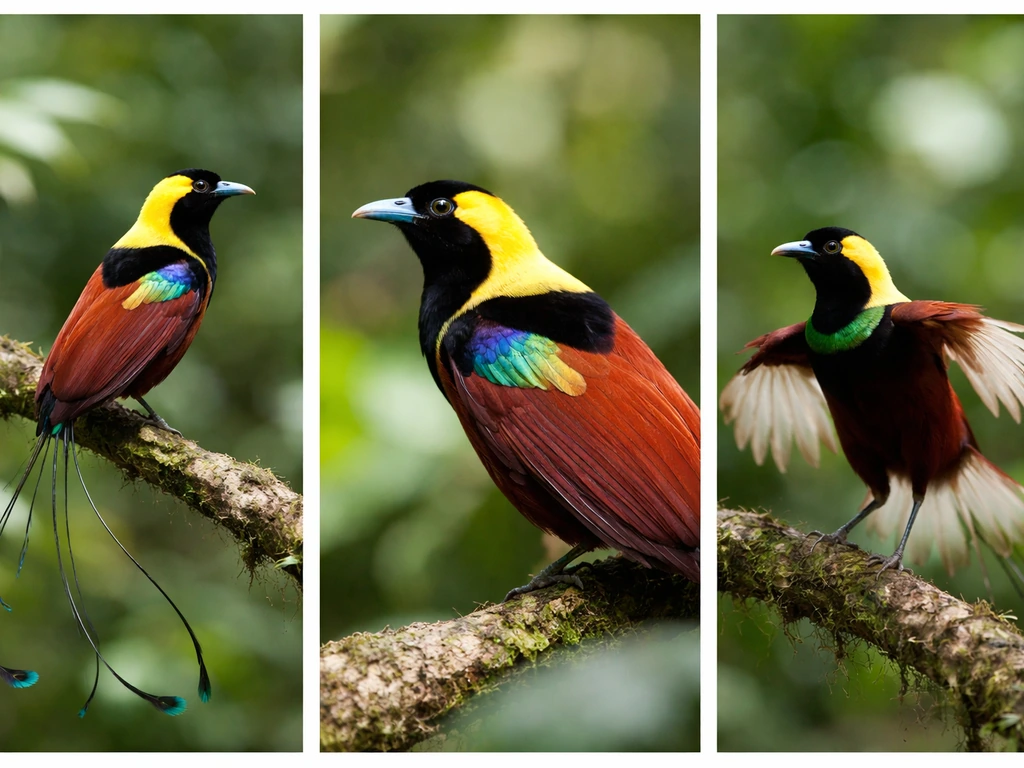
- Yellow, green, or multi-colored cowl or collar: the Raggiana male has a yellow crown, a dark emerald-green throat, and a yellow collar between the throat and the darker upper breast.
- Wire-like head plumes: parotias have six wired head plumes, each ending in a small black oval tip, which are only really visible when the bird fans them out during a dance.
- Plain brown or rufous females: if you see a plain brownish bird with a paler eyebrow and rufous wing tones (like in the paradise riflebird female), that's a typical female bird of paradise pattern. They look nothing like the males.
- Body size similar to a crow or large thrush: most species are medium-sized, roughly crow-sized or a bit smaller. The Raggiana male is about 34 cm not counting those tail extensions.
How to tell which bird of paradise you mean
Breaking the family into visual groups makes identification much more manageable. Think of it in three rough clusters based on the most visible ornament type.
Plume birds (Paradisaea genus)
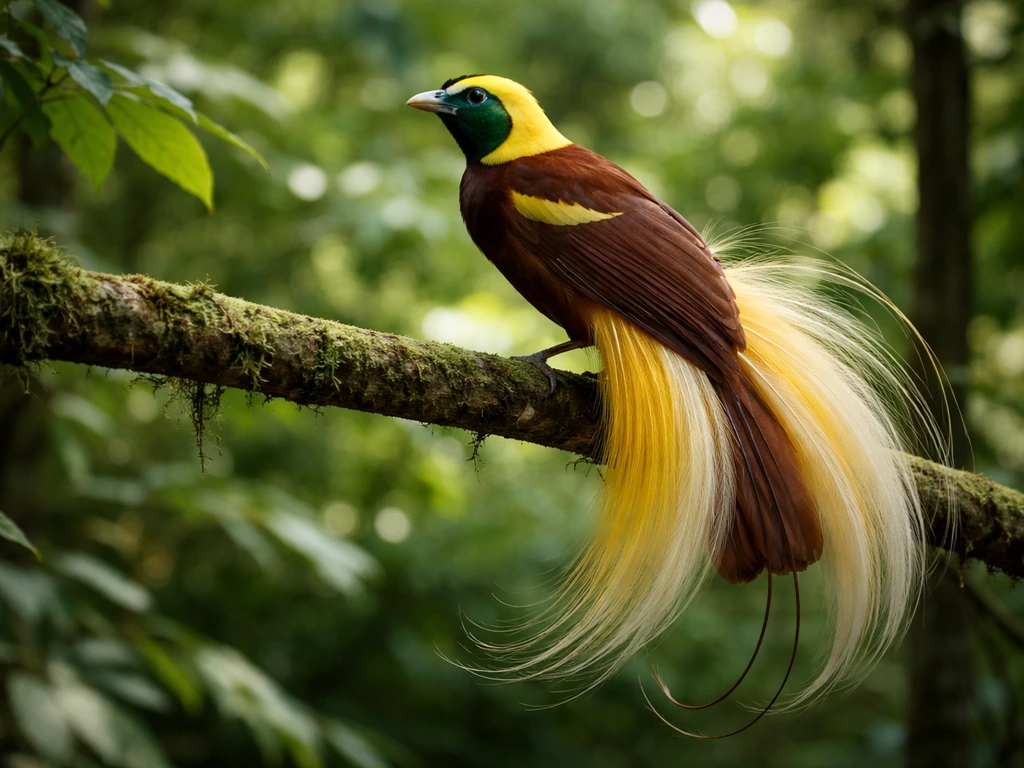
This is the group most people are picturing. The Greater and Raggiana birds of paradise belong here. Males have long, wispy flank plumes (yellow in the Greater, crimson to orange in the Raggiana), yellow heads, green throats, and long tail wires. They gather at display trees (leks) and fan those plumes upward while calling loudly. The female Raggiana is a plain brown bird with a dark face, paler underparts, and no plumes at all.
Riflebirds (Ptiloris genus)
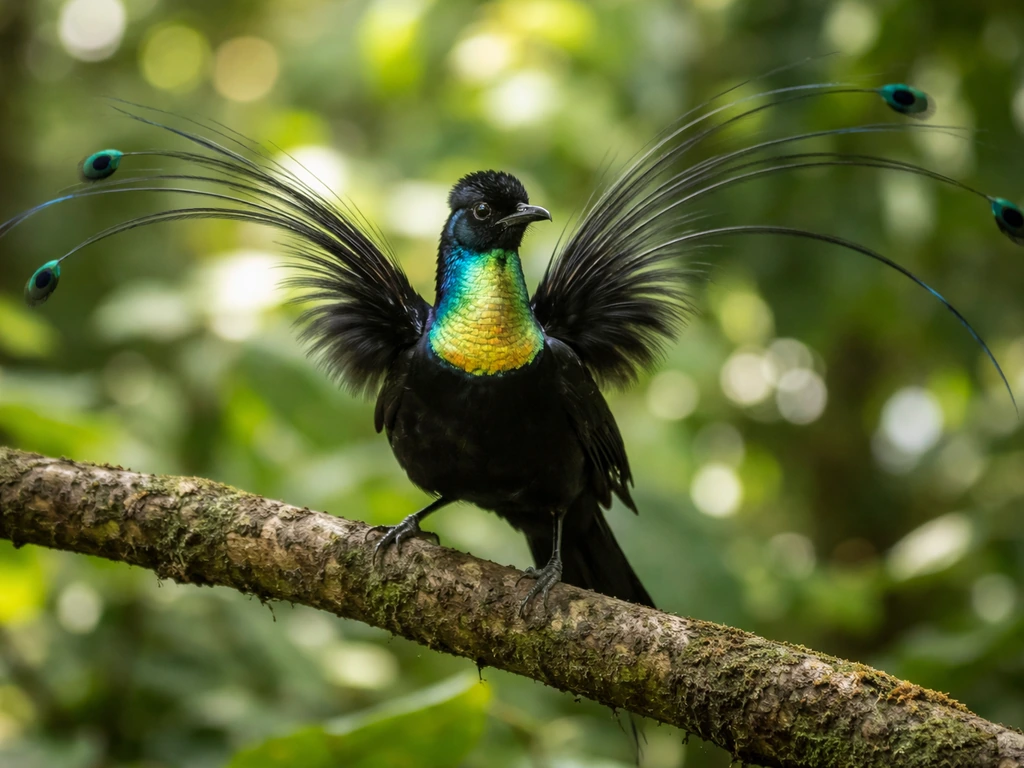
Riflebirds, including the paradise riflebird found in eastern Australia, don't match the plume-bird image at all. Males are mostly black, but in sunlight the plumage shifts to an intense iridescent blue-green or purple. Their signature display involves spreading the wings wide and curving them forward in front of the body, sometimes hanging upside down, with the head thrown back to show a fan of iridescent throat feathers. Researchers in the Ptiloris riflebirds report that males achieve these courtship postures through extreme wrist joint hyperextension, which mechanically specializes the posture and can radically change the bird’s outline in photos. In a dim photo or overcast light, a male riflebird can look like a plain black bird. In full sun or at the right angle, it looks like liquid metal. Females are greyish-brown above with rufous in the wings and a pale eyebrow stripe.
Parotias and wire-plume birds
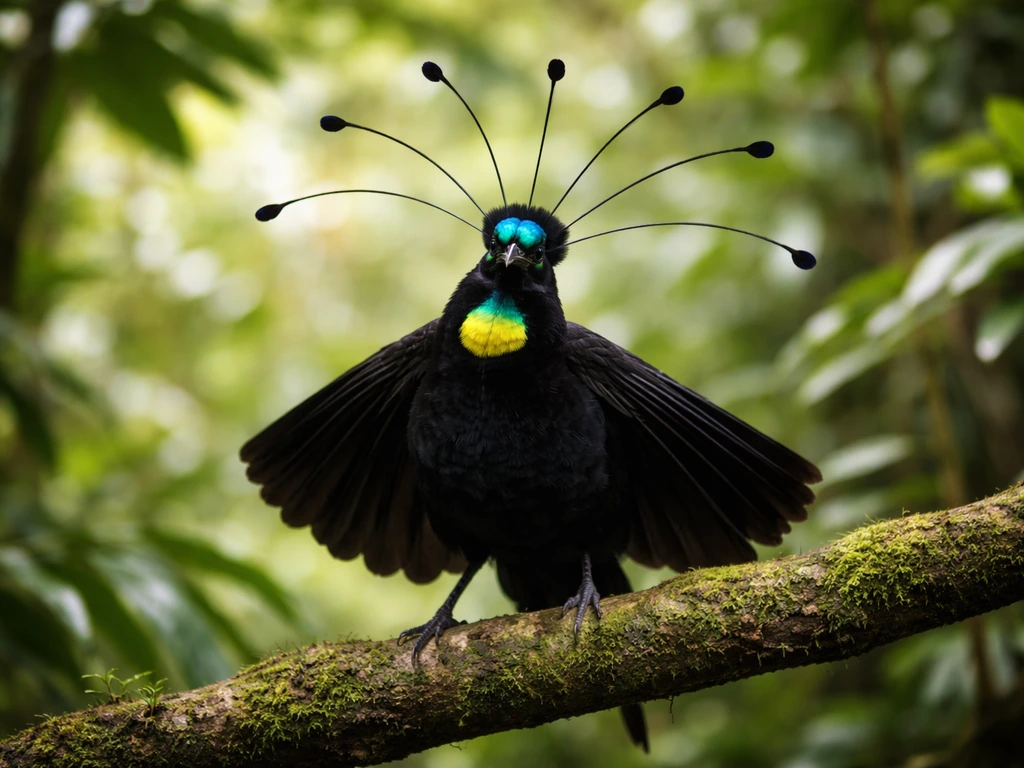
Parotias are the dancers. Males have a black collar that can spread into a wide skirt, bright iridescent patches on the head and throat, and those six distinctive wired head plumes with black oval tips. Their courtship display is often described as ballerina-like, with the skirt fanning out as they bounce and turn. If the bird you're trying to identify has head wires with paddle-shaped tips, you're in parotia territory.
Astrapias (long-tail specialists)
If the feature you noticed most was an impossibly long tail, the ribbon-tailed astrapia is likely your bird. Males are otherwise fairly compact and dark, but the white ribbon-like tail is genuinely extreme. During display, males swish those tails conspicuously. This is a different look from the plume birds, where the long extensions come from the flanks rather than the tail itself.
Why your mental image might not match what you're seeing
This is the part that trips up almost everyone. Here are the four main reasons the bird in front of you might not look like the bird of paradise you had in mind.
Display vs. non-display posture
A male bird of paradise during courtship is essentially shape-shifting. A riflebird curves its wings into a wide disc around its body. A Superb bird of paradise fans out a cape that transforms its outline into something resembling a crescent or heart shape. The Birds-of-Paradise Project has documented how some species' iridescent breast shields are completely invisible unless the male tilts its head at the exact right angle to lift the shield into view. If you saw a photo of one of these displays and then see the same species perched normally, it can look like a completely different bird.
Lighting and structural color
Many birds of paradise have structural color, meaning the iridescence comes from the physical structure of the feather rather than pigment. This means the color you see depends entirely on the angle of the light hitting the feather. A paradise riflebird male in shade genuinely looks flat black. In direct sunlight from the right angle, it looks like it's covered in metallic paint. Photos taken in different conditions can make the same bird look unrecognizable. This is compounded by the fact that structural colors can include UV wavelengths that cameras don't capture the same way the human eye processes them.
Sex and age differences
Females and immature males look so different from adult males that they're often mistaken for completely different species. In Cornell’s account of birds-of-paradise courtship, research on the “courtship phenotype” shows that females evaluate bundles of traits, including visible ornament colors plus the display behavior. A female Raggiana is a plain brown bird with a dark face mask. A young male riflebird may have some iridescent patches but lacks the full wing shape of an adult. Cornell Lab's Bird Academy has specific male-versus-female identification guides for species like the twelve-wired bird of paradise precisely because the differences are that stark. If the bird you saw was brown and unassuming, it may well be a female bird of paradise.
Which species you were expecting
The mental image most people carry (crimson plumes, yellow head, long wires) is closest to the Raggiana or Greater bird of paradise. If you then encounter a photo or sighting of a riflebird, astrapia, or parotia, the mismatch can be jarring. All of them are birds of paradise. None of them look alike. If you’re trying to picture what a bird of paradise looks like, this also explains why sightings can vary so much from one species or moment to the next none of them look alike.
Common look-alikes and how to tell them apart
A few other tropical birds share the long-tail or colorful-plume look that people associate with birds of paradise. Here's how to separate them.
| Bird | Shared trait | Key difference from bird of paradise |
|---|---|---|
| Asian paradise flycatcher (Terpsiphone paradisi) | Long streamer tail on males | Much smaller body (sparrow to thrush sized), tail streamers are narrow ribbons not structured ornamental feathers, lacks iridescent breast shield or flank plumes |
| African paradise flycatcher | Long tail, colorful rufous tones | Slender build, very small, tail length varies (not all individuals have long streamers), no flank plumes |
| Resplendent quetzal | Long tail feathers, iridescent green | Found in Central America (not New Guinea/Australia), tail is made of elongated upper tail coverts rather than wire plumes, bright red belly rather than flank plumes |
| Peacock | Fan-like display, iridescent plumage | Much larger, ground-dwelling, tail fan is made of upper tail coverts with eye-spots, no flank plume cascade |
| Superb lyrebird | Extremely long ornamental tail | Australian ground bird, tail feathers include lyre-shaped outer feathers and fine filamentaries, body shape and habitat (ground scratching in forest) is totally different |
The paradise flycatcher is probably the most common source of confusion when someone sees a long-tailed bird in tropical Asia and assumes it must be a bird of paradise. The size difference is the fastest check: a paradise flycatcher is roughly the size of a large sparrow, while a Raggiana bird of paradise is closer to a crow. The paradise flycatcher also has a completely different face shape, with a prominent flat bill built for catching insects on the wing, compared to the stouter bill of most birds of paradise.
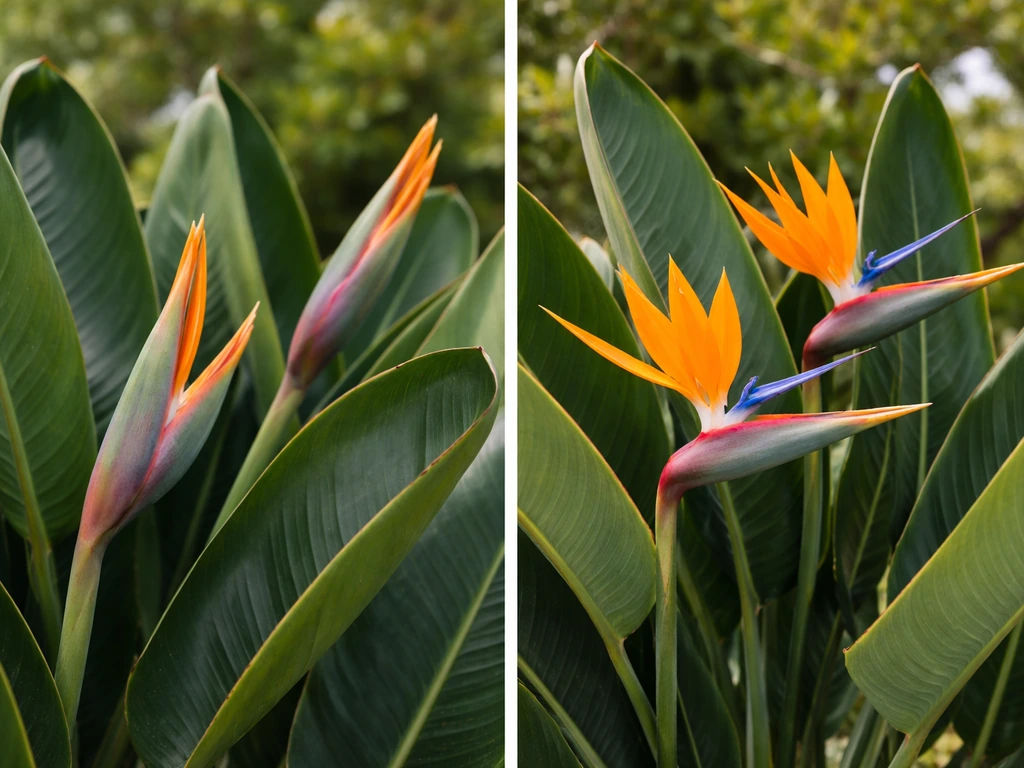
It's also worth noting that the bird-of-paradise flower (Strelitzia) is named for the birds but is a plant, and searches for either can cross over. The flower that looks like a bird is a separate topic entirely from the bird family itself.
How to nail down your identification from a photo or sighting
Whether you have a photo you took or you're looking at an image online and trying to figure out what species it is, work through these steps in order.
- Start with body size and shape: is the bird roughly crow-sized with a chunky body, or is it slim and sparrow-to-thrush-sized? This single check rules out paradise flycatchers and most other long-tailed look-alikes immediately.
- Check the tail type: are the long extensions coming from the tail (astrapia, paradise flycatcher), from the flanks (Raggiana, Greater), or from the wings/body posture during display (riflebird)? The source of the elongated feature matters more than the length itself.
- Look at the throat and breast: does the chest have an iridescent patch, a colored shield, or wired ornaments? A bright iridescent green or blue-green throat points to riflebird or plume-bird genera. Six wired head plumes with paddle tips points to parotia.
- Check body color beyond the ornaments: what color is the back and wings? Most plume birds (Paradisaea) have brown or chestnut bodies with yellow or green heads. Riflebirds are black with iridescent patches only.
- Note the location or range: birds of paradise in the wild are found in New Guinea and northeastern Australia. If the photo is labeled as being taken in South Asia or Africa, you're likely looking at a paradise flycatcher or another look-alike.
- Look for display context clues: if the bird is photographed mid-display, check the posture. Wings spread wide and curved forward with head thrown back is a riflebird. Flank plumes fanned upward while perched is a plume bird. A skirt-like collar fanned out while bouncing is a parotia.
- Compare both sexes: if you only have an image of a female or juvenile, look for a pale eyebrow stripe, rufous wing tones, and plain brown-grey upperparts. A female without those plumes next to or near a male can confirm the species pair.
What angles and details to capture if you're in the field
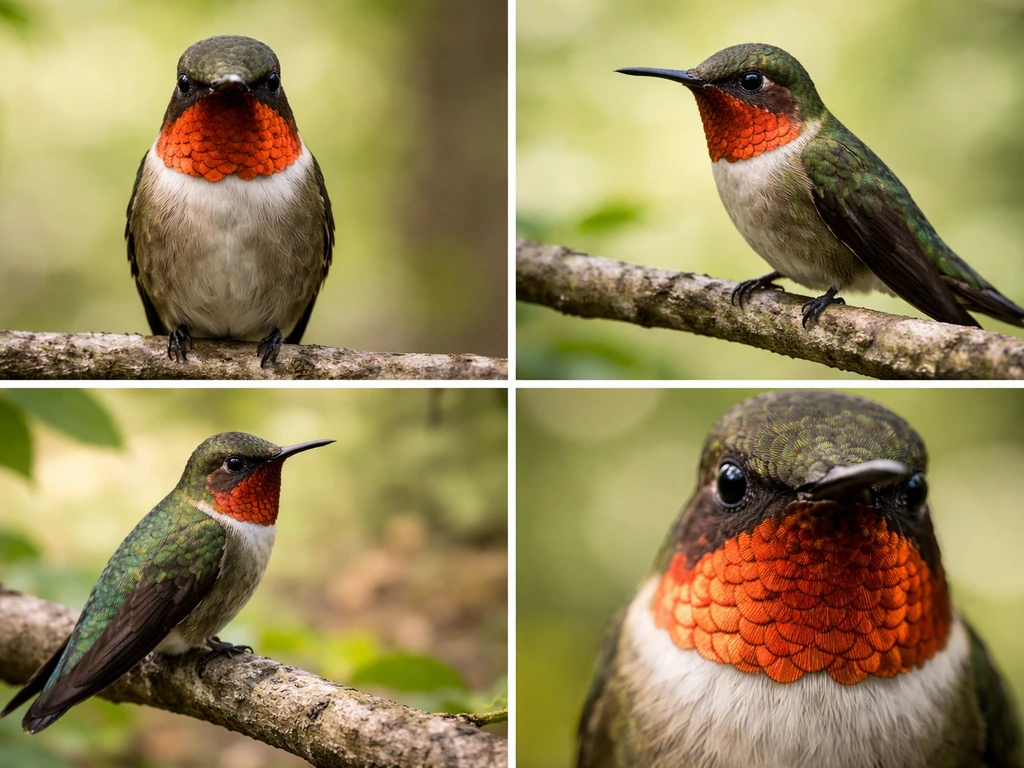
If you have the opportunity to photograph the bird rather than just observe it, prioritize these shots: a straight-on front view of the chest and throat (to capture iridescent patches), a side profile showing the full tail or flank plumes, and a head shot that shows any wired plumes, crown color, or eye color. If the bird is displaying, capture as many frames as possible because the posture changes dramatically second by second and you may only get one angle that shows the key features clearly. Good lighting is everything with structural-color birds: a shot in direct sunlight from the front will reveal iridescence that a backlit or shaded shot completely hides.
Once you have clear photos, compare against species reference images organized by ornament type rather than just searching "bird of paradise" generically. Narrow it down: are you looking at a plume bird, a riflebird, a parotia, or an astrapia? Each of those groups has a distinctive silhouette even outside of display. From there, checking the specific head, throat, and plume color will get you to a species-level match quickly. The Mexican bird of paradise, worth noting, is actually a flowering shrub that shares the family name, not a bird at all, so if you're finding plant results in your search that's why.
FAQ
If I saw a “bird of paradise” briefly and it looked dark, how can I tell whether it was really a riflebird in shade versus a different bird?
Use the silhouette clue first. Riflebirds have a fairly compact build, and even when the body looks black in shade, the head and throat may still show subtle iridescent hints when you catch the right angle. If you can remember whether the wings opened wide and the bird curved them forward (sometimes with an upside-down moment), that behavior points strongly to riflebirds rather than generic black tropical birds.
I have a photo, but the colors look washed out or totally different from what I expected. How should I interpret that?
Structural color depends on angle and lighting, so a “wrong-looking” photo often means the light hit the feathers from the wrong direction or the bird moved between frames. Try to check the sequence: if one frame shows a metallic shift while another looks flat, that pattern is typical for iridescent birds of paradise. Also note that many camera sensors capture colors differently than human eyes, especially for UV-sensitive structural effects.
How can I confirm it was male versus female if I did not see any obvious plumes or wires?
Absence of ornament in a quick look can happen for adult females, juveniles, and males when not displaying. Focus on whether there are any wired head features or long flank extensions, even if faint. If there are none and the bird is small, brown, and unornamented, it is more likely a female or immature male than a fully ornamented adult display male.
What if the bird looked like it had “long wires” but not the crimson or yellow colors I expected?
Color expectations are species-specific, so “wires without the expected palette” can still fit a bird of paradise. Compare the source of the long extension, flank versus head: long flank plumes suggest the plume-birds cluster, while head wires with paddle-like tips suggest parotia. If the long feature is clearly a single extreme ribbon-like tail extension rather than multiple flank streamers, it points to ribbon-tailed astrapia.
Is it possible to mix up a bird of paradise with the paradise flycatcher, and what’s the fastest field check?
Yes, especially if you only notice the long tail and tropical setting. The fastest check is size and bill shape: paradise flycatchers are closer to sparrow size and have a broad, flat-looking bill suited to catching insects in flight, while most birds of paradise have a different overall body proportion and bill profile. If you can also recall wing and tail posture, that helps because flycatchers do not use the same ornament display silhouettes.
If the bird was displaying, how can I tell which group I was seeing from posture alone?
Plume-birds often fan or lift flank plumes upward while producing a strong display outline, riflebirds tend to spread wings into a curved, disc-like posture in front of the body (sometimes with an upside-down moment), and parotias look like a fanning “skirt” with head wires visible and a ballerina-like bounce-and-turn. If the centerpiece of the shape is a cape-like crescent outline, that suggests Superb-type displays within the plume-bird group.
What’s the best order of features to check if I’m trying to identify a species quickly?
Start with the ornament type that controls the silhouette (flank plumes, wing-disc riflebird posture, head wires with paddle tips, or a ribbon-like tail). Then confirm the head and throat region, because throat color and any visible shields tend to be more consistent than body color. Finally, use lighting-dependent shimmer as supporting evidence, not the only evidence.
How should I handle plant search results when I’m sure I want the bird?
Two common mismatches come from names shared with flowering plants, like Strelitzia (bird-of-paradise flower). If your search returns shrubs or flowers, it is likely the plant and not the bird family. Add terms like “bird,” “species,” or the location you saw, then restrict results to birds rather than general “bird of paradise” pages.
If I only have a brief sighting and no photos, what’s the minimum info I should try to remember?
Remember four things: estimated size (sparrow-like versus crow-like), where the long ornament came from (tail, flanks, or head), whether the bird showed iridescence that looked metallic in one moment but flat in another, and any display posture you noticed (wing disc, cape-like fan, skirt-like head collar expansion, or ribbon tail swishing). With those, you can usually narrow to the correct ornament group even without a close look at exact colors.
Next Article
What Does a Bird of Paradise Look Like Bird and Plant Guide
See what a bird of paradise looks like and its lookalike plant Strelitzia orange blue flower buds and foliage ID tips