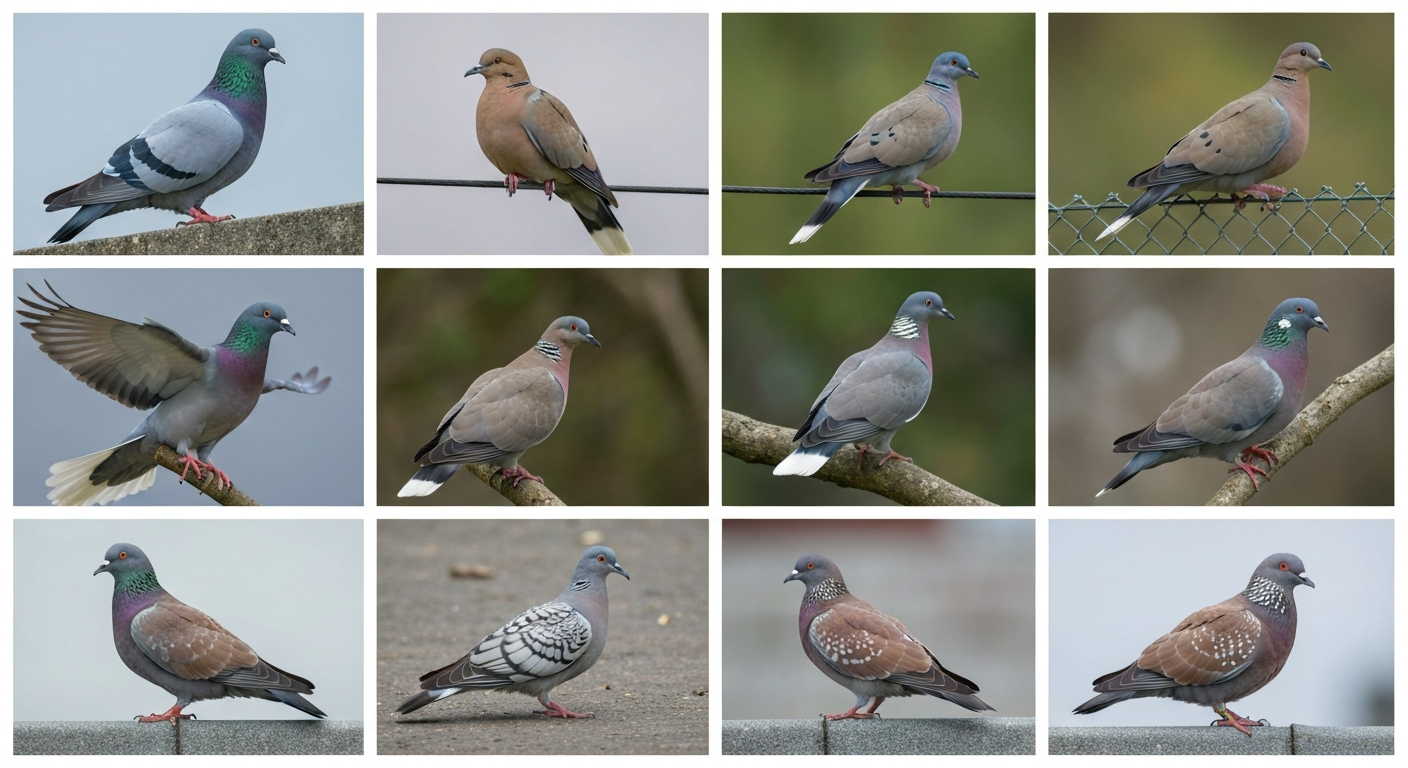
The most common birds that look like pigeons are mourning doves, Eurasian collared-doves, wood pigeons, band-tailed pigeons, white-winged doves, Inca doves, spotted doves, and speckled pigeons. All of them belong to the same family (Columbidae), so the resemblance is genuine and sometimes genuinely tricky to sort out. A few unrelated birds, like certain hawks or doves from other families, can also fool you from a distance. The fastest fix is to check three things: overall size, tail shape, and whether there are any white or pale patches on the neck or wings.
What Bird Looks Like a Pigeon: Quick ID Guide to Lookalikes

Marcus Whitley
30 Jul 2026
Why so many birds look like pigeons
Pigeons and doves all share the same basic body plan: a round chest, small head, short legs, and a compact bill with a soft fleshy cere at the base. That body shape is extremely efficient for ground feeding and short bursts of fast flight, which is why it has persisted across hundreds of species on every continent except Antarctica. When you see a bird that immediately reads as 'pigeon-like,' what you are really picking up on is that shared Columbidae silhouette: the way the head bobs while walking, the puffed chest, and the gentle rocking motion in flight. The differences between species mostly show up in size, markings, tail length, and subtle colour tones, which is exactly why it helps to know what to look for before the bird flies off.
Pigeon lookalikes by region
North America
North America has a rich mix of native and introduced pigeon-family birds. The feral rock pigeon is the urban staple you see on ledges and plaza pavements almost everywhere. The mourning dove is arguably even more widespread, turning up in suburbs, farmland, and open country from coast to coast. The Eurasian collared-dove, introduced to the Bahamas in the 1970s and self-spreading across the continent, has now colonised most of the lower 48 states and is a very common suburban bird. In the southwest, keep an eye out for the white-winged dove, the tiny scaly Inca dove, and the small common ground-dove (roughly sparrow-sized at about 15 to 18 cm). Along the Pacific Coast and in forested mountain zones, the band-tailed pigeon replaces the rock pigeon as the big forest Columba.
Europe and the UK
In Europe the wood pigeon is the dominant large pigeon, noticeably bigger than a feral rock pigeon and unmistakable once you know its white neck patch. The stock dove is a smaller, plainer cousin that nests in tree holes and lacks the wood pigeon's white markings. The turtle dove, now rare in the UK but still present across southern and central Europe in summer, is a slim, warm-coloured dove with a striped neck patch. The Eurasian collared-dove is a fixture in gardens and farmyards right across the continent.
Asia
Across South, East, and Southeast Asia you will encounter the spotted dove, a medium-sized dove with a distinctive black-and-white speckled 'necklace' patch on the back of the neck. The Eurasian collared-dove extends well into Central and South Asia. The Oriental turtle dove, very similar in overall shape to the European turtle dove but with scalloped orange-brown upperparts, is common from Siberia through to Japan. Rock pigeons live in genuine wild cliff populations across the Indian subcontinent and Central Asia, alongside many feral city birds.
Africa and the Middle East
Sub-Saharan Africa's equivalent of the urban rock pigeon is the speckled pigeon, a medium-large bird with bold pale spots on its brown mantle and rusty-red underparts. It is a genuine city and village bird in many parts of the continent. The laughing dove is a small, slim dove common from West Africa through to South Asia, warm pinkish-brown with a spotted necklace. The African collared-dove occupies a similar niche to the Eurasian collared-dove in the drier parts of northeast Africa and the Arabian Peninsula.
Australia and the Pacific
Australia has several native pigeons that will stop you in your tracks. The crested pigeon sports an improbable thin upright crest and bold black-and-white wing markings. The common bronzewing is a chunky forest pigeon whose wings shimmer with iridescent bronze-green patches. The spotted dove (introduced from Asia) is common in urban parks and gardens in eastern and southern Australia. Feral rock pigeons are present in most Australian cities.
Central and South America
The Inca dove and white-winged dove both extend into Central America. The eared dove, which looks like a close cousin of the mourning dove with a similar slim silhouette and long tail, is one of the most abundant birds across much of South America. The pale-vented pigeon and ruddy pigeon are two medium-sized forest Columbas common in tropical lowlands. Rock pigeons are present in most large South American cities as feral birds.
A closer look at the most commonly confused species
Rock pigeon (feral/city pigeon)
This is the reference bird. A typical adult is about 29 to 37 cm long with a wingspan of 62 to 72 cm and weighs roughly 238 to 380 g. The classic morph is blue-grey with two dark wing bars, a white rump patch, and a green-and-purple iridescent neck that catches the light beautifully in direct sun. Feral populations, however, are remarkably variable: you will see birds that are white, rusty-brown, nearly black, or patterned in checker-board brown and grey. If a pigeon-shaped bird seems to come in every colour, it is almost certainly a feral rock pigeon.
Mourning dove
Slimmer than a rock pigeon and noticeably lighter at 96 to 170 g, the mourning dove has a small round head, a buff-pink face, and a very long, tapering pointed tail that is unlike any other common North American dove. In flight, the white edges on the outer tail feathers are easy to see. On take-off, the wings produce an audible whistling sound, which is a helpful instant cue even before you get your binoculars up.
Eurasian collared-dove
Pale buff-grey and chunkier than a mourning dove, the collared-dove's most reliable mark is the thin dark crescent on the back of the neck, like a neat black half-collar. The tail is relatively short and squared compared to the mourning dove's long point. It tends to look a bit pale and washed-out, almost cream in good light, which helps separate it from the warmer tones of most other doves.
Wood pigeon
At 38 to 43 cm long with a wingspan up to 80 cm, the wood pigeon is noticeably bigger than a rock pigeon. The key marks are a broad white neck patch (absent in juveniles) and white wing crescents that flash prominently when it takes off. In flight it looks heavy and direct, with the white wing bars crossing the whole wing. Common across Europe in woods, farmland, and suburban parks.
Band-tailed pigeon
North America's largest native pigeon at 33 to 40 cm and up to 515 g, the band-tailed pigeon lives in Pacific and mountain forests rather than city squares. The tail gives it away: pale grey at the tip with a darker subterminal band visible from behind in flight. It also has a thin white crescent on the back of the neck above an iridescent green patch, similar to a very subtle version of the wood pigeon's marking. If you see a large, dark pigeon in a conifer forest on the West Coast, this is your likely candidate.
Turtle doves
Both the European turtle dove and the Oriental turtle dove are slim, warm-coloured birds smaller than a rock pigeon. Look for orange-brown scalloped feathers on the back, a striped black-and-white patch on the side of the neck, and a relatively long tail with white tips. The European turtle dove is now sadly rare across much of its range due to habitat and farmland changes, so seeing one is worth pausing for.
White-winged dove
Chunky and square-tailed, the white-winged dove gets its name from the broad white stripe along the folded wing, which becomes a vivid white flash in flight. See White‑winged Dove, All About Birds (Cornell Lab) for species account noting the broad white wing stripe/patch as the clearest field mark blank" rel="noopener noreferrer">White‑winged Dove — All About Birds (Cornell Lab). At rest it looks like a slightly burlier mourning dove with a shorter tail. The blue skin around the eye and the orange-red eye itself are helpful close-up details. Common in the southwest US, Mexico, and Central America.
Inca dove
The Inca dove is notably small, around 16 to 19 cm, and has a scaly or scaled appearance on the body created by dark feather edges covering the breast and back. All About Birds maps list the Inca Dove (Columbina inca) as about 16–19 cm long and show it occurring year‑round in the US Southwest, Mexico, and Central America (Inca Dove, All About Birds (sightings map & ID)) blank" rel="noopener noreferrer">Inca Dove — All About Birds (sightings map & ID). The tail is long relative to the body, which gives it an almost stretched look. In flight, rufous wing patches are visible. It is a bird of dry, open, and urban habitats in the southern US, Mexico, and Central America.
Speckled pigeon
Africa's answer to the urban pigeon is the speckled pigeon. It is similar in size to a rock pigeon but immediately distinct thanks to pale white spots covering the brown mantle and wings and a rusty-red breast. The bare red skin around the eye is bold and visible at a reasonable distance. Found across sub-Saharan Africa on cliffs, buildings, and farmland.
Quick species comparison
| Species | Length | Key marking | Tail shape | Typical habitat |
|---|---|---|---|---|
| Rock pigeon | 29–37 cm | Two dark wing bars, iridescent neck, white rump | Short, rounded | Cities, cliffs, farmland (worldwide) |
| Mourning dove | 23–34 cm | Long pointed tail, white tail edges, buff-pink face | Long, tapered, pointed | Open country, suburbs, farmland (N. America) |
| Eurasian collared-dove | ~32 cm | Thin black half-collar on nape, pale buff body | Short, squared | Gardens, farmyards (Europe, Asia, N. America) |
| Wood pigeon | 38–43 cm | White neck patch, white wing crescents in flight | Medium, rounded | Woodland, farmland, parks (Europe) |
| Band-tailed pigeon | 33–40 cm | Pale tail band, thin white neck crescent | Long, banded at tip | Pacific and mountain forests (W. N. America) |
| White-winged dove | ~29 cm | Bold white wing stripe/flash | Short, squared | Desert, scrub, SW USA, Mexico, C. America |
| Inca dove | 16–19 cm | Scaly body pattern, rufous wing patch in flight | Long, narrow | Dry open and urban areas (SW USA, Mexico) |
| Turtle dove (European) | ~28 cm | Scalloped brown back, striped neck patch | Long, white-tipped | Farmland, woodland edges (Europe, Africa in winter) |
| Spotted dove | ~30 cm | Black-and-white spotted neck patch | Medium, white-tipped | Urban parks, gardens (Asia, introduced Australia) |
| Speckled pigeon | ~33 cm | Pale spots on mantle, rusty breast, red eye patch | Short, rounded | Cities, cliffs, farmland (sub-Saharan Africa) |
Size and silhouette: your first ID check
Before you look at colour, get a feel for the bird's size relative to something you know. A rock pigeon is roughly the size of a small fist-sized loaf of bread, noticeably bigger than a starling and smaller than a crow. Now place your mystery bird against that. The wood pigeon is clearly larger than a rock pigeon, almost like a stretched version. The mourning dove is slimmer and lighter, more like an elongated starling. The Inca dove and common ground-dove are genuinely sparrow-sized and look almost comically small next to a rock pigeon.
Posture tells you a lot too. Most Columbidae birds walk with a characteristic head-bob and carry their weight on the chest, but the slimmer doves, like mourning and Inca, look more upright and alert compared to the broader, heavier stance of wood pigeons and band-tailed pigeons. If the bird seems to be waddling rather than stepping, you are probably looking at a larger, heavier pigeon.
Head, neck, and eye or leg colour
The neck is the most information-rich area on a pigeon or dove. A rock pigeon has that beautiful oil-slick iridescence, green and purple depending on the light, with no distinct pattern. A collared-dove has a thin black crescent on the back of the neck, neat and precise. A wood pigeon has a broad white oval patch on the side of the neck, unmistakable once you have seen it. A band-tailed pigeon has a thin white crescent in roughly the same position as the wood pigeon's patch but much narrower. Turtle doves have a striped black-and-white patch on the neck side, while spotted doves have a black patch sprinkled with white spots.
Eye and leg colour are useful for close views. Rock pigeons typically have orange-red eyes and reddish-pink legs. The white-winged dove has a striking blue eye ring with an orange-red iris, visible even in a photo. The speckled pigeon has bare red skin around the eye that glows at close range. Mourning doves have a pale blue-grey eye ring on a plain face. Leg colour is less reliably diagnostic from a distance but can help confirm a species in a good photograph.
Tail shape, tail pattern, and wing markings
The tail is often the quickest separator. Mourning doves have an exceptionally long, narrow, pointed tail, and when they fly away from you those white outer tail feathers are a clean flash of white on each side. Collared-doves have a shorter, squared tail. When a collared-dove fans its tail, you can see the dark base and pale tip creating a contrast pattern. The band-tailed pigeon shows a pale grey tail tip with a darker band just before it, which looks like a grey terminal band in flight. Rock pigeons have that white rump patch visible as the bird flies away, with the tail itself appearing dark. Wood pigeons show white wing crescents across the upper wing in flight, one of the most dramatic wing flashes of any European bird.
Wing markings at rest are equally useful. Rock pigeons show two crisp dark wing bars on the folded wing. White-winged doves have a wide white stripe along the edge of the folded wing, almost like a racing stripe. Inca doves do not have obvious wing marks at rest but reveal rufous wing patches in flight. The common bronzewing of Australia has patches that genuinely shimmer with metallic green and bronze, making it unlike anything in the Northern Hemisphere.
Flight style and behaviour cues
Rock pigeons fly fast and direct, often in tight flocks that wheel and tilt together. Their wingbeats are regular and strong. Wood pigeons also fly powerfully but with slightly stiffer, heavier beats and a tendency to glide briefly before landing. Mourning doves have quick, clipped wingbeats and fly in a more darting, direct line, often alone or in small groups. The band-tailed pigeon is slower and more measured in flight for its size, often flying above the treeline in small groups through forested hills.
On the ground, behaviour can help too. Rock pigeons and wood pigeons walk actively and feed by pecking. Mourning doves tend to sit quietly on wires and branches for long periods and are often seen in pairs. Inca doves are restless little birds, constantly moving and often flicking the tail. The white-winged dove bobs its tail up and down while perched, a useful habit to watch for.
Calls are worth knowing even if your focus is visual ID, because they often alert you to the bird before you see it. The mourning dove's call is a soft, hollow 'ooh-woo-woo-woo' that many people mistake for an owl. If you wondered what bird looks like an owl, the mourning dove's hollow coo is often mistaken for one. The wood pigeon's call is a distinctive five-note cooing, often written as 'my toe bleeds Betty.' The Eurasian collared-dove gives a repeated three-note 'coo-COO-coo.' Rock pigeons produce a low, burbling coo with no strong pattern. Learning even one or two of these saves a lot of searching through leaves.
Step-by-step field ID checklist
- Note the size: is it clearly larger than a rock pigeon (wood pigeon, band-tailed pigeon), similar size (collared-dove, spotted dove), or noticeably smaller (mourning dove, turtle dove, Inca dove)?
- Check the tail: long and pointed (mourning dove, Inca dove, eared dove), short and squared (collared-dove, white-winged dove), or banded at the tip (band-tailed pigeon)?
- Look at the neck: plain and iridescent (rock pigeon), white patch (wood pigeon), thin black crescent (collared-dove), striped patch (turtle dove), spotted patch (spotted dove), or white crescent plus green sheen (band-tailed pigeon)?
- Look for wing markings: two dark bars on folded wing (rock pigeon), white stripe along wing edge (white-winged dove), scaly pattern on body (Inca dove), or white wing crescents in flight (wood pigeon)?
- Note the overall colour tone: pale buff-grey (collared-dove), warm pinkish-brown (mourning dove, turtle dove), blue-grey with iridescent neck (rock pigeon), or spotted mantle with rusty breast (speckled pigeon)?
- Watch the flight style: fast and direct in flocks (rock pigeon), darting with wing-whistle on take-off (mourning dove), heavy and gliding (wood pigeon), or measured and above tree-level in small groups (band-tailed pigeon)?
- If in doubt, photograph the bird from the side, from behind in flight, and close to the head and neck, then compare with a regional field guide or image gallery.
Practical next steps for your sighting
If you are in North America and cannot nail down your pigeon-like bird from the checklist above, the Cornell Lab's All About Birds site has excellent photo galleries and range maps for every species mentioned here, and eBird lets you check which species have actually been recorded in your exact location. If you're asking what bird looks like a robin but smaller, check our short guide on small robin-like birds for quick comparison and ID tips. If you also wondered what bird looks like a vulture, see our guide on what bird looks like a vulture for comparisons and ID tips. If you're trying to identify a larger black bird, see our guide on what bird looks like a crow for help distinguishing crows from similar-looking species. In the UK, the RSPB's online ID tool is reliable and photo-led. For Australia, BirdLife Australia's field guides cover the native Columbidae in good regional detail.
If you think you have found something unusual, especially a bird that does not match any of the common regional species, it is worth logging the sighting on eBird with a photograph. Rare doves and pigeons do turn up as occasional vagrants well outside their normal range, and a well-documented photo sighting with notes on size, location, and habitat is genuinely useful to the birding community. The same methodical approach, checking size first, then tail, then neck markings, works for other lookalike groups too: the same logic applies whether you are trying to separate sparrows, crow-like birds, or owls. For help identifying sparrows, see what does a sparrow bird look like (fb4ae0ac-9150-4602-bbe2-750a08f53460).
FAQ
Quick answer: Which birds commonly look like pigeons and how can I tell them apart at a glance?
Many doves and pigeons (family Columbidae) plus a few lookalike species can look pigeon‑like: common examples are Rock/Feral Pigeon, Mourning Dove, Eurasian Collared‑Dove, White‑winged Dove, Inca/ground doves, Band‑tailed Pigeon, Wood/Common Pigeon and regional species such as Spotted/Spilopelia doves or Speckled Pigeon. At a glance, separate them by overall size and silhouette (chunky vs. slim), tail shape (long and pointed vs. squared/short), distinctive neck or wing marks (iridescent neck, nape collar, white wing patches), and flight features (wing flashes, tail pattern, wingbeat cadence). Use one clear field mark (e.g., nape collar for Eurasian Collared‑Dove; long tapered tail for Mourning Dove; white wing stripe for White‑winged Dove; pale tail band for Band‑tailed Pigeon) plus size/habit to confirm.
Region‑aware list: Which pigeon‑like species should I expect in my region?
North America (common): Rock/Feral Pigeon (Columba livia), Mourning Dove (Zenaida macroura), Eurasian Collared‑Dove (Streptopelia decaocto, introduced), White‑winged Dove (Zenaida asiatica), Inca Dove (Columbina inca), Band‑tailed Pigeon (Patagioenas fasciata), Common/ground‑doves (Columbina spp.). Europe/West Asia: Rock Pigeon (introduced/feral), Wood/Common Pigeon (Columba palumbus), Eurasian Collared‑Dove, Stock/Domestic/feral forms. Africa: Speckled Pigeon (Columba guinea), Rock Pigeon in urban areas, various Streptopelia doves. Asia/Southeast Asia/Australasia: Spotted/Oriental Turtle‑Dove (Spilopelia/ Streptopelia spp.), many local dove species; note introductions (Spotted Dove common in parts of Australasia). For exact local checklists and range maps consult eBird Status & Trends and regional field guides (e.g., eBird species pages and All About Birds links in next steps).
Compact visual comparison (quick reference you can use in the field)
Use these quick ID cues: - Rock/Feral Pigeon: Size ~29–37 cm; chunky; bluish‑gray with two dark wing bars, white rump, iridescent green/purple neck; variable colour morphs. (See Rock Pigeon summary: https://nwlfd.org/species/rock-pigeon) - Mourning Dove: 23–34 cm; slim, small head, very long pointed/tapered tail with white outer edges in flight; buffy pink tones; fast whistling wingbeats. (https://www.allaboutbirds.org/guide/Mourning_Dove/overview) - Eurasian Collared‑Dove: ~32 cm; pale buff/gray, chunky, squared tail; thin black nape 'collar' (dark crescent) on back of neck. (https://science.ebird.org/en/status-and-trends/species/eucdov/range-map) - White‑winged Dove: ~28–31 cm; chunky, square tail; distinctive white stripe/patch along folded wing and broad white trailing edge in flight. (https://www.allaboutbirds.org/guide/White-winged_Dove/overview) - Inca / Common Ground‑Doves: ~15–19 cm; very small, long‑tailed for size, scaly or speckled pattern; 'sparrow‑sized' ground doves. (https://www.allaboutbirds.org/guide/Inca_Dove/maps-sightings) - Band‑tailed Pigeon: 33–40 cm; large forest pigeon; dark body with pale grey tail tip separated by a darker subterminal band (visible as pale tail band). (https://nationalzoo.si.edu/animals/band-tailed-pigeon) - Wood/Common Pigeon (Europe): 38–43 cm; large, grey with conspicuous white neck patch and white wing patches in flight. (https://www.rspb.org.uk/birds-and-wildlife/around-britain/bird-guide/woodpigeon/) - Spotted / Speckled types (Spilopelia/Columba guinea): variable size; characteristic neck or mantle spotting/scale patterns and regional colour tones; check regional guides for species.
Clear visual features to focus on (what to look for in photos or through binoculars)
Key visual cues (prioritize in this order): 1) Size and silhouette: compare to known references (Rock Pigeon ~11–15 in; Mourning Dove noticeably slimmer and with much longer tail proportionally). 2) Tail shape & pattern: long tapered (Mourning Dove), squared/short (collared doves), pale subterminal band (Band‑tailed). 3) Neck/head marks: iridescent neck patch (Rock Pigeon), black nape crescent/collar (Eurasian Collared‑Dove), white neck patch (Wood Pigeon). 4) Wing marks and flashes: two wing bars (Rock Pigeon), white wing stripe/patch visible in flight or on folded wing (White‑winged and Wood Pigeon). 5) Plumage pattern: scaled/scaly or spotted mantle (Inca, Spotted Dove, Speckled Pigeon). 6) Flight style & sound: fast whistling wingbeats (Mourning Dove), heavy rapid wingbeats in larger pigeons; wing‑whistle and flight profile help confirm. 7) Eye/leg colour and bill shape: useful second‑tier cues where visible (e.g., pale eye rings in some species). 8) Behaviour & habitat: ground foraging vs. canopy/forest, urban roosting, flocking behaviour — use as supporting information.
Compact comparison table (sizes, key markings, typical habitats)
Use this compact reference (rows = species; columns = length, key markings, typical habitat): - Rock/Feral Pigeon: 29–37 cm; two wing bars, iridescent neck, variable coloration; urban/ports/buildings. - Mourning Dove: 23–34 cm; long tapered tail with white edges, slim profile; open fields, suburban lawns, edges. - Eurasian Collared‑Dove: ~32 cm; black nape collar, squared tail, pale buff; towns, farms, suburbs. - White‑winged Dove: ~28–31 cm; white wing stripe/edge, chunky; SW US, deserts, towns, woodlands. - Inca / Common Ground‑Dove: 15–19 cm; scaly/speckled, tiny; arid scrub, brushy edges, ground foraging. - Band‑tailed Pigeon: 33–40 cm; pale tail tip with darker subterminal band, larger; forested mountains and riparian woodlands. - Wood/Common Pigeon: 38–43 cm; white neck patch and wing flash; parks, woodlands in Europe. (For precise ranges and measurements consult linked species pages above.)
Annotated photo/illustration suggestions: what to photograph or sketch for best ID evidence
When photographing or sketching a pigeon‑like bird, get these views: 1) Full profile (side) — shows size, silhouette, tail length and head/neck shape. 2) Tail close‑up or whole‑bird tail spread (in flight or perched) — reveals tail shape and bands. 3) Wing upperwing and underwing (open if possible) — captures wing bars, white patches or flash. 4) Nape/back of head close‑up — to show collars or iridescence. 5) Head‑on/face shot — eye colour/eye ring and bill shape. 6) Behaviour/habitat context shot — ground vs. tree perch, group size. Tips: use a scale reference (branch, building) to gauge size, shoot both perched and in flight if possible. Focus on the feather detail around neck/wing/upper tail; these often provide the decisive marks.
Next Article
What Bird Looks Like a Crow? Quick Field ID Guide
Identify the bird that looks like a crow fast with traits, look-alikes, and a step-by-step comparison checklist.