When most people in North America ask what a martin bird looks like, they're talking about the Purple Martin, and the short version is this: it's a chunky, dark swallow-like bird with long pointed wings, a notched tail, and a rich iridescent blue-purple sheen on adult males that can look almost black in poor light. Females and young birds swap that glossy purple for a duller mix of grayish-brown on the head and chest with a paler, dingy belly. They're noticeably bigger than most swallows, which is often the first thing that tips you off in the field. If you’re trying to identify an indigo bunting, the most important clue is the bright blue coloration in adult males.
What Does a Martin Bird Look Like? Key ID Features

Marcus Whitley
7 May 2026
What "martin bird" actually means (and which species you're most likely seeing)
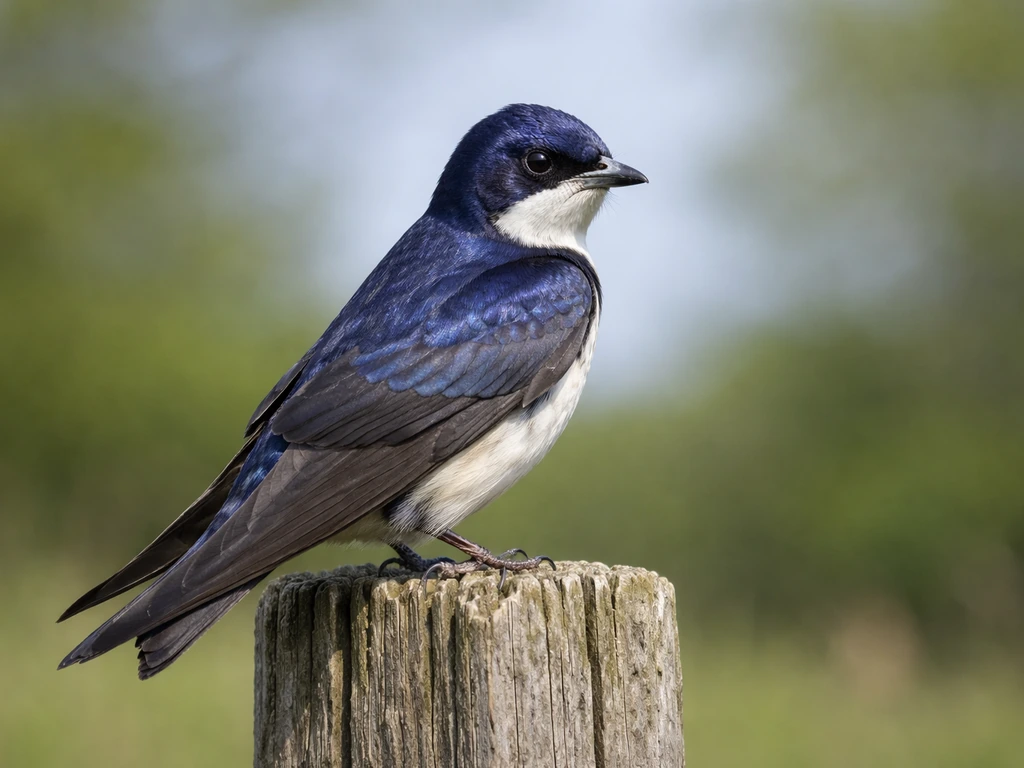
"Martin" isn't a single species name, it's more of a common name applied to several members of the swallow family (Hirundinidae). In the Americas, most martins belong to the genus Progne, which includes the Purple Martin, the Gray-breasted Martin of Central and South America, and the Cuban Martin, among others. If you're in the eastern United States or Canada during summer, the bird you're almost certainly looking at is the Purple Martin.
It's the largest swallow in North America and the one that nests in those distinctive multi-compartment birdhouses (called martin houses) you see in backyards and parks. If you're traveling through Mexico, Central America, or South America, you might be looking at a Gray-breasted Martin instead, which looks similar but has a paler underside. For the purposes of field identification, this guide focuses on the Purple Martin since that's who the vast majority of people are actually spotting.
Quick visual ID checklist: scan for these first
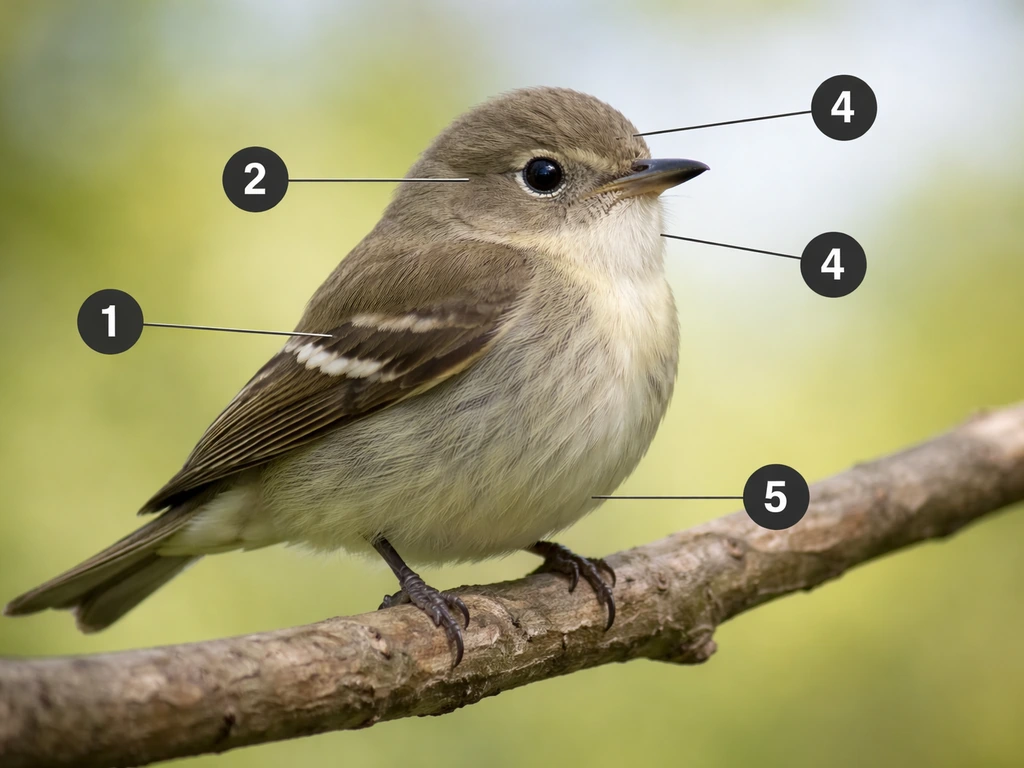
Before you get into the finer details, these are the features to zero in on the moment you spot a bird you think might be a martin. Run through them in order and you'll have a confident answer within seconds.
- Size: noticeably larger and bulkier than barn swallows or tree swallows
- Body color: dark all over, either glossy blue-black (adult male) or dull gray-brown above with a paler belly (female/immature)
- Wings: long and angular, with a pointed tip, held swept back in a smooth arc during gliding
- Tail: notched or slightly forked, not deeply forked like a barn swallow's, and roughly square-tipped
- Sheen: adult males show a strong iridescent blue-purple gloss in good light that no swallow species matches
- Belly and chest: adult males are dark below too, not just on the back; females have a dingy, pale lower belly
- Location: often circling above or near multi-room birdhouses or open water during summer months
Body shape and flight cues that set martins apart
Shape is one of the most reliable things to use when a bird is moving fast overhead and you can't see color detail. Purple Martins have a heavier, broader-chested build compared to most swallows, which tend to look sleeker and lighter. The wings are long and pointed, giving the bird a swept-back, almost triangular silhouette in a glide. You'll notice they alternate between a few quick wingbeats and a long, smooth glide, which feels slightly more leisurely and deliberate than the fluttery flight of smaller swallows.
The tail is a key structural tell. It has a noticeable notch in the middle, making it look slightly forked but not dramatically so. Adult male Purple Martins have a blank" rel="noopener noreferrer">glossy blue-black appearance above and below, with dusky black wings and tail and a distinctly notched tail. Think of it as a gentle V rather than the deep scissor-fork you see on a barn swallow. blank" rel="noopener noreferrer">Audubon describes it as a notched, square-tipped tail, which is a useful way to picture it. In juvenile birds, the tail can actually look surprisingly short and stubby, sometimes shorter than the wing feathers when the bird is perched, so don't expect a perfect adult silhouette on young birds.
Plumage colors and markings, head to tail
Adult males
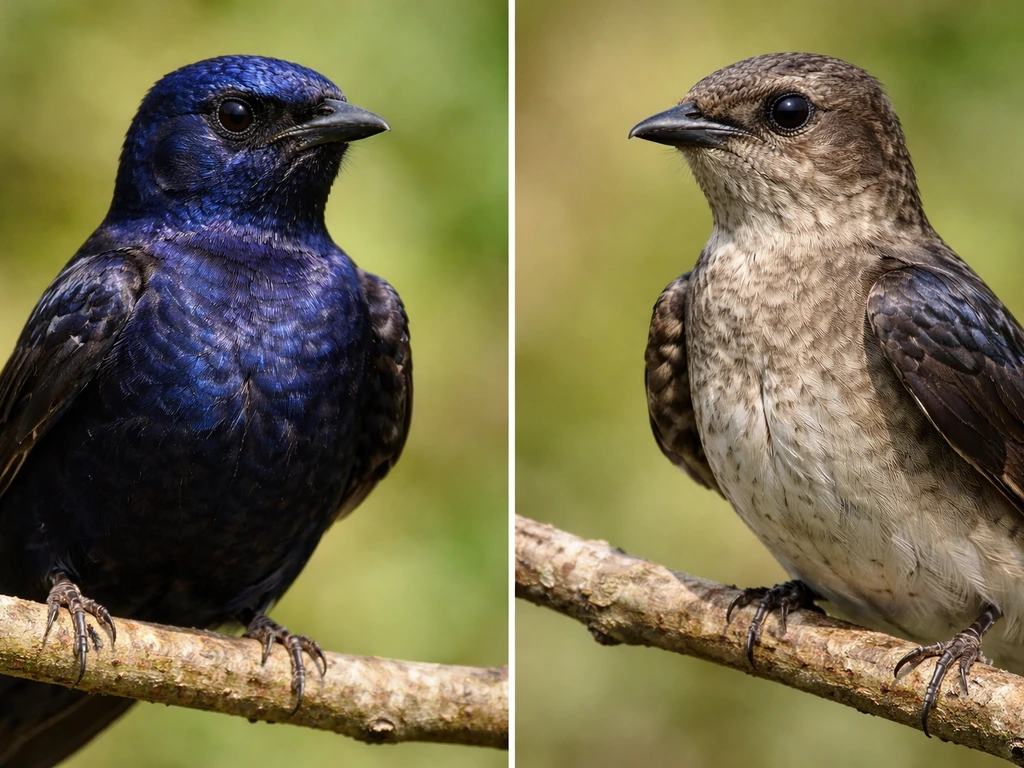
Adult male Purple Martins are one of North America's most striking aerial birds once you see them in the right light. The entire body, head, throat, chest, belly, and back, is covered in iridescent blue-purple feathers. Blue buntings are a smaller, bright blue passerine, and their look varies with light and age blue bunting bird look. In flat or overcast light they can look completely black, which catches a lot of beginners off guard.
But catch them in bright sun at the right angle and that glossy purple sheen lights up unmistakably. The wings and tail are dusky black with a slight sheen. There are no bold contrasting patches, stripes, or marks to look for on adult males; the key feature is that uniform dark iridescence covering the whole bird, top and bottom.
Adult females
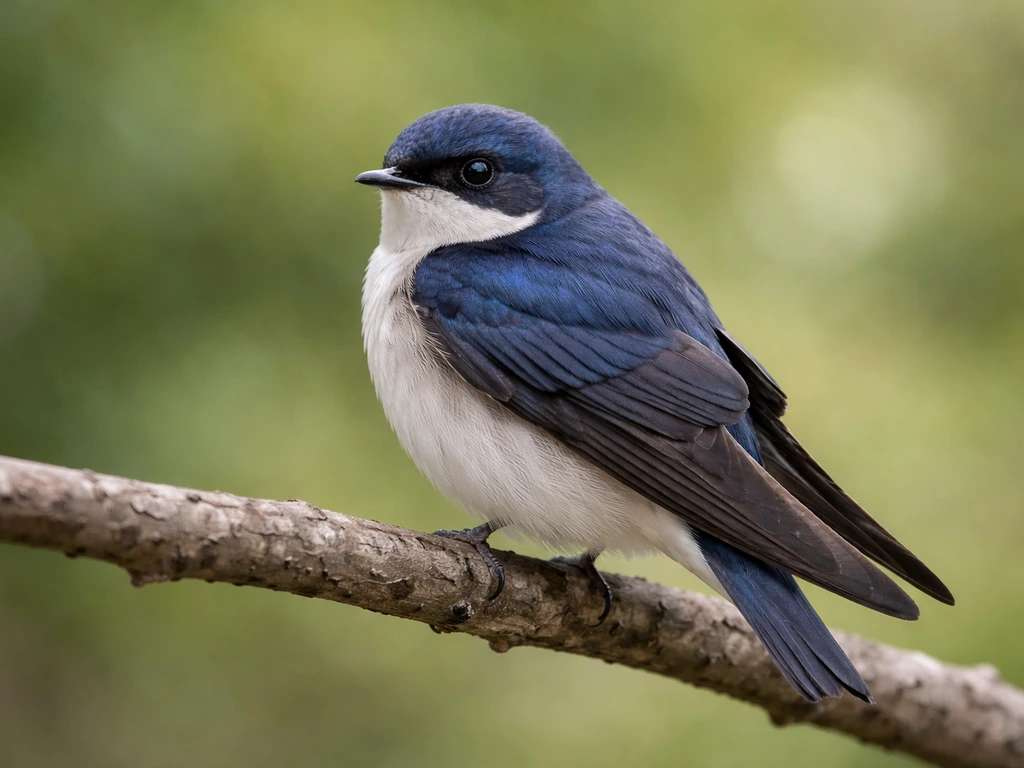
Adult females look quite different from males, which trips up a lot of first-time martin watchers. The back and wings still carry a dull blue-purple sheen, but it's much less flashy. The head and chest are grayish with some lighter scaling, and the lower belly is pale and somewhat dingy. Crucially, females lack the purple iridescence on the chest, belly, and undertail area entirely. If you're looking at a bird with a pale belly and a grayish chest but the same general size and shape as a martin, a female Purple Martin is a very likely answer.
Immature and first-year birds
Young birds in their first year look similar to adult females, with gray-brown tones below and a duller back. Young males may start showing patches of blue-black on the head or underparts, and you might notice darker shaft streaks running through the belly feathers. It takes a full two years for both males and females to reach their complete adult plumage, so during summer you'll frequently see birds that are somewhere in between. One useful detail: the undertail feathers on subadults are noticeably paler than on fully adult birds, which can be a helpful check when a perched bird fans its tail.
How to tell martins from common lookalikes
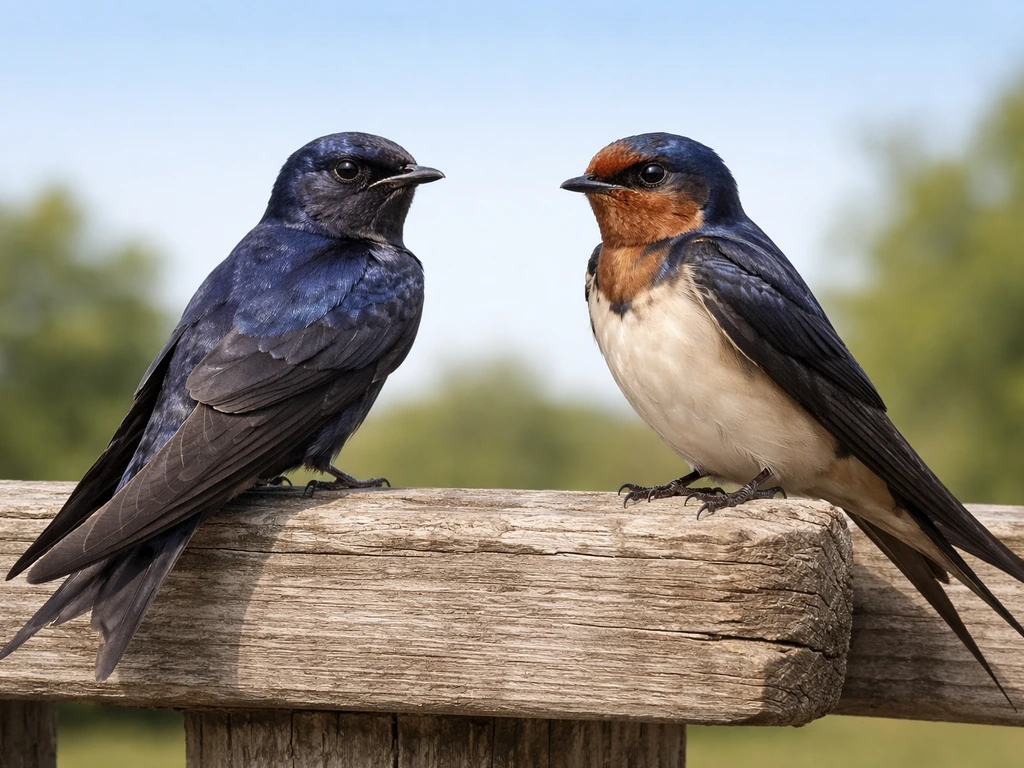
The bird most commonly confused with a Purple Martin is the Barn Swallow, partly because they share similar open-sky habitats around human structures. Here's how to separate the main candidates quickly.
| Feature | Purple Martin | Barn Swallow | Cliff Swallow | Northern Rough-winged Swallow |
|---|---|---|---|---|
| Size | Largest North American swallow, noticeably bulky | Medium, slender | Medium, compact | Small, long-bodied |
| Tail shape | Notched, slightly forked, square-tipped | Deeply forked, long streamers on adult | Square, barely notched | Square, slightly notched |
| Underparts (adult male) | Dark blue-purple all over including belly | Rusty/orange-buff chest and belly | Buff/pale rump, pale below with dark throat | Dull brownish throat, pale below |
| Back/upper color | Glossy iridescent blue-black | Metallic blue-black with rusty forehead | Dark blue cap, pale/orangish buff rump | Dull brown, no gloss |
| Key field mark | Uniform iridescent dark body, heavy build | Deep fork in tail, rusty underside | Pale buff rump patch, square tail | Plain brown, small head, low rapid flight |
The Barn Swallow's deeply forked tail is the single fastest separator. If you see long tail streamers trailing behind the bird in flight, that's a barn swallow, not a martin. Cliff Swallows are another common mix-up, but look for their distinctive pale buff rump patch, which stands out sharply against their dark back and is visible even in fast flight. Purple Martins have no rump patch whatsoever.
Northern Rough-winged Swallows are noticeably smaller and plainer, with a dull brown throat and no gloss anywhere on the body. Size alone usually rules them out once you have a martin nearby for comparison. The one thing to remember is that martins are bulkier and heavier-looking than any of these swallows, and in adult males, that iridescent dark-all-over look is unique.
Sex, age, and seasonal variation: what to expect throughout the year
Purple Martins arrive on breeding grounds in spring and are gone by late summer, so if you're seeing a martin-shaped bird in winter in North America, something else is more likely going on. Within the breeding season, the birds you'll encounter vary quite a bit depending on when in summer you look and whether the colony has fledged young yet.
Early in the season, you'll mostly see adult males in full iridescent plumage, which is the easiest ID of all. As the season progresses, females become more visible at the nest sites, and by late summer you'll start seeing lots of young birds learning to fly. Those juveniles are the trickiest to pin down because their plumage is dull and their tail can look stubbier than you'd expect.
The important thing to remember is that "less purple" doesn't mean "not a Purple Martin. " Focus on the shape, the bulk, the long angular wings, and the location near a martin house, and you'll still get to the right answer. As a note, you cannot reliably tell the sex of a hatching-year juvenile by sight, so if you're looking at a young bird, just confirm species-level traits and move on.
Field steps to confirm your sighting and get a confident ID
Here's a practical step-by-step process you can run through the next time you spot a bird you think might be a martin.
- Check the size and build first. Is it noticeably larger and chunkier than other swallows in the area? Purple Martins are the biggest swallow in North America, so if it looks stocky and heavy-chested, that's a strong start.
- Look at the tail in flight. Is it notched but roughly square-tipped, without dramatic streamers or a deep fork? A mild notch points toward martin; a deep fork points toward barn swallow.
- Assess the overall body color. Is the bird dark all the way around, including the belly? A truly dark belly rules out most swallows immediately. If you can catch any iridescent blue-purple sheen on the back or head, adult male Purple Martin is almost certain.
- Check the belly and chest on duller birds. If the bird is paler below with a dingy or grayish chest, look for whether the back still carries any bluish sheen. Female and immature martins still have that subtle glossy tone on the back even when the underparts are dull.
- Note the location and season. Are you near a multi-compartment martin house, an open field, or a lake edge in summer (roughly April through August in the US)? Martins stick close to their colony sites during breeding season, which narrows things down considerably.
- Rule out the common lookalikes. Run through the table above mentally: no deep fork (not a barn swallow), no pale buff rump (not a cliff swallow), too big and glossy (not a rough-winged swallow).
- If you're still unsure, check an eBird range map for your exact location and date. For most of North America, Purple Martin is the only plausible Progne species. If you're in Central or South America, a Gray-breasted Martin or another regional species might be in play, and the range map will tell you quickly which ones are expected.
If you enjoy identifying birds by their overall silhouette and color patterns, martins are genuinely satisfying once the system clicks. The adult male is one of those birds where, once you see that full iridescent purple-black body against a blue sky, you never forget it. And even the duller females and juveniles have that distinctive heavy build and gentle wing arc that starts to feel instantly recognizable after a few encounters.
A painted bunting has a compact, finch-like body, with bright blue, red, and green on the male and a more muted, brownish look on the female. If you find yourself drawn to brilliantly colored birds, you might also enjoy reading about what a painted bunting or a scarlet tanager looks like, since both share that same "unmistakable in good light" quality that makes field identification so rewarding.
If you're trying to identify a budgie, the best place to start is figuring out what a budgie bird looks like by checking the body shape, color, and markings what does a budgie bird look like. A painted bunting or a scarlet tanager can be great comparison birds too, but if you're asking what a bunting bird looks like, start by focusing on the male's bright colors and the overall compact shape.
FAQ
If I see a very dark bird overhead, how can I tell whether it is a Purple Martin or just a shadowy swallow?
First, check the overall bulk and wing shape, Purple Martins look heavier and more broad-chested than most swallows. Second, watch the flight pattern, they tend to alternate a few quick wingbeats with a longer glide. If you catch even brief light flashes on the body, the uniform iridescent look on adult males is the key clue.
Do Purple Martins have a noticeable rump patch like some other swallows?
No, Purple Martins do not show a pale or buff rump patch. If you see a stark light-colored patch on the lower back during flight, that points more toward species like Cliff Swallows rather than Purple Martins.
What should I look for when the tail is hard to see or the bird is perched?
When perched, focus on the tail outline rather than hoping to see iridescence. Purple Martins have a gentle middle notch that makes the tail look slightly V-shaped, not deeply scissor-forked. Also note that juveniles can have a shorter, stubby-looking tail, so use shape and bulk as your primary cues.
Can I reliably identify the sex of a young (first-year) Purple Martin by sight?
Usually no. Hatching-year birds can resemble females in overall dullness, and sex traits are not dependable at that stage. If you need certainty, confirm species-level features like size, heavy swallow shape, long pointed wings, and the notched tail, then avoid calling sex from a single snapshot.
Why do some martins look almost black in shade or overcast light?
Adult male Purple Martins have iridescent purple-black feathers that can appear nearly black when lighting is flat or the bird is at an angle. Move your attention to silhouette first, then wait for a clearer moment of sun or a body angle change to see the purple sheen.
I’m seeing a martin-like bird in winter. Does that mean it is a Purple Martin?
In North America, Purple Martins are typically absent in winter, they are a spring through late-summer breeding-season bird. A winter “martin-shaped” sighting is more likely a different swallow, a stray individual outside the usual timing, or an ID confusion, so rely on date and location before committing.
What’s the fastest mistake people make when identifying Purple Martins?
Over-focusing on color when the bird is not in good light. Color can mislead, especially with dull females, juveniles, and males in shade. Use structural cues first (bigger/heavier build, long angular wings, notched tail), then add color if lighting allows.
How can I avoid confusing Purple Martins with Barn Swallows when they are flying near buildings?
Use the tail as your first check. Barn Swallows show a deeply forked tail with obvious streamers, while martins have only a gentle notch that does not create dramatic tail streamers. If the bird’s tail looks like two long trailing points, treat it as a Barn Swallow until proven otherwise.