A 'calling bird' is any bird you notice primarily because it's making noise, whether that's a sharp alarm chip, a raspy mew from a thicket, or a loud caw overhead. The term isn't a strict scientific category, it's just a practical description for a bird that draws your attention through sound before you've even laid eyes on it. Visually, calling birds look exactly like their non-calling counterparts, so identifying them comes down to combining what you hear with what you can see: the bird's size and silhouette, bill shape, color pattern, posture, and the habitat it's calling from.
What Does a Calling Bird Look Like: Visual ID Guide

Marcus Whitley
14 Jul 2026
What people actually mean by 'calling bird'
Outside of ornithology textbooks, the phrase 'calling bird' just means a bird that is actively vocalizing in a way that grabs your attention. It shows up in everyday conversation, in field notes, and in casual bird reports where someone heard a bird before they saw it, or heard it and never saw it at all. The term also carries a cultural echo from the 'Twelve Days of Christmas,' where 'four calling birds' refers almost certainly to common blackbirds, though the original lyric may have said 'colly birds' (meaning coal-black birds). That song reference is probably why people search the phrase online, expecting a specific species.
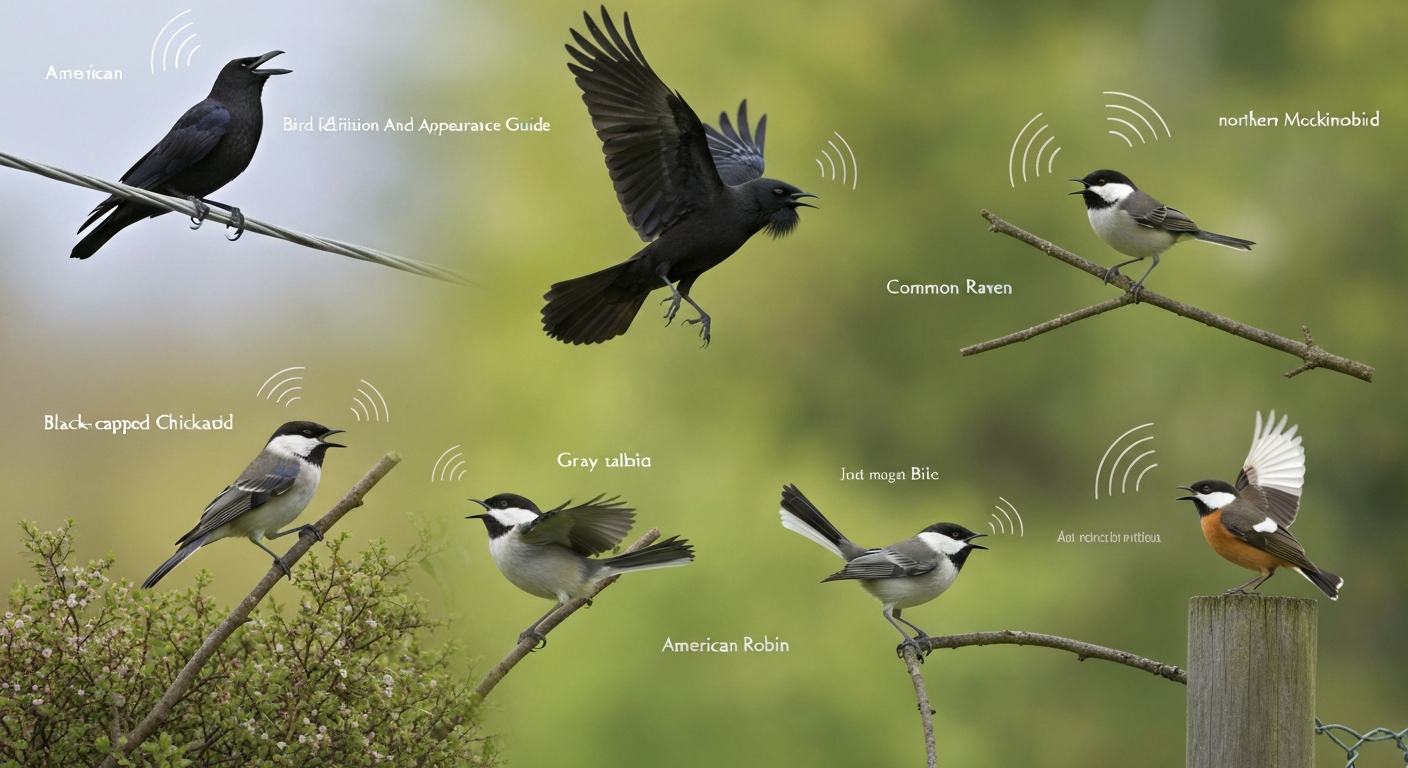
In practice, almost any bird can be a 'calling bird' in the right moment. Crows cawing from a rooftop, a Gray Catbird mewing from a shrub, a chickadee scolding a cat, a robin giving its sharp 'tut-tut' at dusk: all of these birds are 'calling' in the functional sense. What ties them together isn't appearance, it's the behavior of vocalizing in a way you can detect and react to.
Calling bird vs. singing bird: why the difference matters for ID
Ornithologists draw a working distinction between songs and calls, and it's useful to understand even if the line is fuzzy in real life. Songs are typically longer, more complex, and produced mainly by males defending territory or attracting mates, usually during breeding season. Calls are shorter, simpler vocalizations used for a wider range of purposes: keeping a flock together, sounding an alarm when a hawk flies over, signaling flight intention, or just checking in with a mate. That said, researchers acknowledge the boundary between songs and calls isn't sharp across all bird families globally, and some vocalizations don't fit neatly into either box.
For visual identification in the field, though, the distinction matters practically. A singing bird is often perched high, in the open, and singing repeatedly, which gives you time to look. A calling bird might be deep in cover, moving fast, or in flight, giving you only a brief glimpse. Alarm calls especially tend to be short and sharp, designed to be detected quickly by other birds rather than to be traced to a specific individual. That means you often get less visual time with a bird that's calling than with one that's singing.
Why calling birds catch your attention in the first place
Birds call in specific behavioral situations, and recognizing those situations helps you set up your eyes for a look. Alarm calls happen when a predator shows up, a cat walks under a bush, or a hawk passes overhead: you'll often see the calling bird in an upright, tense posture, sometimes bobbing or flicking its tail. Contact calls happen when a bird is moving through vegetation and keeping in touch with others, so look for movement in the foliage right where the sound is coming from. Flight calls are usually short and faint, so look up. Territorial calls often come from a prominent perch, which is actually your best chance for a good long look.
The key habit to build is to stop moving the instant you hear a call and watch the area where it came from. Birds giving alarm calls almost always stay in or near cover, but they betray themselves with small movements. Once you spot motion, that's when you apply the visual checks.
The external features to focus on when IDing a calling bird
The four pillars of visual bird ID work perfectly for calling birds: size and shape, color and pattern, behavior, and habitat. Experienced birders at Cornell's Bird Academy call these the '4 keys,' and they're reliable because you can apply them even with a partial or brief view. When a bird is calling, you might only catch a glimpse of its silhouette against the sky, or a flash of color in a bush. Running through these four checks quickly and systematically is what separates a confirmed ID from a guess.
Size and overall shape: your first filter
Before you can read any color or pattern, you can usually gauge a bird's size and rough proportions. The most useful mental anchor is the American Robin: most people have seen one up close and know it as a medium, upright bird about 10 inches long. Anything noticeably bigger than a robin, think crow-sized or larger, narrows your candidates considerably. Anything sparrow-sized (around 6 inches) points you toward finches, wrens, warblers, and similar small birds.
Proportions matter just as much as size. A bird with a round head, short neck, and compact body reads differently from one with a long tail, slender body, and upright stance. Look at the tail length relative to body length, the neck length, and how the bird holds itself. A mockingbird looks rangy and long-tailed even at a distance. A crow looks chunky and flat-headed. A wren looks almost spherical. These shape clues hold up even in poor light or at distance.
Bill and head features: often the fastest clue
Bill shape is one of the most reliable ID markers because it doesn't change with season, age (in adults), or lighting the way color can. A thick, seed-cracker bill points toward finches and grosbeaks. A long, curved bill suggests a thrasher or a wren. A stout, generalist bill belongs to thrushes, robins, and catbirds. A heavy, chisel-like bill on a large all-black bird? That's corvid territory, and you should immediately check whether it's crow-sized or noticeably larger.
Head markings help too. Look for caps (a darker or distinctly colored top of the head), supercilium stripes (pale lines above the eye), eye rings, and the overall head shape. A small, round head on a tiny body is typical of chickadees. A peaked crest makes a calling bird instantly recognizable as a cardinal, Blue Jay, or similar crested species. The gape (the corner where the upper and lower bill meet) can be visible at close range: a wide gape and pale gape edges often indicate a young bird still being fed, which is relevant if you're trying to explain an unusual-sounding call.
Plumage and color patterns: what to record and what to ignore
Color is the feature most beginners focus on first, but it can mislead you more than shape does. Lighting changes perceived color dramatically, a dark greenish bird in shade can look completely black, while a sparrow in full sun can look almost yellow. Focus on contrast patterns rather than absolute colors: is there a sharp two-tone split? Does the bird have a white wingbar, a rusty patch on the tail, or a pale belly against a dark back? Contrast is more stable across lighting conditions than color alone.
For calling birds specifically, check the undertail coverts (the feathers under the base of the tail) when the bird fans or cocks its tail. These are often a different color from the rest of the body and can be a clinching mark, the Gray Catbird's rufous (warm chestnut) undertail coverts are a perfect example of this. Also note the nape (the back of the neck): in some species like corvids, the nape color or texture (shaggy vs. smooth) is distinctive. Seasonal variation matters mainly in late winter through summer: some birds have brighter breeding plumage that fades by fall, so the time of year shapes what you should expect to see.
Posture, silhouette, and flight shape
Silhouette is what you rely on when a bird is backlit, distant, or moving fast. The overall outline, including how the bird holds its wings in flight, the tail shape, and the proportional relationship between head, body, and tail, is often enough for a confident ID if you know what to look for. Crows in flight look compact with broad, finger-tipped wings and a squared-off or slightly rounded tail. Ravens are noticeably larger in the same sky, with a longer, more tapered wing profile, a wedge-shaped or diamond-shaped tail, and a bulging throat that's visible even at distance when they call.
Perched posture is just as diagnostic. An upright, alert stance with a slightly raised tail is common in thrushes, catbirds, and mockingbirds. A hunched, horizontal posture is more typical of corvids at rest. Wrens cock their tails nearly vertical. Learning these resting postures means you can make a strong genus-level guess from across a parking lot before you even raise your binoculars.
Behavior and perching habits: where a calling bird sits tells you a lot
Where a bird positions itself while calling is a strong clue to its identity. Mockingbirds and Song Sparrows often call and sing from exposed, prominent perches at the tops of shrubs or fence posts. Gray Catbirds call from deep inside dense shrubs and rarely come into the open while vocalizing. American Crows call from high points: rooftop edges, utility lines, tall trees. Chickadees calling a 'chick-a-dee-dee' alarm call may be moving through a mixed flock at mid-height in trees, often with other small birds mobbing a predator nearby.
Watch for specific behaviors that accompany calling. Tail-pumping while calling is common in American Robins. Wing-flicking or drooping wings during calls can indicate alarm or territorial aggression. A bird doing repeated short flights from perch to perch while calling is likely defending territory or tracking an intruder. These behavioral notes lock in an ID much faster than color alone.
Habitat clues: the environment narrows your candidate list fast
Before you even look at a bird, the habitat it's in rules out a huge number of species. A calling bird in a dense suburban shrub border is almost certainly not the same species as one calling from an open agricultural field, even if they sound similar. Tools like eBird's abundance maps let you check which species are actually expected in your area and season before you commit to an ID, which is a surprisingly powerful shortcut. If a species shouldn't be at your location in July, it's not your most likely candidate.
- Dense shrubs and thickets: Gray Catbird, Song Sparrow, Yellow Warbler, wrens
- Open woodland edges and tall trees: American Crow, Blue Jay, American Robin, woodpeckers
- Open fields and grasslands: Eastern Meadowlark, Red-winged Blackbird, American Kestrel
- Suburban lawns and parks: American Robin, House Sparrow, Northern Mockingbird, European Starling
- Conifer forests: Black-capped Chickadee, Red-breasted Nuthatch, various thrushes
- Urban rooftops and structures: American Crow, Common Raven (in range), Rock Pigeon, gulls
Common calling-bird examples: what they actually look like
American Crow
All-black from bill to tail, roughly robin-sized but stockier, around 17 to 21 inches long. The bill is stout and relatively short for a corvid. In flight, the tail looks square or gently rounded at the tip. The wings are broad and the wingtips spread into distinct 'fingers' at full extension. Perched, the crow looks flat-topped with a fairly smooth nape and holds itself horizontally. Voice is the familiar, repeated 'caw.' You might see the throat move visibly when it calls.
Common Raven
Also all-black, but noticeably larger than a crow, more like a hawk-sized bird at 22 to 27 inches. The bill is heavy, long, and curved at the tip, which is visible even at a distance. The throat has shaggy 'hackle' feathers that puff out when the bird calls, giving it a bearded look. In flight, the tail has a clear wedge or diamond shape, and the wings look longer and more pointed than a crow's. Ravens tend to soar more; crows flap steadily. The call is a deep, hollow croak, not a caw.
Gray Catbird
Medium-sized, about the length of a large sparrow to a small robin (around 8 to 9 inches), with a slim, long-tailed silhouette. The plumage is uniform slate gray across most of the body, with a distinctive black cap on top of the head. The most reliable mark is the rufous (warm chestnut-red) undertail coverts, visible when the bird cocks or fans its tail. Sexes look the same. It tends to stay low in dense shrubs, so you often see only partial views: a gray head poking out, a flash of the rusty undertail as it turns. Its signature call is a down-slurred, cat-like 'mew' that sounds almost like a whiny kitten. Gray Catbird, Life History (All About Birds / Cornell) notes the species gives a cat‑like “mew” and a varied mimicking song, and typically does not repeat phrases multiple times like the Northern Mockingbird blank" rel="noopener noreferrer">Gray Catbird — Life History (All About Birds / Cornell).
Black-capped Chickadee
Tiny and round-bodied, about 5 inches long, with a large round head that looks slightly too big for its body. The color pattern is unmistakable: black cap, black bib under the bill, white cheeks, gray back, and whitish underparts with buffy flanks. The bill is short and pointed. Chickadees are acrobatic, often hanging upside down on branch tips while foraging and calling. The 'chick-a-dee-dee' call is a contact and alarm call that gets more 'dee' notes added when danger is closer.
American Robin
The reference-point bird: about 10 inches, upright, with a round head, medium bill, brick-red or orange-red breast (deeper orange-red in males, slightly duller in females), dark gray-black back, and a white eye ring. The alarm call is a sharp, staccato 'tut-tut-tut' or a thin 'seee' that it gives while tail-pumping. Robins are easy to spot because they spend a lot of time on open lawns.
Northern Mockingbird
A medium to medium-large bird (about 10 inches) with a slim, long-tailed build and slightly drooping wingtips. It's gray above and pale below, with white wingbars and large white wing patches that flash conspicuously in flight. The tail is long and often held slightly cocked. Mockingbirds are famously loud and call or sing from exposed perches at any hour. Unlike the Gray Catbird, which tends to stay hidden, mockingbirds seem to want to be seen.
Species at a glance
| Species | Size | Key color marks | Bill type | Typical call perch |
|---|---|---|---|---|
| American Crow | 17–21 in, stocky | All black, smooth nape | Short, stout | Treetops, utility lines |
| Common Raven | 22–27 in, large | All black, shaggy throat hackles | Long, heavy, curved | Rocky outcrops, tall trees |
| Gray Catbird | 8–9 in, slim | Slate gray, black cap, rufous undertail | Short, pointed | Inside dense shrubs |
| Black-capped Chickadee | ~5 in, round | Black cap and bib, white cheeks, gray back | Tiny, pointed | Mid-height branches |
| American Robin | ~10 in, upright | Orange-red breast, dark back, white eye ring | Medium, straight | Open lawns, fence posts |
| Northern Mockingbird | ~10 in, slim | Gray, white wingbars and wing patches | Medium, slightly curved | Exposed high perches |
Lookalikes and how to avoid being fooled
The most common misidentification trap with calling birds is hearing something unusual and jumping to an unlikely conclusion. All-black birds cause the most confusion: American Crows and Common Ravens are frequently mixed up, and in parts of the southwestern US, Chihuahuan Ravens add a third layer of difficulty. Even experienced birders with photos in hand sometimes disagree on raven ID, because regional size variation and individual variation overlap. The rule of thumb is: use the full package, size, bill, tail shape, throat feathering, and voice together rather than any single mark. See American Crow, Audubon Field Guide for guidance that all‑black corvids are best distinguished by posture, proportions, flight silhouette, and vocal cues rather than by size alone American Crow — Audubon Field Guide.
The 'ghost bird' concept is worth mentioning here because it comes up in rare-bird claims and online bird ID discussions. A 'ghost bird' usually refers to a species reported based on a brief or ambiguous sighting, where sound alone or an unclear photograph drives the claim. These reports tend to involve species that are extremely rare or possibly extinct (like the Ivory-billed Woodpecker) and a call or knock heard in a forest. The lesson for visual ID is: a vocalization without a clear, documented look at the bird is not a confirmed sighting. You need to see the bird.
Gray Catbird and Northern Mockingbird are frequently confused in dense vegetation because both are gray mimids that call from cover. The key split is the catbird's black cap plus rufous undertail, combined with its tendency to stay hidden. Mockingbirds are larger, paler below, show white wing patches in flight, and almost always move to open, visible perches. If you can see the undertail and there's a warm rusty patch there, it's a catbird.
Your field-ID checklist for calling birds
- Stop and locate the sound: stand still and use your ears to pinpoint the direction and height of the call before moving.
- Check size immediately: is it sparrow-sized, robin-sized, crow-sized, or larger? This alone rules out most candidates.
- Note the silhouette: overall proportions, tail length relative to body, head size, and how it's holding itself (upright vs. horizontal).
- Look at the bill: thick and seed-cracking, thin and pointed, long and curved, or heavy and chisel-like?
- Scan for color contrast: look for caps, wingbars, breast color, and undertail coverts rather than trying to name an exact color.
- Watch the behavior: is it tail-pumping, tail-cocking, wing-flicking, or staying perfectly still? Is it in the open or deep in cover?
- Note the habitat: what kind of vegetation or structure is it in? Open field, dense shrub, tall tree canopy, or building?
- Consider the season and your location: check whether the species you're thinking of is expected here, at this time of year.
- Cross-check with a second mark: never confirm on one feature alone. Find at least two matching characteristics before deciding.
How to photograph calling birds and record useful visual evidence
If you have a phone or camera with you, the goal isn't a perfect portrait photo but a documentation photo that captures the features most useful for ID. Even a blurry, backlit shot can confirm size relative to a perch, tail shape in flight, or the presence of a wingbar. A few targeted shots are worth more than a dozen frames of the same angle.
- Get a side-profile perched shot first: this shows bill length and shape, body proportions, tail length, and most plumage marks.
- If the bird is calling, try to capture it with its bill open: this shows gape size and can confirm posture and throat pattern.
- Photograph the undertail if the bird fans or cocks its tail: the undertail coverts are often a clinching mark.
- Get a flight shot if possible, even a poor one: wing shape, tail shape, and wingtip pattern are often diagnostic.
- Frame comparison shots: if a second bird of a known species (like a House Sparrow or robin) is nearby, get them in the same frame for scale.
- Record metadata: note the date, exact location, time of day, habitat type, and weather in your photo caption or voice memo immediately after shooting.
- Take a short video if you can: even 10 seconds of video captures posture, movement, and tail habits that a still photo misses.
Where to go from here
Once you've identified your calling bird visually, you can go much deeper. If you're curious about the internal structure behind those powerful calls, articles on what a bird skeleton looks like and what a bird heart looks like explain the anatomical machinery that produces and sustains avian vocalizations. The skeleton piece is especially useful for understanding how different bill structures correlate with different bird families. For a visual guide, see the article “what does a bird skeleton look like,” which explains bird bone structure and how bill shapes relate to feeding strategies. For specific mimid species, an article on what a female catbird looks like covers the subtle plumage differences that trip up beginners who are used to seeing the male. For specific mimid species, an article on what does a female cat bird look like explains the subtle plumage differences that commonly trip up beginners. And if a local report of an unusual calling bird has you chasing something potentially very rare, understanding the visual expectations around what a ghost bird looks like will help you evaluate those claims critically before heading out.
Glossary of terms used in this guide
| Term | What it means in plain language |
|---|---|
| Silhouette | The overall outline or shadow-shape of a bird, as seen at distance or against a bright sky. Useful when color and detail aren't visible. |
| Gape | The corner of the mouth where the upper and lower bill meet. A wide gape with pale or fleshy edges often indicates a juvenile bird. |
| Undertail coverts | The small feathers on the underside of the tail base. Often a different color from the belly and can be a key ID mark (e.g., rufous in the Gray Catbird). |
| Nape | The back of the neck. In many species the nape color or texture (smooth vs. shaggy) differs from the head or back and is a useful field mark. |
FAQ
What do people mean by “calling bird” in casual birdwatching?
A “calling bird” usually refers to any bird that is easily noticed by its calls — short vocal notes used for alarm, contact, or flight — rather than long courtship songs. It’s an informal, listener‑focused label, not a formal taxonomic group: observers often call something a “calling bird” when its distinct calls are the primary clue to its presence.
How is a “calling bird” different from a “singing bird”?
Broadly, songs are longer and more complex vocalizations used mainly for territory and mate attraction, while calls are shorter, simpler sounds used for alarms, contacts, or keeping flocks together. The boundary is fuzzy for some species, so use the behavior and context (where the bird is, what it’s doing) to decide whether you heard a call or a song.
What are the most useful visual features to check when identifying a calling bird?
Use the 4 keys: size & shape (silhouette and proportions), bill type and length, plumage color and pattern (head, wings, tail, undertail), and behavior/posture (foraging method, perch style, flight). Also note habitat (shrub, canopy, open field), since many calling behaviors are tied to particular environments.
How should I use size and shape to ID a calling bird from a distance?
Assess overall size relative to familiar species (sparrow, robin, crow). Note silhouette: long-tailed vs short-tailed, rounded vs slim body, and bill shape (thin/pointed, thick/conical, hooked). Shape and silhouette hold up at distance better than fine plumage details.
Which bill features help narrow down species that make distinctive calls?
Bill length, thickness, and shape indicate feeding style and group (insectivores have thin pointed bills; seed-eaters thicker bills; corvids have heavy bills). A stout heavy bill on a black bird suggests a corvid, while a thin straight bill on a gray bird suggests a mimid like Gray Catbird.
What plumage details should I photograph to support a calling-bird ID?
Get shots of head (cap/eye line), back and wing pattern (bars/wings), tail shape and any distinctive undertail or rump color, and overall shade. For dark birds, expose for detail to show bill shape and throat feathers. Take at least one perched and one in-flight or flared‑tail picture if possible.