A canary is a small, compact songbird roughly the size of a large grape or a house sparrow, typically between 4. 5 and 5 inches long. Most people picture a bright lemon-yellow bird, and while that's the most iconic look, canaries actually come in a wide range of colors including orange, white, cinnamon, green, and even red-orange, depending on the variety.
What Does a Canary Bird Look Like? Identification Guide

Marcus Whitley
15 May 2026
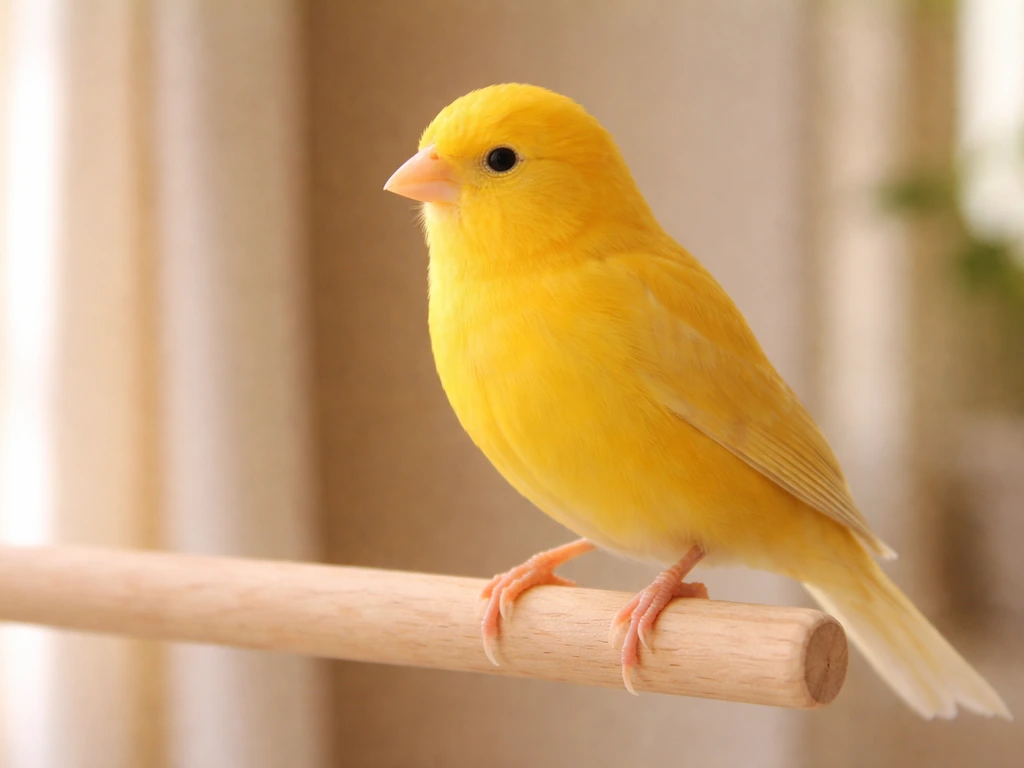
What stays consistent is the body shape: a plump, rounded chest, a short stubby bill, and a slightly notched tail. If you've spotted a small bright bird that looks a bit like a finch but with a softer, rounder profile and no bold wing bars, there's a good chance you're looking at a canary.
A macaw is a very different type of parrot, so if you are trying to figure out what a macaw bird looks like, look for large size, bold colors, and a thick parrot-style beak a canary. If you want to compare more than just canaries, you can also look up what a cuckoo bird looks like to spot differences in size, shape, and pattern what a cuckoo bird look like.
What a canary usually looks like at a glance
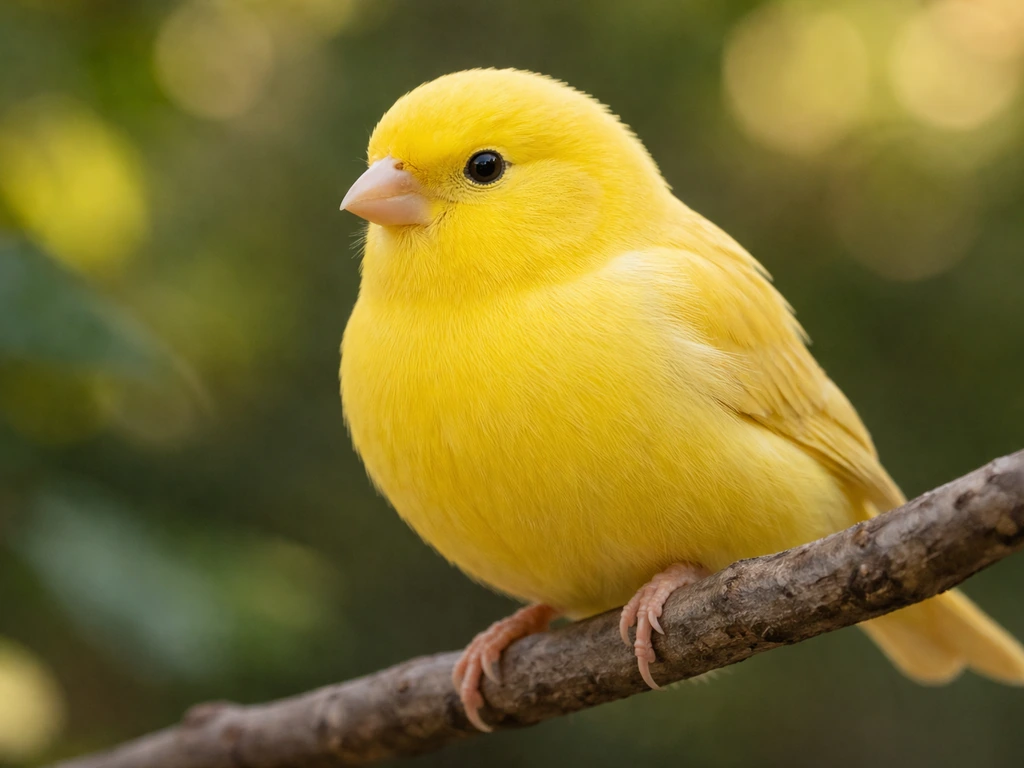
The classic domestic canary is a tidy, small bird with a smooth, soft appearance. Its body is stocky without looking heavy, and the head is rounded with a short, cone-shaped bill. The tail is medium length and slightly forked or notched at the tip. In terms of size, picture something close to a goldfinch or a small sparrow, compact enough to fit comfortably in the palm of your hand.
The wild canary (native to the Canary Islands, Madeira, and the Azores) is actually quite different from the bold yellow pet-store bird most people imagine. In the wild, these birds are streaky olive-green and yellow, blending into foliage much like a greenfinch would. It's centuries of selective breeding that gave us the vivid, clean-colored domestics we recognize today. So if you're looking at a photo and the bird is streaky rather than solid-colored, it could still very much be a canary.
Key features to check first: color, shape, bill, wings, and tail
When you're trying to confirm whether a bird is a canary, start with these five things in order. They'll narrow it down fast.
- Color: Domestic canaries come in yellow, orange-yellow, red-orange, white, cinnamon-brown, and various green shades. The color is usually solid or softly variegated, not sharply patterned in bold stripes or patches.
- Body shape: Compact and rounded, with a full chest and a posture that sits slightly upright. Think 'little barrel with a tail.'
- Bill: Short, conical, and pointed, similar to a finch but generally a bit softer and less heavy-looking than a goldfinch's bill. It curves gently to a fine tip.
- Wings: Canary wings are short and held tightly against the body when at rest. Most domestic canaries have no strong wing bars. Wild-type or green canaries may show faint paler wing edging, but nothing dramatic.
- Tail: Medium length, slightly notched at the tip (not deeply forked like a swallow, and not square-ended like a robin). When perching, the tail often flicks or fans slightly.
One thing a lot of people overlook is posture. Canaries tend to perch in an upright, alert stance with their legs clearly visible. They're active and restless, constantly shifting position. If you're watching a bird in a cage or aviary, this constant perch-hopping with bright, alert eyes is very characteristic.
Common canary varieties and how their looks differ
Here's where it gets genuinely interesting, because 'canary' isn't one single look. Breeders have developed dozens of varieties over the past several hundred years, and they fall into a few broad categories based on what was selectively bred: color, song, or body type/feather style.
Color-bred canaries
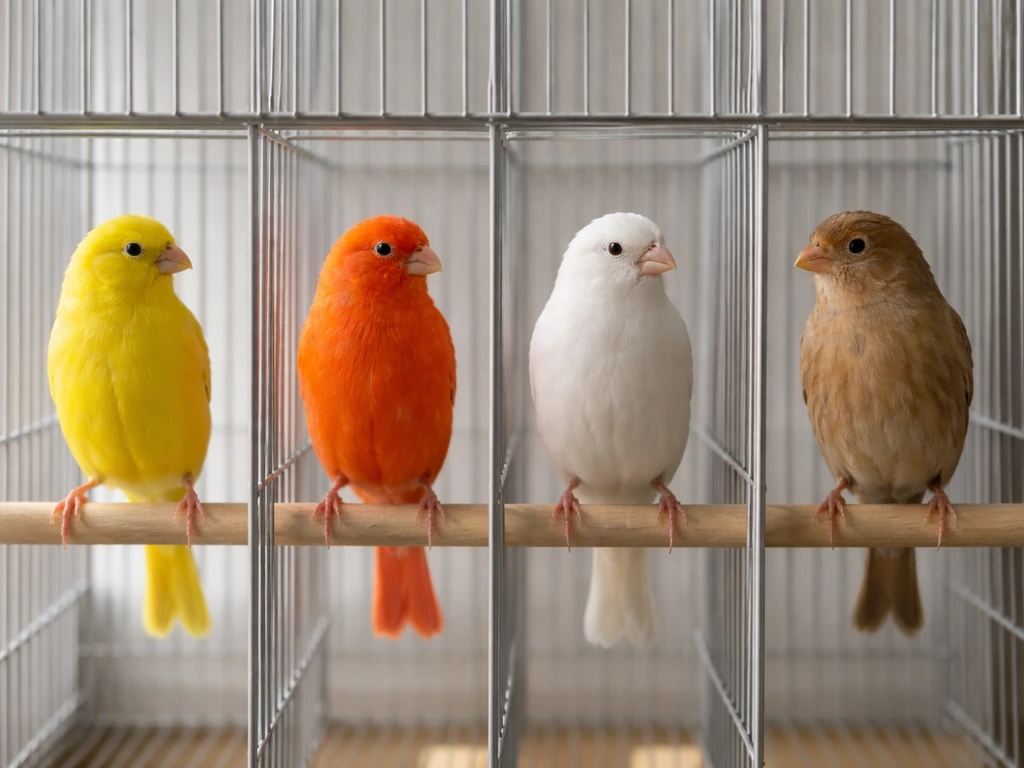
These are what most people picture. Yellow is the classic, and it ranges from pale butter-yellow to a deep, almost greenish-yellow. Orange and red-factor canaries are bred to express warm orange and red-orange tones, often intensified by diet. White canaries are either pure white or have a slight yellow tinge. Cinnamon canaries are a warm buff-brown, and the feathers have a slightly softer texture. Variegated birds are a mix, showing patches of yellow or color against white or green.
Type canaries (body shape focus)
Varieties like the Yorkshire canary and the Belgian canary are tall and slender, giving them a more upright, elongated look compared to the typical rounded pet-store canary. The Gloster canary is noticeably rounder and smaller, and many Glosters have a distinctive crest of feathers on top of the head that looks like a little mop or a bowl cut. If you see a small yellow bird with an obvious feathery crest, it's almost certainly a crested Gloster (called the 'corona' type). Norwich canaries are very round and almost fluffy-looking, sometimes described as the teddy bear of the canary world.
Wild-type and green canaries
The wild island canary is streaky olive-green and yellow above, with a yellowish-green face and breast and streaking on the back and flanks. It looks much more like a siskin or greenfinch than a domestic canary. If you're looking at a bird in a naturalistic setting or an outdoor aviary that matches this description, that's your wild-type reference point.
How male and female canaries may look different
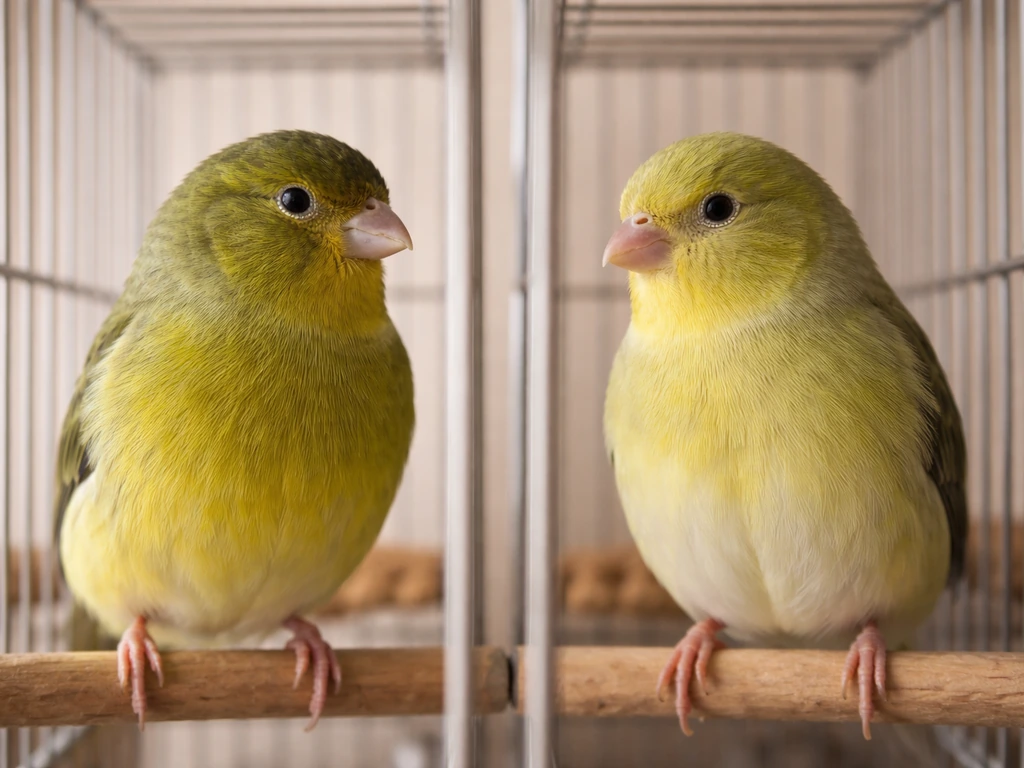
In many domestic varieties, males and females look essentially identical in color and body shape, which is one reason sexing canaries visually can be tricky. The most reliable visual clue comes during breeding season: male canaries often show a slight swelling around the vent (the cloaca), but this is very subtle and hard to see without experience.
In wild-type and green canaries, the differences are a bit clearer. Males tend to have brighter, more saturated yellow-green plumage with a cleaner, more vivid face mask. Females are usually duller overall, with more obvious streaking on the breast and flanks. The yellow on the female's face and underparts is often more washed-out and less intense.
In color-bred varieties like red-factor canaries, males often develop a more intense coloration because they sing more and metabolize color-enhancing carotenoids differently. Even then, it's not a reliable rule across all strains. With crested varieties like the Gloster, both sexes can have the crest (corona) or lack it (consort), and the crest style doesn't predict sex.
| Feature | Male (wild-type/green) | Female (wild-type/green) | Domestic varieties (general) |
|---|---|---|---|
| Plumage color | Brighter yellow-green, vivid face | Duller, more washed-out | Often identical between sexes |
| Streaking | Less streaking on breast | More pronounced streaking | Usually absent in solid-color birds |
| Song | Regular, complex singing | Quieter, rarely sings | Males sing frequently and loudly |
| Vent area | Slight swelling in breeding season | Flatter profile | Requires close inspection |
Canary look-alikes: small yellow birds and how to tell them apart
A bright yellow bird perched in your yard or photographed at a feeder could be several different things. If you’re wondering what a cow bird looks like, it can help to compare size, color pattern, and bill shape side by side with the most likely look-alikes yellow birds. Here are the most common mix-ups and the quickest way to sort them out.
American Goldfinch
This is the most common confusion in North America. The male American Goldfinch in summer is a vivid lemon-yellow with bold black wings and a black forehead cap, and a white wing bar. That combination of jet-black wings and cap against pure yellow is not something you'll see on a domestic canary. Canaries have no black on the head or wings. In winter, the goldfinch fades to an olive-buff color, closer to a wild-type canary, but still shows those white wing bars.
Eurasian Siskin
Siskins are small and green-yellow, with streaky flanks and distinctive yellow patches at the base of the tail and along the wing edges, creating a flash of yellow in flight. The male has a black cap and bib. If the bird you're looking at has streaks on the flanks, yellow wing flashes, and a black cap, it's almost certainly a siskin, not a canary.
Yellow Warbler (North America)
Yellow Warblers are a brighter, more uniform yellow than most canaries, with reddish-brown streaking on the breast in males. They also have a noticeably more slender build, a thinner and more pointed insect-catching bill (very different from the canary's stubby finch bill), and they move in a flitting, quick style through foliage. The thin bill is the fastest tell.
Common Greenfinch
Greenfinches are larger and stockier than canaries, with a noticeably thicker, heavier bill and bright yellow-green wing and tail flashes visible when the bird moves. The overall build feels heftier. A canary next to a greenfinch looks noticeably slimmer and softer.
| Bird | Bill type | Wing pattern | Distinctive marks | Size vs canary |
|---|---|---|---|---|
| Domestic Canary | Short, cone-shaped, fine-tipped | Plain, no bold bars | Solid or soft color, no bold head pattern | Baseline |
| American Goldfinch | Short conical, slightly thicker | Bold black wings, white bars | Black forehead cap (male, summer) | Similar or very slightly smaller |
| Eurasian Siskin | Fine, pointed | Yellow wing flashes | Black cap and bib (male), streaky flanks | Slightly smaller |
| Yellow Warbler | Thin, pointed (insectivore) | Plain yellow | Reddish breast streaks (male) | Smaller, more slender |
| Common Greenfinch | Thick, heavy | Bright yellow-green flashes | Heavy build, large bill | Noticeably larger |
If you're looking at birds in the parrot and large-psittacine world for comparison, canaries are far smaller and lack the curved beak that defines birds like cockatoos or macaws. Even the smallest conure is noticeably bigger, with a hooked bill that a canary's finch-style beak looks nothing like.
How to identify a canary from a photo: a step-by-step checklist
When you're working from a photo rather than a live sighting, follow these steps in order. Most identifications will be resolved by step four.
- Check the bill first. Zoom in on the beak. It should be short, cone-shaped, and gently pointed, not hooked, not needle-thin, and not thick and heavy. If it's thin and pointed like tweezers, you're probably looking at a warbler. If it's heavy and blunt, think greenfinch or finch.
- Look at the overall body proportions. A canary is rounded and compact with a full chest. If the bird looks lanky, elongated, or especially slender, it's probably not a standard canary variety (though some type breeds are more upright).
- Examine the wings and head for bold patterns. Black caps, black wings, bold white bars, and black bibs all rule out most domestic canaries and many wild-type canaries too. Plain wings and a plain head point toward canary.
- Note the color tone. Is it a solid clean color, or does it have streaks? Streaky olive-green with yellow tones suggests wild-type canary or siskin. Bold contrasting patches suggest goldfinch. Solid yellow, orange, white, or cinnamon is consistent with a domestic canary.
- Check for a crest. If the bird has a round tuft of feathers on its head that looks like a small tousled cap, it's almost certainly a crested canary variety, most likely a Gloster corona.
- Look at the tail. Slightly notched at the tip, medium length, usually held still or fanned slightly when perching. If the tail is deeply forked or held in a distinctive cocked position, you're probably looking at a different species.
- Consider the context. Is this bird in a cage, aviary, or backyard feeder in a region where canaries aren't wild? Escaped or kept domestic canaries are the most likely explanation for a solid bright-yellow bird outside the Canary Islands or Azores.
If the bird looks unusually colored
Canaries come in enough color mutations that an unusual color doesn't rule them out. A pinkish-white canary, a deep cinnamon bird, or an intensely orange-red one are all legitimate canary colors from selective breeding. Before ruling out 'canary' because the color seems odd, check the bill shape and body proportions first. If those match, you're almost certainly still looking at a canary, just an unusual color strain.
Where to find reliable visual references to match your specific bird
For domestic varieties and color mutations, canary breeder association galleries and aviculture websites are your best resource, since general bird field guides focus on wild species and won't cover most domestic canary strains. For wild-type island canary appearance, the [BirdLife International species factsheet](https://www. birdlifedata. blob.
core. windows. net/sub-global/8761serinuscanaria. pdf) and blank" rel="noopener noreferrer">Cornell Lab of Ornithology's identification framework give you a solid, consistent baseline using the same features described here (bill, head, wing pattern, underpart coloration).
BirdLife DataZone provides an authoritative species factsheet entry for the Island canary (Serinus canaria) BirdLife International species factsheet. Searching specifically for the variety name you're trying to match, like 'Gloster canary' or 'red-factor canary,' will pull up targeted photo galleries far more quickly than a general bird ID app.
If you're working from a photo of an unfamiliar yellow bird and need to rule out wild species, upload the image to a bird ID app like Merlin (Cornell) and check the closest matches against the checklist above.
FAQ
What should I look for if the bird is yellow but not the exact lemon color people expect?
If the bird is yellow but has any clear black on the head or wing, it is usually not a canary. Domestic canaries can be yellow, orange, red-orange, white, cinnamon, or greenish tones, but they do not show the bold black cap and black wing pattern typical of American goldfinches in summer.
Can a streaky yellow-green bird still be a canary?
Yes. Wild island canaries often look streakier and more olive-green than the clean, solid-colored pet-store bird, so “streaks” can still mean canary. Use the combination of small size, stubby finch-style bill, and rounded body profile to confirm rather than relying on color being solid.
How does a canary usually sit or perch compared with similar small yellow birds?
A canary’s posture is a strong clue, especially in live sightings. They typically perch upright with visible legs, look alert with bright eyes, and make frequent, restless position changes. Birds that consistently crouch lower or hold a more horizontal, boisterous posture are less likely to be canaries.
Is the forked or notched tail tip a reliable identifier?
Don’t rely on tail shape alone in photos. Canaries often have a medium tail that is slightly forked or notched at the tip, but the tail can look different depending on angle, motion blur, or whether the bird is hopping. Confirm with the stubby, cone-shaped bill and the soft, rounded body rather than only the tail notch.
What if the photo is blurry and I cannot clearly see the bill?
If you cannot see the bill clearly, look for body proportions and head shape. Canaries have a short, stubby cone-shaped bill and a rounded head with a plump, compact chest. A bird with a noticeably longer, pointed insect-catching bill (more warbler-like) is unlikely to be a canary even if it is yellow.
Can I tell male vs female from appearance alone?
In many domestic canary strains, males and females look very similar in everyday appearance, and crest presence or absence also does not reliably indicate sex. The most dependable visual sex clue mentioned for canaries is subtle vent-area swelling during breeding season, which is hard to see without close observation.
What can explain a canary that looks extra round or fluffy?
If the bird seems “too fluffy” and very round, it could be a Norwich-type canary. Those varieties are often described as teddy-bear-like due to their fuller look, so an unusually rounded silhouette is not automatically a misidentification.
How should I use a bird ID app when I’m pretty sure it’s a canary?
Most bird ID apps are strongest when they can compare multiple features, so use a clear, well-lit photo that shows the head and both wings. If your bird looks like a canary but the app suggests something with black head or wing bars, double-check the checklist items in your article, because that black pattern is usually the key mismatch.
What’s the right order to confirm “unusual color” canaries from a photo?
If you are trying to confirm whether an odd color mutation is still a canary, start with structure first. Match the compact size, rounded chest, short stubby bill, and slight tail notch, then treat color as a secondary check. Color alone is the easiest way to overrule the identification incorrectly.
Why do wild-type canaries look confusing compared with domestic ones?
Wild island canaries are harder to call from distance because they blend like foliage and can resemble siskins or greenfinches. Use the total impression, small size, streaking pattern, and underparts coloration, and remember they are typically streaky olive-green and yellow rather than solid bright yellow.