A cockatoo is a medium-to-large parrot with one feature that makes it instantly recognizable: a prominent, movable crest on the top of its head. That crest fans out, rises up, or flattens depending on what the bird is feeling, and it's the first thing you'll notice. Add a strongly curved, hooked beak, a stocky body, and plumage that's usually white, pink, or grey (rarely the vivid greens and blues you see in macaws or conures), and you've got a bird that looks quite different from most other parrots once you know what to look for.
What Does a Cockatoo Bird Look Like? Cockatiel vs Cockatoo

Marcus Whitley
12 May 2026
Cockatoo vs cockatiel: quick identity check
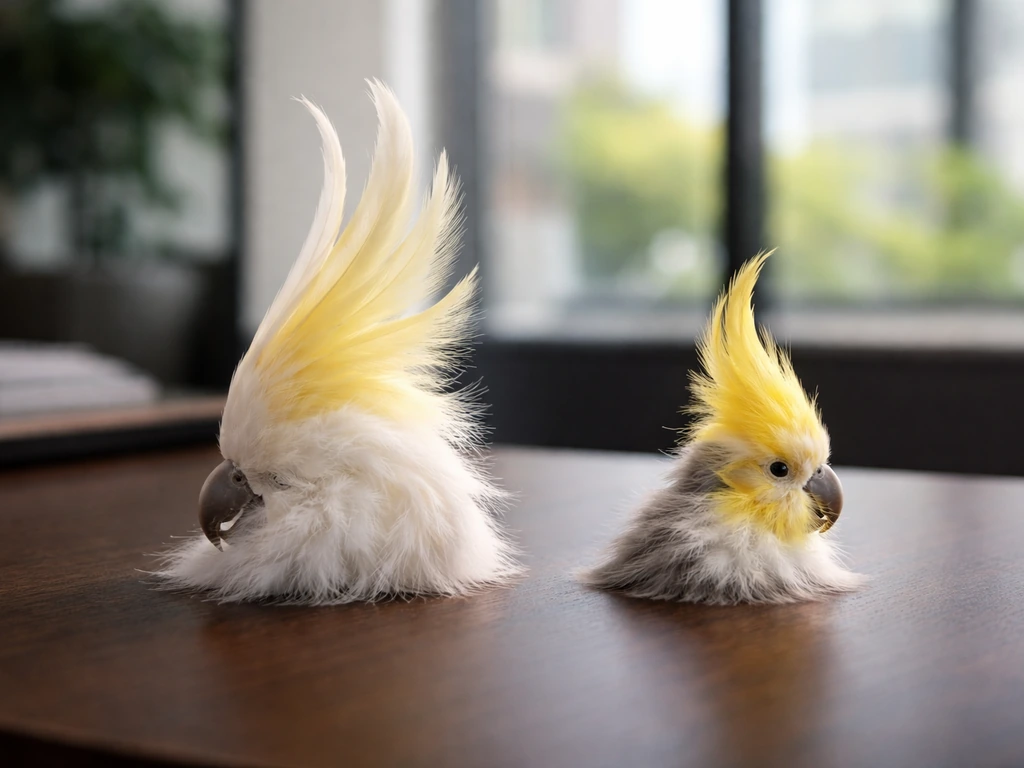
This is probably the most common mix-up people run into, so let's clear it up right away. Both birds have crests and curved beaks, and that's because cockatiels are actually the smallest member of the cockatoo family. But they look noticeably different once you know the key size and color clues. If you were wondering what a cow bird looks like, the best starting point is comparing its overall size, color pattern, and distinctive markings in clear photos.
| Feature | Cockatoo (larger species) | Cockatiel |
|---|---|---|
| Body size | Medium to large, roughly 35–60 cm total length | Small, around 30 cm including the long tail |
| Tail length | Proportionate, not unusually long | Long pointed tail makes up roughly half the bird's total length |
| Body color | Typically white, pink, or grey overall | Predominantly grey body |
| Face/cheek markings | Plain or subtly colored, varies by species | Bright yellow face with a vivid orange cheek/ear patch |
| Wing markings | Minimal or none | Bold white flashes/patches on the wings |
| Crest shape | Large, dramatic, often fan-shaped or forward-curling | Narrower, more pointed crest; raises vertically when startled |
| Beak size | Large, heavy, clearly hooked | Smaller beak proportionate to the smaller body |
The fastest check in a photo: look at the face. If you see a bright orange circular cheek patch against a yellow face, that's a cockatiel. If the face is plain white or uniformly pink, you're looking at one of the larger cockatoo species. Tail length is the second quick clue, a cockatiel's tail looks almost comically long for its body size.
Overall body shape, size, and posture to expect
Most cockatoos you'll encounter in photos or in the wild are noticeably stocky birds. Think of them as the heavyset, broad-shouldered parrots of the bird world. Their bodies are compact and muscular-looking, with short square tails (except the cockatiel, which is a different story). When perched, they tend to hold themselves fairly upright, and they look solid and substantial even at a glance.
Size-wise, the galah sits at around 35 cm, Major Mitchell's cockatoo comes in at about 38 cm, and larger species like the sulphur-crested cockatoo push well past 45 cm. These are birds you'd describe as similar in overall bulk to a large city pigeon, but taller and more upright on a branch. That upright posture, combined with the crest standing tall above the head, gives cockatoos a distinctive silhouette that's hard to mistake once you've seen it.
Head, crest, and beak features (most distinguishing traits)
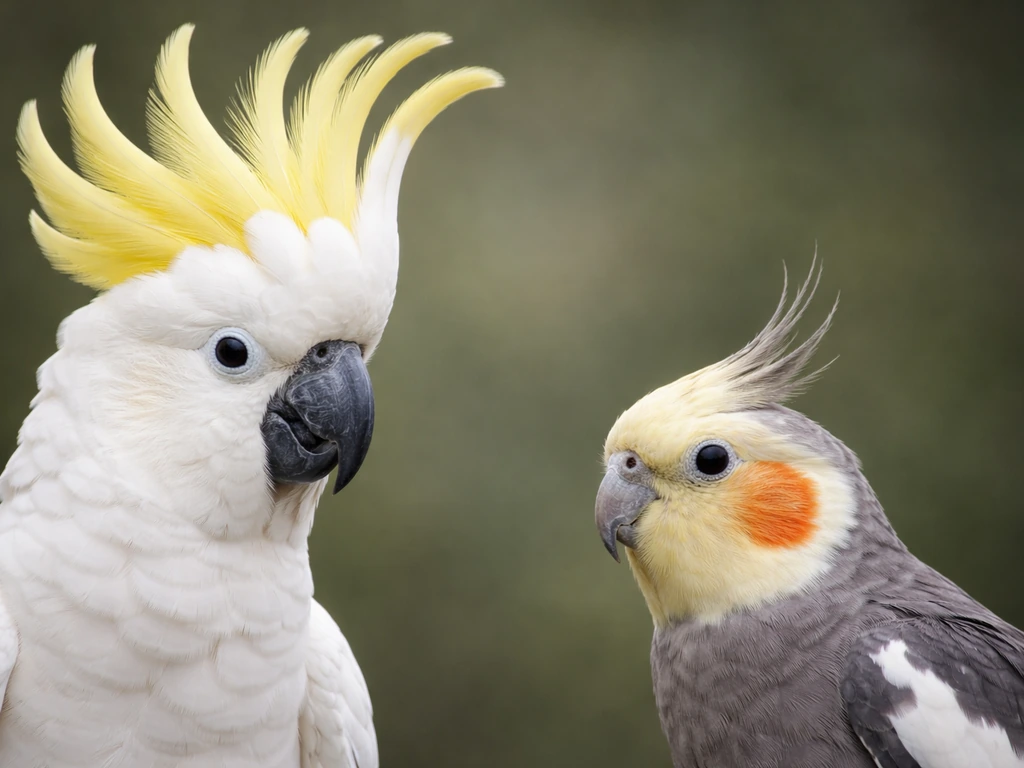
The crest is the headline feature, and it's what you should look for first in any photo. Cockatoos raise their crest when they're excited, alarmed, or just landing, and the shape varies quite a bit between species. The umbrella cockatoo fans its crest out into a wide, semi-circular shape that really does look like an open umbrella from the front. The sulphur-crested cockatoo's crest sweeps forward and upward in a long arc of bright yellow feathers. Major Mitchell's cockatoo has a spectacular banded crest with yellow and red stripes across it that faces forward when raised. The galah's crest is much shorter and more subtle compared to the rest of the family.
The beak is the second thing to look at. All cockatoos share the same strongly curved, hooked upper beak that looks powerful and clearly designed for cracking hard seeds and nuts. It's noticeably larger and heavier than what you'd see on smaller parrots. On most white cockatoos and galahs, the beak is dark grey to black, which creates a strong contrast against white or pink plumage. This hooked beak silhouette is a reliable family-wide identifier.
Color patterns and common cockatoo varieties
Unlike macaws or conures (which tend toward vivid tropical greens, reds, and blues), cockatoos are mostly built around a softer palette of white, grey, and pink. If you're specifically comparing conures, you can look at their smaller, sleeker bodies and bright feather colors to understand what a conure bird looks like what does a conure bird look like. That makes them stand out in a different way: they're elegant rather than flashy. Here's how the most commonly seen species break down by color.
- Sulphur-crested cockatoo: all white body with a bright sulphur-yellow crest, a yellow wash visible on the underside of the wings, and a dark grey-black beak. One of the easiest species to identify.
- Umbrella cockatoo (white cockatoo): pure white throughout with a large fan-shaped white crest, a dark grey beak, and a rounded, heavy build.
- Yellow-crested cockatoo: very similar to the sulphur-crested but with a longer, more forward-curling yellow crest, yellow ear-coverts, and yellow on the undersides of the wings and tail.
- Blue-eyed cockatoo: mainly white with a yellow-and-white crest, a black beak, and a distinctive pale blue ring of bare skin around each eye.
- Galah (rose-breasted cockatoo): bright pink face and chest, grey back and wings, and a short pale pink crest. This is the most widespread cockatoo species, at around 35 cm long.
- Major Mitchell's cockatoo: pale pink overall with a white back and wings, and a dramatic forward-sweeping crest banded with yellow and red stripes. About 38 cm long.
- Cockatiel: grey body, white wing patches, yellow face with a bright orange cheek patch, and a pointed crest. Smallest of the family at around 30 cm including the long tail.
If you're already familiar with what a macaw looks like, cockatoos will immediately read as a very different bird: less intensely colored, more compact, with that signature crest where a macaw has bare facial patches. Canaries and other small cage birds are so much smaller that there's really no risk of confusion once you see them side by side. Canaries typically have a small, slimmer build, with bright yellow or soft golden feathers depending on the variety what does a canary bird look like.
Cockatiel look-alikes: key differences you can spot fast
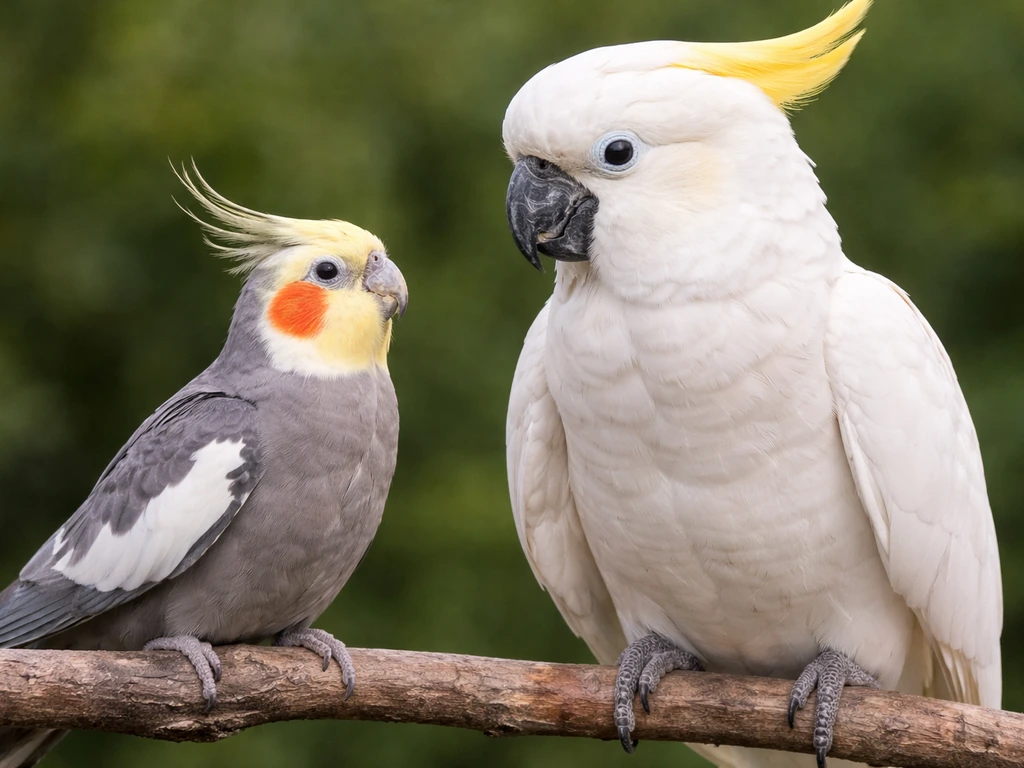
Because cockatiels are technically the smallest cockatoo, they share the crest and hooked beak with the rest of the family. But their overall look is quite distinct. The single most useful feature is the face pattern: cockatiels have a bright yellow face with a vivid, clearly defined orange circular patch over each cheek and ear area. No other cockatoo has this marking. The orange cheek patch is almost like a painted dot, and it shows up clearly even in low-resolution photos.
The second unmistakable cockatiel trait is those white wing flashes. When a cockatiel spreads its wings or you see it from the side, there are bold white patches against the grey feathers that stand out immediately. Larger cockatoos don't have this kind of contrasting wing patch. Finally, check the tail: a cockatiel's tail feathers are long and tapered, making up a striking portion of the bird's total length, while most other cockatoos have shorter, more squared-off tails relative to their bodies.
The crest behavior is also a useful tell. A cockatiel's crest shoots straight up when it's startled, angles back gently when relaxed, and presses flat against the head when defensive. The crest itself is narrower and more pointed compared to the wide fan crests of umbrella or sulphur-crested cockatoos. If the crest in your photo looks like a narrow pointed spike rather than a broad fan or sweeping arc, you're probably looking at a cockatiel.
How to use the features to identify photos (step-by-step)
When you've got a photo and you're trying to nail down what you're looking at, run through these checks in order. Each step either confirms cockatoo or narrows down which one.
- Check for a crest first. Any crest at all, even a flattened one, points strongly toward the cockatoo family. No crest rules them out entirely.
- Gauge the size. If the bird looks small and slender with a long tail, you're likely looking at a cockatiel. If it looks stocky and medium-to-large, you're in larger cockatoo territory.
- Look at the face. Bright orange cheek patch on a yellow face? That's a cockatiel, and you're done. Plain white face? You're looking at a sulphur-crested, umbrella, or similar white species. Pink face and chest? That's a galah or Major Mitchell's.
- Check the crest color and shape. Yellow crest sweeping forward on a white bird = sulphur-crested or yellow-crested cockatoo. Wide white fan crest = umbrella cockatoo. Banded yellow-and-red crest = Major Mitchell's. Short pale pink crest on a pink-and-grey bird = galah.
- Look at the beak. Dark grey to black and strongly hooked confirms cockatoo family. Any blue ring around the eye? That's the blue-eyed cockatoo specifically.
- If you're still uncertain between two species, focus on what's under the wings. A yellow wash on the underwing surface points to the sulphur-crested cockatoo. White underwings with no wash lean toward the umbrella cockatoo.
- For cockatiels specifically, confirm with the wing patches: bold white flashes on grey wings, combined with the orange cheek patch and long tail, make a definitive ID.
Running through these steps takes about thirty seconds once you know what you're looking for. Crest, size, face color, crest color and shape, beak, underwing. Most of the time you'll have your answer by step three or four. The more photos of cockatoos you look at, the faster this process becomes intuitive, and soon you'll be spotting that upright silhouette and hooked beak at a glance before you even consciously process the details. A cuckoo bird has its own distinctive look, so it helps to compare it against similar birds by markings and overall shape what does a cuckoo bird look like.
FAQ
What does a cockatoo bird look like when its crest is down or flattened?
Even with the crest lowered, you can usually spot a cockatoo by the upright, stocky body shape and the strong hooked beak. A flattened crest often means the bird is defensive, but the crest will still sit on a prominent head base that contrasts with most other parrots.
Can a cockatoo look like a cockatiel in a blurry photo?
Yes, if the face markings are hard to see. In that case, check the underwing and tail next, cockatiels typically show bold white wing flashes and have a notably long, tapered tail for their body size, while many other cockatoos have shorter, more squared tails.
What face details confirm a cockatiel specifically?
Look for a bright yellow face with a clearly defined orange circular patch on each cheek/ear area. If the face looks uniformly white or uniformly pink without crisp orange cheek circles, it is unlikely to be a cockatiel.
Do cockatoos always have white or pink plumage, or can they look different?
Most commonly photographed cockatoos are white, grey, or pink, but coloration can vary by species and lighting. If the bird is in shadow, grey feathers can appear darker and pink can look washed out, so compare beak color and overall silhouette (upright posture, crest set) rather than relying only on feather color.
How can I tell a sulphur-crested cockatoo from a smaller cockatoo species?
Use size as a supporting clue, sulphur-crested cockatoos tend to be larger and more upright-looking with a crest that sweeps forward and upward in a long arc of bright yellow feathers. If the crest shape is a wide, semi-circular fan (umbrella-like), that points in a different direction.
What should I look for if the crest is not raised in the photo?
Focus on fixed features, the thick hooked beak, the heavy, compact body, and the tail shape. Crest shape can still help, but when it is down, tail length and facial pattern become more reliable.
Are the beak and cheek patch clues enough to identify without seeing the whole body?
They are helpful, but beak alone cannot confirm species. A cockatiel’s orange cheek circles plus the yellow face are the strongest partial-ID combo, while a cockatoo with a plain white or pink face usually requires checking tail length or crest shape to narrow the species.
What are common photo mistakes when identifying what a cockatoo bird looks like?
Mistakes usually come from confusing angle and lighting with markings, for example, glare can hide the orange cheek circles, and motion blur can make crest shapes look flatter. Use multiple photos or confirm with crest position, wing flashes, and tail proportion.
Do juvenile cockatoos look the same as adults?
Often they look similar in body shape and crest placement, but facial color and crest patterns can be less defined in young birds. If a bird lacks crisp cheek or crest banding, treat it as a tentative ID and verify with a clearer face view or additional photos.