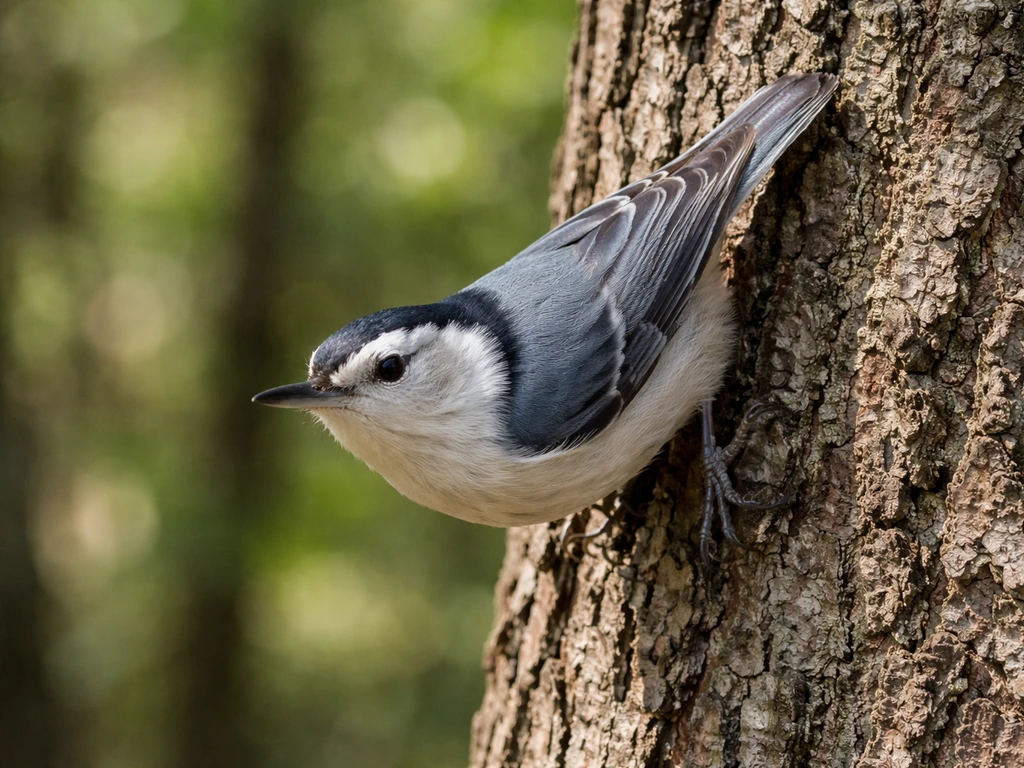
Nuthatches are compact, big-headed little birds with almost no visible neck, a short squared-off tail, and a sharp straight bill they use like a chisel. The thing that really gives them away, though, is their behavior: they're the ones creeping headfirst down a tree trunk while everything else is going up. Swallows are a completely different group of birds, and their appearance changes a lot by species, so checking key traits like shape and markings can help you tell them apart from nuthatches. That alone is usually enough to confirm what you're looking at. Most species share a blue-gray back, a strongly patterned head, and pale to rusty underparts, though the exact colors shift depending on which species you're dealing with.
What Does a Nuthatch Bird Look Like? Key Features to Identify

Marcus Whitley
3 May 2026
Key features to look for first
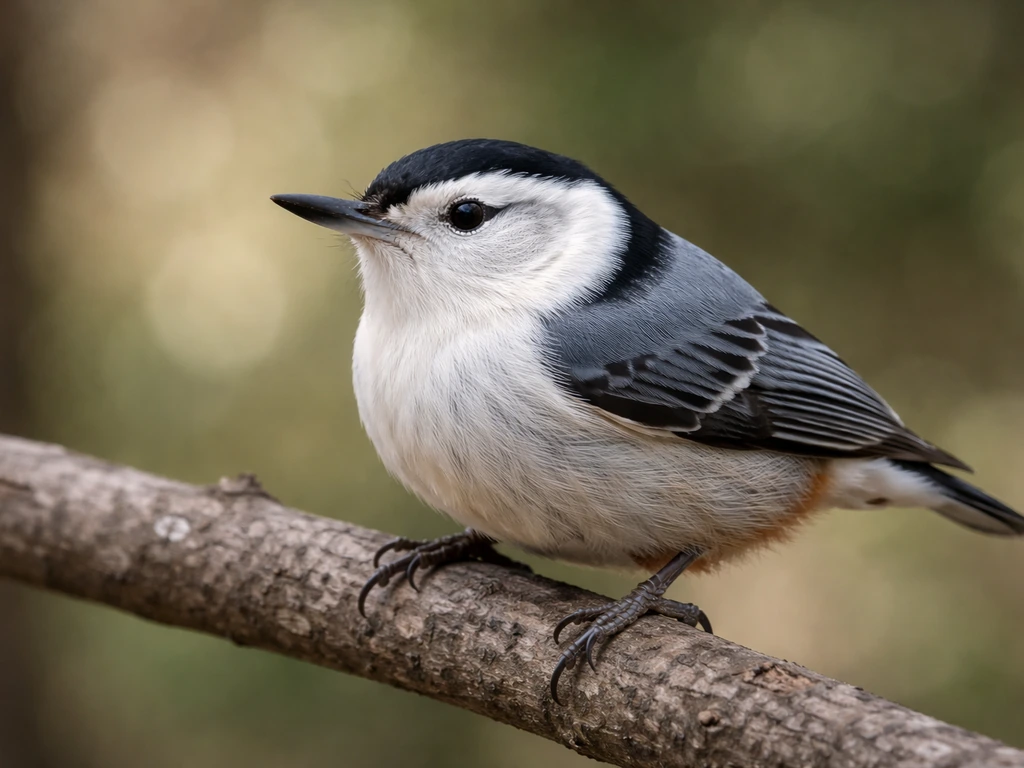
If you're trying to nail a quick ID in the field, these are the features that will get you there fastest. Nuthatches have a very specific look that's hard to mistake once you know what to focus on.
- Compact body with a large head and almost no neck — they look a little like a bird head was placed directly on a body without the usual proportions
- Very short tail, often appearing square at the tip
- Long, straight, sharp bill — thinner and more pointed than a finch or sparrow
- Blue-gray back across all North American species
- Strongly patterned head: usually a dark cap (black or brown depending on species), and often a bold stripe through the eye
- White or pale face, chest, or underparts (extent varies by species)
- Creeping headfirst down tree trunks — this is the clincher
Common nuthatch species and where you'll find them
There are four nuthatch species regularly seen across North America, and your region is the first clue about which one you're looking at. They share the same basic body plan but differ enough in head color, underpart color, and eye pattern that you can separate them pretty reliably once you know what to look for.
| Species | Where it lives | Cap color | Underparts | Eye stripe |
|---|---|---|---|---|
| White-breasted Nuthatch | Widespread across most of North America | Black (male), gray/lead (female) | Completely white | None — isolated dark eye on white face |
| Red-breasted Nuthatch | Conifer forests, irrupts widely in winter | Black (male), blue-gray (female) | Rich rusty-cinnamon, paler in females | Bold black stripe through the eye, broken by white above |
| Brown-headed Nuthatch | Southeastern US pine forests | Brown, down to the eye | Whitish to pale buff | None — brown cap ends sharply at eye level |
| Pygmy Nuthatch | Western US ponderosa pine forests | Gray-brown, down to the eye | Pale whitish below | None — gray-brown cap ends at eye with no stripe |
The white-breasted is the most widespread and the one you're most likely to encounter at a backyard feeder. The red-breasted shows up more broadly in winter, sometimes far outside its usual conifer habitat. The brown-headed and pygmy nuthatches are strongly tied to specific pine forest types, so geography does a lot of the work for you with those two.
Size, shape, and proportions up close
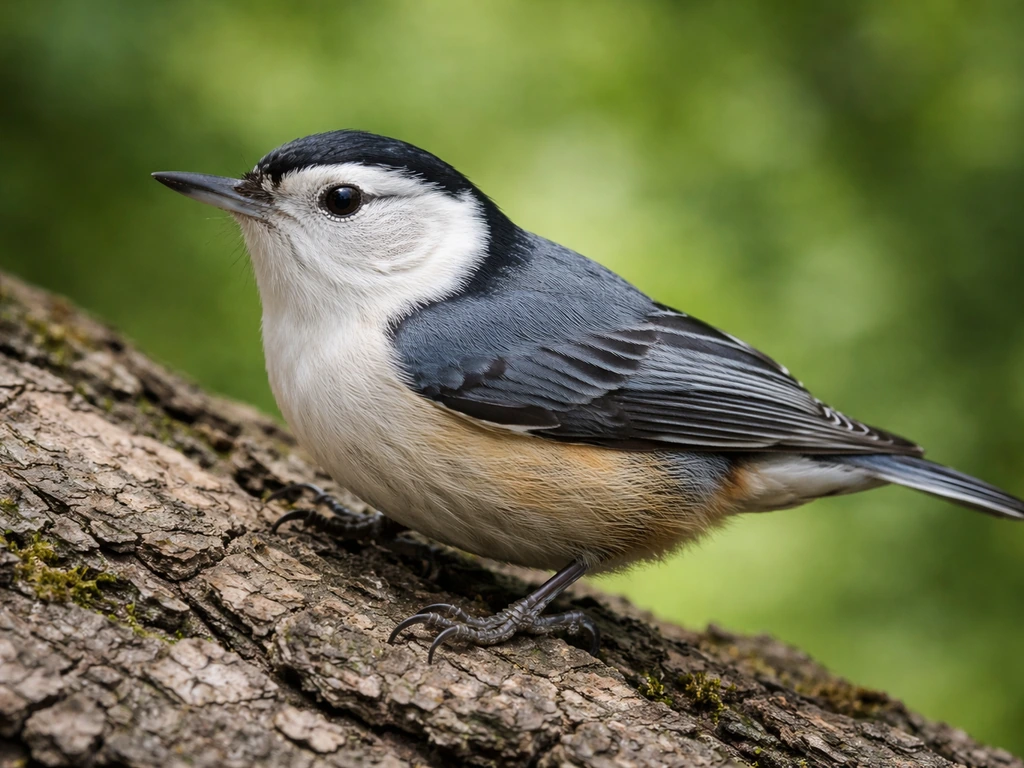
Nuthatches are small birds, but not the tiniest thing in your yard. The white-breasted is the largest of the North American species and still qualifies as small, sitting somewhere around the size of a large sparrow. To put some numbers on it: the red-breasted nuthatch runs about 4.3 inches long with a wingspan of roughly 7 to 8 inches and weighs barely half an ounce. The brown-headed is slightly smaller at 3 to 4 inches, and the pygmy nuthatch is in the same tiny range.
What makes the shape really distinctive is the combination of features. That oversized head sitting right on the body with almost no neck gives nuthatches a front-heavy look you don't see on most other small birds. The tail is so short it barely registers, it's not the long fan-like tail of a mockingbird or the cocked tail of a wren. The bill is longer than you'd expect for the bird's body size, straight, and sharp at the tip. Think of it like a little ice pick attached to a fluffy head.
Plumage and color patterns for each species
White-breasted Nuthatch
This is the one most people meet first. The back is blue-gray, the face is stark white, and the cap is jet black in males, it sweeps back from the bill over the crown and down the nape. That isolated dark eye sitting in the middle of all that white face is genuinely distinctive. Females look similar but the black on the head is softer and more lead-colored. The underparts are completely white, sometimes with a faint rusty wash near the lower belly. No eye stripe, which is important when you're comparing to the red-breasted.
Red-breasted Nuthatch
The red-breasted is the most boldly marked of the group. You get that blue-gray back, but the head pattern is more complex: a black cap, then a white stripe over the eye, then a black stripe running right through the eye like a bandit mask. Below all that, the underparts are a warm rusty-cinnamon that covers the breast, sides, and belly. Males are more vivid; females have a blue-gray cap instead of black and paler, more washed-out rusty tones underneath. It's a small, punchy little bird and when you see that eye stripe combination it's pretty unmistakable.
Brown-headed Nuthatch
Instead of a black cap, this one wears a warm brown cap that extends right down to eye level and stops there in a clean line. The back is blue-gray like the others, and the underparts are whitish to pale buff. Look for a small white spot on the back of the neck, that nape spot is a useful confirmation mark when you get a clear look. There's no eye stripe. If you're in the pine flatwoods of the Southeast and you see a tiny nuthatch with a brown cap, this is almost certainly what you've found.
Pygmy Nuthatch
The pygmy is the western counterpart to the brown-headed and looks remarkably similar. The cap is gray-brown rather than warm brown, and it also drops sharply to eye level with no eye stripe. The back is slate gray, the underparts are pale, and there's a white spot on the nape that you might catch if the bird pauses for a moment. In flight, look for small white spots in the tail. It's genuinely tiny, and in ponderosa pine country in the West, you'll often hear and see them moving through the canopy in chattering flocks.
Behavior and habitat, the confirmation you need
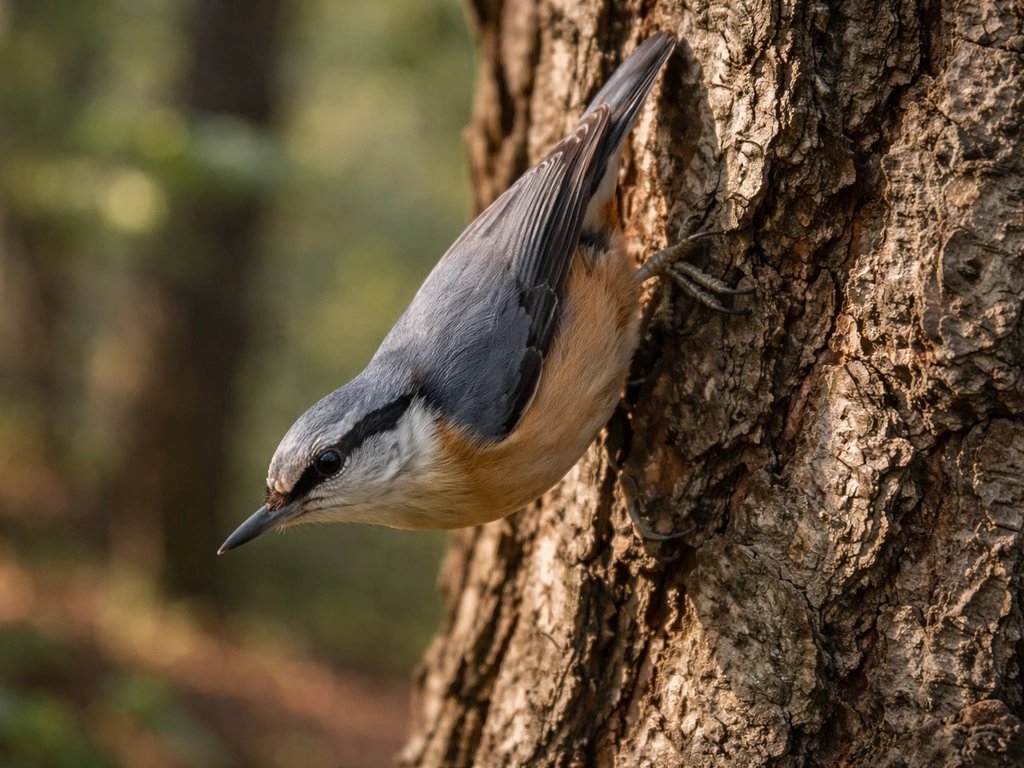
Honestly, behavior is the fastest way to confirm a nuthatch. blank" rel="noopener noreferrer">No other small bird regularly descends tree trunks headfirst. Woodpeckers go up. Brown creepers spiral up in a tight corkscrew. Nuthatches go down, confidently, headfirst, defying gravity while they probe bark crevices and flakes for insects and seeds. Nuthatches are known for descending tree trunks head-first and can also blank" rel="noopener noreferrer">hang upside down while foraging, a behavior that helps them access insects and seeds in bark crevices. Watching one work a tree is genuinely fun because they'll circle the trunk, hang upside down from a branch, and generally move in ways that look physically improbable.
You'll find them in wooded areas almost anywhere there are mature trees, but habitat matters for the species. White-breasted nuthatches love deciduous and mixed forests and are a regular feeder visitor. Red-breasted nuthatches prefer conifer forests but wander widely in winter and will show up at feeders far from the woods. Brown-headed nuthatches are almost entirely restricted to longleaf and loblolly pine forests in the Southeast. Pygmy nuthatches stick closely to ponderosa pine forests in the West and are rarely found outside them.
Listen for them too. The white-breasted's call is a nasal, honking 'yank-yank' that carries well. The red-breasted has a higher, more tin-horn tooting call. Brown-headed and pygmy nuthatches both give rapid, high-pitched chipping calls and are often heard before you see them, especially when they're moving through the canopy in a group. If you hear a tiny, fast, squeaky chatter coming from the pines, look up.
Birds that look similar and how to tell them apart
A few birds share the nuthatch's tree-trunk habitat and can cause some initial confusion, especially for newer birders. Thrasher birds can look quite different from nuthatches, so use this guide alongside a dedicated thrasher ID checklist for the best results tree-trunk habitat. Here's how to sort them out.
Brown Creeper
The brown creeper is the most commonly confused with nuthatches because it also works tree trunks. But it looks completely different up close: it's streaky brown all over, almost like a piece of bark come to life, with a long curved bill and a long stiff tail it uses as a prop. It always goes up the trunk in a spiral, never down. If the bird is streaky brown and heading upward, it's a creeper, not a nuthatch.
Woodpeckers
Downy and hairy woodpeckers share the tree-trunk foraging zone and the black-and-white color scheme, but they're built differently. Woodpeckers have a longer, chisel-shaped bill, a longer tail they use as a brace, and they don't hang upside down the way nuthatches do. They also hitch upward rather than headfirst downward. Size helps too, even a downy woodpecker is noticeably larger and more elongated than a nuthatch. Sapsuckers are another trunk-foraging woodpecker worth knowing; they're also clearly larger and more distinctly patterned than any nuthatch.
Chickadees and Titmice
At a feeder or in a mixed flock, chickadees and titmice can look vaguely nuthatch-like because they're also small with dark caps. But chickadees have a longer tail, a more distinct neck, and a rounder body without that front-heavy proportional look. They also hang acrobatically but don't creep along bark the way nuthatches do. Titmice have a crest that nuthatches lack entirely. If the bird has a visible crest or a noticeably longer tail, it's not a nuthatch.
White-breasted vs. Red-breasted: the most common mix-up
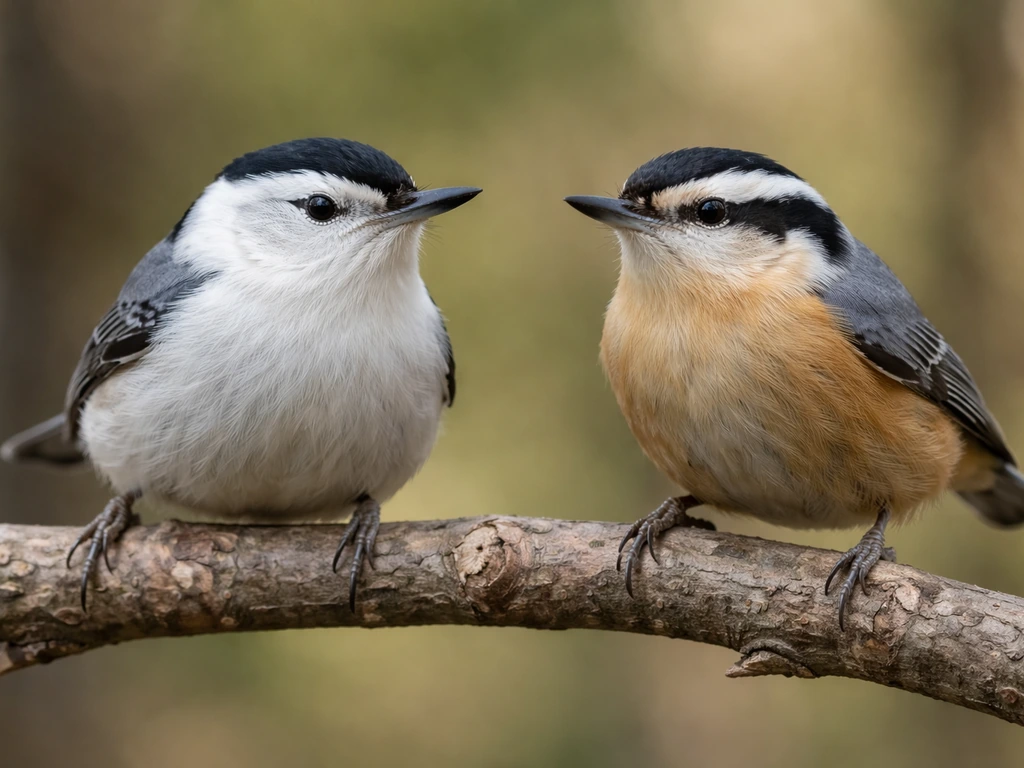
These two are genuinely similar in structure and are the most frequent source of confusion. The easiest split: look at the underparts and the face. White-breasted has completely white underparts and no eye stripe, just that dark eye floating in a white face. Red-breasted has rusty-cinnamon underparts and a bold black eye stripe running through the eye, broken by a white stripe above it. Once you've seen both side by side in a photo, the difference is obvious and you won't mix them up again.
How to use this when you're out in the field
Start with posture and movement. If the bird is going headfirst down a trunk, you've almost certainly got a nuthatch. Flycatchers are different from nuthatches, and their look depends on the species, but they generally have a distinct head and flat, forward posture while catching insects in the air what does a flycatcher bird look like. Then look at the head: is the cap black or brown? Brown thrashers have a grayish-brown, streaky look with a bright white belly and bold wing patterns, plus a long tail that helps set them apart. Is there an eye stripe? What do the underparts look like, all white, rusty, or pale buff? Those three questions will get you to the right species almost every time. If you're at a feeder, watch for that short-tailed, large-headed silhouette landing sideways on the suet cage or clinging below a peanut feeder. They're acrobatic in a way that's completely their own, and once you've learned to recognize that body shape and those headfirst movements, you'll spot a nuthatch from across the yard without even needing to see the colors.
FAQ
What does a nuthatch bird look like in flight, and how is it different from when it’s on the trunk?
In flight, nuthatches look small and direct with a slightly bulky, big-headed silhouette. A useful tell is that they often show small pale spots in the tail on some species, like the pygmy, and they do not do the long, wobbly, fluttery flight style you see in many songbirds. When you’re trying to confirm in motion, prioritize the compact body and short tail rather than color alone, since lighting can wash out markings.
Can nuthatches look different in winter or bad lighting, and what should I rely on then?
Yes. Winter glare, wet feathers, and distance can make blacks look gray-brown and rusty areas look dull. In those conditions, rely on structure and pattern placement: the very large head with almost no neck, the short squared tail, and the presence or absence of an eye stripe (none on white-breasted and brown-headed/pygmy, prominent on red-breasted).
How can I tell a white-breasted nuthatch from a chickadee at a feeder?
Use the “shape first” check. Chickadees have a rounder body and a longer neck look, and their movement is more of a hopping perching style. Nuthatches tend to creep along bark and cling with a sideways, trunk-hugging posture, and the underparts for white-breasted are clean and fully white, not grayish with a darker belly patch.
What’s the quickest way to separate a nuthatch from a brown creeper if I only get a brief look?
If the bird is going up the trunk in a spiral, it’s almost certainly a brown creeper. Nuthatches go down headfirst. Also, creepers look streaky and bark-like overall with a curved bill and a long stiff tail that acts like a prop, while nuthatches look smooth-faced with a straight, chisel-like bill and a barely-there tail.
Do young nuthatches look the same as adults, or can juveniles confuse the ID?
Juveniles can look less crisp, with paler or muddier head and underpart colors and less sharply contrasted markings. The decision aid is to focus on the structural traits that do not change much: the big head on a short body, the straight bill, the short tail, and the headfirst descending trunk behavior. If you’re relying on the eye stripe, give extra weight to whether it runs through the eye clearly, not whether the colors look vivid.
If I hear a call but don’t see the bird, which nuthatch species should I suspect?
High-pitched rapid chipping from pine canopy flocks usually points toward brown-headed or pygmy nuthatches, since both are commonly heard before they’re visible. A nasal honk-like call is more consistent with white-breasted, while a higher, tin-horn style call is more in line with red-breasted. If you can combine the sound with habitat, that often beats trying to identify by call alone.
What feeder setup or food type helps attract the most nuthatches?
Nuthatches are especially common at suet and peanut feeders when they are available and nearby woodland holds breeding birds. If you’re aiming for more consistent visits, place feeders close to trees so the birds can move between cover and the food quickly, and use sturdy platforms or cages that let them cling below rather than only perch on top.
Are nuthatches ever confused with woodpeckers even though they both forage on trunks?
Yes, especially downy or hairy woodpeckers in a quick glance. The fastest split is movement and body “geometry.” Nuthatches can hang upside down or move headfirst downward while probing bark cracks, while woodpeckers typically brace with a longer tail, hitch upward, and show a more elongated build with a longer bill.
How do I confirm species (white-breasted vs red-breasted vs brown-headed vs pygmy) when I’m not sure about markings?
Confirm in this order: (1) check underparts color and the presence or absence of an eye stripe, (2) compare cap color and how far it extends down the face (black cap for male white-breasted, black-and-white bandit mask for red-breasted, warm brown cap for brown-headed, gray-brown cap for pygmy), and (3) use location and habitat to break ties, since brown-headed and pygmy are strongly tied to pine types and certain regions.