
If you spotted a bird that reminded you of a wren but seemed noticeably larger, the most likely candidates are the Gray Catbird, the Cactus Wren (in the Southwest), or the Bewick's Wren. A quick way to confirm what a wren bird looks like is to compare size, tail shape, and face markings like eyebrow stripes. The Gray Catbird is by far the most commonly confused bird for an oversized wren across most of North America: it haunts the same dense thickets, has a similar skulking style, and even cocks its longish tail.
What Bird Looks Like a Wren but Is Bigger? ID Guide

Marcus Whitley
11 May 2026
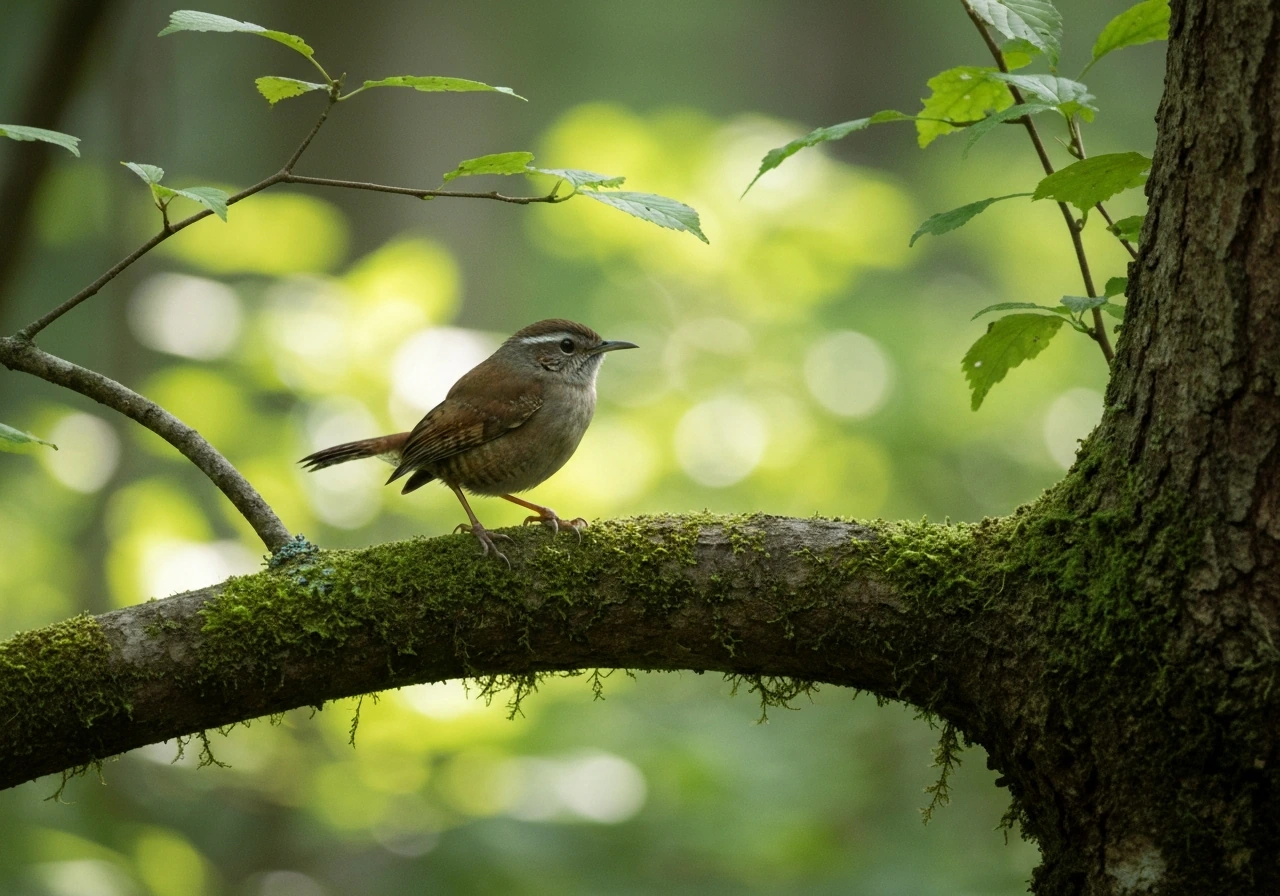
The difference is that the catbird is plain slate-gray with a black cap, runs about 8 to 9 inches long, and has that unmistakable rusty patch under its tail. True wrens top out around 5 to 5. 5 inches. So if whatever you saw felt meaningfully bigger, read on and you'll have your answer quickly.
Quick field-mark checklist to use right now
Run through these questions while the bird is still fresh in your mind (or while you're still in the field). They'll steer you to the right species faster than trying to match a photo in a field guide.
- Was the bird noticeably bigger than a sparrow? Wrens are sparrow-sized or smaller. If the bird felt robin-sized or close to it, think catbird.
- Did it have a white eyebrow stripe? A bold stripe above the eye is the number one wren-family feature shared by Carolina Wren, Bewick's Wren, and Cactus Wren.
- Was the tail cocked upward? Carolina Wrens almost always tilt their tail up. Cactus Wrens and Gray Catbirds tend to hold their tails flat or slightly lowered.
- What color was the body? Warm reddish-brown points to a wren. Plain gray points to catbird. Heavily spotted or streaked on the breast points to Cactus Wren.
- Did you see a white-tipped tail with barring? That narrows things to Bewick's Wren specifically.
- Where were you? Desert Southwest with cacti nearby? Think Cactus Wren. Eastern woodlands, a backyard thicket, or shrubby forest edge anywhere from the Great Plains east? Think catbird or Carolina Wren.
- Did it make a mewing or cat-like call? That's a Gray Catbird, almost certainly.
Size and silhouette: just how much bigger are we talking?
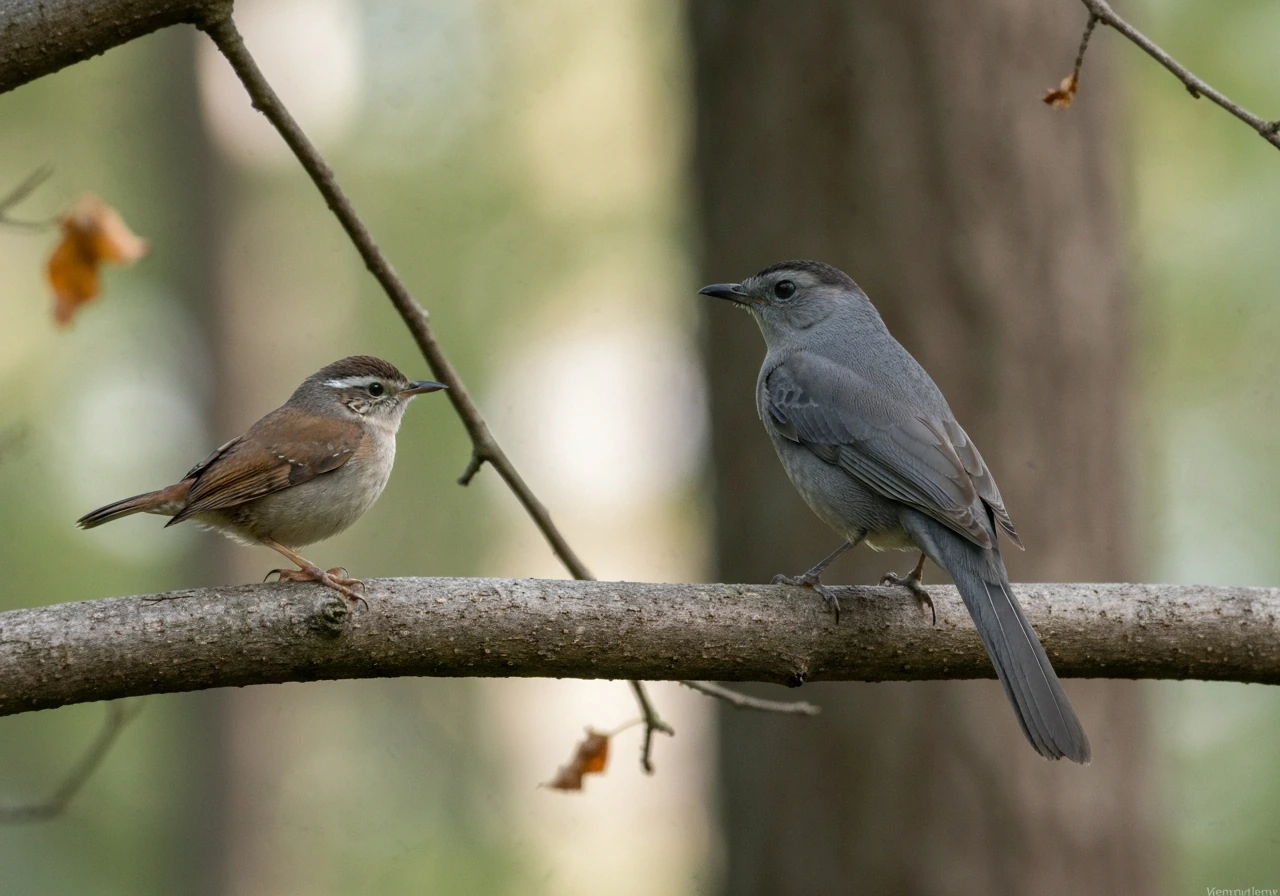
Getting a sense of size in the field is tricky, but there's a useful mental benchmark. A true wren like the Carolina Wren is about 5.5 inches from bill tip to tail tip, roughly the size of a large grape cluster with a long bill sticking out. It's noticeably chunky for its size with a round body, short neck, and proportionally long tail. Bewick's Wren is very close to that at around 5.5 inches (14 cm) as well, so if your bird didn't feel much bigger than a sparrow, it could still be a wren species.
The Gray Catbird, on the other hand, is a medium-sized bird running 8 to 9.25 inches long. That's roughly the same length as a Robin but slimmer and longer-tailed. It has a lean, elongated silhouette, a moderately long bill, and a long tail that it often droops or holds level rather than cocking. From a distance it can look like a wren because it hunches its body and stays low in dense brush, but once you get a clear look the size difference is obvious.
The blank" rel="noopener noreferrer">Cactus Wren sits in between: it's the largest wren in North America at around 7 to 8.5 inches, roughly the size of a small thrush. It has a much stockier build than a catbird, a heavier curved bill, and a barrel-chested profile. You'll often see it perched upright and openly on a cactus or shrub, which is very different from the skulking behavior of true wrens.
| Bird | Length | Body shape | Tail posture |
|---|---|---|---|
| Carolina Wren | ~5.5 in | Chunky, round, short neck | Usually cocked upward |
| Bewick's Wren | ~5.5 in (14 cm) | Slender, long-tailed for a wren | Often cocked or fanned sideways |
| Cactus Wren | ~7–8.5 in | Stocky, barrel-chested, large bill | Held level, not cocked |
| Gray Catbird | ~8–9.25 in | Slim, long-tailed, slightly hunched | Often drooped or held level |
Plumage patterns: the details that really matter
Gray Catbird
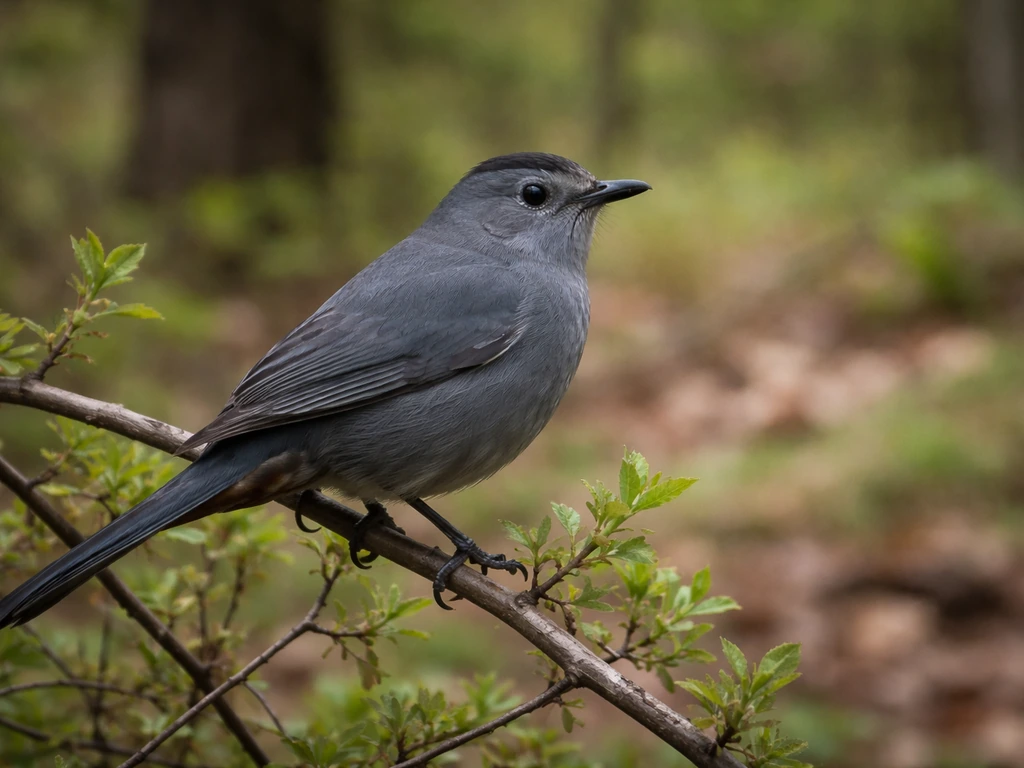
The catbird is about as plain as a bird can get. Think smooth slate-gray from head to tail, with no wing bars, no streaking, and no eyebrow stripe. The one pop of color is a small rusty-chestnut patch under the base of the tail (called the undertail coverts), which you'll catch when the bird lifts or fans its tail. There's also a black cap on top of the head that gives it a slightly masked look. The tail itself is solid black. If the bird you saw had any streaking, spotting, or a bold eyebrow stripe, rule out the catbird right away.
Cactus Wren
This is a heavily patterned bird. You'll notice a bold white eyebrow stripe that runs from the bill all the way back past the eye to the sides of the neck. The throat and breast are white with heavy brown spotting, which gets denser on the upper chest. The back is brown and streaked, and the tail is long, dark, and barred. The red eye is also a useful detail once you're close enough. The overall impression is a big, boldly marked, almost thrush-like wren.
Bewick's Wren
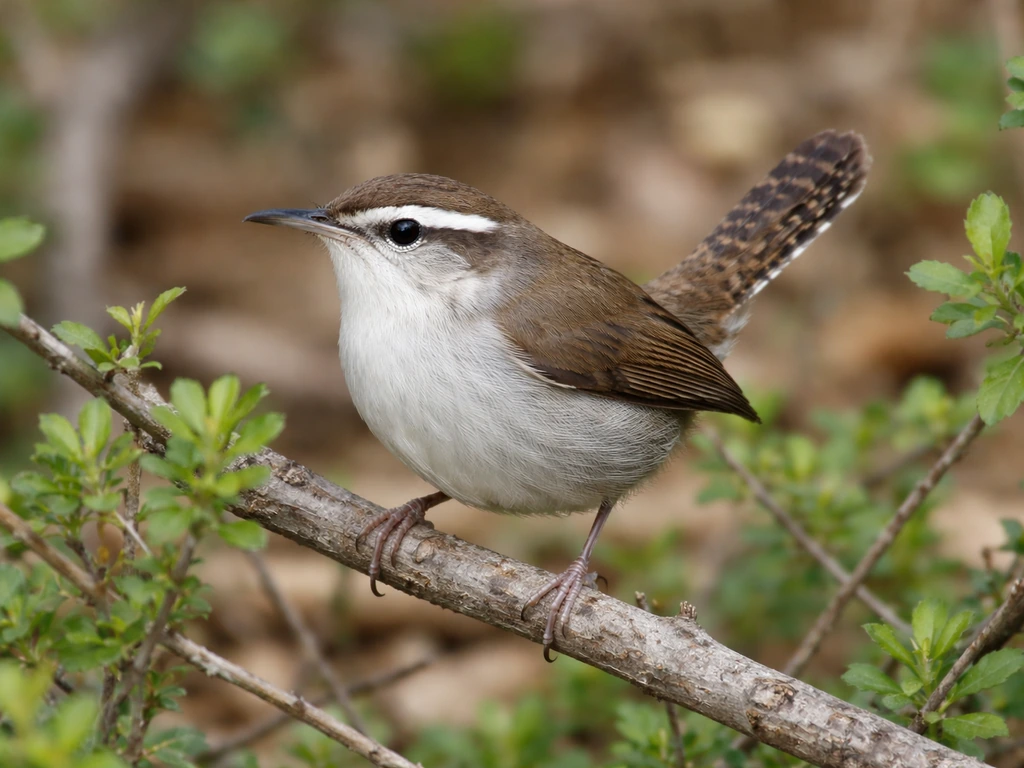
Bewick's is gray-brown above and clean white below, with a very conspicuous white supercilium (eyebrow stripe) that makes the face look almost striped. The tail is the real tell: it's long compared to a typical wren, with barring across the middle feathers and white spots on the tips of the outer tail feathers. When it fans or cocks its tail you can see those white corners clearly. The underparts lack any real spotting or streaking, which separates it from the Cactus Wren.
Carolina Wren (your size baseline)
Just to ground the comparison: the Carolina Wren has rich reddish-brown upperparts, a white or buff underside, and that strong white eyebrow stripe. The wings and tail both show fine black barring. The overall color is warm and rusty compared to the cooler gray-brown of Bewick's. If your bird matched all this but felt bigger, you probably weren't looking at a Carolina after all.
Beak, tail, wings, and how the bird moves
The bill is one of the most underrated ID tools for this group. To nail down your bird's ID, look closely at what a warbler bird look like compared to these wren-like species underrated ID tools. Wrens, including the Cactus Wren, all have long, thin, noticeably downward-curved bills designed for probing bark crevices and insects. The Gray Catbird's bill is shorter, straighter, and more generalist-looking, similar to a mockingbird's. If the bill looked distinctly curved and slender, you're almost certainly in wren territory.
Tail behavior is equally useful. The Carolina Wren almost reflexively cocks its tail up at a steep angle, especially when it pauses. The Cactus Wren is the opposite: it keeps its tail flat or slightly lowered, which is one of the behaviors that makes it feel un-wren-like despite being a true wren. The Gray Catbird often holds its tail in a slightly drooped, hunchbacked posture. Bewick's Wren is somewhere in between, often fanning or cocking its long tail sideways, which shows off those white-tipped outer feathers.
Movement and foraging style can also tip you off. True wrens tend to creep and flick through dense cover at or near ground level, almost like small rodents. The Gray Catbird does this too, which is part of why people confuse it with a wren, but it also hops up to exposed perches more readily.
The Cactus Wren is the most conspicuous of the group: it regularly perches openly on top of cactus or tall shrubs and forages by hopping across open ground or probing into vegetation from a visible perch. If the bird you saw was out in the open and clearly visible, Cactus Wren is worth putting at the top of your list (if you're in the right region).
Similar species lookalikes and how to rule them out
Beyond the main candidates above, a few other birds occasionally get flagged in this search. Here's how to cut through them quickly.
- House Wren: Smaller than Carolina Wren, plain brown with faint barring and no obvious eyebrow stripe. If the bird was bigger than a Carolina Wren, rule out House Wren immediately.
- Northern Mockingbird: Gray with white wing patches and a long tail, superficially catbird-like. But mockingbirds are noticeably larger (about 10 inches), have obvious white patches in the wings during flight, and hold their tails upright with a very upright, alert posture.
- Brown Thrasher: Brown and heavily streaked below with a very long tail and a long curved bill. It's often mistaken for a giant wren. It runs about 11 inches long, much bigger than any wren or catbird, and the streaking on the underparts is heavier and more elongated than the spotting on a Cactus Wren.
- Marsh Wren: Smaller than Carolina, strongly streaked on the back, with a white eyebrow. Lives in cattail marshes specifically. If you weren't near a marsh, rule it out.
- Sedge Wren: Even smaller, streaked crown and back, very secretive. Much smaller than what you're describing.
- Warblers: Many warblers have striped faces and move quickly through shrubs, but they're smaller than wrens and have thin, straight, insect-picking bills. If you found yourself wondering about warblers, they're worth knowing as a group, but size alone usually rules them out here.
The main rule-out triangle for this query is: Gray Catbird (no eyebrow stripe, plain gray, larger), Bewick's Wren (white-tipped long tail, gray-brown, white below), and Cactus Wren (spotted breast, bold eyebrow, desert habitat only). If your bird had a white eyebrow but was smaller and rusty rather than gray, you were probably looking at a Carolina Wren after all.
Where you are matters a lot
Geography is one of the fastest ways to narrow down your options. The Cactus Wren is only found in the arid Southwest: Arizona, New Mexico, Southern California, southern Nevada, Utah, and into Texas, where spiny desert scrub and cacti like cholla and saguaro are common. If you saw this bird somewhere outside that zone, you can take Cactus Wren off your list entirely.
The Gray Catbird is widespread across most of North America during the breeding season, from southern British Columbia and Nova Scotia south through much of the US. In winter it retreats to the southeastern US, Mexico, Central America, and the Caribbean. It strongly prefers dense thickets, shrubby forest edges, and hedgerows over open areas. American Bird Conservancy notes that the gray catbird genus [Dumetella reflects its preferred habitat of deep thickets and shrubs](https://abcbirds.
org/bird/gray-catbird/), where it often flips through leaf litter and twigs while foraging. In the Audubon Field Guide, the gray catbird is described as strongly preferring dense thickets, shrubby forest edges, and hedgerows.
If you were in any kind of shrubby edge habitat in the eastern or central US between late April and September, Gray Catbird should be your first guess for a larger wren-like bird.
The Carolina Wren is a year-round resident across the eastern US, from Kansas and Nebraska east to the Atlantic and south into Mexico. It loves tangled undergrowth, riverbank vines, suburban brush piles, and forest understory. Bewick's Wren, by contrast, is mostly a western bird (though it has a small eastern population), preferring open arid woodlands, brush-covered hillsides, and scrubby areas. If you're in the Midwest or western states and saw a wren-like bird with a noticeably long, white-tipped tail, Bewick's is the right call.
| Bird | Primary range | Key habitat |
|---|---|---|
| Gray Catbird | Widespread across North America; SE US in winter | Dense thickets, shrubby forest edge |
| Cactus Wren | Desert Southwest (AZ, NM, S CA, TX) | Desert scrub, cacti (cholla, saguaro) |
| Bewick's Wren | Primarily western US; small eastern population | Open dry woodlands, brush-covered hillsides |
| Carolina Wren | Eastern US year-round | Forest understory, suburban tangles, riverbanks |
How to confirm your ID using photos and sound

If you managed to get a photo, here's how to get the most out of it. Crop in tight on three areas: the face (to check for eyebrow stripe, eye color, and bill shape), the tail (look for barring, white tips, and how it's being held), and the underparts (spotting, streaking, or plain coloring). Those three crops will answer most of your ID questions without needing a perfect full-body shot.
For the best angles, a side profile is most useful for comparing body size, bill curve, and tail length. A view from below or behind lets you check the undertail coverts (that rusty patch on a catbird shows clearly from below). A head-on or three-quarter view helps you see the eyebrow stripe and face pattern. Even a blurry photo is worth cropping if you can isolate one of those key features.
Sound is a powerful confirmation tool. The Gray Catbird has one of the most distinctive calls in North American birding: a flat, nasal mewing sound, almost exactly like a cat. Once you've heard it you won't forget it. The Cactus Wren has a harsh, repetitive, low-pitched churring song that sounds almost mechanical or like an engine trying to start. Carolina Wrens are loud singers with a ringing, whistled 'teakettle-teakettle-teakettle' song. Bewick's Wren has a more musical, buzzy song with variable phrases. Free apps like Merlin Bird ID from Cornell Lab let you record the call on your phone and get an instant ID suggestion, which is genuinely useful if you're still in the field.
Once you have your photo crops and any audio, compare them against a visual reference for each species. Pay particular attention to the tail: that single feature separates most of these birds faster than anything else. A long tail with white-spotted outer tips is Bewick's. A long barred tail held flat with a spotted chest is Cactus Wren.
A plain black tail with a rusty undertail patch is catbird. A shorter tail cocked upward with fine barring and a reddish-brown back is Carolina Wren. If you need a quick picture of what a waxwing bird looks like, check the dedicated guide for common field marks what does a waxwing bird look like.
If you find yourself wanting to go deeper on any individual species in this group, the detailed looks at what a wren, warbler, or waxwing look like can help you build a sharper eye for the whole family of small, energetic songbirds that share these brushy, tangled habitats.
FAQ
If the bird has a striped face, does that automatically mean it is a wren-like species instead of a catbird?
Look for the presence or absence of a bold white eyebrow stripe and compare the tail. A Gray Catbird lacks that obvious eyebrow stripe and has a plain slate-gray body with a rusty undertail patch. Bewick's and Carolina Wrens have a conspicuous white supercilium, and Bewick's also shows long tail barring plus white-tipped outer tail feathers.
What if I cannot see the tail marks clearly, how can I still tell the bird apart?
Distance and angle can hide key field marks, especially the rusty undertail coverts on the catbird and the white-tipped outer feathers on Bewick's. If you cannot see either feature, use posture plus habitat, and keep checking as it moves. A quick retreat into thickets with a hunchbacked look supports Gray Catbird, while an openly perched, more upright stance on shrubs or cactus supports Cactus Wren.
Can molting make these birds look like the wrong species, and what should I trust instead?
Yes, wrens and catbirds can molt, and fresh or patchy feather growth can make patterns look faint. In that case, rely on “structural” clues that change less: tail length relative to the body, bill shape (Gray Catbird bill looks shorter and straighter, wrens look longer, thin, and more curved), and consistent undertail color (rusty patch under the base of the tail for catbird).
How accurate is ID based on sound alone for this group?
If you are only hearing a sound, the ID is less reliable because some wren and thrush-like songs can overlap in complexity. Still, Gray Catbird’s call stands out as a flat, nasal, cat-like mew, while Carolina’s is the repeating whistled “teakettle” style, and Cactus Wren’s is harsh and repetitive. If you cannot clearly match the call type, wait for a visual opportunity and then use tail cues.
What other common birds get mistaken for a larger wren, and how do I rule them out quickly?
Crows, mockingbirds, and some juvenile songbirds can look wren-like due to size and behavior when perched low, but they usually do not match the specific tail traits. Before concluding it is one of these, double-check that the tail is truly long and active, and that the bill is the wren-type probe shape. Also, confirm it is in dense brush or the correct habitat zone for the candidate.
If the bird is perched, what bill features are most reliable for separating catbird from wren?
For wrens versus catbirds, focus on bill curve and bill length. Wrens typically have a longer, thin, noticeably downward-curved bill for probing. Gray Catbird tends to have a shorter, straighter, more generalist-looking bill. If the bill looked curved and slender, that supports Cactus Wren, Bewick’s, or Carolina rather than Gray Catbird.
How can I tell Bewick’s Wren from Carolina Wren if both have an eyebrow stripe?
Bewick’s and Carolina can both show a strong white eyebrow stripe, so use tail details. Bewick’s typically has a long tail with barring and white spots on the outer tail feathers, often visible when it fans or cocks the tail. Carolina also has a long tail but lacks the white-tipped outer tail-feather look that is so characteristic of Bewick’s.
What is the fastest “decision routine” if I only have a moment to observe the bird?
In the field, take 3 specific checks in under 10 seconds: (1) tail held flat or drooped versus cocked up, (2) undertail color when the bird lifts or fans its tail, and (3) whether there are any white-tipped outer tail feathers or a rusty undertail patch. If you only get one clear moment, the tail check usually resolves the species faster than the body pattern.
What should I check if it looks almost like a small thrush, but I suspect catbird or wren?
Yes, especially for Gray Catbird versus “small thrush” confusion. Catbirds keep a plain slate-gray look with no wing bars and have the rusty undertail patch that appears from below or when tail is raised. A thrush-like bird usually shows different wing patterning and body proportions, so confirm the undertail color and the plain slate-gray overall look before committing.
How much should geography override what I’m seeing visually for the cactus wren and the gray catbird?
Region can be decisive for Cactus Wren, but not for Gray Catbird. If you are outside the arid Southwest, do not assume Cactus Wren, even if it looks big and boldly marked. Instead, prioritize Gray Catbird if you are in shrubby edge habitat, or Bewick’s/Carolina based on the face and tail details and your state.