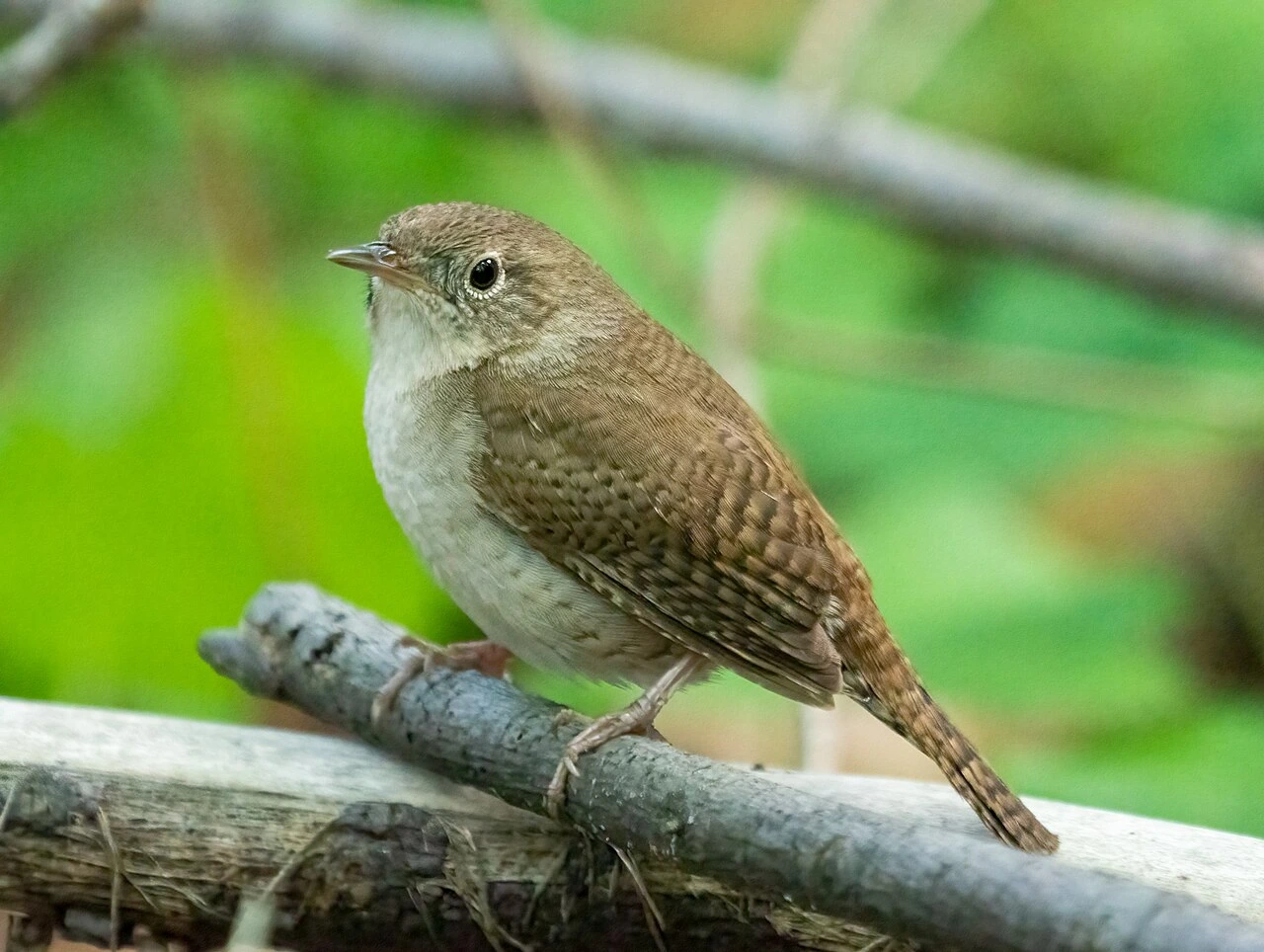
A wren is a tiny, round-bodied brown bird with a short upright tail, a thin curved bill, and enough attitude to make up for its small size. If you spot a little brown bird bouncing around your backyard with its tail cocked up like an antenna and then hear it launch into an almost absurdly loud, bubbly song, you've almost certainly found a wren. The House Wren is by far the most common species most people encounter in North America, and once you know its key field marks, you'll recognize it at a glance.
What Does a Wren Bird Look Like Plus House Wren ID Tips

Marcus Whitley
14 Apr 2026
Typical wren appearance: a quick field description
Wrens are genuinely tiny birds. A House Wren comes in around 4.3 to 5.1 inches long, which puts it closer in size to a large sparrow than anything else. The body is compact and rounded, almost like a little feathered fist, and the tail is short and often held cocked up at a sharp angle above the body. That upward-tilted tail is one of the most reliable visual cues you'll find in the field.
The overall color of a wren is brown. Not a pretty, warm chestnut brown or a clean gray-brown, but a plain, nondescript warm brown above with paler grayish-brown or gray underparts. The throat tends to be even paler, almost whitish. What breaks up that plainness is a pattern of dark barring on the wings and tail, and sometimes on the belly and undertail coverts. That fine dark barring gives the bird a faintly checkered or scaled look up close, especially on the tail. The bill is thin and slightly curved downward at the tip, built for probing into crevices and bark for insects.
The overall impression is a small, energetic, brown bird that never seems to hold still. Wrens are constantly bouncing, hopping, and flicking their tails. They're inquisitive birds and will often pop into the open to investigate a noise, which makes them easier to observe than their size suggests.
House Wren look-alikes and key identifying field marks
The House Wren is intentionally plain. That might sound like a strange thing to say, but it's actually the most useful starting point for identifying it. There's no bold eyebrow stripe, no bright rusty color, no crisp pattern. If you're looking at a very small brown bird in a suburban backyard or garden edge and thinking 'nothing stands out on this bird,' that's a strong sign you're looking at a House Wren.
Here are the specific field marks to lock in when you're trying to confirm a House Wren identification. The eyebrow stripe is faint or completely absent. This is the single biggest distinguishing feature that separates it from its close relatives. Some wrens have a bold, bright white stripe over the eye that's impossible to miss. The House Wren has almost none. You might see a faint buff wash above the eye, but nothing dramatic. The barring on the wings and tail is present and visible when the bird is perched close by. The underparts are pale grayish with faint dark barring on the lower belly and undertail. The tail is short, stubby, and almost always angled upward. The bill is thin and slightly downcurved. The wings look short and rounded.
What to look at first: size, tail, bill, color, and pattern
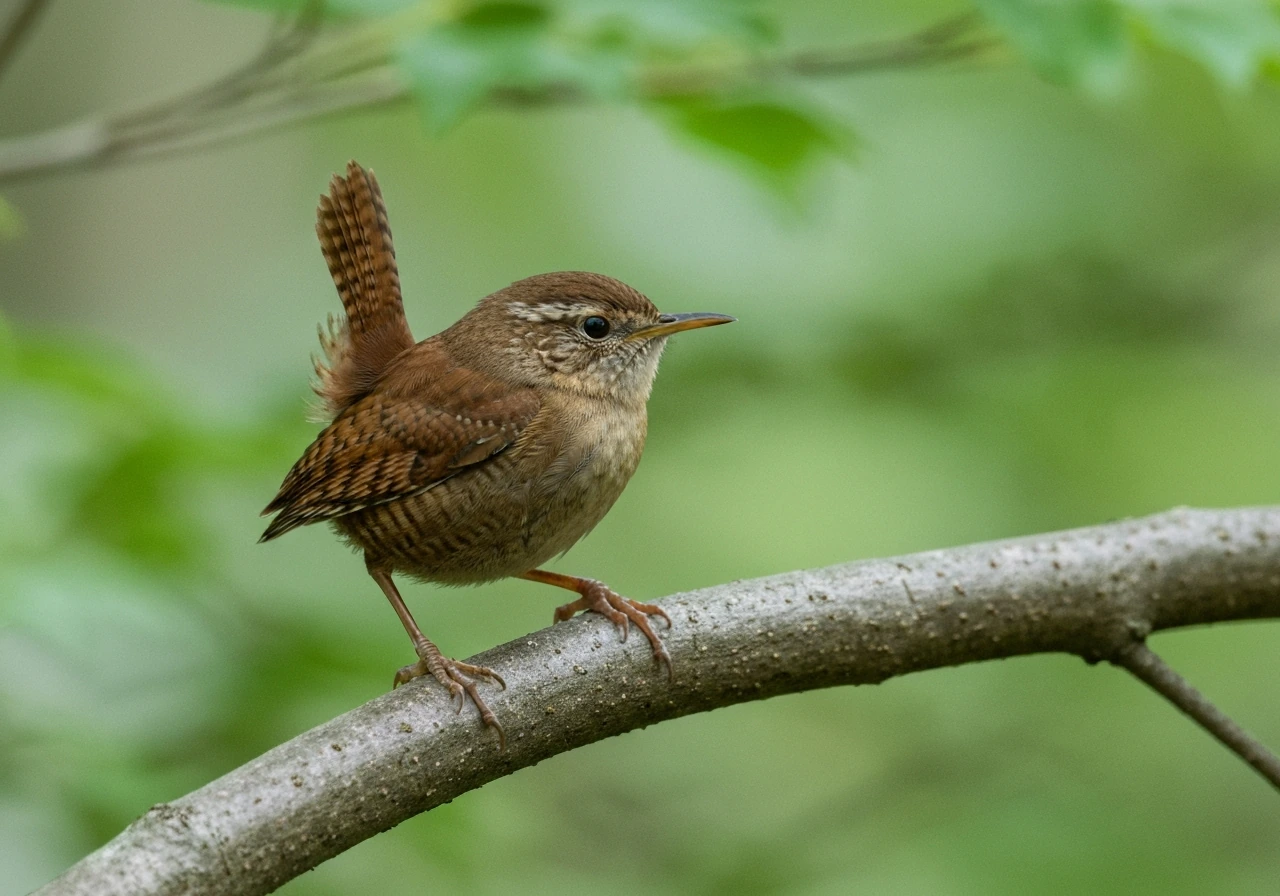
When you spot a small brown bird and want to run through a quick mental checklist, focus on these five things in order. They'll get you to a confident ID faster than trying to take in everything at once.
- Size: Is it very small, smaller than a sparrow? Wrens are tiny. If the bird looks noticeably larger, you might be looking at something else entirely, like a bird that looks like a wren but is bigger.
- Tail: Is it short and cocked upward? That upright tail posture is the single fastest wren identifier in the field.
- Bill: Is it thin and slightly curved, not thick and seed-cracker-shaped? Wrens are insect eaters with delicate bills.
- Color: Is the bird brown above and pale grayish below with no bright colors at all? House Wrens are famously drab.
- Pattern: Look for dark barring on the wings, tail, and lower belly. Also check for an eyebrow stripe. If there's a bold white eyebrow, you may not be looking at a House Wren.
Birds people often mix up with wrens
The House Wren causes the most confusion when people compare it to the Carolina Wren, and to a lesser extent the Winter Wren. Here's how to tell them apart at a glance.
| Feature | House Wren | Carolina Wren | Winter Wren |
|---|---|---|---|
| Size | Very small (4.3–5.1 in) | Slightly larger (5.5 in) | Tiny, even smaller than House Wren |
| Eyebrow stripe | Faint or absent | Bold bright white stripe | Faint buff, not bold |
| Upper color | Plain warm brown | Rich reddish-brown | Deep warm brown with barring |
| Underparts | Pale gray, faint barring | Warm buffy-orange | Pale buff with heavy barring |
| Throat | Pale, whitish | White and bright | Pale buff |
| Tail posture | Short, often cocked up | Long, often cocked up | Very short, strongly cocked |
| Where found | Open woods, gardens, backyards | Dense thickets, suburban areas | Dense forest undergrowth |
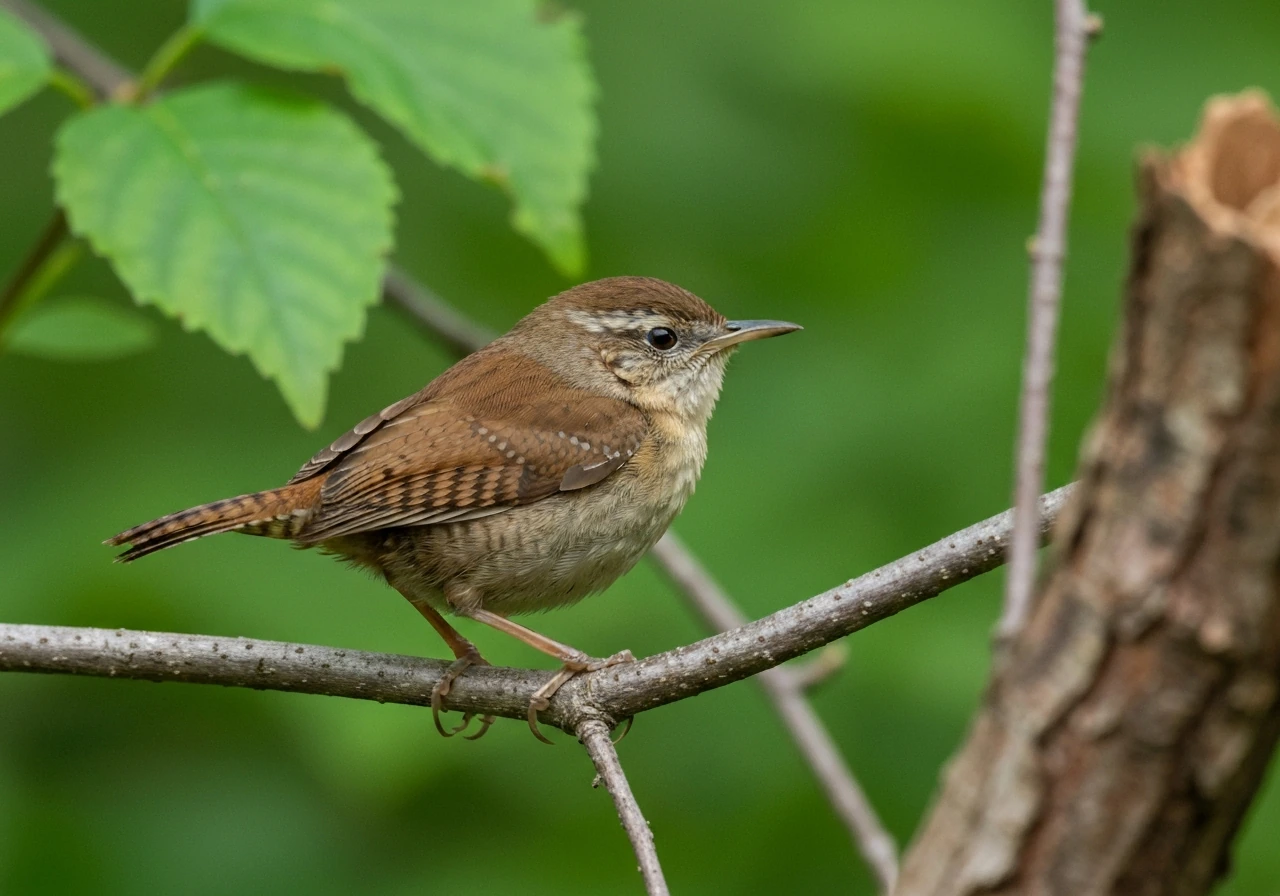
The Carolina Wren is the one that trips people up most often. It's warmer, richer in color, and has that unmistakable bold white eyebrow stripe that the House Wren completely lacks. If you can see the bird's face and there's a bright white stripe running clearly over the eye, you're looking at a Carolina Wren, not a House Wren. The Carolina Wren has rich reddish-brown upperparts, a pronounced white eyebrow, and is about 5½ inches long (bill tip to tail tip) blank" rel="noopener noreferrer">rich reddish-brown upperparts, a pronounced white eyebrow, and about 5½ inches long. The Carolina's underparts are also a warm buffy orange rather than pale gray. People also sometimes confuse small warblers with wrens when a bird is moving quickly through brush. If you're unsure, it's worth knowing what a warbler bird looks like, since warblers tend to be slimmer, often show more color or pattern, and have a different overall body shape than the rounded, tail-up wren silhouette.
What a wren birdhouse looks like (and why it's not the bird)
If you searched for 'what does a wren bird house look like,' you might have been curious about the nesting box rather than the bird itself. It's worth a quick note so you're not confused. A wren birdhouse is a small wooden box, noticeably smaller than a bluebird box, designed to match the dimensions that House Wrens prefer for cavity nesting. The most important feature is the entrance hole: it should be approximately 1 to 1 and 1/8 inches in diameter. That small hole is specifically sized to let wrens in while keeping larger, competing birds out. The interior floor is typically around 4 by 4 inches, with a cavity depth of about 6 to 8 inches. The entrance hole is positioned roughly 4 to 6 inches above the floor of the box. These boxes are usually mounted at a height of 5 to 10 feet on a post or fence and placed near shrubs or woodland edges where wrens feel at home. They're plain wooden structures, often unpainted, and intentionally small and lightweight. The bird itself is, of course, entirely different: a live, moving, brown, barred little creature with a cocked tail. If you were picturing the box, the bird will likely surprise you with how lively it is.
Confirming your ID with location, habitat, and behavior
Plumage is only part of identification. Knowing where and how a bird behaves gets you the rest of the way there, especially with a plain bird like the House Wren where you can't rely on bold markings.
Habitat and range
House Wrens breed across most of North America during spring and summer. In the eastern US, you'll find them from late April through August in backyards, gardens, woodland edges, orchards, and parks. They love brushy, shrubby areas with plenty of cover close to the ground. If you're in a dense forest interior and you spot what looks like a wren, that's more likely a Winter Wren. House Wrens prefer the messier edge habitats where yards meet trees. Knowing the seasonal calendar also helps. If you're watching birds in January in the northern US and you think you spotted a House Wren, double-check, because most have headed south for the winter.
Behavior cues
Behavior is one of the best ID tools you have with wrens. House Wrens are constantly active, bouncing and hopping with that tail up and held high. They investigate everything, darting in and out of shrubs, poking around woodpiles, and singing from exposed perches with remarkable volume for such a small bird. The song is a rapid, bubbling, descending cascade of notes that seems almost too big for the bird producing it. If you hear that song and then spot a small brown bird with a cocked tail nearby, you can confirm your ID with confidence. The behavior of inquisitive, almost fearless bouncing movement in yards is something you'll start to recognize immediately after seeing your first House Wren.
When the ID is still uncertain
If you're looking at a small brown bird and you're still not sure, consider whether it might be something outside the wren family entirely. Some birds with subtle plumage and active behavior get lumped into the 'little brown bird' category unfairly. For example, if the bird you're watching has a distinctive crest and silky plumage, you might actually be watching something completely different, like what a waxwing bird looks like. And if the bird is cryptic, mostly nocturnal, and has a completely different body shape with a wide flat head and cryptic brown camouflage, it could be something like what a whip-poor-will bird looks like. Running through that mental checklist of size, tail posture, bill shape, and eyebrow presence or absence will almost always separate a wren from anything else quickly. With a House Wren specifically: small, brown, no bold eyebrow, barred wings and tail, short upright tail, thin bill, bouncing actively in a shrubby backyard. That combination points to one bird and one bird only.
FAQ
What does a wren bird look like at a distance, when the markings are hard to see?
House Wrens can look especially plain at a distance or in shadow, but the short tail held upward is still usually the most reliable cue. If you only catch a quick silhouette, focus on the combination of small size, compact rounded body, and tail cocked up (not a long or level tail).
How can I tell if a quick glimpse is a wren, especially if it keeps moving?
Wrens often pause briefly to watch you, then resume bouncing. If you can time it, look for the pattern of darting into cover and reappearing on exposed perches, they commonly sing while holding the tail up. That behavior can confirm a wren even when the face details are fleeting.
What’s the fastest way to tell a House Wren from a Carolina Wren?
First, check the eyebrow area: House Wrens usually have a faint buff wash or no distinct stripe, while Carolina Wrens show a clear bold white eyebrow stripe. Second, compare underparts color, House Wrens look pale grayish below, Carolina Wrens are warmer and buffy-orange.
If I’m in a forest, what should I look for to avoid confusing House Wrens with Winter Wrens?
To separate House Wrens from Winter Wrens, location and habitat matter. Winter Wrens are more likely in dense forest interior, while House Wrens show up more in yard and woodland-edge situations near shrubs. Also, Winter Wrens tend to have a less uniformly compact, more upright and “stubbier” silhouette, but tail posture alone is not enough.
Can a bird be mistaken for a wren because it’s small and brown?
If the “wren” you saw had a noticeable crest or a different overall body shape, it may not be a wren at all. Wrens are small, round-bodied, brown, with a thin slightly downcurved bill and a short tail held up. A crest or silky, standout plumage is a red flag that you should re-check with other bird groups.
How does lighting or camera quality affect what a wren bird looks like?
Yes, lighting can make the belly look darker or make barring seem invisible. When possible, observe the wings and tail while the bird is perched, the fine dark barring gives a faint checkered look close up. If you only see one side, try to watch as it turns, barring patterns can vanish from certain angles.
What feeding behavior should I expect from a House Wren?
Feeding style can help. Wrens probe around bark, woodpiles, and dense ground cover, and their thin slightly downcurved bill is built for that. If the bird seems to hover over open ground or feeds mainly by sallying from mid-air, it may be something else.
What parts of a wren’s body should show barring versus plain color?
A wren will typically be more “barred and checkered” on the wings and tail than on the back, and the throat is often paler than the rest of the face and head. If you notice a bird that looks boldly patterned all over, or with strong clean gray versus brown contrast, consider whether it’s a different species rather than assuming it is a House Wren.
Next Article
What Does a Herring Bird Look Like? Herring Gull ID Guide
Learn what a herring bird likely is: clear herring gull ID guide with key marks, plumage differences, and lookalike comp