A roadrunner is one of those birds that looks almost too cartoon-like to be real. It's a large, lean, streaky ground bird with a shaggy crest on its head, a thick pointed bill, and a tail so long it seems like it belongs on a different animal. If you've spotted something like that darting across a desert road or scrubby open ground, you've almost certainly found your bird. Here's everything you need to know to confirm it and tell it apart from a few similar species that trip people up.
What Does a Roadrunner Bird Look Like? Key ID Cues

Marcus Whitley
16 Apr 2026
Quick visual ID: overall shape and size
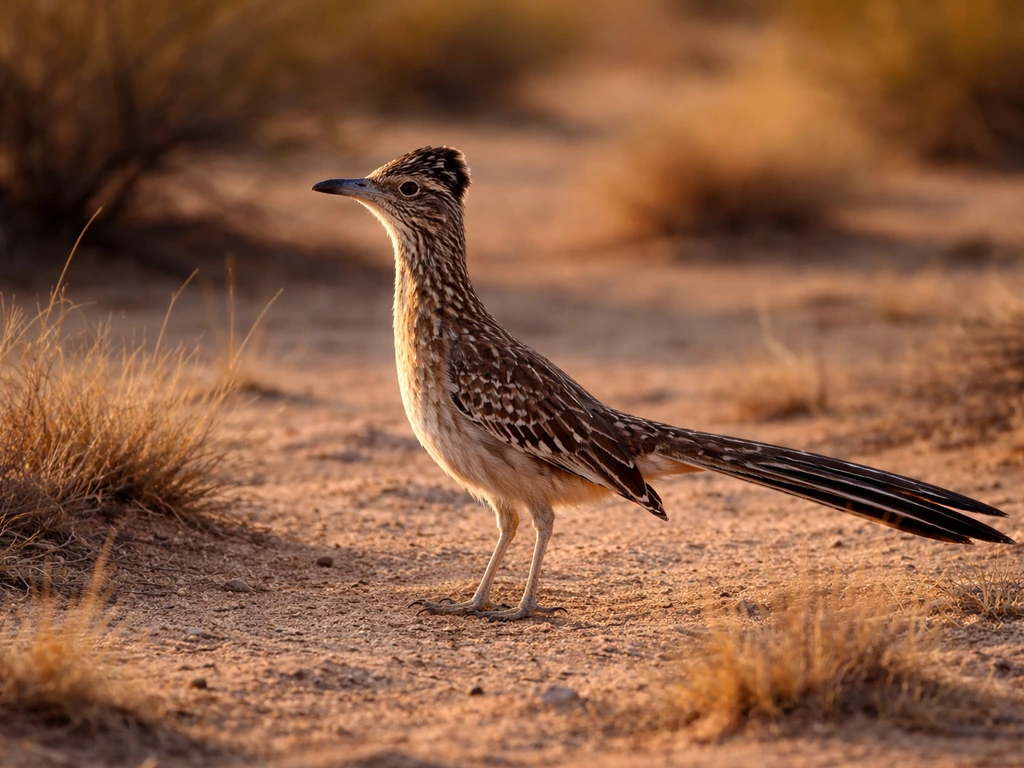
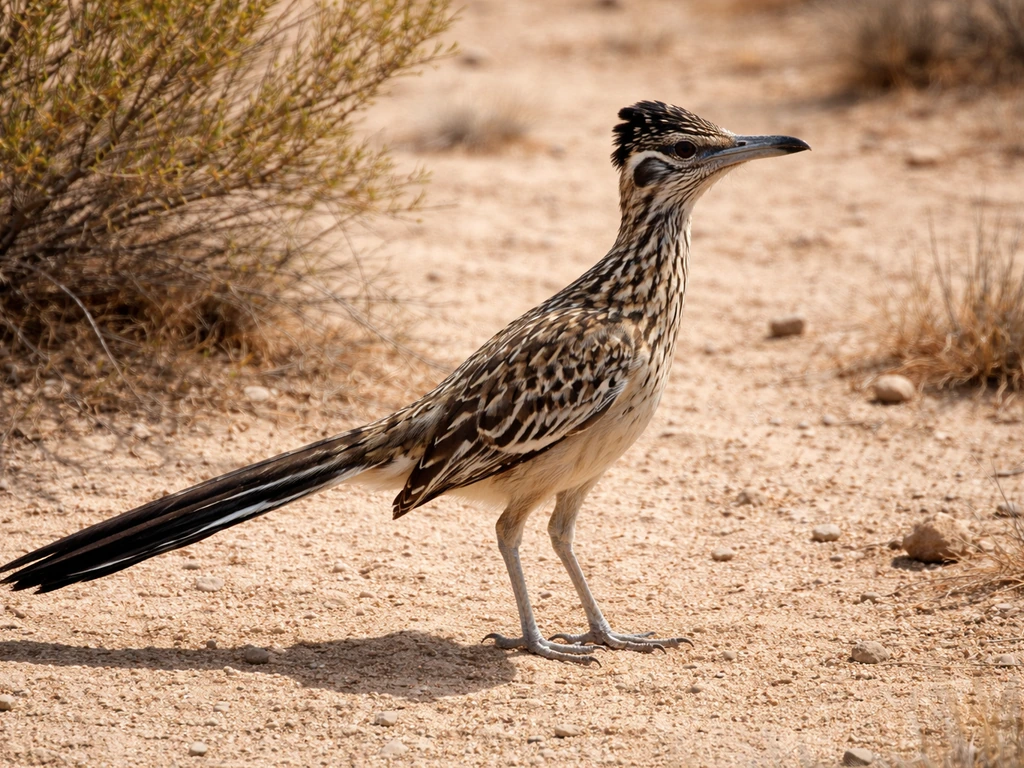
The Greater Roadrunner is big for a ground bird. Adults run about 20 to 24 inches long (roughly 50 to 62 cm), which puts it closer in size to a crow than to most songbirds. About half of that length is pure tail, so when you see one standing still it looks almost comically back-heavy. The body itself is slender and streamlined, sitting low on long sturdy legs. The neck is noticeably long and often stretched forward when the bird is moving, giving it that distinctive running posture you might recognize. When it's relaxed it often tilts its tail upward at a slight angle, which is one of the silhouette clues that stands out even at a distance.
In the field, the first impression is a large, leggy, brown-streaked bird that would rather sprint away from you than fly. It's a cuckoo family member that has essentially given up on the canopy and gone fully terrestrial. It can run at up to 17 miles per hour, which explains why your first view might just be a fast-moving streak of brown disappearing into the brush.
Key field marks to lock onto first
Head and crest
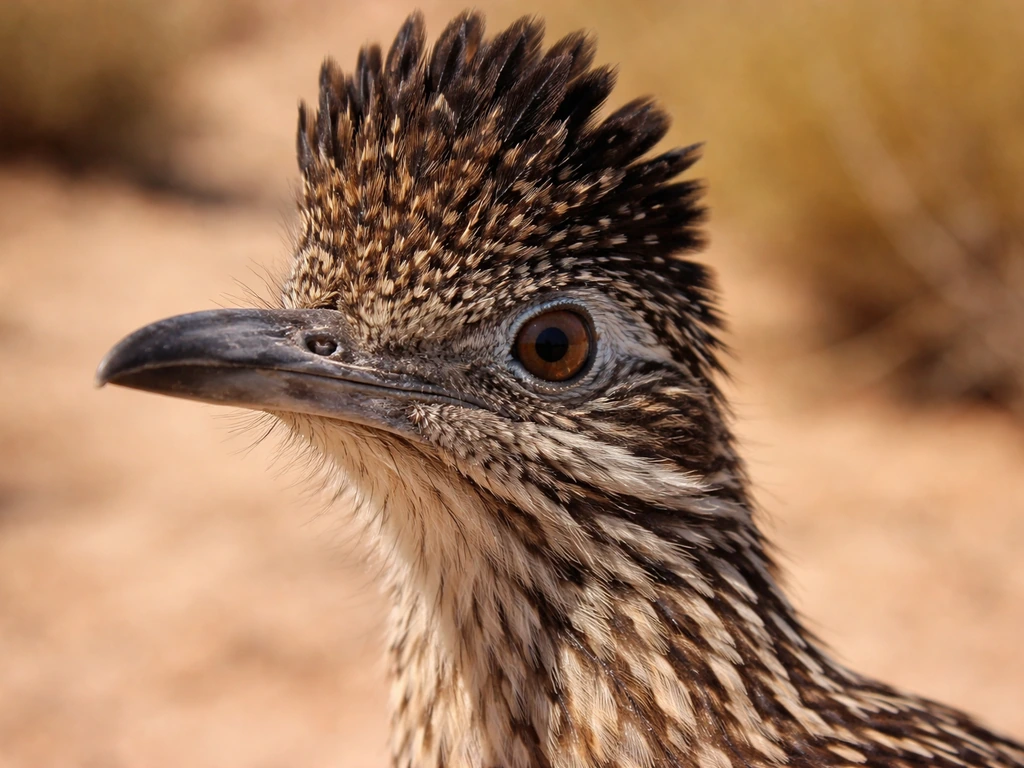
Start at the head. The roadrunner has a bushy, shaggy crest made of brown feathers that it raises and lowers depending on mood. The crown is dark, almost black, peppered with small pale spots. That spotted dark crown plus the ragged crest is one of the fastest visual confirmations you can get, especially in photos. Look for it right away.
The eye and bare skin patch
Right behind each eye there's a patch of bare skin, and this is one of the most distinctive features on the whole bird. The skin is blue toward the front and red or orange toward the rear, creating a little two-toned tear-drop shape. In males the blue portion is especially vivid. The bird usually keeps this patch tucked under its feathers, but when it's alert or agitated it shows clearly. The eye itself is yellow, which pops noticeably against the dark head. If you can see that yellow eye and the blue-orange skin patch, you're looking at a roadrunner.
Bill and legs
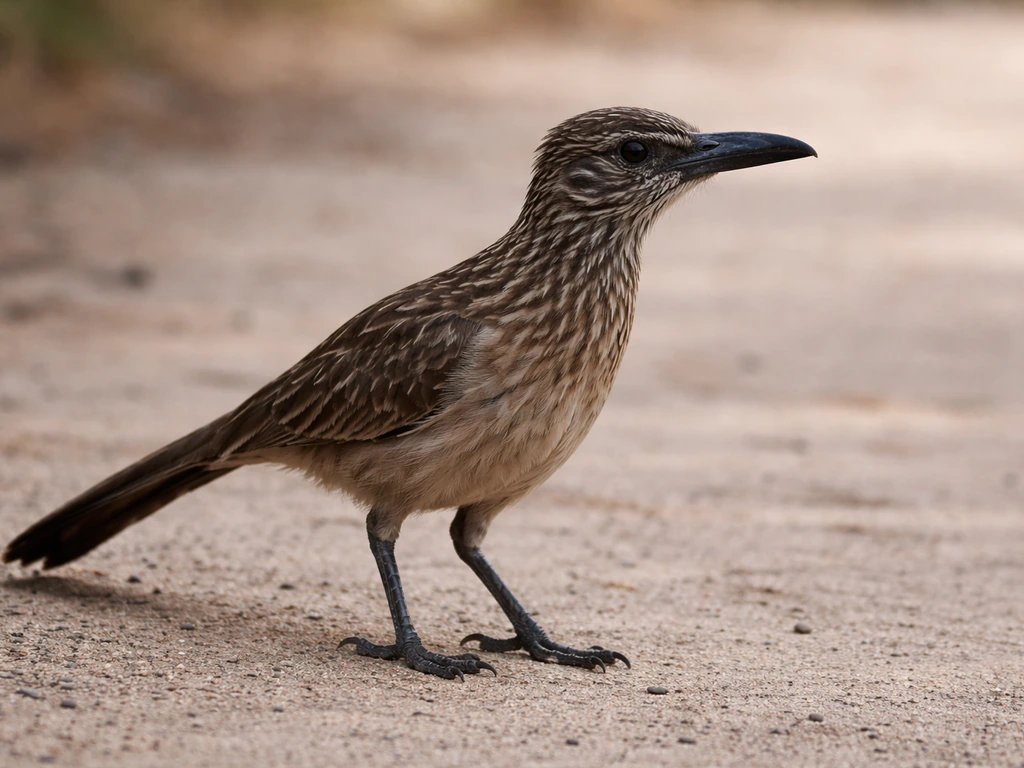
The bill is long, thick, and dark, with a very slightly hooked tip. It looks heavy relative to the head and is one of the features that sets the roadrunner apart from thinner-billed ground birds. The legs are long and strong, built for running, and when you watch one walk you'll notice it moves with a purposeful, almost mechanical stride. The feet have two toes pointing forward and two pointing back, a zygodactyl arrangement common in the cuckoo family, though you'd need a close-up photo to confirm that detail.
Plumage patterns worth studying
The back and upperwings are dark brown with extensive pale edging on the feathers, which creates a strongly streaked or striped look. This pattern runs from the shoulders all the way down the back and is one of the most consistent features across all ages and sexes. The neck and upper breast are pale, whitish or light brown, with dark streaks running down them. The belly is clean white or pale. The tail is long and dark with white tips on the outer feathers, which you'll notice especially when the tail is fanned or when the bird turns away from you. In flight, you'll see white crescent shapes at the base of the primary wing feathers, though roadrunners don't fly much or for long distances.
To summarize the key plumage cues quickly: dark spotted crown, streaky brown-and-white back, pale streaked chest, clean pale belly, and a long dark tail with white outer tips. You can confirm most of those from a decent photo or a moderately close field view.
Birds that look like a roadrunner (and why people mix them up)
From a distance or a quick glance, a few other birds share enough visual traits with the roadrunner to cause confusion. The main culprits are the Ring-necked Pheasant, the Lesser Roadrunner, and occasionally large brown ground birds like certain thrushes or even a low-flying cuckoo. Here's what to know about each.
Ring-necked Pheasant
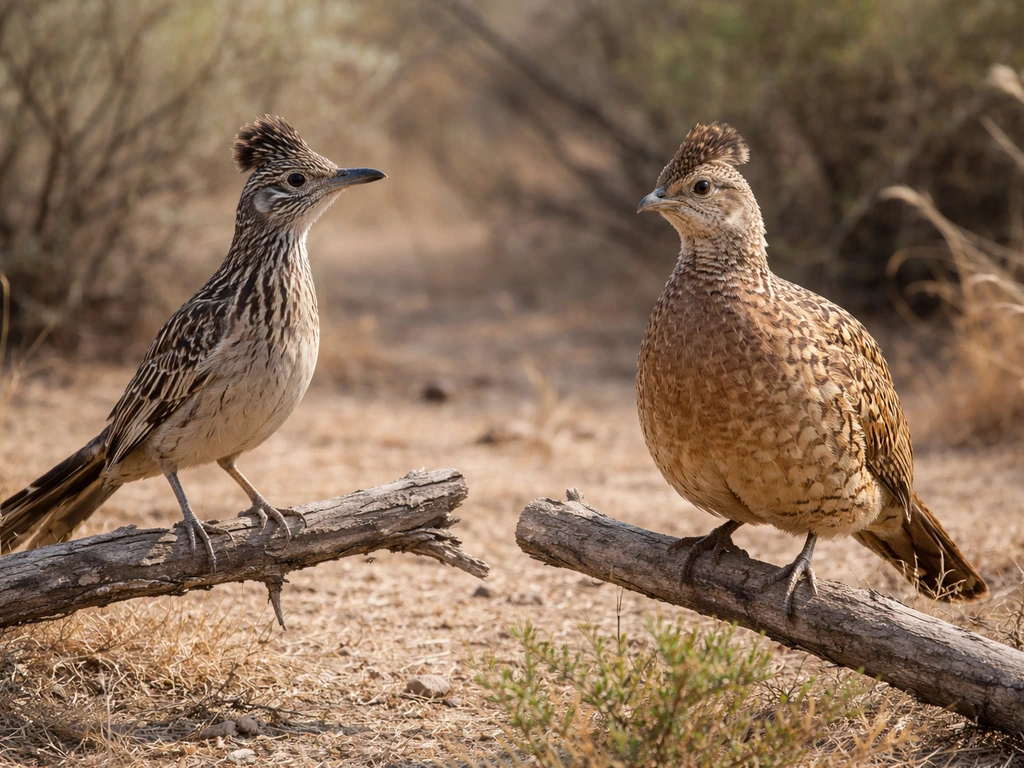
Cornell Lab explicitly lists the Ring-necked Pheasant as a species that gets confused with the Greater Roadrunner, and it's easy to see why. A pheasant is also a large, long-tailed ground bird that runs rather than flies when startled. At a glance the silhouettes can feel similar. But pheasants have noticeably smaller heads relative to their bodies, shorter legs, and a very different plumage style. Male pheasants have that unmistakable iridescent green head with the red face patch, and females are mottled buffy-brown without the roadrunner's streaky patterning. Pheasants also lack the crest, the yellow eye, and the blue-orange facial skin patch. They tend to favor agricultural edges and grasslands rather than desert scrub.
Lesser Roadrunner
If you're in Mexico or Central America, you might actually be looking at the Lesser Roadrunner rather than the Greater. The Lesser is smaller, running about 18 to 20 inches in total length with a tail around 9 to 10 inches. Its crown and crest show a black pattern with a bronze gloss and small light brown spots, slightly different from the Greater's head. The eye-ring on the Lesser tends to be pale lavender to bright blue, and the beak coloration differs too, with an upper gray mandible and a lower bluish-gray one. The underpart streaking is less heavy than on the Greater. In North America you're almost certainly seeing a Greater, but range is the first thing to check if the two seem like candidates.
Other large brown ground birds
People occasionally mistake a roadrunner for a large thrush, a brown thrasher, or even an unusually low-flying cuckoo perched on the ground. The differences come down to scale and proportions. Thrashers and thrushes are much smaller, typically 10 to 12 inches at most, and lack the heavy bill, long legs, and obvious crest of a roadrunner. A roadrunner next to a thrasher looks enormous. If the mystery bird is about the size of a crow with a long tail, a crest, and a heavy bill, you're back to roadrunner territory. Interestingly, the roadrunner is itself a member of the cuckoo family, which is part of why certain cuckoos can feel vaguely similar in shape, though no other North American cuckoo matches the roadrunner's size on the ground.
Side-by-side: telling them apart fast
| Feature | Greater Roadrunner | Ring-necked Pheasant | Lesser Roadrunner |
|---|---|---|---|
| Length | 20–24 inches | 21–35 inches (inc. tail) | 18–20 inches |
| Crest | Bushy, brown, prominent | None | Bushy, brown, similar but smaller |
| Eye color | Yellow | Brown/orange (male: red skin) | Similar to Greater |
| Bare facial skin | Blue + red/orange behind eye | Red face patch (males only) | Pale lavender to blue eye-ring |
| Bill | Long, thick, dark, slightly hooked | Short, pale, curved | Slightly smaller, gray/blue-gray |
| Underpart pattern | Pale with dark streaks on chest, white belly | Buffy/mottled (female) or iridescent (male) | Less streaking than Greater |
| Legs | Long, built for running | Medium, stockier | Long, similar to Greater |
| Typical habitat | Desert scrub, open terrain | Agricultural edges, grassland | Tropical scrub, Central America |
| Tail | Long, dark, white outer tips | Very long, pointed, barred brown | Long, similar to Greater but shorter |
The fastest route to a confident ID is to look for three things in combination: the bushy crest, the yellow eye, and the blue-orange bare skin patch behind the eye. No other common North American ground bird has all three. If you have a photo, zoom in on the head first. Those features will either confirm or rule out the roadrunner almost immediately.
Using photos and real-world checks to confirm your ID
If you managed to get a photo, start by cropping it tight on the head. Look for the crest shape, the eye color, and that bare skin patch. Then check the back pattern: is it streaky and dark with pale edges? Is the tail noticeably long and dark with pale tips at the outer edges? Those head and back details together are essentially a signature. If the photo is blurry or distant, focus on silhouette: long tail held at an upward angle, long neck stretched forward, and very long legs. That posture is hard to mistake once you've seen it.
In the field, behavior is a supporting clue. Roadrunners move fast on the ground, often in short bursts, and they tend to pause and look around with the crest raised. They don't flush easily and will run rather than fly when startled. If the bird you saw did all of that in desert scrub, open chaparral, or dry open country in the southwestern US, you've almost certainly got your roadrunner. The species ranges through the American Southwest into the south-central states, so range alone can narrow things down quickly.
For a deeper confirmation, apps like Merlin Bird ID from the Cornell Lab let you upload a photo or describe what you saw and will return a short list of likely candidates. Merlin Bird ID is a free Cornell Lab of Ornithology app, and its photo ID capabilities were launched after an initial question-based approach blank" rel="noopener noreferrer">Merlin Bird ID from the Cornell Lab lets you upload a photo or describe what you saw. It's a genuinely useful tool for beginners and experienced birders alike. Pair it with a regional field guide and you'll rarely be stuck. If you want to sharpen your eye for streaky ground birds generally, it helps to spend time with comparison species. understanding what a meadowlark bird looks like is a good exercise because meadowlarks share some of the open-ground habitat and streaky patterning, but their compact body and short tail make them look nothing like a roadrunner up close.
It's also worth knowing that unusual bird shapes can sometimes fool you because you're comparing to whatever you've seen most. If the bird struck you as exotic or almost tropical-looking, that reaction is worth trusting. There are genuinely strange-looking birds out there, and the roadrunner is one of them. If you've ever tried to figure out what an umbrella bird looks like, you'll know what I mean about birds that look almost invented. The roadrunner has that same quality: real, but almost too theatrical to believe.
What to do next if you're still not sure
If you've gone through all of the above and you're still uncertain, try these steps in order:
- Check range first. If you're in the southwestern US, south-central US, or northern Mexico, a Greater Roadrunner is very plausible. Outside that range, it becomes much less likely.
- Zoom in on the head in any photo you have. Look specifically for the crest, yellow eye, and the blue-orange bare skin patch. These three features together are the fastest visual lock.
- Look at the tail. It should be notably long, dark on top with white on the outer tips, and often carried at an upward tilt.
- Compare size to something familiar. At 20 to 24 inches this bird is crow-sized. If the bird you saw felt smaller, consider a thrasher or thicket bird instead.
- Use a bird ID app with your photo. Merlin is free and accurate and will return a ranked list of candidates you can compare visually.
- If you're birding outside North America and spotted something with a similar feel, the identification landscape changes. Knowing what an Australian storm bird looks like or what a fieldfare bird looks like can help you recognize when a mystery bird belongs to a completely different group, which in turn helps you rule out roadrunner-like misidentifications when you're far outside its natural range.
The roadrunner is honestly one of the more distinctive birds in North America once you know what to look for. The combination of size, that long upward-tilted tail, the spotted dark crest, yellow eye, and blue-orange facial skin makes it largely unmistakable. If your bird checks most of those boxes and was running across open dry ground in the right region, you can feel confident about your ID.
FAQ
Can I identify a roadrunner if I only see it from behind or in a fast dash across the road?
Yes, but focus on silhouette and proportions. Even without seeing the facial skin patch, a roadrunner’s long, dark tail with pale outer tips and its long legs with a stretched neck forward are strong clues. If the tail is held slightly upward when it pauses, that’s another helpful confirmation.
What if the yellow eye or the blue-orange bare skin patch are not visible in my photo?
Try to confirm using the crest and back pattern first. The bushy shaggy crest with a dark, peppered spotted crown and the strongly streaked brown-and-white upperparts are usually visible even when the head angle hides the facial skin patch. If those are clear, the ID is still likely.
Do juvenile roadrunners look different from adults, and what should I watch for?
Juveniles tend to look more overall brown and less “sharp” in the facial contrast, but the key structural cues usually remain. In particular, keep looking for the long, back-heavy tail look, the streaked back, and the crest. The facial skin patch can be less prominent, so don’t rely on it alone for a young bird.
Are roadrunners ever misidentified as Roadrunners’ relatives, like other cuckoos?
Occasionally, but size is your first filter. North American cuckoos are generally smaller and don’t match the roadrunner’s crow-like ground proportions, long tail held up at rest, and heavy-billed, leggy stance. If the bird feels “crow-sized on the ground” with a crest, that strongly points to roadrunner rather than a different cuckoo.
How can I tell a Greater Roadrunner from a Lesser Roadrunner if I’m in the right region?
Check both size and head details. The Lesser is smaller overall, with a shorter-looking tail, and its eye-ring color tends to be paler (lavender to bright blue). The head pattern also differs subtly, with a different look to the crown and crest gloss. If you can’t reliably estimate size, prioritize the eye-ring color and head pattern.
What is the quickest single detail in the head area that rules in or out a roadrunner?
The combination of a spotted dark crown plus the yellow eye is the fastest first pass, then the bare skin patch behind the eye seals it. If the bird has a crest but lacks yellow and the blue-orange facial skin patch, it is very unlikely to be a roadrunner.
Do roadrunners ever act like they might fly, or do they always run?
They usually prefer running and don’t flush easily, but they can make short flights or reposition if startled. So if you see one hopping or briefly taking off, don’t let that eliminate roadrunner, especially if the ground posture, long tail, and crest behavior match what you’d expect.
How far away can a bird be and still be identifiable as a roadrunner?
Distance matters, but roadrunners remain distinctive because of proportions. You can often ID from a moderate distance using the “large, leggy ground bird” silhouette, long upward-tilted tail when paused, and the streaky look of the back. At very long distances, rely less on subtle facial skin colors and more on crest plus body-and-tail shape.
What should I do if I can’t tell whether the bird is a roadrunner or a pheasant?
Use the head-to-leg proportion and facial pattern clues. Pheasants typically have shorter legs and smaller heads relative to their bodies, and their plumage patterning style is different (especially males with a green head and red facial area). A roadrunner’s crest and the yellow eye plus blue-orange facial skin patch are the decisive break from pheasant features.
If I submit a photo to an ID app, what photo angle will be most useful?
Upload a clear image cropped to the head first, then one that shows the back and tail tips. Apps work best when they can see the crest shape, eye color, and the facial skin patch, and they also use the streaked upperparts and tail pattern as confirmation. If the head is sharp, you can often get a confident result even if the body is partially obscured.
Next Article
What Does a Herring Bird Look Like? Herring Gull ID Guide
Learn what a herring bird likely is: clear herring gull ID guide with key marks, plumage differences, and lookalike comp