If you spotted a large waterbird with an enormous bill and a droopy pouch hanging under it, you almost certainly saw a pelican. No other bird carries that combination quite so dramatically. The two species you're most likely to encounter in North America are the Brown Pelican (coastal, stocky, dark-bodied, famous for its dramatic plunge-dives) and the American White Pelican (inland lakes and wetlands, snow-white with black-tipped wings, a scooper rather than a diver). The birds most often confused with pelicans are the Great Blue Heron, the Anhinga, and occasionally large cormorants, but once you know the key features to check, the difference becomes obvious fast.
What Bird Looks Like a Pelican? How to Tell Them Apart

Marcus Whitley
3 Jul 2026
What a pelican actually looks like (your baseline)
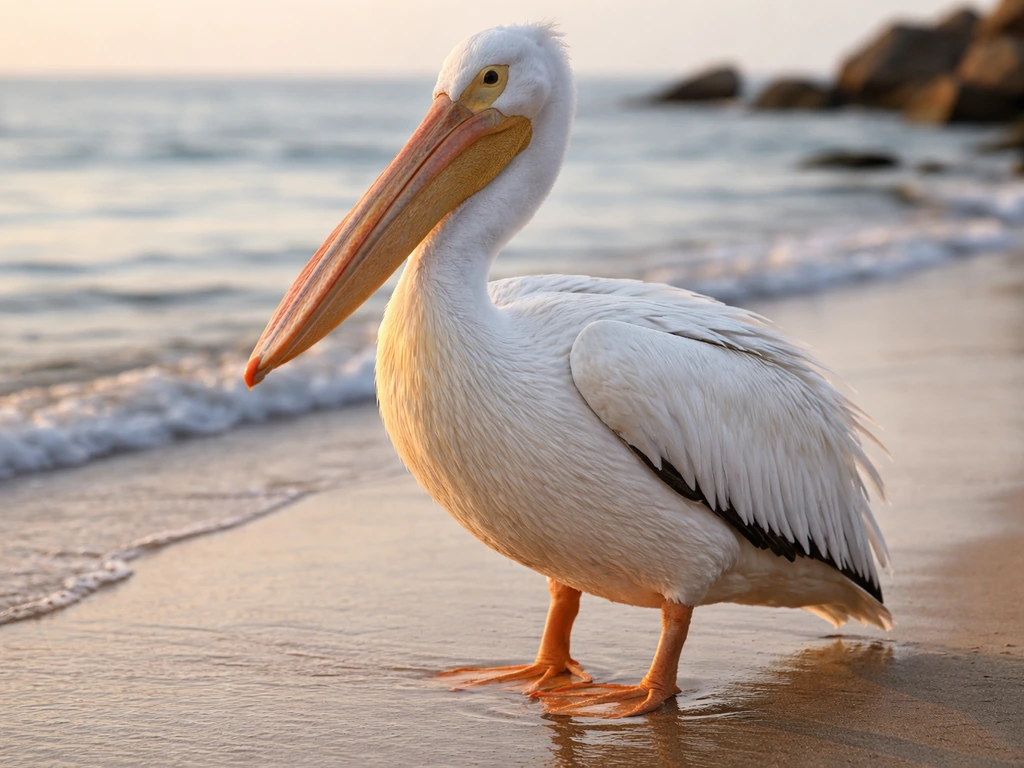
Before you can confidently say 'that's not a pelican,' you need a solid mental image of one. Pelicans are massive birds, among the largest waterbirds you'll encounter in North America. Think of a football with wings and a comically oversized bill. Their necks are long but thick, and they carry them in a slight S-curve when resting, pulling the head back close to the body in flight. The bill is the single most important feature: it's long (about 9 inches on a Brown Pelican), slightly hooked at the tip, and suspended below it is a large, stretchy throat pouch called a gular pouch. If the bird's throat pouch and bill shape don't match, you can also compare against a bird that looks like it has hair as a nearby visual check. That pouch isn't just decorative. On a Brown Pelican it can hold more liquid than the bird's own stomach.
In terms of color, the Brown Pelican is grayish-brown and streaked across the back, with a blackish-brown breast and belly, a white head with a pale yellow wash on the crown, and dark legs and feet. The American White Pelican is almost entirely white when perched, but open those wings and you'll see bold black flight feathers along the wingtips. Its bill is a bright yellow-orange, compared to the Brown Pelican's grayish bill. Both species have broad, long wings built for effortless soaring and gliding, giving them a prehistoric, almost pterodactyl-like quality in the air.
Birds people commonly mistake for pelicans
Several large waterbirds share enough visual real estate with pelicans that a quick glance can fool you, especially at a distance or when the bird is in flight.
Great Blue Heron
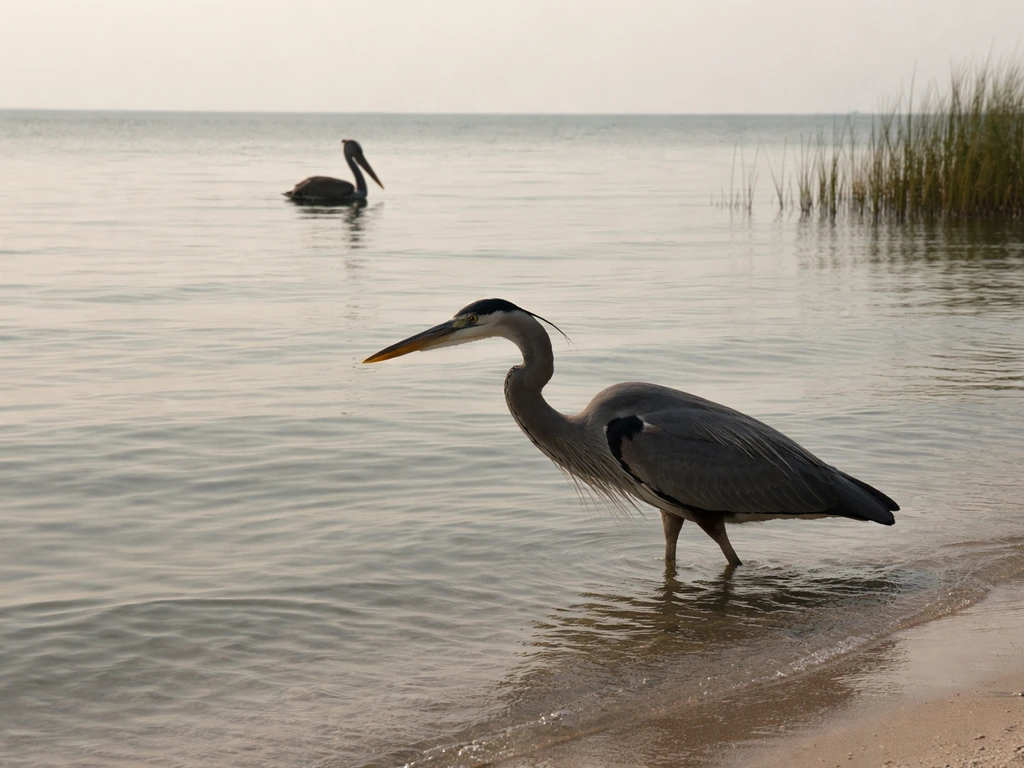
This is probably the most common mix-up. If you still cannot narrow it down, remember there are other look-alikes, including the kind of bird someone might describe as a man who looks like a bird. The Great Blue Heron is a tall, slate-blue bird with a long dagger-like bill and a very long neck that it folds into a tight S-shape during flight. That last point is a quick giveaway: pelicans stretch their heads back but keep the bill extended forward, while a flying heron tucks its neck so sharply the head appears to sit right on the shoulders. Herons also have legs that trail far behind the tail in flight, giving them a completely different silhouette. You'll find Great Blue Herons in the same coastal and marsh habitats as pelicans, which is exactly why the confusion happens.
Anhinga
The Anhinga earns its nickname 'snakebird' because it swims with only its long, thin neck poking above the water, giving it a genuinely serpentine look. It's a large, dark waterbird with silver-white patches on its wings and a long, straight, pointed bill, nothing like the pelican's heavy hooked bill with a pouch. From a distance, a perched Anhinga spreading its wings to dry in the sun might catch your eye as something pelican-sized, but up close the sleek build and pointy bill are completely different. Anhingas are mostly found in freshwater swamps and the southeast U.S., particularly places like the Everglades.
Double-crested Cormorant
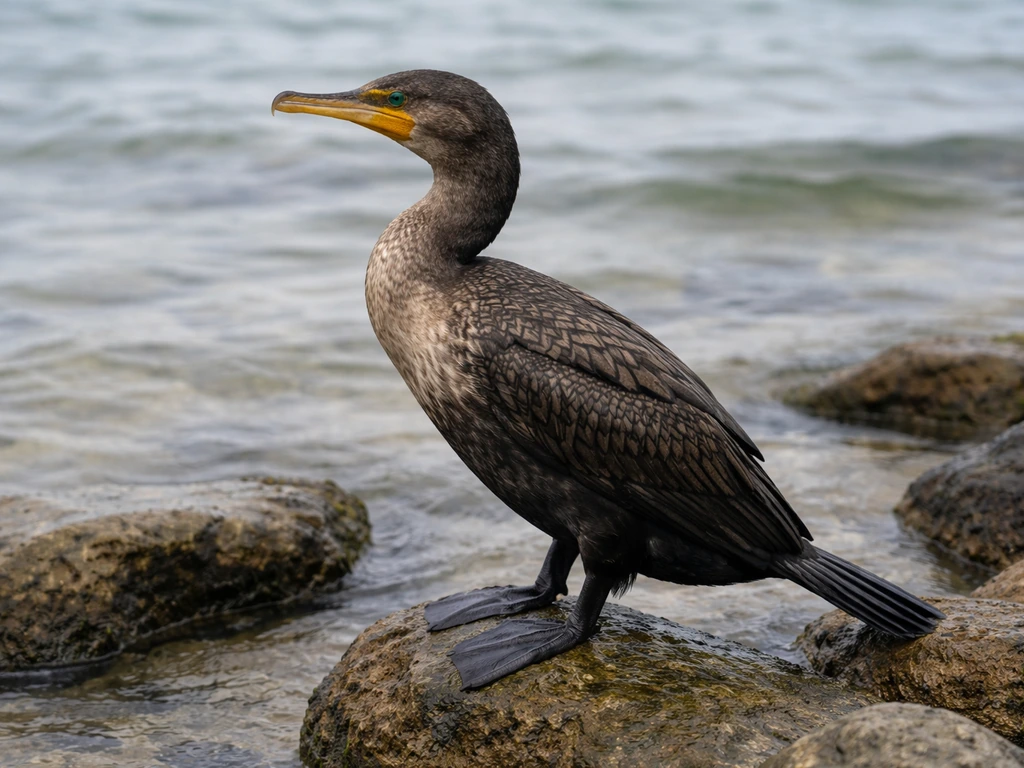
Cormorants are stocky, dark waterbirds with a longish bill and a small throat pouch, so they can momentarily read as 'pelican-like.' But a cormorant's pouch is tiny compared to a pelican's, their bill is thin and strongly hooked at the very tip (not a big scooping tool), and the overall bird is much smaller. Cormorants also hold their wings low and flat when drying, often perching on rocks, pilings, and buoys in the same spots you'd see pelicans. The size difference alone usually settles it.
White Ibis (juvenile)
Juvenile White Ibises are brown-and-white with a long, strongly curved reddish-orange bill, and from certain angles on the water they can briefly suggest a smaller pelican. The curved bill is the visual connection, but an ibis is much smaller, slimmer, and has no gular pouch. A quick size and neck-thickness comparison rules it out.
How to tell look-alikes apart using key visual features
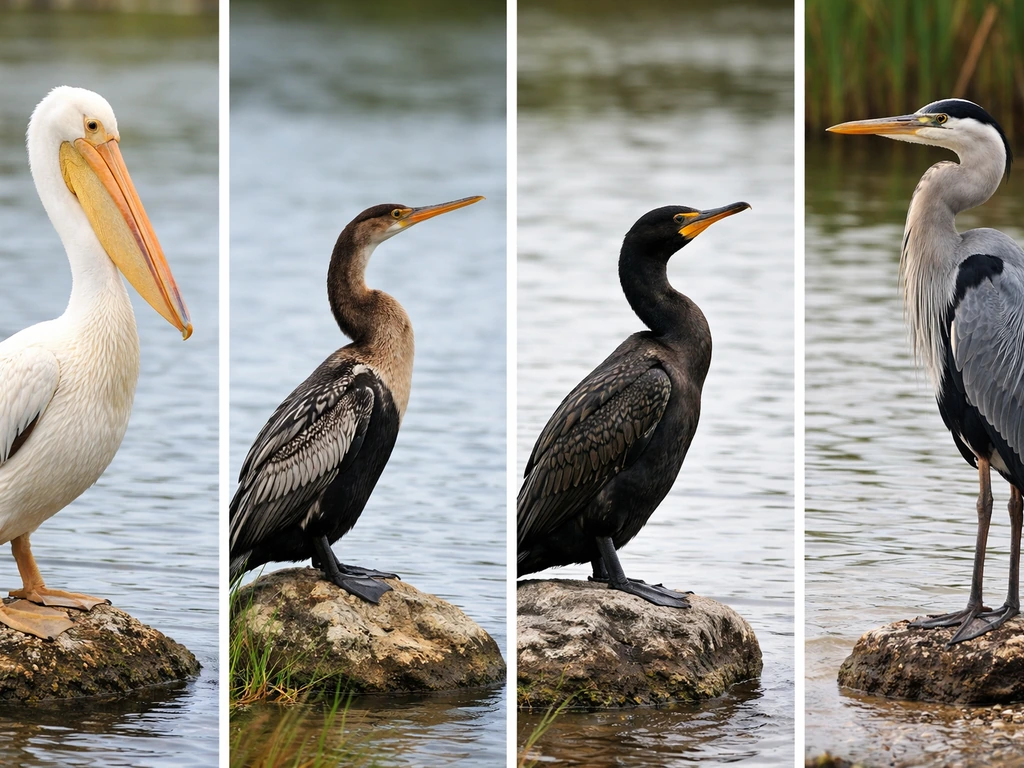
| Feature | Pelican | Great Blue Heron | Anhinga | Cormorant |
|---|---|---|---|---|
| Bill shape | Long, thick, hooked tip | Long, straight dagger | Long, straight, pointed | Shorter, thin, hooked tip |
| Throat pouch | Large and obvious | None | None | Very small, barely visible |
| Neck in flight | Extended, head pulled back | Folded in tight S | Extended, snake-like | Extended, held lower |
| Legs in flight | Tucked beneath body | Trail far behind tail | Trail behind tail | Tucked beneath body |
| Overall color | Brown/grayish or white | Slate blue-gray | Dark with wing patches | Dark overall |
| Wing shape | Long, broad, flat soar | Broad, rounded, bowed | Long, spread to dry | Shorter, pointed |
| Size | Very large (4-5 ft wingspan) | Very tall, large wingspan | Medium-large | Medium |
The pouch is your fastest confirmation. If that pendulous pouch is clearly hanging below the bill, even partially collapsed, you're looking at a pelican. No other common waterbird carries that structure. A downy woodpecker looks much smaller, with a short chisel-like bill and no pouch or pelican-like body shape. After the pouch, check the neck posture in flight: pelicans keep their bill pointed forward with the head slightly pulled back but never fold the neck sharply the way herons do. Finally, look at the feet when the bird is perched: pelicans have large, webbed feet that sit visibly beneath the body, and their black legs on a Brown Pelican contrast noticeably with the pale belly.
Where you are tells you a lot, fast
Location cuts your identification work in half before you even raise your binoculars. Brown Pelicans are almost exclusively coastal: Atlantic and Gulf coasts, Pacific coast from California south, and around barrier islands. If you're watching a large bird work the surf line, diving headfirst into waves from 20-30 feet up, that plunge-dive behavior alone confirms Brown Pelican. They commonly stand on rocks, pilings, and docks in harbors and inlets.
American White Pelicans, on the other hand, are freshwater and large-lake birds for much of the year, breeding on inland lakes across the northern Great Plains and wintering along Gulf and Pacific coasts. They don't dive. They scoop fish cooperatively by swimming in groups and herding fish, which is a completely different fishing style. If you're at a large interior reservoir or wetland and you see a massive white bird with an orange bill scooping fish alongside others, that's your bird.
Anhingas overlap with pelicans in coastal Florida and the southeastern U.S. but prefer freshwater swamps and slow rivers. Great Blue Herons are everywhere, coast to coast, in almost any wet habitat, which is why they cause more confusion than any other species. Cormorants are coastal and inland, often mixing directly with pelicans on the same rocks and buoys.
Age, season, and plumage changes that can throw you off
Pelicans don't always look like the classic image in a field guide, and that's where a lot of the 'is that a pelican?' uncertainty comes from. Here's what to watch for:
- Juvenile Brown Pelicans are brown all over, including the neck, and have a grayish bill rather than the adult's more colorful one. They look a bit dull and uniform, which can make them harder to recognize as pelicans at first glance.
- Breeding adults change noticeably. The neck on Atlantic-coast Brown Pelicans turns a rich dark reddish-brown during breeding season. The bill can shift toward pinkish-red to pale orange, and the pouch actually turns blackish. Pacific-coast birds show a paler bill that becomes yellow in breeding condition.
- Non-breeding adults look more washed out overall, with the white head pattern more prominent and the pouch returning to a muted color.
- American White Pelicans grow a bizarre temporary knob on their bill during early breeding season. It's called a fibrous plate and it falls off after eggs are laid. If you see a white pelican with a strange bump on its bill, that's not an injury, it's a breeding display structure.
- In flight, a young American White Pelican may show dirtier, brownish-gray on the head and back, making it look less purely white than an adult.
The key takeaway here is that if a large bird's plumage looks a little 'off' for a pelican, check the bill and pouch first before writing it off. The structure is always there even when the colors are unexpected.
Your step-by-step field checklist
Run through these in order the next time you're staring at a large waterbird and wondering whether it's a pelican:
- Is there a large, pendulous pouch hanging below the bill? If yes, it's almost certainly a pelican. Stop here if the pouch is obvious.
- How long and thick is the bill? Pelicans have a truly oversized bill, about 9 inches or more, thick throughout its length and hooked at the tip. A heron's bill is long but slim and straight. A cormorant's is shorter and hooked only at the very tip.
- What's the neck doing in flight? Pelicans extend the bill forward with the head pulled back slightly. Herons fold the neck into a sharp S. Anhingas extend their thin neck straight forward like a snake.
- What's the bird doing? Is it plunge-diving headfirst from height? That's a Brown Pelican. Is it scooping fish while swimming in a group? That's an American White Pelican. Is it standing with wings spread to dry? That points toward Anhinga or Cormorant.
- What color are the wings in flight? American White Pelican shows white body with bold black flight feathers. Solid dark wings suggest cormorant or Anhinga. Brown Pelican shows dark-brown wings with pale inner areas.
- Where are you? Coastal surf and harbor pilings: lean toward Brown Pelican. Inland freshwater lake or reservoir: lean toward American White Pelican or, if dark and slim, Anhinga.
- How big is it really? Pelicans are genuinely enormous. If it looks about the same size as a Great Blue Heron, check for the pouch. If it's clearly smaller, move toward cormorant or Anhinga.
Still not sure? Here's what to do next
If you're still on the fence after running the checklist, get a photo. Even a blurry, shaky phone shot is worth taking. You want to capture the bill and head profile, the overall body shape, and if possible a wing-spread shot. Even low-quality images can confirm or rule out a species when you compare them to reference photos later. For suggested IDs in iNaturalist, the practical advice is to compare photos carefully because the suggestion may be wrong when you look at the pictures for the proposed species or genus blank" rel="noopener noreferrer">compare them to reference photos later. To help confirm uncertain IDs, Cornell Lab describes Merlin Bird ID and its photo-identification capabilities, which can be a useful next step blank" rel="noopener noreferrer">Merlin Bird ID photo-identification capabilities.
Once you have a photo, these are your best next steps: If you are trying to figure out what bird looks like a red-headed woodpecker, use the head and bill shape, then compare size and patterning with your local sightings what bird looks like a red headed woodpecker.
- Upload it to the Merlin Bird ID app from the Cornell Lab of Ornithology. The photo ID feature is remarkably good at large waterbirds and will give you a species suggestion with supporting images.
- Post your observation on iNaturalist. The community there includes experienced birders who can help confirm or correct an ID from your photos, and the automated suggestions give you a starting point to compare visually.
- Log it on eBird (also by Cornell Lab). Submit it as a checklist entry with your photo attached. Even if you mark it as uncertain, the visual record helps and experienced reviewers may follow up.
- Pull up the All About Birds species pages for Brown Pelican and American White Pelican and click through the photo galleries. Compare your bird against the juvenile, breeding, and non-breeding photos, not just the adult reference shot.
- If you're comparing large dark waterbirds and still unsure, look at Anhinga and Double-crested Cormorant gallery images side by side with your photo. The bill profile difference is usually definitive in a head shot.
Pelicans are one of those birds where the more you study the pouch and bill structure once, the more instantly recognizable they become forever after. The confusion with herons, anhingas, and cormorants almost always comes from a quick silhouette glance rather than a focused look at the bill. Slow down, check the bill, and you'll have your answer. And if you enjoy working through these kinds of visual puzzles, identifying birds by structural quirks rather than just color is the same process you'd use for other tricky IDs, like working out what bird looks like a red headed woodpecker or figuring out a distant woodpecker by its bill shape and head markings. If you are wondering, “what bird do I look like,” focus on structural clues like bill shape, neck posture, and any pouch-like features what bird looks like.
FAQ
How can I tell a pelican from a heron when they’re flying and I can’t see the throat pouch clearly?
In flight, pelicans are the more “bill-forward” bird: they keep their bill extended and the head held back slightly, rather than folding the whole neck into a tight tuck. If you see a long neck that clearly snaps into a sharp S or V position during flight, you are more likely looking at a heron.
What if the bird doesn’t look like the “classic” pelican color, could it still be a pelican?
Juvenile pelicans can look less cleanly colored than adults, and their bills and pouch may look slightly less dramatic at a distance. The reliable shortcut is structure: confirm a long, heavy hooked bill plus a throat pouch hanging below it, then use size and webbed feet when perched to seal the ID.
Could a cormorant fool me into thinking it’s a pelican, and what’s the quickest way to tell?
A cormorant can sometimes look pelican-like at rest because both are dark and water-adapted. The decisive check is pouch size, bill type, and overall scale: cormorants have a much smaller throat pouch, a thinner bill with a tight hook at the tip, and a noticeably smaller body that sits lower in the silhouette.
Are there any birds that look like a pelican at a glance because of a curved bill?
White ibises can mimic a “smaller pelican” impression only briefly because of their curved bill and water stance. Pelicans are larger, have a much thicker neck and body, and have a pouch, so if the bird lacks that pendulous pouch and the curved bill looks pencil-thin rather than heavy, it’s almost certainly not a pelican.
What should I do if the throat pouch isn’t hanging clearly, can I still confirm it’s a pelican?
If the pouch is partially collapsed, it may look like a faint fold or crease rather than a full hanging sac. Still, it should read as a thicker, loose throat area under the bill compared to look-alikes. When possible, wait for a posture change or capture a photo as the bird turns its head.
Can behavior (diving versus scooping) confirm which pelican species I’m seeing?
Yes. Brown Pelicans are strongly tied to coastal shorelines and harbors, and they also commonly show the plunge-diving feeding pattern in surf. If you see a massive pelican-like bird diving headfirst into waves repeatedly, that behavior strongly points to Brown Pelican rather than the inland American White Pelican.
If it’s an American White Pelican, what specific behavior or setting should I watch for?
American White Pelicans often form groups during feeding and can look surprisingly “plain” when perched. Their cooperatively driven scooping style, large scooping presence, and bright bill are useful cues, especially in large interior wetlands and lakes where pelican-sized white birds are actively herding fish together.
When I take a photo to identify a possible pelican, what angles or details matter most?
Because some look-alikes perch low and hold their wings differently, take your photo with the bill and head profile visible, ideally from the side. If you can, include one image where the bird is either walking (for foot visibility) or wings are open (for wing feather pattern and scale).