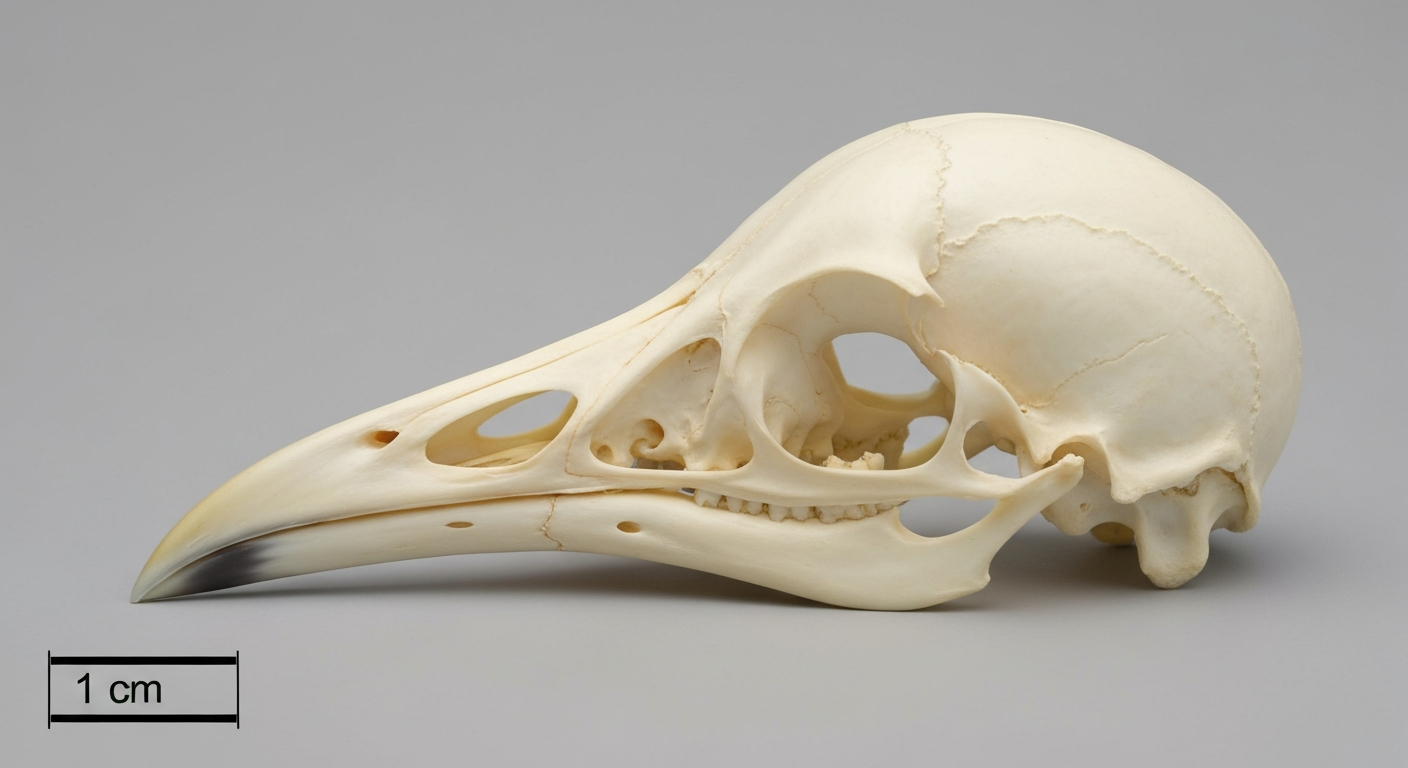
A bird skull is a surprisingly delicate, lightweight structure that looks a bit like a hollow helmet with a beak attached. From the front you see two enormous eye sockets that often take up more space than the braincase itself, a tapered beak made of fused bone, and a rounded dome at the back for the brain. The whole thing tends to be pale ivory or yellowish-white when cleaned, with thin walls you can almost see through in places, and a smooth curve from the beak tip back to where the neck would attach at the base.
What Does a Bird Skull Look Like: Structure, Beak, Eyes, Types

Marcus Whitley
28 Jul 2026
Quick at-a-glance: what a bird skull looks like
Picture a small, lightly built dome, roughly egg-shaped when viewed from the side, with a pointed or hooked extension at the front (the beak) and two wide, open circles dominating the face (the eye sockets). The beak is seamlessly part of the skull, not bolted on. The back of the skull narrows to a single rounded knob, the occipital condyle, which is the ball-joint that connects to the spine. Compared to a mammal skull there are no separate teeth, no heavy jawbones, and the bones are far thinner and more fused together. The overall impression is airy and almost fragile, even on a large bird like a crow or gull.
The basic parts you can actually see
Even without any background in anatomy you can identify the main regions just by looking. Here is a quick tour of what each part is and what it does.
The beak (premaxilla and lower jaw)
The upper beak is built around a bone called the premaxilla, which extends forward from the front of the skull and sets the length, depth, and curvature of the bill you see on a live bird. On a prepared skull the premaxilla looks like a long triangular shelf or wedge fused to the front of the face. The lower jaw (the mandible) is made of several bones fused together, with the dentary being the main visible one. In life both upper and lower beak are covered by a tough keratin sheath called the rhamphotheca, the same protein that makes fingernails. That outer sheath is what gives a beak its smooth, coloured surface; the underlying bone is usually rougher and paler.
The eye sockets (orbits)
The orbits are the two large holes on either side of the skull, and in most birds they are enormous relative to skull size. They are formed by contributions from several bones including the frontal and the orbitosphenoid. Inside the orbit, if you look closely at a clean skull, you may find a ring of small, thin, interlocking bones called scleral ossicles. These form a bony support ring directly in the eyeball itself (not in the socket, but within the eye). Their size and shape tell researchers whether a bird was active by day or night.
The braincase (cranium)
The rounded dome sitting behind the orbits is the braincase, formed mainly by the frontal, parietal, and temporal bones. In birds these bones are fused so tightly in adults that the seams (sutures) largely disappear, giving the braincase a smooth, uninterrupted surface. You will also notice a single large hole at the very back where the spine connects; that hole is called the foramen magnum, and directly below it is the rounded occipital condyle knob.
The palate (underside of the skull)
Flip a bird skull upside down and you see the palate, the bony roof of the mouth. The key bones here are the pterygoids, palatines, vomer, and the quadrate (a small cube-like bone at the back corner of the jaw joint). These bones are linked in a lever-and-strut system that allows the upper beak to move slightly up and down independently of the braincase, a trick called cranial kinesis. For a detailed study of how linked palatal and quadrate articulations mediate cranial kinesis, see Insight into the evolutionary assemblage of cranial kinesis from a Cretaceous bird (eLife). You can sometimes see the fine rod-like bones of this system in a well-prepared skull, and their arrangement differs noticeably between groups like songbirds and waterbirds.
Why bird skulls are so light
Bird skulls feel almost weightless for their size, and there are three main reasons for that. First, the bones are fused into a single rigid unit in adult birds, which removes the need for heavy overlapping joints. Second, the individual bone walls are extremely thin, sometimes just a fraction of a millimetre in small species. Third, many of the larger bones contain internal air spaces called pneumatic cavities, which are essentially hollow chambers connected to the bird's air-sac system. On a prepared skull you can sometimes spot the tiny foramina (small holes) where air diverticula entered the bone, and if you could slice through a large skull you would see a honeycomb-like trabecular (lattice) structure inside rather than solid bone. Interestingly, diving birds like penguins and dippers show reduced pneumaticity compared to aerial birds, since dense bones help with buoyancy control underwater.
Anatomical diagrams: what to look for and how to read them
If you find a labeled diagram of a bird skull, the most useful views to look for are the lateral view (side), the dorsal view (top), and the palatal view (from underneath). Each one reveals different bones. Side view diagrams are the most common and usually label the premaxilla, nasal bone, frontal bone, parietal, squamosal, orbit, quadrate, and occipital region. Top-down views show you how the braincase width compares to the beak, and the palatal view reveals the pterygoid and palatine struts. If you find a skull in the field and want to get your bearings, start with the side profile because the beak-to-braincase ratio, orbit size, and overall skull depth are the fastest clues to which bird group you are looking at.
For high-resolution reference images, the MorphoSource database and DigiMorph project (University of Texas) both host free 3D CT scans of bird skulls from museum collections, complete with scale bars and specimen metadata. Museum institutions including the American Museum of Natural History, the Smithsonian National Museum of Natural History, and the Natural History Museum in London are the main source institutions for these specimens.
Glossary: skull parts and what they do
| Term | Where it is | What it does |
|---|---|---|
| Premaxilla | Front tip of the upper skull, forms the upper beak | Sets the length, depth, and curve of the upper bill; the main visible beak bone |
| Mandible (dentary) | Lower jaw | Forms the lower beak; articulates with the quadrate to open and close |
| Rhamphotheca | Covers both upper and lower beak in life | Keratin sheath; gives the bill its colour, texture, and hardness |
| Orbit | Large circular opening on each side of the skull | Houses the eyeball; its size reflects how large the eye is |
| Scleral ossicles | A ring of small bones inside the eyeball itself | Support and shape the cornea; size indicates day/night activity pattern |
| Frontal bone | Top of the skull between beak and braincase | Roof of the orbit and top of the braincase; often the widest bone visible from above |
| Parietal bone | Rear top of the braincase | Protects the brain from above and behind |
| Quadrate | Small cube-shaped bone at jaw joint | Key lever bone linking upper beak movement to lower jaw; enables cranial kinesis |
| Pterygoid | Palate, running toward the quadrate | Part of the kinesis strut system; transmits force from jaw to beak |
| Palatine | Palate, running forward alongside the vomer | Roof of the mouth; part of the kinesis mechanism |
| Vomer | Midline of palate | Median palatal bone; varies dramatically across bird groups |
| Occipital condyle | Single rounded knob at the skull base | Ball-joint connecting skull to the first neck vertebra |
| Foramen magnum | Large opening at the back base of skull | Passageway for the spinal cord into the braincase |
| Pneumatic cavities | Inside walls of larger skull bones | Air-filled chambers connected to the air-sac system; reduce skull weight |
How skull shape varies across different bird groups
Once you have seen a few bird skulls you start to notice that the proportions shift dramatically between groups. An owl skull looks almost nothing like a heron skull, and a parrot skull is immediately recognisable by its deep, hooked beak. Recent geometric‑morphometric studies show parrots have strong skull–beak functional integration, diet correlates with cranial and beak shape, although skull shape is also strongly constrained by body size (Fit for purpose? Analysis of the relationship between skull, beak shape and feeding ecology in Psittaciformes (Journal of Anatomy, PMC)). The biggest variables are beak length and curvature, how deep the skull is from top to bottom, orbit size and position, and the width of the braincase. Feeding ecology is the main driver: a bird that probes for insects needs a long thin beak and a narrow skull; a bird that cracks hard nuts needs a short deep beak with thick bony reinforcement. The table below gives a quick comparison.
| Bird group | Beak shape on skull | Orbit size and position | Braincase shape | Notable skull feature |
|---|---|---|---|---|
| Songbirds (passerines) | Short to medium, roughly conical or slender | Medium, positioned toward sides of skull | Rounded, moderate width | Flexible kinesis mechanism; small and lightweight overall |
| Raptors (hawks, eagles) | Deep hooked premaxilla with sharp curve | Large, slightly forward-facing | Broad and rounded | Pronounced supraorbital ridge (brow ridge) over orbits |
| Owls | Short deep hook, faces more downward | Enormous, fully forward-facing, nearly touching midline | Wide and flattened | Scleral ossicle rings very large; orbits dominate the face |
| Parrots | Very deep, strongly hooked, upper beak highly kinetic | Medium, positioned laterally | Rounded, relatively large | Upper beak articulates with extra mobility; deep curved premaxilla |
| Waterbirds (herons, egrets) | Very long, straight, dagger-like | Medium, positioned laterally | Narrow and elongated | Skull very elongated front to back; reduced kinesis |
| Seabirds (gulls, gannets) | Medium-long, slightly hooked or straight | Medium, lateral | Moderate, oval | Often pneumatized; some have pronounced tomial notch visible on beak bone |
| Ducks and geese | Broad, flat, spatula-shaped (or deep in diving ducks) | Medium, lateral | Rounded, wide | Palatal lamellae ridges visible on underside of beak bone |
Songbird skulls: small but surprisingly complex
Most of the birds you see in a garden or park are passerines, and their skulls reflect that generalist, adaptable lifestyle. A typical songbird skull is small enough to sit on a fifty-cent coin, lightly built, and roughly egg-shaped with a short to medium beak. The orbits are set well to the sides of the head, which gives the bird a wide panoramic view rather than focused forward binocular vision, handy for spotting approaching cats. The beak bone (premaxilla) varies more within this group than almost any other: seed-eaters like finches have short, deep, triangular premaxillae built to crack seeds, while warblers have fine needle-like beaks for probing among leaves. Darwin's finch species are the classic example of how rapidly beak bone shape can shift in response to available food, with measurable changes recorded across just a few generations.
One feature you might notice if you handle a clean passerine skull is how the upper beak can flex very slightly upward from the braincase. That is cranial kinesis in action, enabled by the linked quadrate-pterygoid-palatine system mentioned earlier. It is subtle in many songbirds but contributes to gripping and manipulating food. The skull walls in small passerines are almost translucent when held up to light, which gives you a real sense of just how far birds have pushed lightweight construction.
Raptor and owl skulls: built for the hunt
If you have ever come across a hawk or eagle skull you will not mistake it for anything else. The most obvious feature is the beak: the premaxilla sweeps downward in a sharp hook with a pronounced depth from top to bottom, built to tear meat rather than probe or crack seeds. Just above the orbits you will often see a bony shelf called the supraorbital ridge, a brow-like overhang that shades the eyes from glare, similar in function to a peaked cap. The braincase is wide and rounded, and the overall skull has a powerful, compact look compared to the airy build of a songbird.
The orbits on a hawk skull are large and angled slightly forward, giving more binocular overlap than you get in a duck or sparrow. This forward placement maps directly to the forward-facing eyes you see on a live hawk, and it is the skull geometry driving that appearance. More frontal orbits mean a narrower face and a more forward-directed gaze, both of which help with depth perception when judging the distance to prey.
Owl skulls take this even further. The orbits on an owl skull are so large and so forward-facing that they nearly meet at the midline, leaving barely any bone between them. This is why owls look like they have a flat face: the skull really is that wide and flat at the front. The scleral ossicle rings inside owl eyes are correspondingly large and stiff, which is part of why owl eyes cannot rotate in their sockets (the eyeball is essentially a rigid tube). Owls compensate by rotating the whole head, and that wide skull shape is part of what allows the extreme neck rotation. If you think about what the world looks like to a bird with that kind of skull geometry, the experience is very different from a garden robin's wide monocular panorama.
Finding and handling bird skulls: what you should know first
Coming across a bird skull on a walk is exciting, but there are some practical and legal points worth knowing before you pick it up. In the United States, the Migratory Bird Treaty Act protects most wild bird species, and that protection extends to feathers, eggs, nests, and skeletal remains including skulls. Collecting, possessing, or transporting the skull of a protected species without a permit is illegal, even if you found it naturally on the ground. Similar legislation applies in Canada, the UK (Wildlife and Countryside Act), Australia, and most of Europe. Non-native or unprotected species (like European starlings or rock pigeons in the US) generally fall outside that protection, but if you are unsure of the species it is safest to photograph and leave the skull in place.
If you are handling a skull you are legally allowed to possess (for example from a science supplier, a legally salvaged specimen, or a species exempt from protection), basic hygiene is important. Wear disposable gloves, avoid touching your face, and wash hands thoroughly afterward. Bird skulls can carry bacteria and fungal spores, particularly if they are freshly found rather than professionally prepared. Store prepared skulls in sealed containers away from humidity to prevent the thin bones from becoming brittle or discoloured over time.
Clearing up some common misconceptions
Because this is a visual identification site, it is worth briefly addressing a few things people sometimes search for alongside real bird skull anatomy. The creatures in Bird Box and related fiction are not birds and have no connection to actual avian skull structure; those are purely invented monsters from a horror story, and any searches mixing those topics with real ornithology will not lead anywhere useful for identification. Similarly, Angry Birds is a video game with stylised cartoon characters whose proportions bear no relationship to real bird anatomy. Real bird skulls are nothing like the exaggerated round heads and huge beaks of that franchise, though you might argue a real puffin comes closer than most. If you're curious how unseen monsters are imagined, see what do the creatures in Bird Box look like for one popular fictional portrayal.
Another topic that connects naturally to skull anatomy is how birds actually experience the world visually. The position and size of the orbits in a skull directly determines what a bird can see and how it perceives its environment, and that is a genuinely fascinating area if you want to go deeper once you understand the basic skull structure.
FAQ
At a glance, what does a typical bird skull look like?
A bird skull is lightweight and often elongated by the beak. Key visible regions are the slender beak (upper premaxilla and lower dentary/maxilla bones covered by keratin), a rounded cranium housing the brain, large eye sockets (orbits) often with a ring of small bones (scleral ossicles), and a rear occipital region where the neck connects. Many skulls show fenestrae (openings) and thin bone walls reflecting pneumaticity (air spaces).
What are the main bones and parts I should know (quick glossary)?
Premaxilla (upper bill bone), Maxilla/dentary (lower bill bones), Nasal bones, Frontal & Parietal (forehead/cranium), Orbit & Scleral ossicles (eye socket and ring), Jugal & Quadrate (cheek and jaw hinge), Pterygoid/Palatine/Vomer (palate bones), Basioccipital/Basisphenoid (braincase base). Functionally: beak = feeding tool, cranium = brain protection, orbits = eye size/placement, palate/quadrate = beak movement and bite mechanics.
Can you suggest labeled anatomical diagram(s) to include in the article?
Use: (1) lateral view diagram labeling premaxilla, maxilla/dentary, nasal, frontal, parietal, orbit, quadrate, jugal, and occipital; (2) dorsal/top and ventral/bottom skull views to show palate bones (pterygoid, palatine, vomer) and interorbital spacing; (3) close-up of eye socket with scleral ossicles; (4) exploded inset showing keratinous rhamphotheca over bony beak. Ensure clear labels, scale bar, and a simple legend for beginners.
How does skull shape vary across common bird groups (songbirds, raptors, waterbirds, parrots, seabirds)?
Songbirds (passerines): relatively small, lightly built skulls, often with mobile upper beaks (cranial kinesis); varied beak shapes tied to diet. Raptors: stout craniums with strong hooked premaxilla, forward-facing orbits for binocular vision, robust quadrate/palate to transmit bite/tear forces. Waterbirds (ducks, herons): broader, often flattened beaks for filtering or probing; some have heavier bones and reduced cranial kinesis. Parrots: deep, curved premaxilla and strong palatal/quadrate attachments for powerful bite; pronounced hooked upper bill and robust jaw muscles. Seabirds (gulls, albatrosses): elongated or stout beaks depending on feeding, variable pneumaticity, often long, narrow skulls in surface-feeders and robust bills in predators or scavengers.
What is cranial kinesis and why does it matter to identification?
Cranial kinesis is mobility between the upper beak and the braincase via movable joints (quadrate–pterygoid–palatine pathways). It affects beak opening mechanics and is visible in skull architecture (mobile joints, slender palatal bones). Functionally, groups with strong kinesis (many songbirds) show more varied external beak shapes for probing/seed handling, while reduced kinesis (some waterbirds, raptors) correlates with stiffer bills for crushing or tearing.
How does eye socket size and placement on the skull map to a bird’s outward appearance and behaviour?
Large orbits and prominent scleral ossicles correspond to large visible eyes; forward-set orbits increase binocular overlap (seen in raptors and owls) and are linked to predatory, depth-perception tasks. Lateral orbits give wide monocular fields (common in ducks, many passerines) for predator detection. So a bird with a broad face and large forward eyes likely has a skull built for binocular hunting.
Next Articles
What Does an Angry Bird Look Like: Visual ID Guide
What does angry bird look like: quick visual ID checklist, species examples, vocal cues, and safe photo tips.
What Does the World Look Like to a Bird: Vision Explained
Explore how birds perceive color, motion, depth & UV; species differences, ID tips, skull diagrams, and photo advice.

What Do the Creatures in Bird Box Look Like?
Learn what Bird Box creatures look like: alien-like silhouettes, hooked faces, long limbs, movement and distance cues.