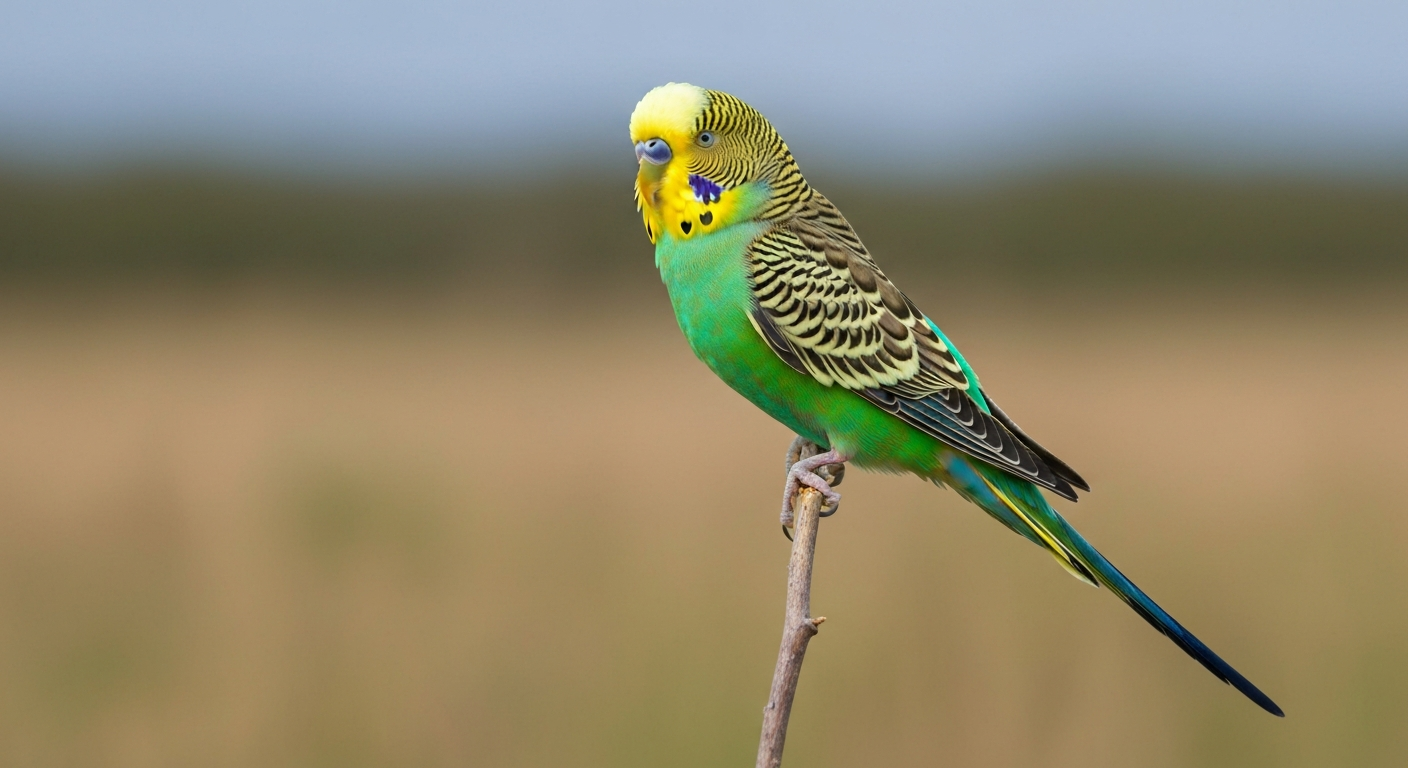
A budgie is a small, streamlined parrot about the size of your hand, measuring roughly 17 to 20 cm (6.7 to 7.9 inches) from bill to tail tip. In their wild form, they wear a bright yellow face, a green body, and a bold black scalloped pattern across the back and wings that makes them look almost hand-painted. That long, tapered tail sets them apart from small songbirds at a glance, and once you know that silhouette, you will spot a budgie quickly.
What Does a Budgie Bird Look Like: Photo-Ready ID Guide

Marcus Whitley
20 Jul 2026
Quick ID Snapshot
Size: 17 to 20 cm long, weighing around 25 to 35 g, with a wingspan of roughly 30 cm (about 12 inches). Silhouette: compact, round-chested body with pointed wings and a long, wedge-shaped tail that tapers to a point, giving a dart-like outline unlike any small songbird. One-sentence field ID: look for a tiny parrot with a yellow face, green-and-black scalloped back, blue cheek patches, and a noticeably long pointed tail.
At a Glance: Key Marks to Look For
- Bright yellow forehead and face (unbarred in adults, barred with black in juveniles)
- Green body with yellowish-green underparts (wild-type coloring)
- Black or dark grey undulating/scalloped markings on the crown, nape, mantle, and upper wings
- Pair of blue cheek patches on the lower face
- Row of small dark throat spots just below the chin (usually 3 visible on each side)
- Long, pointed, wedge-shaped tail with yellow-green central feathers
- Pointed wings that look streamlined in flight
- Compact upright posture when perched, tail angling downward
- Blue cere (the bare skin above the beak) in adult males; brownish in adult females
Overall Size, Shape, and Posture
Budgies are genuinely tiny. At 17 to 20 cm and around 30 g, they are roughly comparable to a small finch in body mass but with that extra length coming almost entirely from the tail. When one perches in front of you, the body looks compact and slightly barrel-chested, held upright on thin, zygodactyl feet (two toes pointing forward, two back, a classic parrot arrangement). The tail extends well behind the perch and tapers cleanly to a point, which is one of the easiest things to key on when scanning a flock from a distance.
In flight, the pointed wings reinforce that streamlined, parakeet-like outline. You will not mistake this for a songbird once you see the silhouette: most small passerines have short, rounded or square tails, while a budgie's tail looks more like a miniature falcon's. That tail and wing shape together are your best long-distance clues before you can see any color detail.
Head and Face Up Close
Forehead, Crown, and Eye
In an adult wild-type budgie, the forehead is clean and bright yellow, with no dark markings. That yellow extends across the face and throat area. The crown and nape carry the same bold black barring that continues down the mantle and back. You might notice a pale, almost white eye ring around the dark pupil in adults, and the iris itself is pale yellowish-white. In juveniles, however, the black barring extends all the way down the forehead to the cere, and the iris is noticeably darker (brown to dark grey). Once the bird goes through its first molt at around 3 to 4 months old, those forehead bars disappear and the iris lightens, which is the most reliable way to age a budgie without handling it.
Beak, Cere, and Cheek Patches
The beak is small, hooked, and pale greenish-yellow, typical of seed-eating parrots. Above it sits the cere, the bare patch of skin that is one of the most useful sex and age indicators on the whole bird. In adult males, the cere is a solid, often vivid blue, becoming especially deep or 'royal' blue during breeding condition. In adult females it turns pale brown to tan or even crusty brownish when she is in breeding condition. Immature birds of both sexes show a pinkish to purplish cere before they fully mature. It is worth noting that some color mutations in captive birds can disrupt this cue, so cere color works best as an identifier on wild-type or standard colored birds.
On the lower cheek, look for a round, vivid blue or violet-blue patch on each side of the face. These cheek patches sit just below and behind the eye and are one of the signature features of the species. Below the chin and along the throat, you will see a row of small, dark round spots, often described as throat spots, with typically three prominent spots visible on each side. These facial markings together, the yellow face, the blue cheek patches, and the dark throat spots, give the budgie an almost decorated look that is unlike any small songbird you are likely to compare it to.
Plumage in Detail: Crown, Back, and Body Feathers
Work your way back from that yellow face and you hit the bold black barring almost immediately. The crown starts with narrow dark bars on a yellow base, and as those markings move down the nape and onto the mantle (the upper back), they broaden into the characteristic undulating or scalloped pattern that budgies are famous for. Each feather on the back and wing coverts has a dark centre or terminal marking against a yellow or green ground color, creating the rippled look. Think of it like the grain pattern in wood, except bold and high-contrast.
The underparts are a cleaner, brighter yellow-green, with far less heavy patterning. The rump is often a bright, unbarred green that can flash noticeably when the bird moves. The overall impression from the side is a bird that is dark and patterned on top and clean and bright below, which helps a lot when you are trying to separate it from other small green birds in the field.
Wings, Flight Feathers, and the Tail
Folded Wings When Perched
When a budgie is perched and the wings are folded, you see the continuation of that scalloped black pattern across the wing coverts. The primary feathers (the longer outer flight feathers) are darker, often a dark grey-green with yellow or pale green edging that forms a subtle but visible pale wing bar or streak along the folded wing edge. This edging can look quite bright in good light. The overall folded wing looks dark and patterned against the brighter body, which adds to the contrast-heavy appearance that makes budgies recognizable even in blurry photos.
Wings in Flight
In flight the pointed wings open to show the dark primaries more clearly, and the pale edging on those feathers can create a faint wingbar-like stripe. The underwing is generally paler. The tail deserves special attention here: the two central tail feathers are long, pointed, and a deep blue-green to teal color in wild-type adults, while the outer tail feathers are shorter and show yellow edging. From below or above, that long central tail structure looks like a spike, and it is one of the fastest ways to confirm you are looking at a budgie rather than a sparrow, warbler, or any small passerine.
Wild Colors vs. Captive Color Mutations
The wild-type green-and-yellow bird described above is what you would encounter in Australia's interior, but captive and escaped budgies come in dozens of color forms. The most common mutations you might encounter include the blue series (the yellow pigment is removed, producing a white face and blue-green body with the same dark scalloping), the lutino (a yellow bird with red eyes and very reduced dark markings), the albino (white with red eyes, almost no patterning), the pied (irregular patches of plain color breaking up the scalloped pattern), and the cinnamon (the black markings replaced by a warm brown). In mutation birds, the reliable visual markers, such as cere color for sexing or iris color for ageing, can be less dependable, so be cautious about making confident calls on heavily mutated captive birds.
Juvenile vs. Adult: How to Tell Them Apart
| Feature | Juvenile (under ~3–4 months) | Adult |
|---|---|---|
| Forehead | Dark bars extend to the cere | Clean, unbarred yellow |
| Iris color | Dark brown to dark grey | Pale yellowish-white |
| Cere color | Pinkish to purplish | Blue (male) or tan/brown (female) |
| Overall markings | Full scalloped pattern present | Same scalloped pattern, cleaner face |
| Body size | Similar to adult but slightly smaller | Full adult size reached early |
Male vs. Female: Spot the Difference
Outside of the cere color, male and female budgies look nearly identical in plumage. The cere is your clearest guide: adult males typically have a blue cere that becomes deeper and more saturated when they are in breeding condition, while adult females show a pale tan to brown cere, becoming darker and sometimes crusty during breeding season. Both sexes share the same facial markings, scalloped back pattern, and body coloring, so if the cere is not visible in a photo or at a distance, sexing by appearance alone is not reliable.
How Budgies Behave: Posture and Flight Cues That Help ID
Behavior can be a surprisingly useful identification tool, especially in Australia where wild budgies live. They are ground feeders much of the time, hopping along on grass seeds in open country, which sets them apart from many small parrots that feed mostly in trees. See Budgerigar, Australian Museum (feeding & behaviour) for details that wild budgerigars frequently feed on the ground and often forage in tight social groups Budgerigar — Australian Museum (feeding & behaviour). When perched, they sit very upright on thin branches or grass stems, with the long tail pointing more or less straight down. They are highly social and almost always seen in groups, ranging from pairs to enormous flocks numbering in the thousands after good rains in the Australian interior.
In flight, wild budgies travel in tight, fast-moving flocks with an undulating, slightly bouncy trajectory, similar in rhythm to finch flocks but faster. The flocks will circle and descend sharply to drink at waterholes, which is a classic scene in outback Australia. Even from a distance, that long pointed tail and the rapid wingbeats help you separate them from any small songbird. If you see a group of tiny green-and-yellow birds making fast, chattery contact calls and dropping to drink at a claypan, you are almost certainly looking at budgies.
Where You Are Likely to See Them
Wild budgies are native to most of mainland Australia, particularly the arid and semi-arid interior, where they follow rainfall patterns and seed availability across open grasslands, scrublands, and lightly wooded country. They are largely absent from far southwest Western Australia, the densely forested east coast, the far north of the Northern Territory, and Tasmania. Outside Australia, any budgie you spot in the wild is almost certainly an escaped or feral captive bird. Globally, the species is not threatened and remains one of the most common pet birds in the world.
How Budgies Compare to Similar Small Birds
If you are trying to confirm what you are seeing, comparing a budgie to similarly sized birds helps sharpen the ID. Buntings and tanagers are a common source of confusion for first-time observers because they are also small and often brightly colored. If you want to know what a blue bunting bird looks like, see our brief guide on what does a blue bunting bird look like. For typical plumage and shape of bunting species, see what does a bunting bird look like. Buntings such as the indigo bunting or painted bunting are passerines, meaning they have a very different short-tailed, thick-billed songbird shape, and they lack any scalloped back pattern or parrot-style beak. For a visual comparison, see what does an indigo bunting bird look like for photos and key field marks of that passerine. A painted bunting's colors are bold reds and blues, but the silhouette is short and chunky compared to a budgie's long-tailed, streamlined form. Similarly, the scarlet tanager is larger, has a thick seed-cracker bill rather than a hooked parrot bill, and shows a completely different wing and tail shape. For more on its appearance, see what does a scarlet tanager bird look like for details on size, bill shape, and plumage differences. If you need to compare with other small birds, see our guide on what does a martin bird look like for differences in silhouette and plumage. Purple martins and other martin species are swallow-like aerial feeders with forked tails and very different flight styles, making them easy to rule out once you get a clear look.
| Feature | Budgie | Bunting (e.g., Indigo/Painted) | Martin (e.g., Purple) | Scarlet Tanager |
|---|---|---|---|---|
| Body length | 17–20 cm | 12–14 cm | 19–21 cm | 16–19 cm |
| Tail shape | Long, pointed, wedge-shaped | Short, slightly notched | Forked | Medium, slightly notched |
| Bill shape | Hooked parrot bill | Thick, conical seed-cracker | Small, wide, flat | Thick, pointed |
| Back pattern | Bold black scalloping | Plain or streaked (varies by species) | Plain dark/iridescent | Plain (black in males) |
| Cheek patches | Vivid blue round patches | Absent | Absent | Absent |
| Flight style | Undulating flocks, fast | Short undulating bursts | Aerial, swooping | Direct, moderate |
| Typical habitat | Open grassland, arid scrub | Open woodland, fields | Open air, nests in cavities | Forest canopy |
The key takeaway is that the budgie's parrot features, hooked beak, zygodactyl feet, scalloped back markings, cheek patches, and long pointed tail, put it in a completely different visual category from small songbirds. If you can see the face clearly, the combination of yellow forehead, blue cheek patches, and dark throat spots is essentially unique among birds of this size.
Your Photo-Ready ID Checklist
- Confirm the long, pointed, wedge-shaped tail first — rules out all small songbirds
- Check for the yellow face with no dark bars (adult) or barred forehead (juvenile)
- Look for bold black scalloped markings on the back and wing coverts
- Find the round blue cheek patches on each side of the lower face
- Spot the dark throat spots below the chin
- Check the cere color above the beak: blue for adult male, brown for adult female, pinkish for immature
- Note the pale iris in adults versus dark iris in juveniles
- Observe behavior: ground feeding, tight social groups, upright posture when perched
- In flight: look for pointed wings, long tapering tail, and fast undulating flock movement
Best Visual Resources for Budgie Identification
For photos and video, the Macaulay Library (hosted by the Cornell Lab of Ornithology) has an excellent collection of wild and captive budgerigar images showing the scalloped back pattern, facial markings, cere color variation, and in-flight wing and tail shape from multiple angles. The Australian Museum species factsheet includes range maps and labeled identification notes. eBird photo galleries are useful for browsing images tagged with behavior notes, including the spectacular flock-drinking footage from Australian claypans. If you want to explore the full range of captive color mutations, the Australian National Budgerigar Council's eStandard catalog is the most thorough reference, showing everything from standard green to albino, lutino, opaline, cinnamon, and pied varieties side by side.
FAQ
What is a quick visual ID summary of a budgie (Melopsittacus undulatus)?
A budgie is a very small parrot (about 17–20 cm total length) with a compact body, pointed wings and a long, tapered tail. Wild-type birds show a yellow face and forehead, green body, black scalloped barring on crown and back, blue cheek patches and dark throat spots. In flight the silhouette is streamlined and parakeet-like, with a pointed tail and distinctive wing barring.
What are the key measurements and size cues to expect?
Adult budgerigars typically measure 17–20 cm (6.7–7.9 in) from bill to tail, weigh roughly 25–35 g (commonly ~30 g) and have a wingspan near ~30 cm. Their small size combined with a long pointed tail and narrow wings distinguishes them from many short-tailed passerines.
What head and facial features help identify a budgie up close?
Look for a pale yellow face and forehead (wild adults), black barring across the crown and nape, a small curved bill with a fleshy cere above it, blue cheek/ear patches, and several dark throat (neck) spots. Juveniles keep forehead barring; adults usually have a clean (unbarred) forehead after the first molt.
How does the cere and beak indicate sex and age?
In mature wild-type budgies, adult males usually show a blue cere while adult females show a pale brown to brown cere when breeding; non-breeding females can be paler or whitish. Immature birds often have pinkish/purplish ceres. Note: many captive colour mutations can alter or obscure cere cues, so use cautiously.
What plumage patterns appear on wings, back and tail?
Wild-type budgies have black scalloped/banded markings on the crown, nape and mantle, dark barring on the wings, and a long pointed tail often showing yellow/green at the base. Wing bars and the pointed, wedge-shaped tail remain visible in perched and in-flight views and are useful for ID at a distance.
How do wild-type plumage and captive mutations differ visually?
Wild budgies are yellow-and-green with black barring. Captive birds show many mutations: blue series (loss of yellow pigment), albino (all white, red eyes), lutino (bright yellow with red eyes), pied, opaline, cinnamon, dilute and others. Mutations can change overall color, eye color and sometimes obscure sexing cues like cere or iris changes.
Next Articles
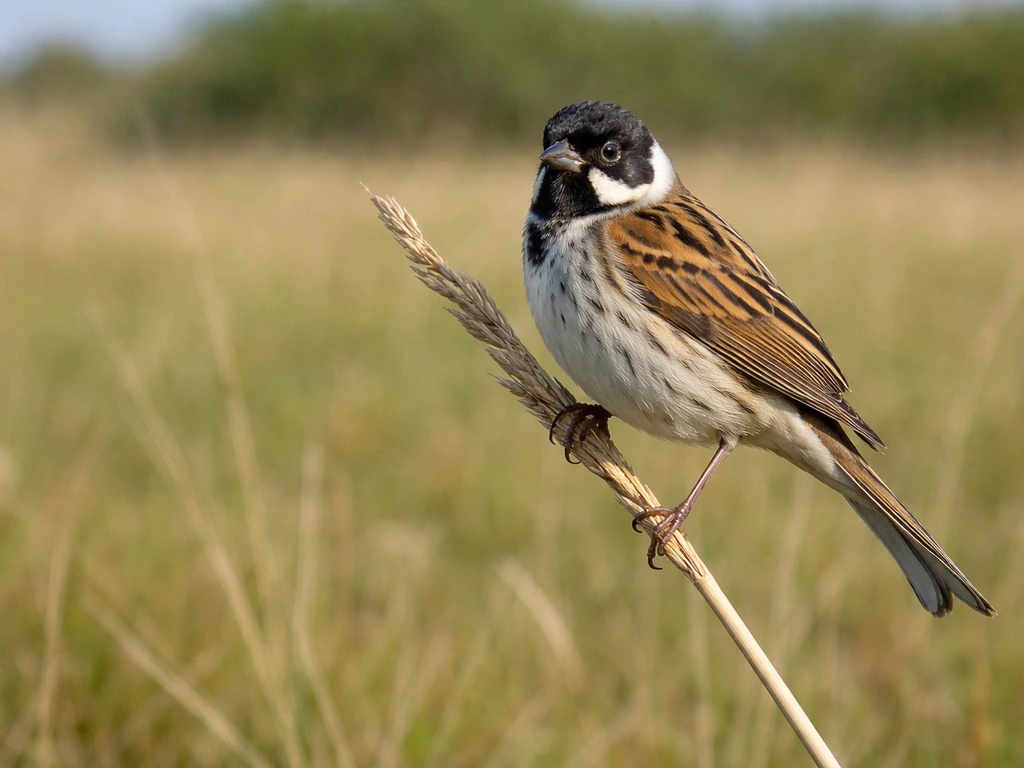
What Does a Bunting Bird Look Like A Field Guide
Visual field guide to buntings: key features, sex and season differences, and how to spot similar sparrows.
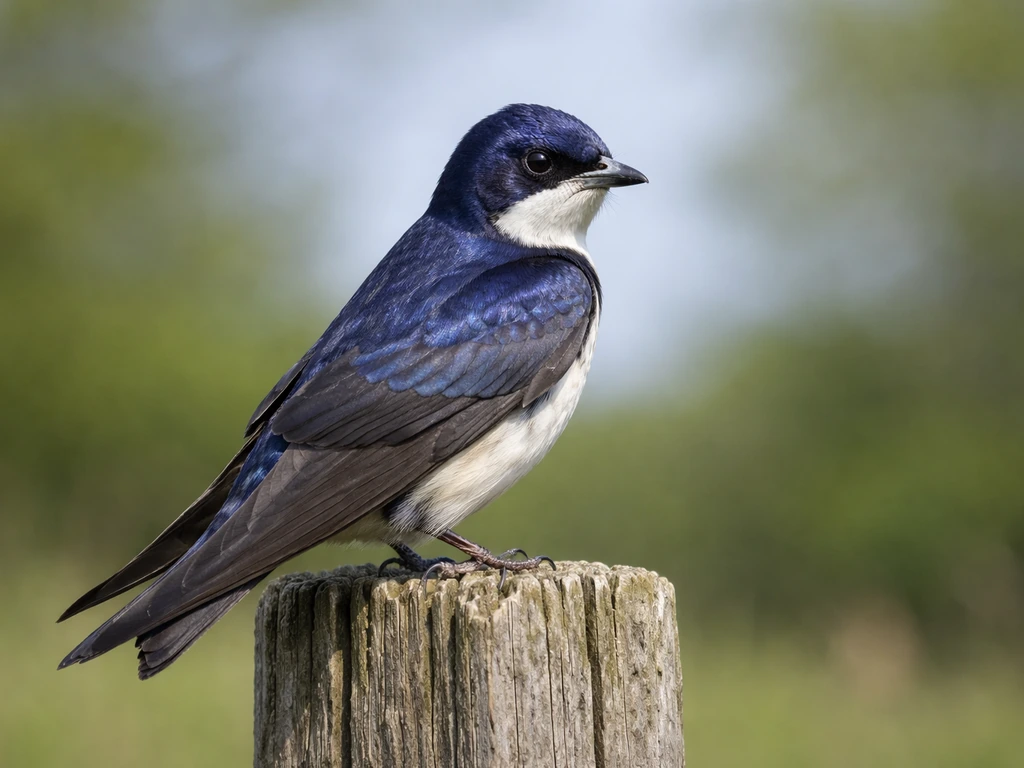
What Does a Martin Bird Look Like? Key ID Features
Quick checklist and ID tips for martin birds, including key plumage, tail, mask, and how to tell them from swallows.
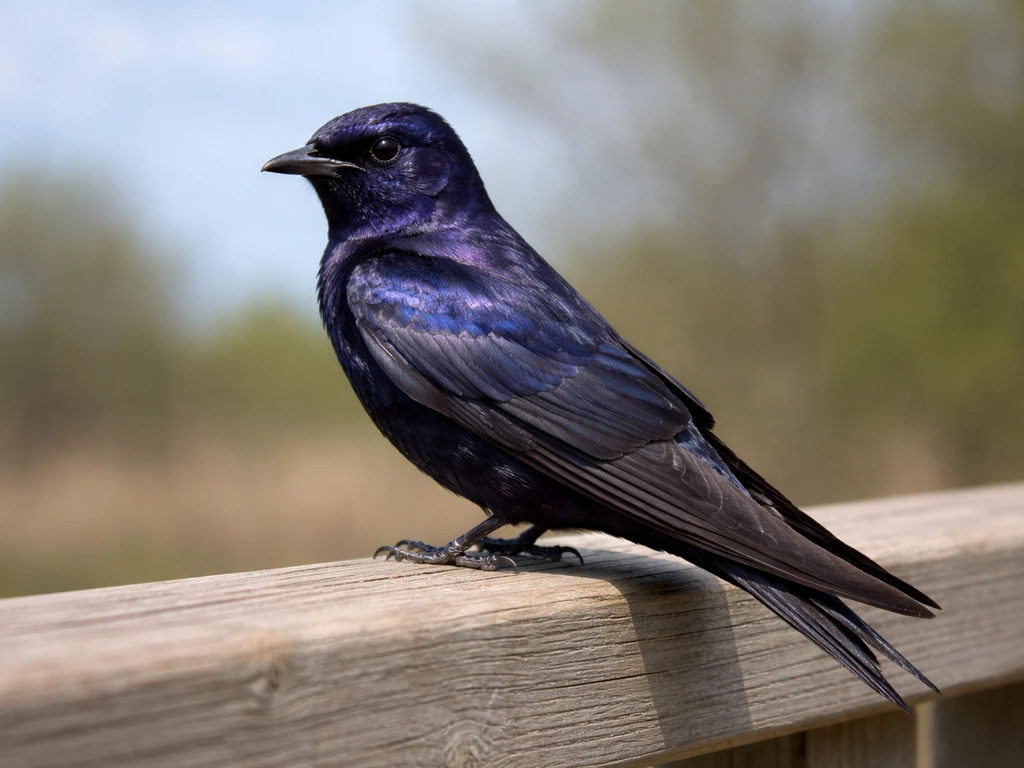
What Does a Purple Martin Bird Look Like? ID Guide
ID guide for purple martins: glossy dark colors, sexes and flight look, plus quick look-alikes to confirm.