
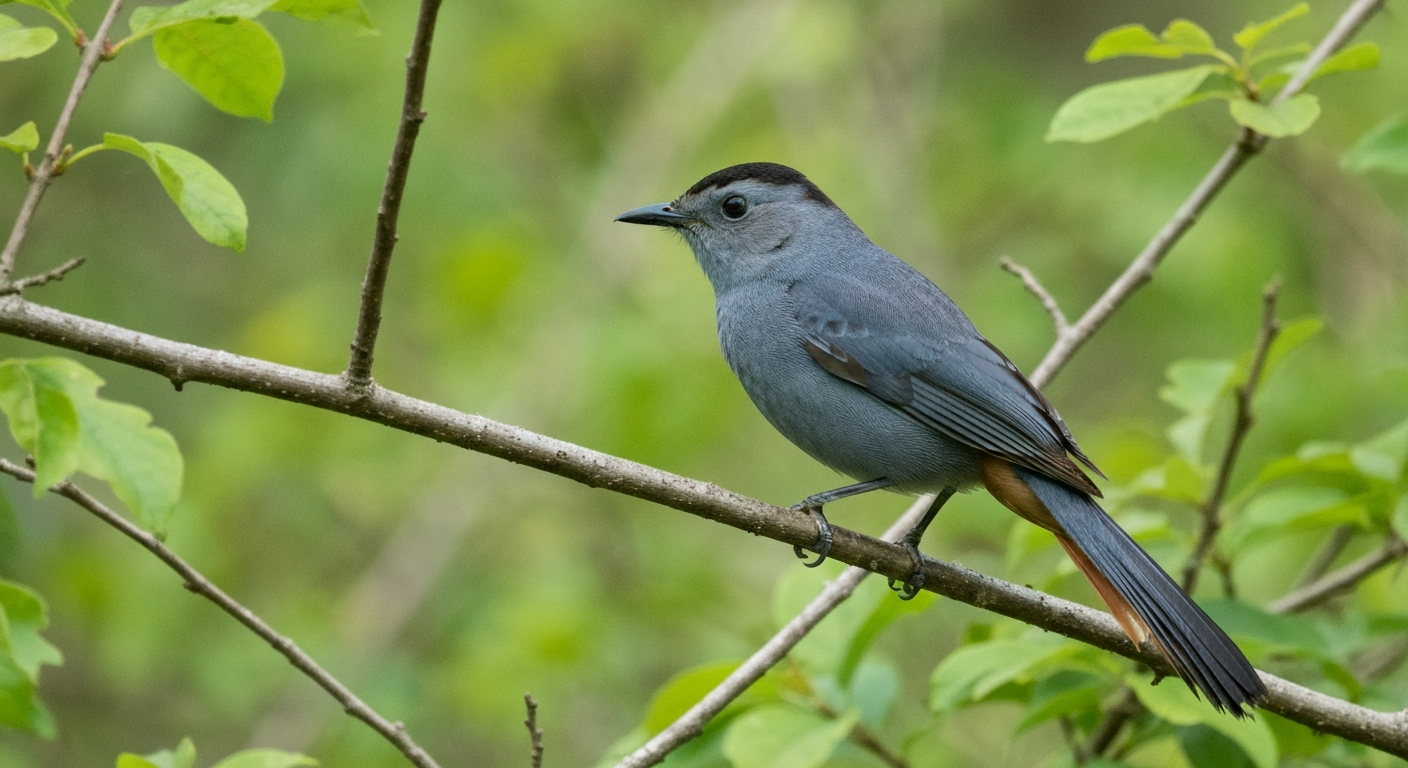
A female Gray Catbird looks almost exactly like the male: a slim, medium-sized bird covered in smooth slate-gray feathers from bill to tail, with a neat blackish cap on top of the head and a small patch of rich rufous (rusty-orange) color tucked under the base of the tail. That undertail patch is the single best thing to look for in the field, and it shows up on females just as reliably as on males. If you see a plain grayish bird creeping through a thicket and catch a flash of rusty color when it cocks or flicks its longish tail, you almost certainly have a catbird.
What Does a Female Catbird Look Like: Field ID Guide

Marcus Whitley
23 Jul 2026
Which 'catbird' are we actually talking about?
The word 'catbird' gets used for several completely unrelated birds around the world, so it is worth pinning down which one you are most likely looking for. In North America, 'catbird' almost always means the Gray Catbird (Dumetella carolinensis), a common backyard and woodland-edge bird found across temperate North America from spring through fall, and wintering in the southeastern U.S., Mexico, Central America, and the Caribbean.
Two other groups carry the name. The Black Catbird lives on the Yucatan Peninsula and in Belize: it is a small, all-glossy-black bird (both sexes look alike) with no gray at all, so it is not going to be confused with a Gray Catbird outside of that narrow coastal range. Then there are the Australasian catbirds, a group of bowerbird relatives (genus Ailuroedus) found in Australia and New Guinea with green, spotted plumage that looks nothing like a North American catbird. Unless you are in Queensland or Belize, the Gray Catbird is the one this article is about.
Quick ID snapshot: size, shape, and key colors
Before we get into detail, here is a fast mental image to carry into the field. Picture a bird roughly the size of an American Robin but noticeably slimmer and with a longer, more expressive tail. It holds itself with a slightly hunched, horizontal posture when moving through branches. The overall impression is of a tidy, understated gray bird that flicks its tail almost constantly.
- Length: roughly 20 to 24 cm (8 to 9.5 inches) from bill tip to tail tip
- Wingspan: approximately 22 to 30 cm
- Weight: about 23 to 57 grams (1 to 2 oz), females average slightly lighter
- Overall color: smooth, uniform slate gray on the body
- Crown: distinctly darker, almost black cap sitting on top of the head
- Undertail coverts: rufous or cinnamon (rusty-orange), the most distinctive field mark
- Bill: slender and slightly curved, dark
- Tail: relatively long, often held cocked or pumped up and down
A close look at what a female Gray Catbird actually looks like
Start with the body. The back, wings, breast, and belly are all covered in the same smooth slate gray, without streaks, spots, wing bars, or eye-stripes. This unmarked uniformity is actually one of the most useful ID features because very few birds that share the same habitat are quite that plain. For comparison with unusually pale or 'ghostly' gray birds, see the guide titled "what does a ghost bird look like". The gray is medium-toned, not charcoal and not pale, and it looks the same in most lighting conditions.
The cap is the first accent to notice. On top of the head, the feathers shift to a noticeably darker blackish or very dark gray, forming a clean-edged cap that contrasts with the lighter gray of the face and neck. It does not extend down over the eye as a mask, so the face itself stays the same gray as the rest of the bird. The dark eye is visible but not ringed or accented.
The most important mark is under the tail. The undertail coverts (the short feathers at the very base of the underside of the tail) are a warm rufous or chestnut color. You might see this described as rusty, cinnamon, or tawny depending on the light. The patch is not large, and it can be hidden when the bird is perched quietly, but catbirds are restless birds and they pump and cock their tails frequently. When that tail goes up, the rusty flash is hard to miss. This mark applies equally to females and males.
The bill is slender, slightly downcurved, and dark, more like a thrush's bill than the heavy bill of a towhee or sparrow. If you're curious about internal anatomy, see a brief guide on what does a bird heart look like. The legs are dark. There are no wing bars, no tail spots, no supercilium (eyebrow stripe), and no malar streaks. For a brief overview of avian anatomy and how a bird's bones support its shape and posture, see what does a bird skeleton look like. When you strip away what is NOT there, the Gray Catbird is a genuinely simple-looking bird.
Male, female, juvenile, and fledgling: how they differ
Here is the honest answer about sexing catbirds by sight: it is essentially not possible in the field. The male and female Gray Catbird are what ornithologists call monomorphic, meaning they wear the same plumage. Both have the slate-gray body, dark cap, and rufous undertail coverts. Females do average slightly smaller and lighter in weight, but that difference is too subtle to use reliably when you are watching a single bird through binoculars. Even researchers using banding measurements can only sex individual birds with about 78% accuracy using a combination of measurements, which is not something you can eyeball.
Age differences, on the other hand, are a bit more visible. Juveniles and fledglings (birds in their first year) tend to look browner and duller overall rather than the clean slate gray of adults. Their undertail coverts are paler and more buffy rather than the rich rufous of an adult. You might also notice retained barring on the tail feathers in very young birds. So if you see a catbird-shaped bird that looks washed-out or brownish rather than crisp gray, you are probably looking at a young bird rather than an adult female.
| Feature | Adult (male or female) | Juvenile / First-year bird |
|---|---|---|
| Body color | Clean slate gray | Brownish or washed-out gray |
| Cap color | Distinctly dark blackish | Duller, less contrasting dark cap |
| Undertail coverts | Rich rufous or chestnut | Pale buff or faint rusty |
| Tail feathers | Plain dark gray | May show faint barring on retained feathers |
| Overall impression | Neat, uniform, crisp gray | Duller, slightly scruffy |
How the look changes through the year
Gray Catbirds go through one complete molt per year, usually after the breeding season in late summer or early fall. This means that by late fall through winter, birds are wearing fresh, crisp feathers and look their best: the slate gray is clean, the cap is sharp, and the rufous undertail is bright. As spring and summer wear on and those feathers accumulate wear, the gray can look a little faded or duller, and some feather edges may look abraded. The undertail color stays visible through the year because those feathers are somewhat sheltered from daily wear.
In terms of when you will actually see catbirds, breeding season (May through August) is when they are most conspicuous across temperate North America. They are calling constantly, nesting in dense thickets, and relatively easy to locate by sound. During migration (March through May in spring, August through October in fall) you might find them in hedgerows, shrubby backyards, or forest edges that are not their usual summer spots. In winter, if you are in the southeastern U.S., Mexico, Central America, or the Caribbean, you can still find them but they are quieter and more skulking than in breeding season.
Behavior that helps you pin down the ID
One of the most reliable ID tools for catbirds is where they spend their time. These birds are skulkers. They actively prefer dense tangles, overgrown hedgerows, thickets along stream edges, bramble patches, and brushy woodland edges. You will often hear one before you see it, and when you do get a look, it will often be brief as the bird dives back into cover. This habit of hugging dense vegetation immediately separates catbirds from the Northern Mockingbird, which loves open perches at the tops of shrubs and trees.
When foraging, catbirds work low, hopping along the ground or moving through low branches in search of insects and berries. They are omnivores with a clear preference for fruit during migration and winter, which is why you might find them in fruiting shrubs like elderberry, pokeweed, and multiflora rose. Watch for the characteristic tail-cocking and tail-pumping behavior: a catbird almost never sits completely still, and that constant tail movement will reveal the undertail pattern.
If you are trying to determine whether the catbird you are watching is female or male, behavior can give you a soft clue during breeding season. Males tend to sing loudly from exposed perches at the top of their territory, especially early in the morning and at dusk. Females sing too, but typically more quietly and from lower, less exposed positions. If the bird is belting out a song from a treetop, it is probably a male. If it is singing softly from inside a thicket, a female is more likely, though neither rule is ironclad.
Using sound to confirm what you are seeing
Even if you never get a great visual, the Gray Catbird's voice is one of the most distinctive in North American birds. The signature call is a short, nasal, descending 'mew' that sounds remarkably like a cat. Once you have heard it, you will not forget it. If you hear that sound coming from a thicket and catch a glimpse of a gray bird, you have your confirmation. For more on the visual traits of birds known for their calls, see what does a calling bird look like.
The full song is a long, rambling sequence of squeaks, whistles, mimicked phrases, and musical notes strung together. Catbirds are mimics like mockingbirds and thrashers, borrowing sounds from other species and weaving them into their own compositions. The key acoustic feature that separates a catbird's song from the others is phrase repetition: a catbird tends to sing each phrase just once before moving on to the next one. The Cornell Lab's Gray Catbird sounds page documents the characteristic short nasal 'mew' call and the long, mimic-rich songs, noting that catbird song phrases are generally not repeated in long runs blank" rel="noopener noreferrer">Gray Catbird sounds — All About Birds (Cornell Lab). A Northern Mockingbird will repeat the same phrase three to six times in a row before switching, and a Brown Thrasher typically repeats each phrase twice. So if you hear a mimic bird and count the repetitions, 'once through' strongly suggests a catbird, 'twice' points to a thrasher, and 'many times' is a mockingbird.
Female catbirds do sing, particularly a softer, quieter version of the song sometimes described as 'whisper song.' This is most often heard during the breeding season, sometimes as a quiet response to the male. It uses the same mimicking, rambling style but is subdued in volume. If you hear what sounds like a catbird song but cannot locate the singer at a high perch, it may well be a female singing from deep within a shrub.
Birds that look similar and how to tell them apart
The Gray Catbird's plain gray plumage means there are a handful of birds that new observers might mix it up with. Here are the most common ones and the fastest ways to separate them.
| Species | Similar to catbird because... | Key difference to look for |
|---|---|---|
| Northern Mockingbird | Gray overall, similar size, also a mimic | Two white wing bars, large white wing patches visible in flight, no dark cap, no rufous undertail, prefers open perches |
| Brown Thrasher | Mimid family, frequents thickets | Heavily streaked brown upperparts and breast, much more rufous-brown overall, yellow eye, very long tail |
| Hermit Thrush | Grayish body, skulking in undergrowth | Spotted breast, rufous tail (not undertail coverts), habit of slowly raising and lowering the tail (not flicking) |
| Eastern Towhee (female) | Medium-sized, frequents thickets, flicks tail | Female towhee is brown and rufous with white belly and white tail corners, not plain gray at all |
| Dark-eyed Junco | Grayish color, similar size | Smaller, white outer tail feathers flash in flight, pinkish bill, paler belly |
| Gray-cheeked Thrush | Gray-brown tones, thrush shape | Spotted breast, lacks cap and rufous undertail, rounder head, larger eye appearance |
The Northern Mockingbird is the most common source of confusion because it is also gray and also a mimic. The fastest way to separate them at a glance: mockingbirds are paler gray and show obvious white patches in the wings when they spread them, while catbirds have entirely dark wings. The mockingbird also lacks the dark cap and the rufous undertail. And as noted above, the song repetition pattern is a dead giveaway once you know what to listen for.
Your field ID checklist for a female catbird
When you think you are looking at a female Gray Catbird, run through this quick mental checklist. The more boxes you can check, the more confident you can be in the identification.
- Smooth, uniform slate-gray body with no streaks, wing bars, or eye-stripes
- Distinct dark (blackish) cap on the crown of the head
- Rufous or cinnamon undertail coverts visible when the bird flicks or cocks its tail
- Slender, slightly curved dark bill (not heavy like a sparrow or towhee)
- Longish, dark tail that is often pumped or cocked
- Bird is moving through or near dense thickets, tangles, or hedgerows
- You hear a cat-like 'mew' call from the same area
- Song (if audible) is a long rambling mix of mimicked phrases, each sung only once
- No white in the wings or tail (rules out mockingbird)
- No spotted breast (rules out thrushes)
When and where to find female catbirds
In the eastern half of North America, your best chances of spotting a female catbird are from May through August in brushy habitats: overgrown gardens, forest edges, hedgerows along fields, shrubby stream corridors, and suburban neighborhoods with dense plantings. Seasonal media, including recordings and photos often carrying age/sex metadata that help confirm female or juvenile records, are available at Gray Catbird media, Macaulay Library (Cornell Lab) Gray Catbird media — Macaulay Library (Cornell Lab). They are remarkably tolerant of people when nesting, and a tangled backyard shrub with berry-producing plants is exactly the kind of place they nest.
During spring and fall migration, catbirds push through areas where you would not normally find them, sometimes showing up in city parks and coastal scrub during peak movement in late April through May and again in September. Winter birds are concentrated in Florida, the Gulf Coast, the Caribbean, and Central America, where they feed heavily on fruit in forest edges and gardens. Wherever you are looking, dense low vegetation is the key habitat clue: if there is a thicket nearby, check it for catbirds.
FAQ
Which species do people usually mean by "catbird" and where are they found?
In North America, "catbird" almost always means the Gray Catbird (Dumetella carolinensis). It breeds across much of temperate North America in spring and summer and migrates to the southeastern U.S., Mexico, Central America and the Caribbean for winter. Other birds called "catbird" exist worldwide (e.g., Black Catbird in the Yucatán and several Australasian Ailuroedus species) but those have very different appearances and ranges.
What does a female Gray Catbird look like in the field?
Female Gray Catbirds are essentially the same as males: uniform slate‑gray upperparts and underparts, a slightly darker (blackish) cap, medium‑length straight bill, long tail often cocked, and conspicuous rufous/cinnamon undertail coverts visible when the tail is flicked or raised. Size is about 20–24 cm (8–9.5 in) long. Plumage is plain and lacks bold streaking or bright patches.
Can you give a simple, non‑technical visual description I can use while birding?
Look for a medium‑sized, plain slate‑gray songbird with a darker head, a slim straight bill, and a long tail. The giveaway is the rusty/cinnamon feathers under the tail — you’ll usually see them when the bird flicks or fans its tail. The bird often sits low in shrubs and moves in dense tangles.
Are female catbirds different from males or easy to sex in the field?
Gray Catbirds are visually monomorphic: males and females look alike to the casual observer. Females are very slightly smaller on average, but visual sexing in the field is unreliable. Behavior and vocal cues (see below) are more useful for inferring sex during breeding season (males typically sing louder and occupy exposed singing perches).
How do juveniles and first‑year birds differ from adult females?
Juveniles and first‑year Gray Catbirds are browner and duller overall, with paler, buffier undertail coverts (not as rich rufous) and may show faint barring on tail or wing feathers. These age differences — not sex — explain most of the brownish/duller variation you’ll see.
What seasonal or molt variations should I expect when identifying a female catbird?
Plumage is fairly consistent across seasons, but during post‑breeding molt feathers can look fresher or slightly worn; undertail covert color remains diagnostic. In late summer you’ll see more juveniles with browner plumage. During migration and winter in southern regions, sightings are still slate‑gray but birds may appear fluffed or faded in worn plumage.
Next Articles
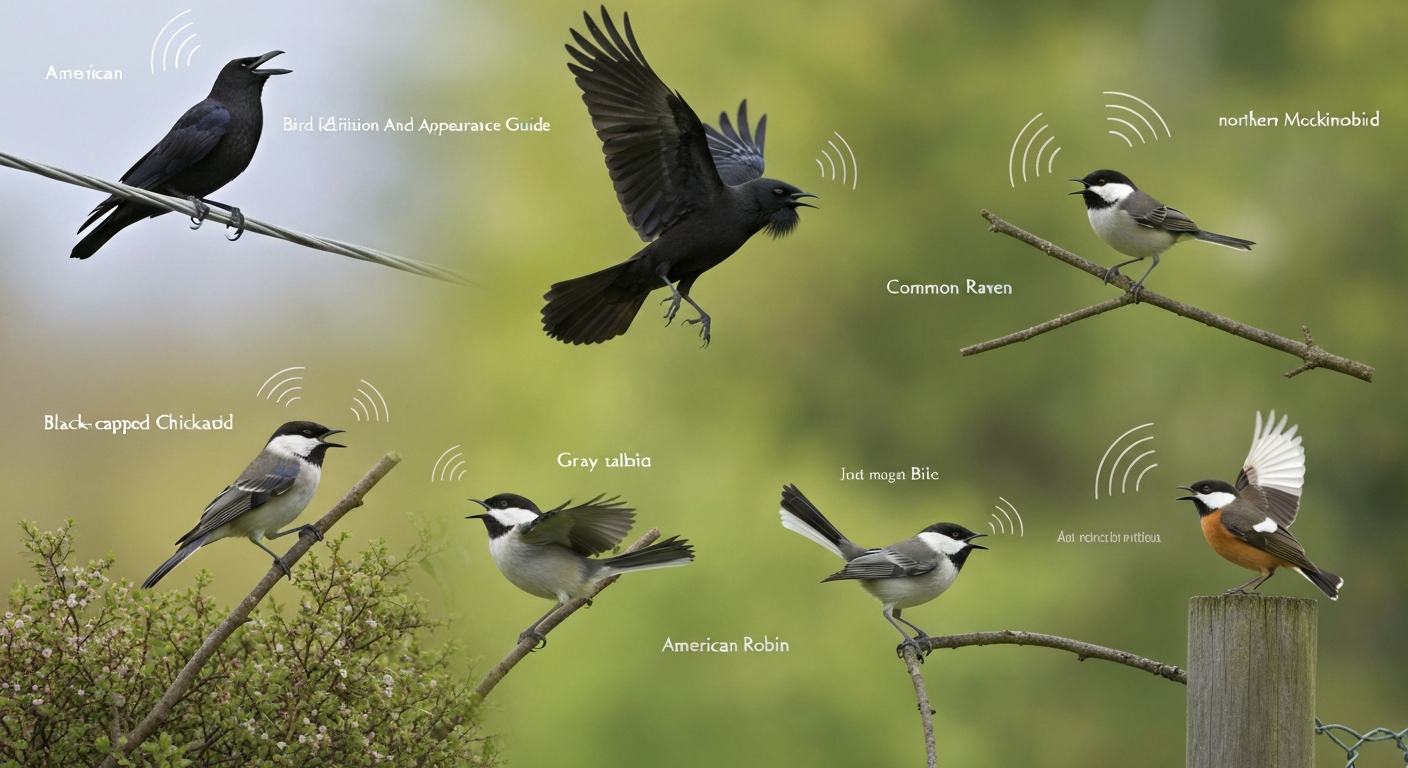
What Does a Calling Bird Look Like: Visual ID Guide
Learn how to ID calling birds by sight and sound: features, common species, lookalikes, checklist & photo tips.
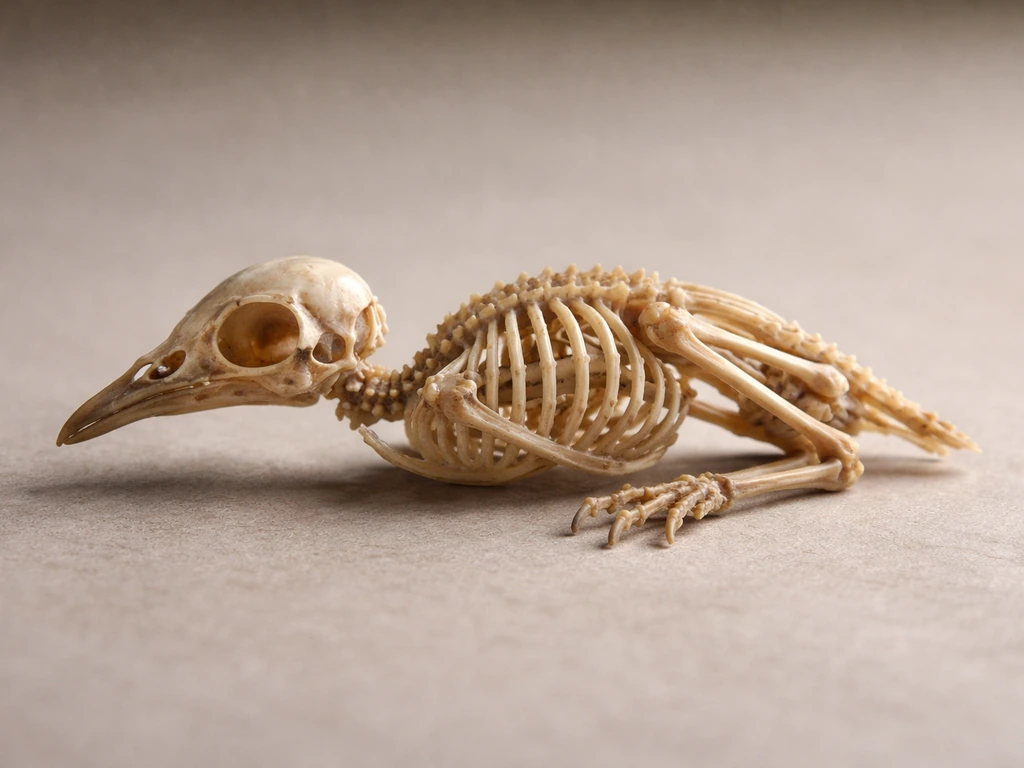
What Does a Bird Skeleton Look Like? Visual Guide
Learn what a bird skeleton looks like, its anatomy names, and how to identify fused bones, skull, ribs, keel, and legs.

What Does a Bird Heart Look Like? Size, Shape, and Location
Learn what a bird heart looks like by size, shape, color, and location, plus how to verify it in diagrams or specimens.