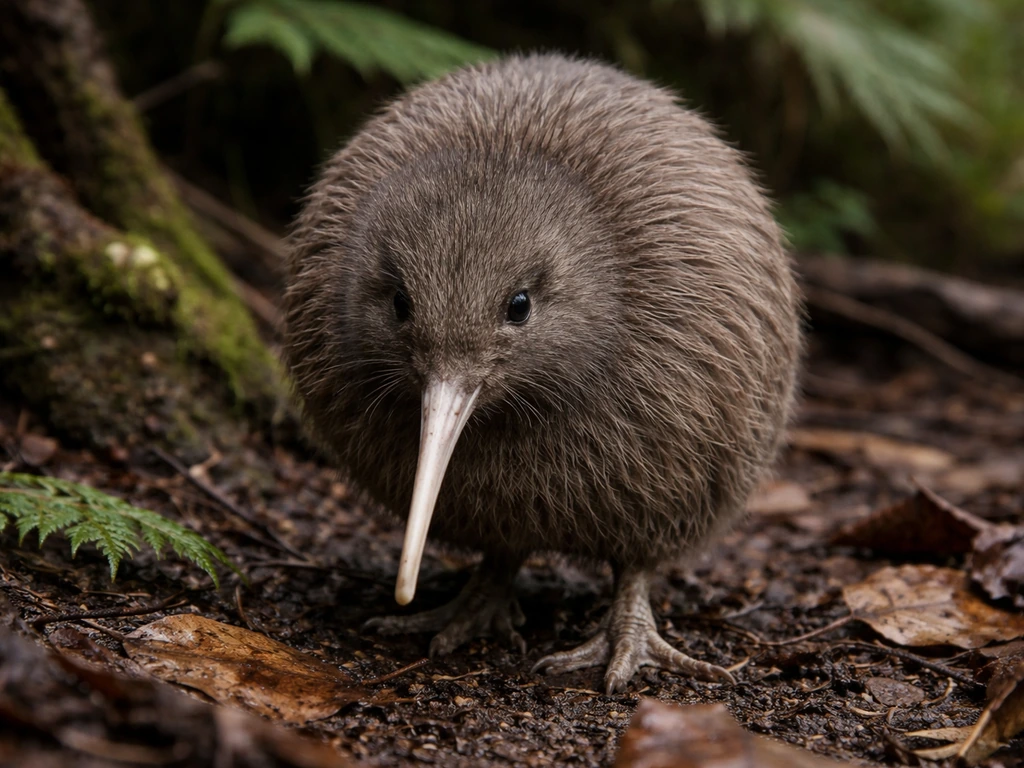
A kiwi bird looks like nothing else you've ever seen. It's a small, round, tailless bird with a disproportionately long bill, shaggy hair-like feathers in earthy browns and greys, and sturdy legs that make it walk with a surprisingly purposeful, almost bouncing stride. There are no wings to speak of, no tail, and the overall silhouette is closer to a fuzzy pear balanced on two strong legs than anything you'd picture when you think 'bird.' Once you know what to look for, a kiwi is instantly recognizable, even in a dark photo or a brief nighttime sighting.
What Does a Kiwi Bird Look Like? Key Visual Traits to Spot

Marcus Whitley
20 Apr 2026
Overall size and shape: the pear on legs
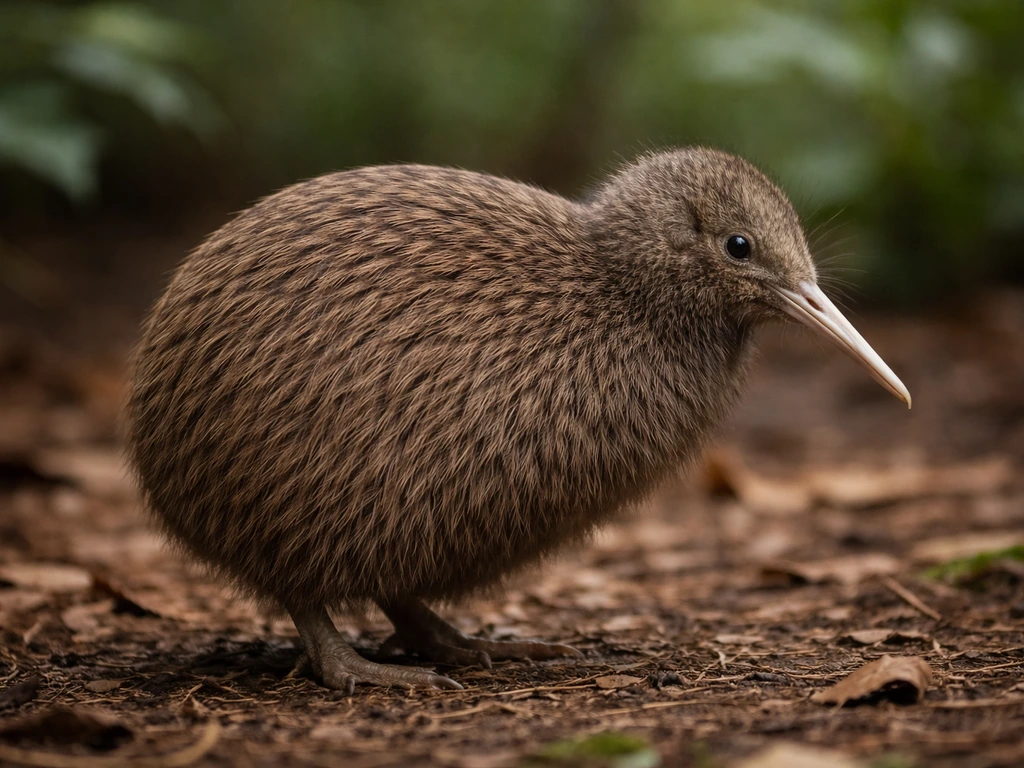
The first thing to lock in is the silhouette. Kiwis have a distinctly pear-shaped or round body, a small head, and absolutely no visible tail. The wings are so tiny they're completely hidden under the feathers, so the body looks like one smooth, feathery oval. The head sits on a short neck and looks almost too small for the body, which adds to the slightly comical but unmistakable outline.
In terms of size, kiwis vary by species, but the great spotted kiwi (the largest) stands about 45 to 50 cm tall and weighs between 2.4 and 3.3 kg, roughly the size of a small domestic cat. The little spotted kiwi is closer to 35 cm and is sometimes described as about the size of a bantam chicken. All species share that same round-bodied, leggy, bill-forward look regardless of size.
Head and face: small head, big personality
The kiwi's head is noticeably small relative to its body, and the eyes are tiny and dark, sitting low on the face. You won't get much expression from those eyes in a photo. What you will notice immediately is the bill, which dominates the entire face and often looks almost as long as the head and neck combined. But there are a couple of other face details worth knowing for confident ID.
Look closely at the base of the bill and you'll see whisker-like bristles, almost like a cat's vibrissae, fanning out from where the bill meets the face. These are sensory feathers that help kiwis find food in the dark. In clear photos, they're a great confirmation detail. The other truly unique feature is where the nostrils sit: kiwis are the only birds in the world with [external nostrils at the very tip of the bill](https://en.
wikipedia. org/wiki/Greatspottedkiwi), not at the base near the face. In most birds the nostrils are up near the head. In a kiwi, they're right at the end.
If you can see the tip of the bill in a photo and there are visible nostril openings there, you're looking at a kiwi.
Feathers and coloring: shaggy, not sleek
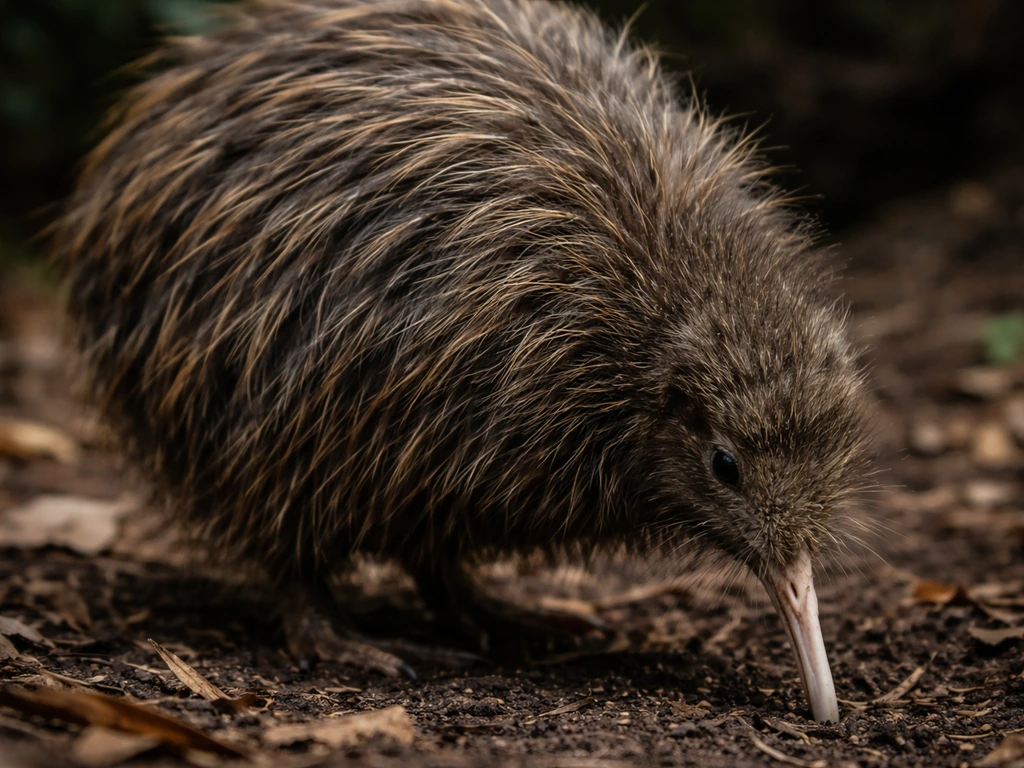
Kiwi feathers are unlike any other bird's. Instead of the neat, interlocking structure you'd see on a pigeon or a sparrow, kiwi feathers are loose and filamentous, more like coarse hair or fur than feathers. The overall effect is shaggy and slightly unkempt, as if the bird is wearing a thick bristly coat. This texture is one of the easiest things to spot in photos, especially compared to the smooth plumage of most other ground birds.
The coloring across most kiwi species runs from warm brown to charcoal grey, and the great spotted kiwi in particular tends toward brownish-grey with fine horizontal banding or mottling with white across the body. The little spotted kiwi looks similar but lighter, a kind of greyish-brown with more obvious white horizontal streaking or spotting. The southern brown kiwi goes in a different direction, showing reddish-brown streaking that runs lengthways (top to bottom) rather than horizontally. That streaking direction is a quick pattern cue when you're trying to tell species apart in photos.
The bill, legs, and how a kiwi moves
The bill is long, slender, and slightly curved downward. The Smithsonian describes the long, curved pale gray-brown kiwi bill as unique because its nostrils are located near the tip, and it also provides size context for north island brown kiwi (about 1.5 to 2 feet tall) long, slender, and slightly curved downward. On the great spotted kiwi it measures between 8.3 and 13.5 cm, which on a bird this size is genuinely impressive. The bill is usually pale or whitish, which makes it stand out against the darker plumage of the face, and it tapers to a fine point where those nostrils sit at the tip.
The legs are short but strong and muscular, and they're set well back under that round body. Kiwis have four toes and large claws used for digging and defense. When a kiwi walks, it moves with a rolling, deliberate gait, leaning forward slightly as if following its bill. You won't see it fly, obviously, and it won't perch in trees. Everything about its movement is built for the ground: probing leaf litter, pushing through dense undergrowth, and moving quickly on foot when it needs to.
How the main kiwi species differ in appearance
There are five kiwi species and they all share the same basic body plan, but their coloring and patterning are different enough to tell apart once you know what to look for. Here's a quick breakdown of the three most commonly referenced species.
| Species | Size | Plumage color | Pattern direction | Useful ID cue |
|---|---|---|---|---|
| Great spotted kiwi (roroa) | 45–50 cm tall, 2.4–3.3 kg | Brownish-grey to charcoal grey | Horizontal banding/mottling with white | Largest kiwi; pale bill stands out against grey face |
| Little spotted kiwi | ~35 cm, under 1 kg | Light greyish-brown | Horizontal white banding/spotting | Smallest species; noticeably lighter overall tone |
| Southern brown kiwi (tokoeka) | Similar to great spotted | Rufous to dark brown | Lengthways streaking in reddish-brown and black | Streaks run top-to-bottom, not side-to-side |
The pattern direction is genuinely one of the easiest ways to separate the brown kiwi from the spotted species when you're looking at a photo. Spotted kiwis have that crosswise banding; the southern brown kiwi is streaked in the other direction. The great spotted kiwi also tends to have a slightly darker face overall, with a small dark patch visible below the eye in good photos.
Kiwi vs similar birds: how to rule out lookalikes
If you're looking at a photo of a round, brownish, ground-dwelling bird with no obvious wings or tail and trying to decide if it's a kiwi, the most common source of confusion is the weka, another New Zealand ground bird with a similar compact shape. Here's how to rule it out and confirm you're looking at a kiwi.
- Bill length: a kiwi's bill is dramatically longer than a weka's, often as long as the bird's head and neck combined. If the bill looks short or medium length, it's probably not a kiwi.
- Nostrils at the tip: check the very end of the bill. Visible nostril openings right at the tip are a kiwi-only feature.
- No tail: kiwis have no visible tail whatsoever. Wekas have a short, often-cocked tail. If there's any tail action, it's not a kiwi.
- Feather texture: kiwi plumage looks shaggy and hair-like. Wekas have smoother, more conventional feathers.
- Cat-like whiskers: those sensory bristles at the base of the bill are visible in close photos and are unique to kiwis.
- Size context: if there's anything in the frame for scale, a great spotted kiwi is roughly cat-sized, while a little spotted kiwi is closer to a large chicken.
For distance sightings in low light (kiwis are nocturnal and most wild sightings happen at dusk or with a torch), focus on silhouette: round body, no tail, long bill pointing forward or downward, and a slightly hunched forward lean as it walks. That combination of features rules out almost everything else you'd encounter in New Zealand bush.
If you're exploring other unusual birds with striking visual features, it's worth knowing that some other distinctive species like cranes, kingfishers, and kites each have their own strong silhouette markers that make them identifiable at a glance in photos, much like the kiwi's tailless, bill-forward profile. Some bird guides also cover king birds, so you might be looking for what a king bird looks like what does a king bird look like.
If you’re also curious about other odd-looking birds, you might wonder what an elephant bird looks like as well. If you meant a kite bird, it typically has a more raptor-like body with broad wings and a clearly visible tail, unlike a kiwi kites. Kingfishers look very different from kiwis, with bright colors and a sleek, streamlined body built for perching near water.
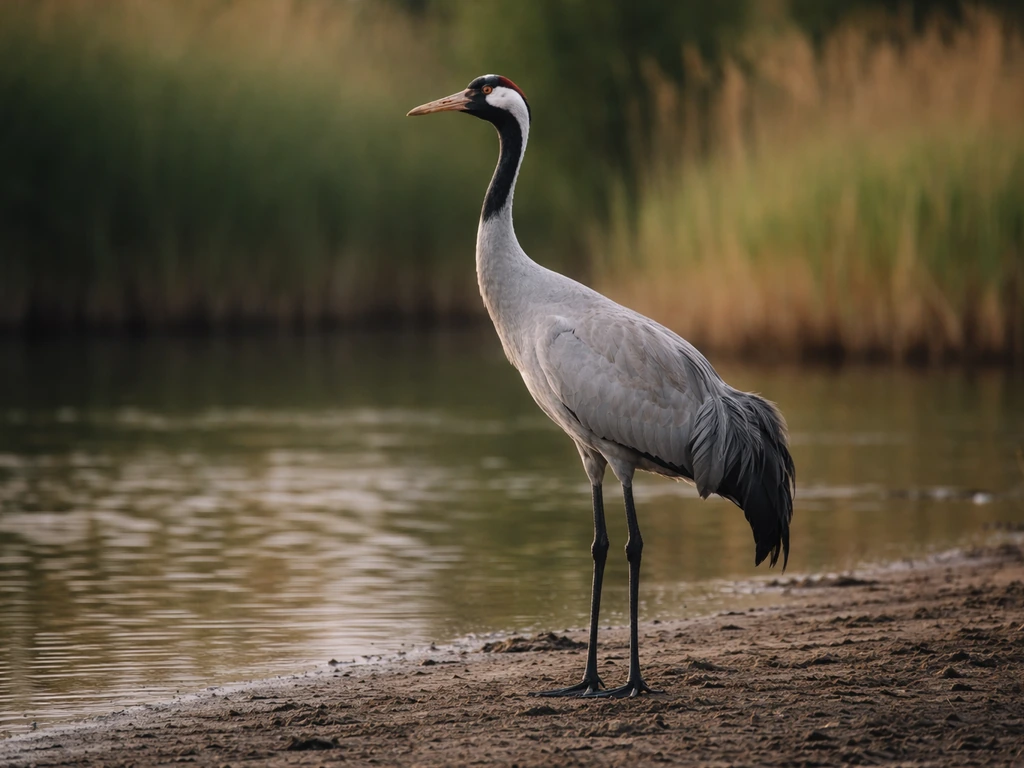
Crane silhouettes can also look bill-forward and distinctive, but their overall body and feather shape differ from a kiwi cranes. The kiwi stands out even in that company because it's the only one that looks genuinely mammal-like in its texture and build.
What to look for in photos to confirm it's a kiwi
When you're working with a photo rather than a live sighting, run through this quick mental checklist. First, check the body shape: round and tailless with no visible wings. Second, look at the bill: long, slender, pale, and noticeably curved downward. Third, zoom in on the bill tip if resolution allows and look for nostril openings right there at the end. Fourth, check the feather texture: it should look shaggy and almost furry, not smooth or sleek. Finally, check the plumage pattern: is it horizontal banding (spotted kiwi types) or vertical lengthways streaking (southern brown kiwi)? Those five checks will get you to a confident ID in almost any decent photo.
FAQ
If the photo is blurry, how can I still tell what a kiwi bird looks like?
In many images, the giveaway is not the “look” of feathers but the absence of any tail and the hidden wings. If you cannot make out wings or a tail at all, yet the bird has a round, pear-like body and a very long bill that points forward or slightly downward, that combination fits kiwi more than most other New Zealand ground birds.
Do kiwis have nostrils you can see, and where are they located on the bill?
Yes, but it usually takes a clear view of the bill tip. Kiwis are unusual because the nostrils are external and sit right at the end of the bill, so in higher-resolution shots you should be able to spot openings at the tip rather than near the face.
What’s the easiest way to rule out a weka when I’m trying to figure out what a kiwi bird looks like?
A weka can look compact and ground-dwelling, but the kiwi’s bill-forward silhouette is different. Weka typically shows a more “bird-like” head-to-body proportion and more obvious feather shape, while kiwi shows a fuzzy, hair-like coat effect plus a bill that dominates the face.
Can you ever see the wings on a kiwi, or are they completely hidden in photos?
A kiwi usually appears to have no wings because the wings are tiny and tucked under shaggy feathers, so you may never see them. However, if you get an angle where the body edge is visible, you might see small wing coverts blending into the coat rather than a raised wing.
Will a kiwi look different in low light or flash photography? What should I prioritize?
It can. Because kiwis are nocturnal, lighting can wash out the bill color and hide nostril detail, but the body shape (round, tailless, bill-forward) and the shaggy, filament-like texture tend to remain visible even in dark photos.
How reliable is color patterning to tell which kiwi species I’m seeing in a photo?
Not always. Species patterns can be subtle in poor resolution, so use pattern direction only after confirming the core silhouette. Spotted kiwi types tend to show horizontal banding, while the southern brown kiwi shows lengthwise streaking (top to bottom).
What bill details are most consistent across kiwi species when identifying what a kiwi bird looks like?
Yes, the bill can look oddly long even compared to the head, but the most consistent point is the bill shape: long, slender, and usually slightly curved downward, with the tip being pale and tapering. That tapering bill tip is often easier to confirm than small body details.
How does kiwi movement help if I only have a short video or a sequence of images?
Look for the walking posture. Kiwis tend to lean forward while moving, often with a deliberate, almost rolling stride. If the bird is upright and perching-like, or shows a clear tail for balance, it is unlikely to be a kiwi.
What photo framing or zoom strategy gives the best chance of identifying a kiwi?
Yes, resolution and cropping matter. If you zoom too far, the feather texture may look smoother than it really is, and if the bill tip is out of frame you lose the best confirmation detail. For ID, try to include the full body outline and enough of the bill tip to check for nostril openings.
When should I stop assuming it’s a kiwi and treat it as a different type of bird?
If you see a bird with broad wings and a clearly visible tail, it is almost certainly not a kiwi, even if it looks ground-hugging. Kiwis do not have a traditional tail silhouette, and their “no visible tail” plus “fuzzy pear body” profile is a strong filter.
Next Article
What Does a Crane Look Like Bird Style Guide for ID
Learn crane bird features to identify it: long legs, neck shape, bill, wings, colors, and how to spot look-alikes.