A raven is a large, all-black bird that looks like a crow on steroids. If you've ever spotted a massive dark bird perched on a fence post or soaring overhead and thought 'that's a really big crow,' there's a good chance you were actually looking at a Common Raven. The two are easy to mix up, but once you know what to look for, you'll never confuse them again.
What Does a Raven Bird Look Like? Key Field Marks

Marcus Whitley
22 Mar 2026
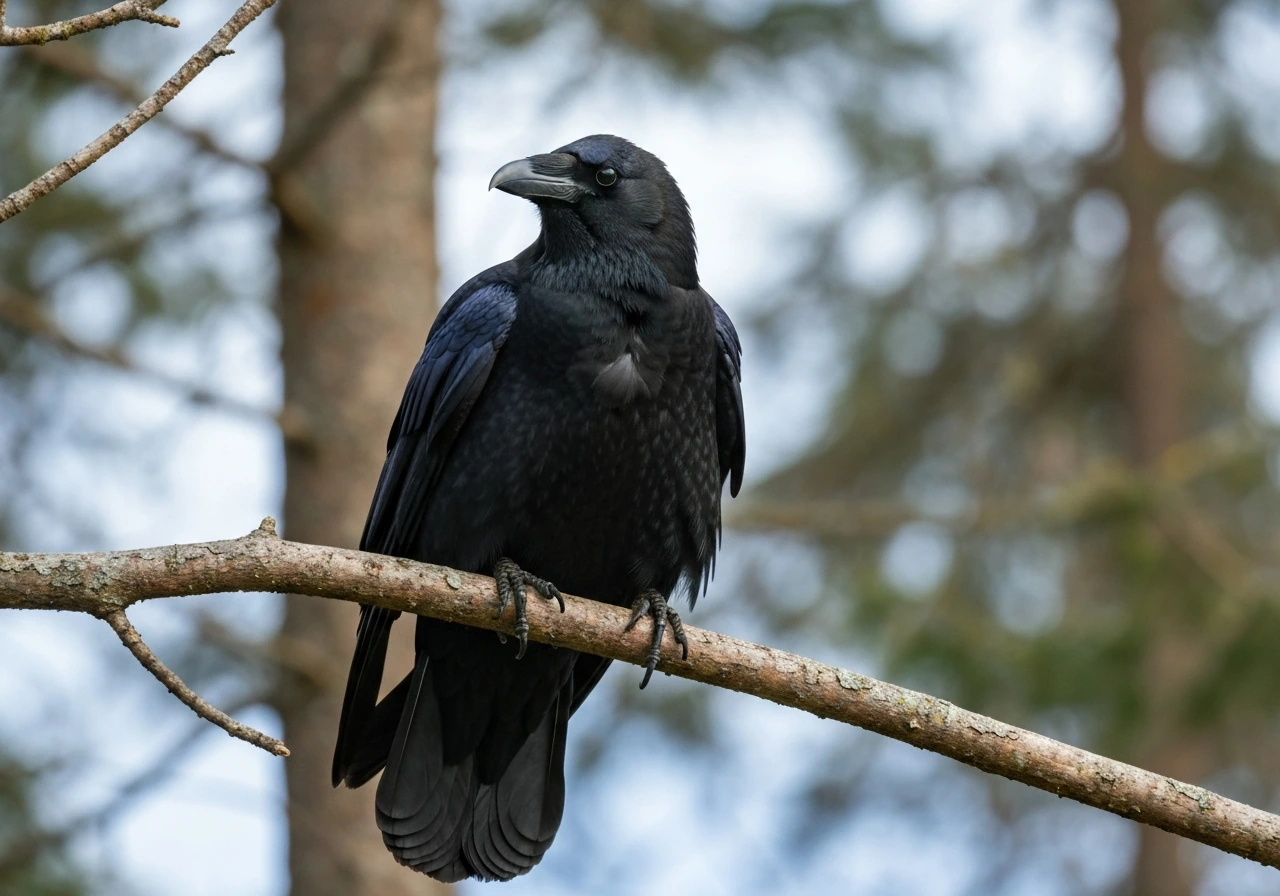
So what exactly is a raven?
When people in North America say 'raven,' they're almost always referring to the Common Raven (Corvus corax). It's a member of the family Corvidae, the same group that includes crows, jays, magpies, and rooks. Ravens sit at the top of that group in terms of sheer size, and the Common Raven is actually considered the largest passerine (perching bird) in the world. It's not a hawk, not a vulture, not a blackbird in the songbird sense. It's a corvid, and it shares the same sharp intelligence and bold personality that makes corvids so fascinating to watch.
First impression: the raven's size and shape
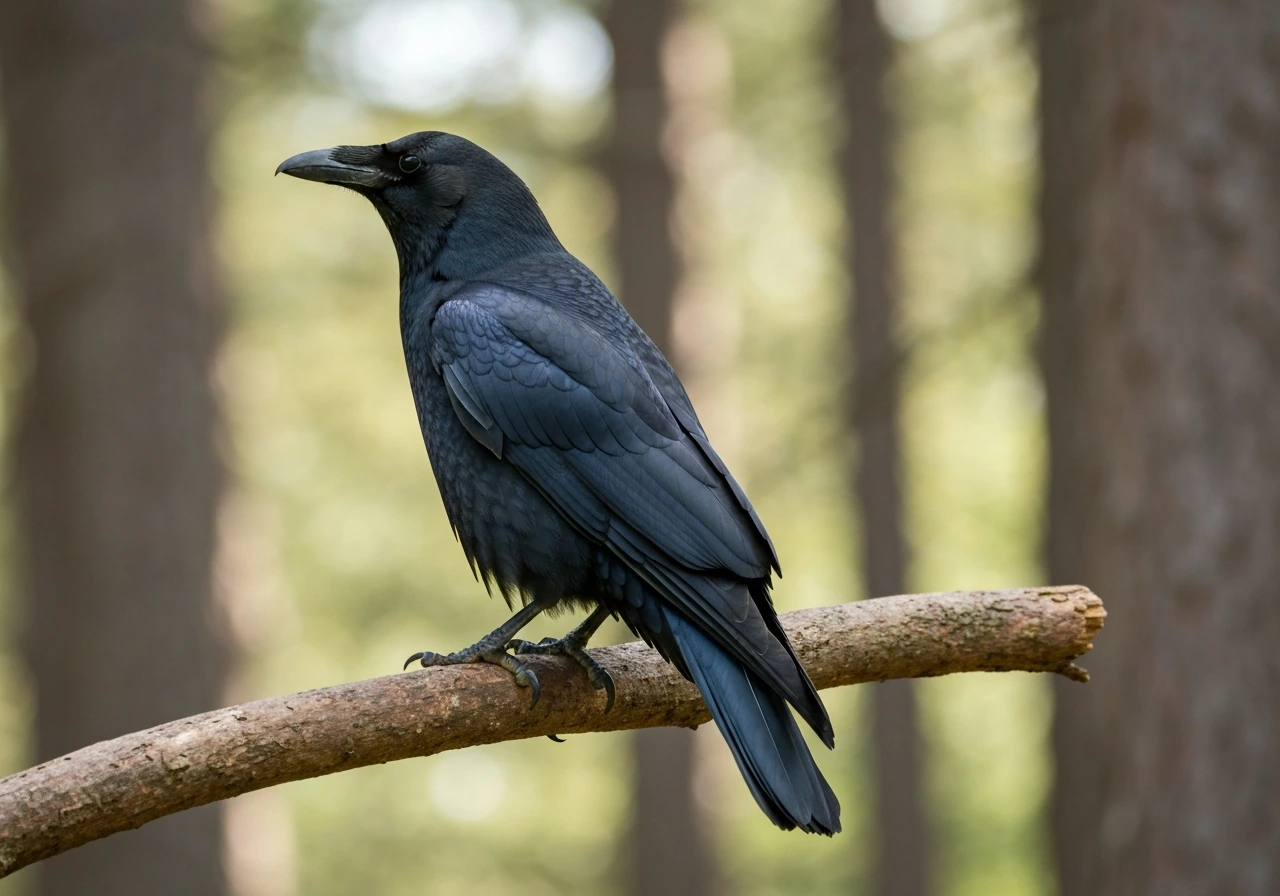
The first thing that hits you when you see a raven up close is just how big it is. Common Ravens measure about 22 to 27 inches from bill to tail
When a raven is perched, you'll notice the stocky, broad-shouldered posture and that thick neck giving it a slightly hunched, powerful look. In flight, the silhouette is very distinctive: long, slender wings paired with that telltale wedge-shaped tail. The overall shape in the air looks more like a small raptor than a crow, which is part of why people sometimes do a double-take when they spot one soaring.
That all-black color, but with a twist
Yes, ravens are all black. Every feather, from the tip of the bill to the end of the tail, is black. But 'all black' undersells what you're actually seeing. Raven plumage is a deep, glossy black with an iridescent sheen that shifts in good light. Depending on the angle and how the sun hits the bird, you might catch flashes of blue, purple, or even a greenish gloss across the wings and back. It's similar to how a crow can look almost oily in direct sunlight, but on a raven the effect is more pronounced and the bird is big enough that you can really appreciate it. In flat or overcast light the bird just looks intensely, solidly black, but catch it in sunshine and it almost shimmers.
The key field marks: bill, head, throat, wings, and tail
This is where raven identification really gets useful. Color alone won't reliably separate a raven from other large black birds. You need to look at the structure, and ravens have several features that stand out once you know what to check.
That bill is hard to miss
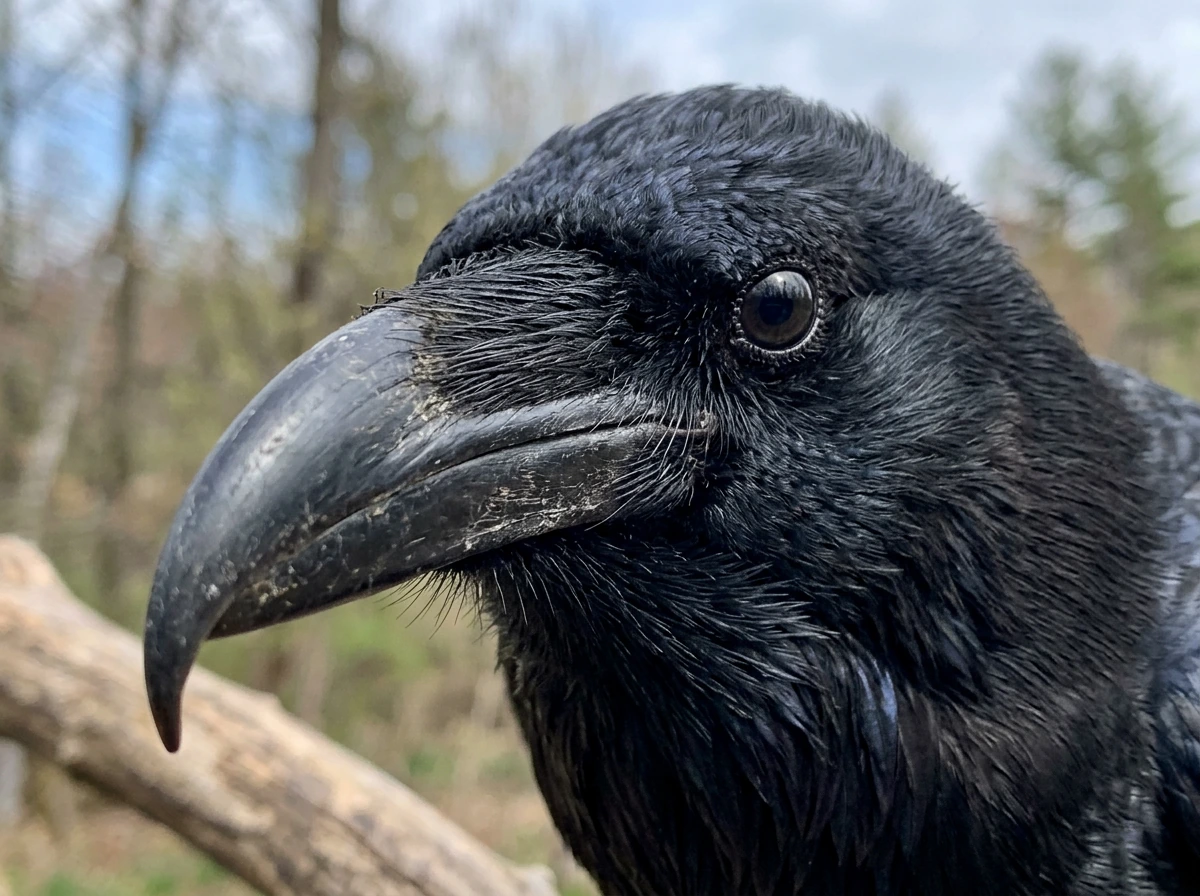
The Common Raven's bill is one of its most impressive features. It's not just large, it's heavy and thick, with a noticeable downward curve at the tip. Cornell Lab's description puts it well: the raven's bill is often longer than the bird's own head, giving the face a front-heavy, powerful look. Compare that to a crow's bill, which is more moderate and roughly the same length as the head. When you see a raven's bill up close, it looks like a serious tool, built for tearing, prying, and problem-solving. That bulk alone is a strong clue.
The shaggy throat (look for the hackles)
Look at the throat and upper chest. Ravens have long, loose, ruffled feathers around the throat called hackles. This gives the bird a distinctly shaggy or scruffy appearance around the neck, almost like it's wearing a feather boa that got slightly ruffled. Ravens can raise these hackles during displays, but even when resting they look noticeably shaggier than a crow, whose throat feathers lie flat and smooth. You might notice this most clearly when the bird tilts its head or calls, and the throat feathers flare out.
The tail in flight: your best quick ID
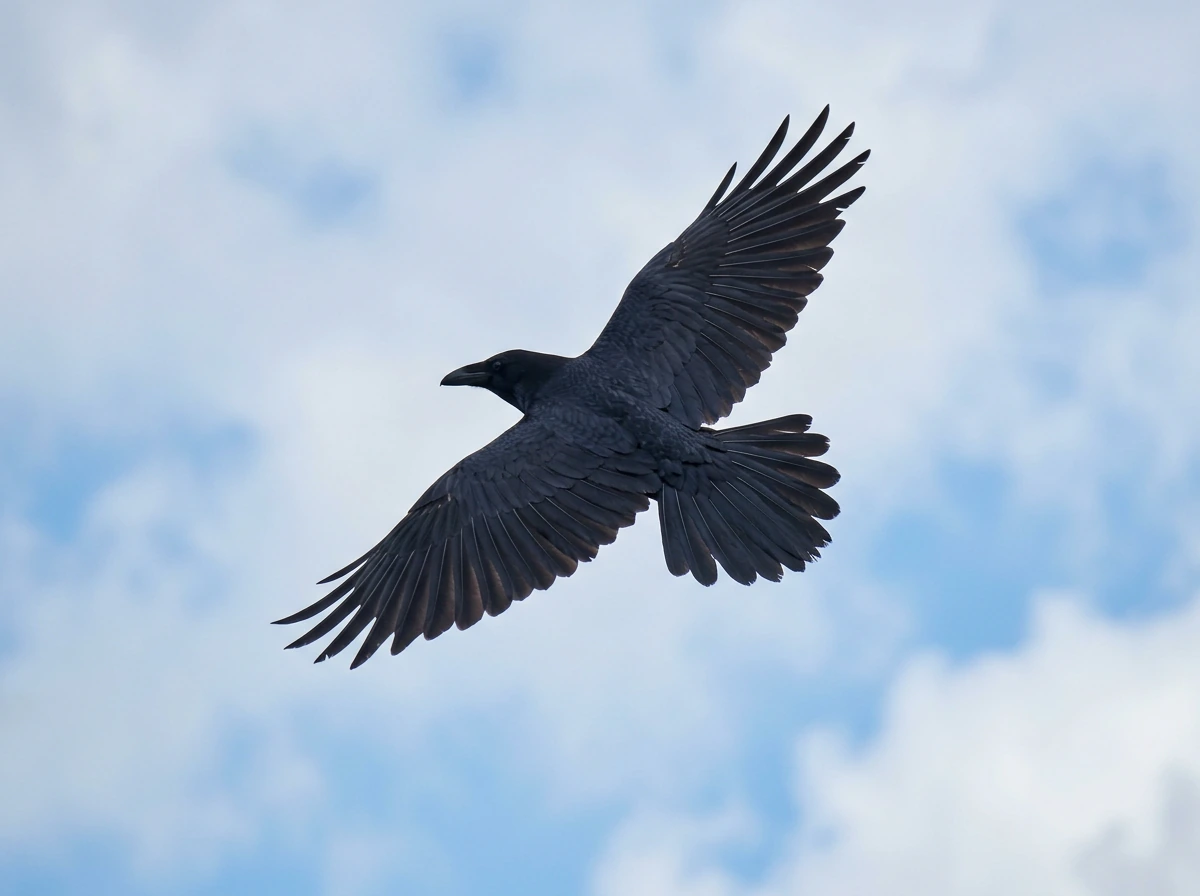
If you catch the bird in flight, the tail shape is probably the fastest and most reliable field mark. A raven's tail is wedge-shaped, meaning the central feathers are longer than the outer ones, creating a pointed or diamond-shaped silhouette at the back of the bird. A crow's tail fans out in a rounded or slightly squared shape. This difference is visible even at a distance, and once you've seen it, it clicks immediately. If you're looking at a flying black bird and the tail narrows to a point like a stretched diamond, you're looking at a raven.
Wings and overall flight style
Raven wings are long and somewhat slender relative to the bird's body, and ravens are powerful fliers. You'll often see them soaring and gliding effortlessly, sometimes for extended periods without flapping, more like a hawk than the steady flapping you'd expect from a crow. Ravens are also notorious aerial acrobats, and Audubon notes that a large dark bird doing mid-air somersaults is almost certainly a raven rather than a crow. That kind of playful aerial tumbling is very on-brand for ravens.
Ravens vs. similar black birds: how to tell them apart
The American Crow is the most common bird people confuse with a raven, but there are a few other large black birds worth knowing about. Here's a quick comparison of the main look-alikes.
| Feature | Common Raven | American Crow | Fish Crow | Common Grackle |
|---|---|---|---|---|
| Size | Very large, 22–27 inches | Medium-large, up to 21 inches | Smaller than American Crow | Medium, robin-sized with long tail |
| Bill | Very thick and heavy, longer than head | Moderate, roughly head-length | Smaller, thinner | Long, thin, slightly curved |
| Tail shape in flight | Wedge or diamond shape | Rounded or slightly fan-shaped | Rounded | Long, keel-shaped (flared edges) |
| Throat feathers | Shaggy, ruffled hackles | Smooth and flat | Smooth and flat | Smooth |
| Plumage sheen | Glossy black with strong iridescence | Black with some gloss | Dull black | Purple-green iridescence, especially on head |
| Body build | Massive, thick-necked | Sturdy but noticeably smaller | Slender | Slender with long tail |
| Flight style | Soars and glides like a hawk, aerial acrobatics | Steady flapping, occasional glide | Similar to American Crow | Direct with shallow wingbeats |
The American Crow is the one you really need to nail. Side by side, a raven dwarfs a crow, but without a reference point it can be tricky. Focus on three things: the tail shape in flight (wedge vs. fan), the bill bulk (heavy vs. moderate), and the throat feathers (shaggy vs. smooth). If all three check out, you've got a raven. Common Grackles are much smaller and have that distinctive long, keel-shaped tail and a very different iridescent pattern, so those are easier to dismiss once you know the size difference.
How to confirm what you're seeing, in the field or in a photo
Whether you're outdoors or working from a photo, here's a practical checklist to run through when you think you might be looking at a raven. what bird looks like a <a data-article-id="BD8E3C50-5BF4-4026-A442-13E392CD2E5E">pterodactyl</a> If the raven’s dinosaur-like silhouette has you wondering what bird looks like a dinosaur, you can compare the body shape and tail wedge to narrow it down fast. Whether you're outdoors or working from a photo, here's a practical checklist to run through when you think you might be looking at a raven what bird looks like a pterodactyl? (pterodactyl-like silhouette). If the raven’s dinosaur-like silhouette has you wondering what bird looks like a dragon, you can compare the body shape and tail wedge to narrow it down fast.
- Check the overall size. Does it look noticeably larger than any nearby crows, pigeons, or other reference birds? Ravens are hard to miss once you calibrate to their scale.
- Look at the bill. Is it thick, heavy, and front-loaded looking, almost longer than the bird's head? That's a raven bill.
- Check the throat and neck. Do the feathers around the throat look shaggy or ruffled? Hackles are a reliable raven marker.
- If the bird is flying, watch the tail. Does it taper to a wedge or diamond point? A rounded or fan-shaped tail points to a crow instead.
- Watch for soaring or gliding behavior. Ravens glide effortlessly and sometimes perform aerial rolls or somersaults. Crows flap more steadily.
- Look for that iridescent gloss. In good light, raven feathers shimmer with blue, purple, or green tones rather than flat black.
If you want to go deeper on comparing large black birds, it's worth getting familiar with how ravens fit into the broader corvid family alongside crows, jays, and magpies. And if you're curious about the appearance of other dramatic-looking birds, you might enjoy exploring what different raptors look like, since ravens are sometimes spotted in the same habitats and share that bold, imposing silhouette from a distance.
The bottom line: a raven is a massive, glossy-black corvid with a heavy downward-curved bill, shaggy throat hackles, and a wedge-shaped tail in flight. If you’re wondering what the dodo bird looked like, that’s a different question, since the dodo was a much rounder, ground-dwelling bird than a raven what did the dodo bird look like. Get those four features in your head and you'll confidently separate a raven from every similar black bird you're likely to encounter.
FAQ
What does a raven look like compared to a blackbird or a starling?
Ravens look like a much larger corvid with a bulky, heavy bill and a wedge-shaped tail in flight. Blackbirds and starlings are typically smaller with smoother-looking bodies and do not show the same shaggy throat hackles or the raptor-like silhouette from below.
Are ravens ever not all-black?
They are generally fully black, but in good light the feathers can show a strong glossy sheen with flashes that look bluish, purplish, or greenish. In flat light they can appear uniformly black, which is why checking bill thickness, throat hackles, and tail shape matters more than color.
How can I tell a raven from a crow when the bird is perched and not in flight?
Use the bill and neck first. A raven’s bill looks heavier and often more front-heavy with a noticeable downward curve, and the throat has long loose hackles that make the neck look scruffy or shaggy. Then, look for the overall stocky build and broad-shouldered posture.
What should I look for in a photo if the tail shape is unclear?
Focus on the bill size and curve, and whether the throat area looks shaggy rather than smooth. If wing shape is visible, ravens also look more long-winged and powerful, and they tend to hold a posture that looks heavier through the chest and neck.
Can young ravens look different from adults?
Yes, juveniles can look less uniformly glossy than adults, and some may show a duller sheen. The most reliable identification still comes from structure, especially the thick, heavy bill and the wedge-shaped tail in flight, plus the neck’s loose hackles.
If I see a very large “crow” doing aerial flips, does that always mean raven?
It strongly suggests raven behavior, but not every acrobatic dark bird is a raven. Confirm with at least one structural field mark, especially the wedge-shaped tail in flight and the heavy, downward-curved bill, since other large birds can show odd flight behavior too.
Do ravens and crows sound different, and does that help with identification?
Yes. Ravens often have deep, rough vocalizations and can sound lower and more guttural than crows. However, since calls can vary by region and context, treat audio as supportive evidence and still verify using tail shape, bill bulk, and throat feathers.
What’s the quickest “field checklist” I can use when I only get a brief glance?
Ask three fast questions: Is the bird clearly larger than the typical crow size? In flight, does the tail narrow to a point (wedge) rather than fan out? Does the bill look thick and heavy with a downward curve? If those match, you’re very likely looking at a raven.