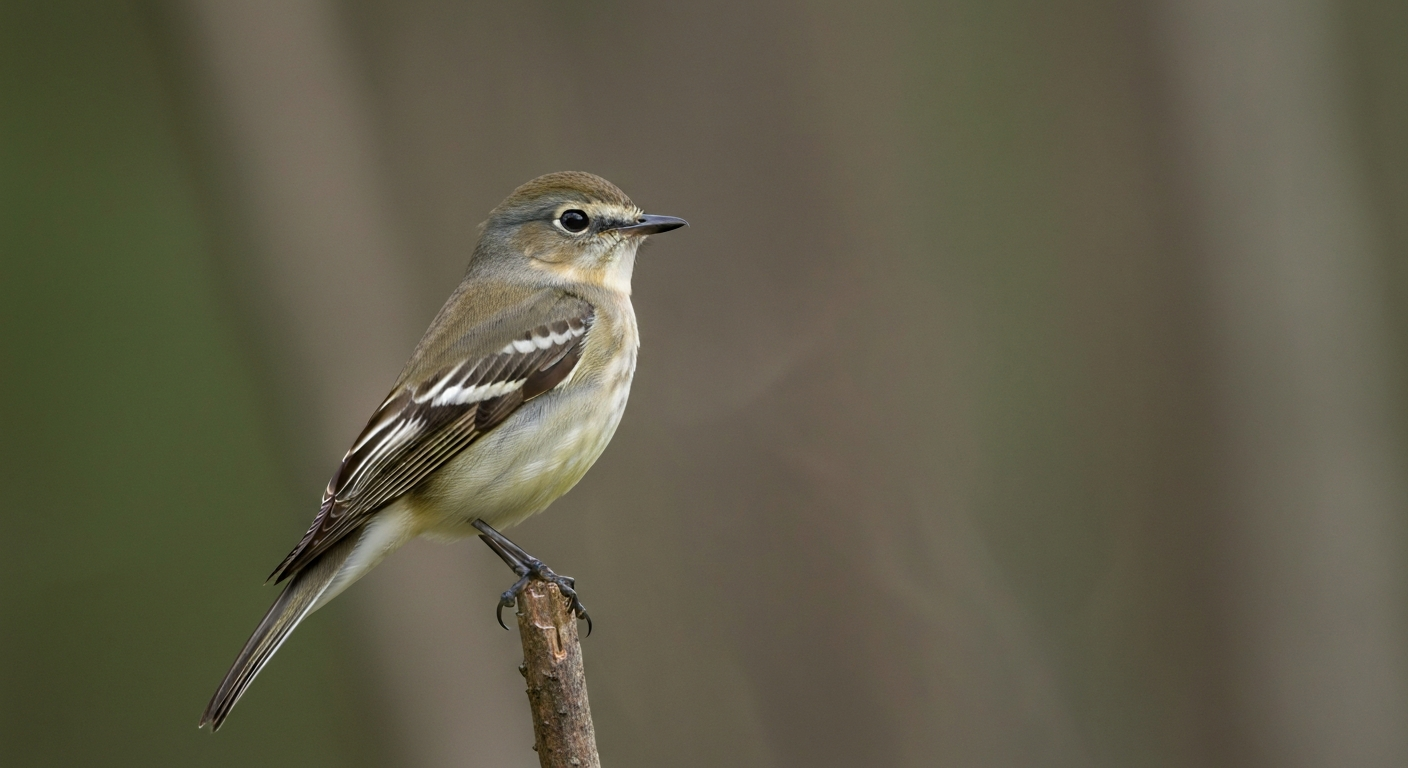
A flycatcher is a small to medium-sized songbird with an upright, alert posture, a fairly flat head, a short notched bill, and two pale wing bars on each wing. Most species are dressed in muted olive, brown, or gray tones with a pale belly, making them easy to overlook until you notice how they behave: they sit still on an exposed twig, dart out to snag a flying insect in midair, and return to almost exactly the same spot. That sit-and-wait hunting style, combined with their compact upright shape, is often the fastest way to confirm you're looking at a flycatcher before you even nail down the species.
What does a flycatcher bird look like: Field ID Guide with tips

Marcus Whitley
16 Jul 2026
What this guide covers and who it's for
This guide is written for casual birdwatchers and curious nature lovers who want a clear, visual-first way to identify flycatchers in the field. You don't need any prior birding experience or a background in ornithology. What you do need is a decent look at the bird and a sense of what features to focus on. We'll walk through size and shape, bill and head details, plumage colors, wing and tail shape, posture and movement, and how juveniles or females might look slightly different. We'll also show you how to tell flycatchers apart from similar-looking birds like swallows, nuthatches, thrashers, and sapsuckers, and give you a simple checklist you can use on your next outing.
At-a-glance ID checklist
When you spot a bird you think might be a flycatcher, run through these quick visual checks before it flies off. Most flycatchers will tick the majority of these boxes.
- Small to medium size, roughly sparrow-sized up to robin-sized depending on species
- Upright posture on a perch, sitting bolt-straight like a tiny sentry
- Compact, rounded head, often appearing slightly flat on top
- Short, straight, slightly flattened bill with a small pale base on the lower mandible in many species
- Two pale wing bars visible on each folded wing
- Muted olive, brown, gray, or brownish-green upperparts
- Pale or whitish underparts, sometimes with a yellowish wash on the belly
- Sits still for long periods then launches out to catch insects and returns to the same perch
- No forked tail (unlike swallows) and no streaked breast (unlike thrushes or sparrows)
Size, shape and overall silhouette
Flycatchers in North America range quite a bit in size depending on the species. At the small end, the Least Flycatcher is only about 12 to 14 cm long (roughly 5 to 5.5 inches) and weighs as little as 10 grams, making it noticeably smaller than a house sparrow. At the larger end, the Olive-sided Flycatcher stretches to 18 to 20 cm (about 7 to 8 inches) and can weigh up to 40 grams, putting it closer to a large sparrow or small thrush in bulk. The Great Crested Flycatcher falls in a similar range at 17 to 21 cm.
The silhouette is one of the most reliable starting points. Flycatchers tend to look compact and upright, with a relatively large, rounded head sitting directly on a short neck. The body is roughly oval or slightly barrel-shaped in stockier species like the Olive-sided, while smaller Empidonax species (the group that includes Willow, Least, and Acadian flycatchers) look slimmer and more delicate. The tail is medium length and square-tipped or very slightly notched, never deeply forked the way a swallow's tail is. When perched, the wingtips often just reach or barely pass the base of the tail, giving the bird a compact, well-proportioned look.
Bill, head shape and eye features
The bill is one of the most useful details to look at up close. In the smaller Empidonax flycatchers, the bill is short, fairly narrow, and slightly flattened from top to bottom, a bit like a tiny spatula. Many of these species have a pale or pinkish-orange lower mandible that catches the light. In larger species, the bill gets more impressive: the Great Crested Flycatcher has a noticeably wide-based, slightly hooked bill, and the Olive-sided Flycatcher has a heavy, broad bill that looks almost oversized for its head.
Head shape varies too. The Empidonax group tends to have a rounded, slightly peaked crown that can look almost crested when the bird is alert or agitated. The Olive-sided has a distinctly large, blocky head. Look especially at the eye area: many Empidonax flycatchers have a bold white or pale eye ring that forms a complete circle around the eye, making the dark eye pop. The Least Flycatcher has one of the boldest eye rings in the group. See Least Flycatcher, All About Birds (Cornell Lab) for details: the species shows a bold white eye ring, two narrow pale wing bars, short primary projection (a blunt‑winged look), and the repeated “che‑BEC” call, all useful field marks blank" rel="noopener noreferrer">Least Flycatcher — All About Birds (Cornell Lab). By contrast, the Eastern Phoebe (a close relative) has no eye ring at all, and pewees like the Eastern Wood-Pewee show only a faint partial ring or none. The presence or absence of a clear, complete eye ring is one of the first things to check.
Plumage: colors, patterns and the marks that matter
Most flycatchers are what birders call 'drab' birds, but once you know what to look for, the subtle patterns become really useful. The upperparts (back, wings, and top of the head) are typically olive-green, olive-brown, or grayish-brown. The underparts are pale: usually a whitish or pale gray throat and breast, often grading to a yellow or yellowish-white belly. In the Empidonax group, the contrast between the throat and belly is usually subtle, though it's worth noting.
The two wing bars are a key mark. They show up as two pale, narrow stripes across the folded wing, formed by pale tips on the wing feathers. They're usually whitish or pale yellow, and their width and contrast varies by species. Beyond the wing bars, look for any yellow tones: the Great Crested Flycatcher has a bright lemon-yellow belly that stands out clearly, and its rufous (rusty orange-brown) tail and wing panel patches are very distinctive. The Olive-sided Flycatcher has a striking 'vested' look: the sides of the breast are dark olive or brownish, while the center of the belly is pale, making the bird look like it's wearing an unbuttoned dark vest over a white shirt. If you see that pattern, you've got an Olive-sided.
Wings, tail shape and what they look like in flight
When a flycatcher is perched, pay attention to how far the wingtips extend past the base of the tail. This is called 'primary projection' and it's a surprisingly useful field mark. Smaller Empidonax flycatchers like the Least have short primary projection, meaning the wingtips don't extend far beyond the folded tertial feathers, giving the wing a blunt, rounded look. Larger flycatchers like pewees and the Olive-sided have longer primary projection, with the wingtips reaching noticeably further, creating a more tapered, pointed wing shape.
In flight, flycatchers have a distinctive look that sets them apart from swallows at a glance. The tail is square or slightly notched, not forked. The wings are relatively short and broad compared to a swallow's long, swept-back wings. The flight itself is often direct and purposeful for short distances, and the bird typically doesn't glide or soar the way a swallow does. Instead, you'll see short, energetic sallies from a perch followed by a quick return to roughly the same spot. The Eastern Phoebe pumps its tail almost constantly while perched, which is one of the most distinctive motion field marks of any flycatcher.
Posture and behavior: the easiest way to spot a flycatcher
Honestly, behavior might be the single most helpful ID tool for flycatchers, especially when the bird is sitting still and the plumage details are hard to make out. The core behavior is called 'sallying': the bird sits upright on a visible, exposed perch like a dead branch tip, a fence wire, or a shrub top, then suddenly darts out into open air to snatch a flying insect, and comes straight back to the same perch or one nearby. This is also called 'hawking' for insects. It's very different from the behavior of a nuthatch (which creeps down tree trunks) or a thrasher (which forages on the ground).
Some species add their own behavioral twists. The Eastern Phoebe bobs its tail in a smooth pumping motion almost every few seconds while perched. The Least Flycatcher often returns to the exact same exposed twig repeatedly and flicks its wings upward. The Olive-sided Flycatcher sits very high on a dead snag or treetop and launches impressive long-distance sallies after larger insects. The Great Crested stays high in the forest canopy and is often heard before it's seen. All of these behavioral details are worth noting alongside the visual marks.
Juvenile, sex and seasonal plumage: what changes and what stays the same
Good news: most flycatchers don't change dramatically between male and female, or between seasons. Unlike many warblers or ducks, the sexes in most North American flycatcher species look nearly identical, so you won't need a separate mental image for males versus females. Seasonal changes are also modest for most species, since adults look similar year-round.
Juveniles are where you might notice subtle differences. Young flycatchers that have recently left the nest often look a touch 'fresher' and brighter, with more obviously buffy or washed-out wing bars compared to the crisper, whiter wing bars of adults. Juvenile Olive-sided Flycatchers tend to be a bit browner on the upperparts but otherwise closely resemble adults. For most casual birding purposes, these differences are minor and won't throw you off if you're using the key shape, posture, and behavioral cues described above. Where juvenile plumage does matter most is in the Empidonax group during fall migration, when birds in fresh juvenile plumage can look slightly different from the adults you might have studied earlier in the season.
Labeled field marks to look for (what a photo or sketch should capture)
When you're photographing or sketching a flycatcher for later ID, focus your frame on the following areas. Think of it as a mental diagram with callout points on the bird.
- Eye ring: is it present, bold, and complete, or faint and partial? (circled around the eye)
- Bill: note the length, the width at the base, and whether the lower mandible has a pale or orange base
- Wing bars: count them (there should be two), note their width and how much they contrast with the darker wing
- Primary projection: how far do the folded wingtips extend past the tertials?
- Breast and belly contrast: is the breast the same color as the belly, or does the belly have a yellow wash?
- Breast sides: are they darker than the center of the belly? (the 'vest' pattern of the Olive-sided)
- Tail: is it square-tipped, slightly notched, or does it have any rufous coloring? (key for Great Crested)
- Overall posture: is the bird sitting upright and bolt-straight, or more horizontal?
Comparing the most common flycatcher species side by side
The table below covers the six flycatchers you're most likely to encounter across North America. Use it as a quick reference when you have a bird in front of you and need to narrow it down fast.
| Species | Size (length) | Key visual marks | Belly color | Eye ring? | Tail/wing notes | Distinctive habit |
|---|---|---|---|---|---|---|
| Eastern Phoebe | 14–18 cm (5.5–7 in) | Dark head, no wing bars, all-dark bill | Whitish to pale yellow | None | Square tail, pumped constantly | Constant tail-bobbing while perched |
| Least Flycatcher | 12–14 cm (5–5.5 in) | Very small, bold complete eye ring, two narrow wing bars | Whitish with faint yellow | Bold, complete | Short primary projection, blunt wing | Flicks wings, returns to same exposed perch |
| Willow Flycatcher | 13–15 cm (5–6 in) | Drab olive-brown, indistinct or absent eye ring, narrow wing bars | Pale whitish-yellow | Faint or absent | Similar blunt wing to Least | Best told by 'fitz-bew' song; silent birds often unidentifiable |
| Olive-sided Flycatcher | 18–20 cm (7–8 in) | Stocky, large head, dark vest sides contrasting pale belly center | Pale center with dark sides ('vest') | Faint or absent | Long primary projection, tapered wing | Perches high on dead snag tops, long-distance sallies |
| Great Crested Flycatcher | 17–21 cm (6.7–8.3 in) | Olive-brown back, gray throat, lemon-yellow belly, rufous tail panels | Bright lemon-yellow | Faint | Rufous wing panels and tail edges | Stays high in canopy; often heard before seen |
| Eastern Wood-Pewee | 14–16 cm (5.5–6.3 in) | Slim, long-winged, two wing bars, no eye ring, grayish overall | Pale grayish-white | None or very faint | Long primary projection, pointed wing | Drooped-wing posture; slow deliberate sallies |
Range and habitat: using location to narrow down the species
Where you are and what habitat you're standing in can cut your candidate list in half before you even look at the bird. Flycatchers are widespread across North America, but different species strongly prefer different environments. The Great Crested Flycatcher is a bird of mature deciduous and mixed forests in the eastern half of the continent, where it nests in tree cavities. The Olive-sided Flycatcher favors open conifer forests, bogs, and burned forest edges, and you'll most often see it perched conspicuously on a high dead snag. The Least Flycatcher prefers open deciduous woods, forest edges, and orchards, particularly in the northern US and Canada during breeding season.
The Willow Flycatcher, true to its name, loves shrubby wetland edges, willow thickets, and brushy riparian areas. Willow Flycatcher, All About Birds (Cornell Lab) notes that the Willow Flycatcher (Empidonax traillii) has drab brown‑olive upperparts, faint or no crown pattern, narrow wing bars and an indistinct eye ring, and that separation from Alder Flycatcher is primarily by song blank" rel="noopener noreferrer">Willow Flycatcher — All About Birds (Cornell Lab). The Eastern Phoebe is one of the most adaptable and is commonly found near water, under bridges, on rocky outcrops, and around buildings where it nests on ledges. During migration, many flycatcher species pass through habitats they wouldn't normally breed in, so context matters less during spring and fall. Pay attention to the date: most Empidonax flycatchers are present in the northern US and Canada from late May through August, and the Olive-sided is a medium-distance migrant that passes through in May and again in August to September.
How to tell flycatchers from similar birds
A few other birds get confused with flycatchers regularly, especially when you glimpse them briefly. Here's how to separate the groups quickly.
Flycatchers vs. swallows
Swallows are sleek, long-winged, and deeply forked-tailed in most species. They spend most of their time in continuous aerial flight, sweeping and gliding through the air rather than perching on a twig to watch for prey. A flycatcher's wings are shorter and more rounded, its tail is square rather than forked, and it always returns to a perch between hunting flights. If the bird barely lands and is almost always airborne, it's almost certainly a swallow, not a flycatcher.
Flycatchers vs. nuthatches
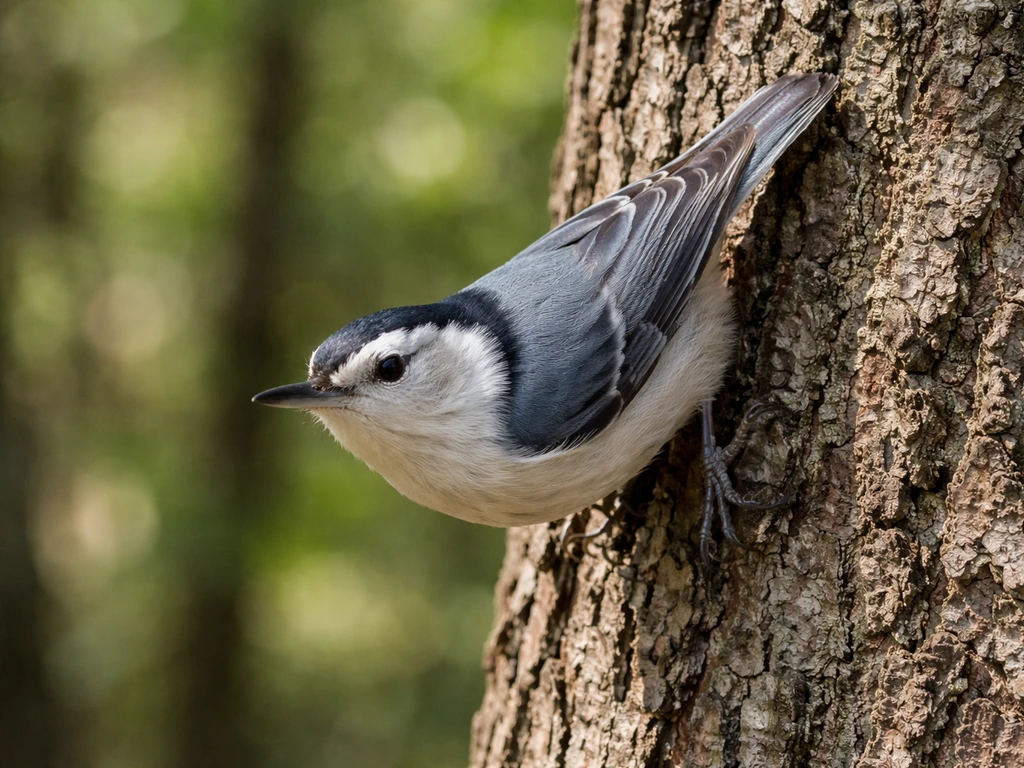
Nuthatches are compact little birds too, but their behavior is completely different: they creep headfirst down tree trunks and branches, probing bark for insects. A flycatcher never does this. Nuthatches also have a very short tail, a long pointed bill designed for probing bark crevices, and a distinctive blue-gray back. If the bird is moving down a tree trunk, it's a nuthatch.
Flycatchers vs. thrashers (including brown thrasher)
Thrashers are noticeably larger than any flycatcher, with long downcurved bills and long tails, and they spend most of their time foraging on or near the ground, flipping leaves aside with that curved bill. For a quick visual guide to thrashers and how to tell them apart from flycatchers, see what does a thrasher bird look like. The Brown Thrasher, one of the most commonly seen thrashers, has heavy brown streaking on its breast, a bright rusty-brown back, and a very long rounded tail. No flycatcher has heavy breast streaking or a downcurved bill, and none forages primarily on the ground the way thrashers do. Size alone is often enough: a thrasher is more like a large robin in bulk.
Flycatchers vs. sapsuckers
Sapsuckers are woodpeckers, and once you know what a woodpecker looks like, the confusion dissolves quickly. Sapsuckers have strong chisel-like bills for drilling into bark, bold black and white patterning on their bodies (with a red crown or throat), and they cling to the sides of trees. They don't perch upright on thin twigs or dart out to catch insects in midair. The body plan is just completely different from a flycatcher. For a full description of their appearance and markings, see the guide on what does a sapsucker bird look like.
Simple field decision checklist
Use this sequence in the field when you spot a small to medium bird on an exposed perch and want to confirm whether it's a flycatcher.
- Is the bird sitting upright on an exposed perch (twig tip, wire, snag top)? Yes: continue. No: probably not a flycatcher.
- Does it dart out, catch something in the air, and return to the same perch? Yes: strong flycatcher indicator.
- Does it have two pale wing bars on the folded wing? Yes: continue. No wing bars and no tail-pumping: check if it's a pewee or phoebe.
- Is the tail deeply forked? Yes: look at swallows instead. Square or slightly notched tail: continue.
- Does it creep down tree trunks or have a long downcurved bill? Yes: it's a nuthatch or thrasher, not a flycatcher.
- Is there a bold complete eye ring around the eye? Yes: likely an Empidonax (Least is the boldest).
- Is the belly bright lemon-yellow with a rufous tail? Yes: Great Crested Flycatcher.
- Does the breast have dark sides contrasting a pale center, giving a 'vested' look? Yes: Olive-sided Flycatcher.
- Is there constant tail-pumping with no wing bars? Yes: Eastern Phoebe.
- Is it drab olive-brown with indistinct or no eye ring and narrow wing bars? Likely Willow or Alder Flycatcher: listen for the 'fitz-bew' call to confirm Willow.
Photography tips for capturing ID-confirming details
Flycatchers are cooperative photography subjects because they return to the same perch repeatedly. Once you spot one sallying, find a comfortable position, keep still, and let it come back to you rather than chasing it. Use burst mode on your camera or phone to capture several frames as it lands, since the wings are briefly spread and the belly is fully visible at that moment.
For ID-confirming shots, aim for a clean side-on or three-quarter view that shows the eye, the bill profile, and the full length of the folded wing including the wingtips. A front-on shot showing the breast can be very helpful for capturing the vest pattern on an Olive-sided or the yellow belly of a Great Crested. If you can, get one photo from slightly below and in front of the perch: this angle shows the eye ring, bill base color, and breast pattern all at once. Avoid backlit shots if possible, since they make subtle plumage details invisible. Natural morning light from the side is ideal.
When you're not sure: what to record and next steps
It's worth saying clearly: some flycatchers, particularly the silent Empidonax species in the field (Willow, Alder, Acadian, Hammond's), are genuinely very difficult to identify by sight alone. Even experienced birders often record them as 'Empidonax sp.' and move on. If you can't confirm the species, that's completely fine. The honest approach is to note exactly what you saw and heard, and let vocalizations be the deciding factor when possible.
When uncertain, write down or voice-record these details on the spot: overall size relative to a known bird nearby, the presence or absence of an eye ring and its boldness, wing bar width and contrast, belly color (white, pale yellow, or bright yellow), any rufous in the tail, the habitat and height where the bird was perching, and the date and location. If the bird called or sang, try to replicate the sound phonetically. A recording on your phone, even a rough one, is often more useful than a photo for Empidonax ID. Once home, compare your notes to the species accounts on sites like All About Birds, or submit your observation to eBird and attach the photo and audio: the community and reviewers there can often help confirm a tricky ID.
Your one-page flycatcher ID cheat sheet
Here's the condensed version you can screenshot or jot down before heading out. It covers the most common species and the single most useful mark for each.
| Species | The one mark that clinches it | Habitat shortcut | Listen for |
|---|---|---|---|
| Eastern Phoebe | Constant tail-pumping, no wing bars | Near water, bridges, buildings | 'Fee-bee' raspy song |
| Least Flycatcher | Bold complete white eye ring on a tiny bird | Open woods, orchards, forest edges | Repeated sharp 'che-BEC' |
| Willow Flycatcher | Drab, almost no eye ring, indistinct wing bars | Willow thickets, wet shrubby edges | Sneezy 'fitz-bew' |
| Olive-sided Flycatcher | Dark vest sides on pale belly, large bill, high snag perch | Open conifers, bog edges, burned forest | Loud 'quick-THREE-beers' |
| Great Crested Flycatcher | Lemon-yellow belly plus rufous tail panels | Mature deciduous forest canopy | Loud rising 'wheep' |
| Eastern Wood-Pewee | Slim, long-winged, drooped-wing posture, no eye ring | Open woodland, forest edges | Slow drawn-out 'pee-a-wee' |
For related bird ID guides that compare naturally with flycatchers, the pages on what swallows look like, what nuthatches look like, what thrashers (including the brown thrasher) look like, and what sapsuckers look like are worth reading alongside this one. Each of those birds gets confused with flycatchers by beginners, and seeing the direct comparisons side by side makes all the differences click into place much faster.
FAQ
At a glance, what does a flycatcher bird look like?
Small to medium passerines with an upright posture, relatively large head, and a bill often broader at the base for catching insects. Silhouette is key: compact, short-necked birds (Empidonax/pewees) or chunkier, billier birds (Myiarchus/Contopus). Plumage is generally muted—olive‑brown, gray, or rufous tones—with varying pale or buffy wing bars and eye rings depending on species.
What are the complete field marks I should check (size, shape, bill, plumage, tail/wings, posture)?
Size: length range ~12–21 cm depending on species (Least ~12–14 cm; Olive‑sided/Great Crested ~17–20 cm). Shape: upright perching posture; Empidonax are compact, short‑billed, blunt‑winged; Myiarchus are larger with long primary projection and rufous tail panels; Contopus/pewees are longer‑winged/slimmer. Bill: Empidonax have short, narrow bills with small gape; Myiarchus and Contopus have broader, stouter bills. Plumage: generally olive/gray/brown upperparts, paler underparts; look for eye ring (Least), vesting (Olive‑sided), yellow belly (Great Crested), wing bars (usually two narrow bars). Tail/wings: look at primary projection—short in Empidonax, longer/tapered in pewees and Myiarchus; tail color (rufous in some Myiarchus) and tail length/shape help. Posture/behavior: perches upright on exposed twigs or snags, frequently sallies out for flying insects; some species tail‑pump or tail‑flick.
Which visual features help separate the main flycatcher species I’m likely to see (Least, Willow, Eastern/Willow, Olive‑sided, Great Crested)?
Least Flycatcher: very small, bold white eye ring, two narrow wing bars, blunt wingtip, “che‑BEC” call. Willow Flycatcher (Empidonax traillii): drab olive‑brown, faint/no crown pattern, indistinct eye ring—song is diagnostic. Eastern Phoebe (Sayornis phoebe, a pewee‑type): no eye ring/wing bars, frequent tail‑pumping, darker bill. Olive‑sided Flycatcher: stocky, barrel chest, large head and bill, ‘vested’ dark sides with pale center, perches high on snags. Great Crested Flycatcher (Myiarchus): olive‑brown upperparts, gray throat/breast, lemon‑yellow belly, rufous tail/wing panels, large broad bill.
How reliable is plumage alone for identifying Empidonax flycatchers (Willow, Alder, Least, etc.)?
Not very reliable. Empidonax species are notoriously similar in plumage with overlapping tones and markings. Visual cues can suggest possibilities (size, eye‑ring strength, wingbar width), but vocalizations, breeding habitat and behavior are typically required for confident separation. Field guides often recommend recording song/calls or labeling silent birds as Empidonax sp.
What juvenile and sex/seasonal plumage variations should I expect?
Most flycatchers show subtle juvenile vs adult differences: juveniles can appear fresher, with buffier wingbars and edges, and sometimes slightly warmer tones above. Sexes are usually similar in plumage for most species (no strong sexual dimorphism). Seasonal wear and molt affect brightness and prominence of wingbars/eye rings; fall migrants often look browner and fresher, spring adults may be worn.
What behavior and posture cues help confirm a flycatcher ID?
Key behaviors: upright, exposed perching (often on twigs/snag tops), sallying flights to catch insects and returning to the same perch, occasional hovering or flycatching from a low perch. Species‑specific cues: Olive‑sided often perches very high on dead tops and sallies for larger insects; Great Crested hunts higher in canopy and may use more active sallies; Eastern Phoebe tails‑pumps frequently when perched; Empidonax may flick wings/tail slightly and remain more still.