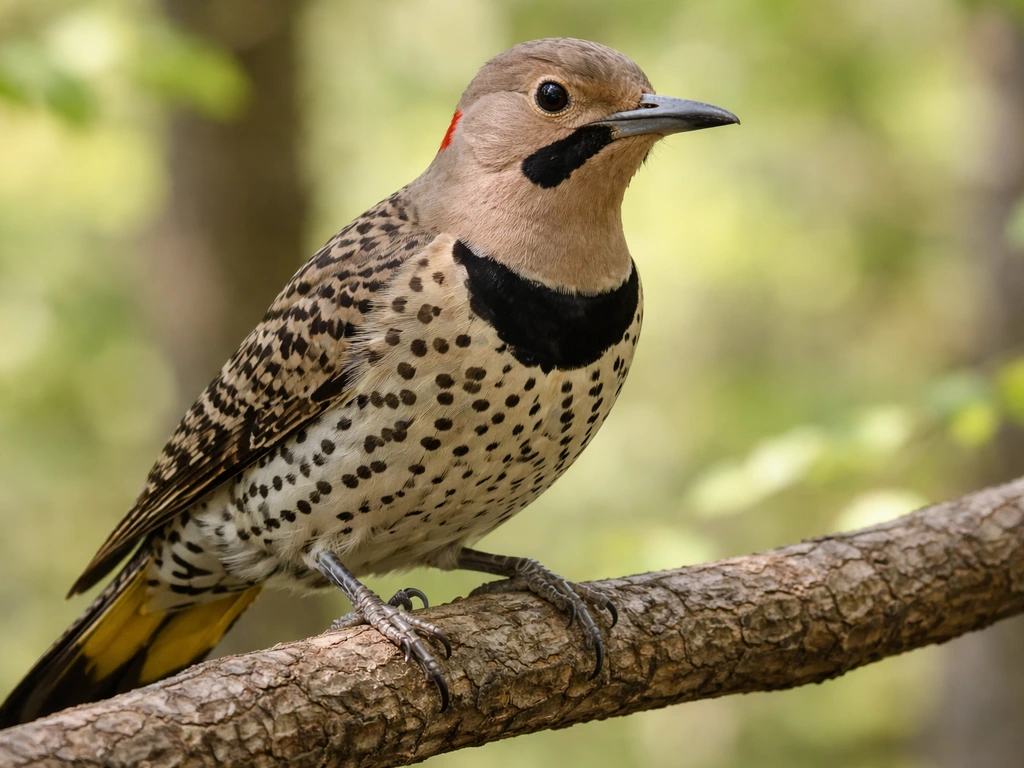
The Northern Flicker is a medium-to-large woodpecker, roughly 11 to 12 inches long, with a brown back covered in neat black bars, a boldly spotted cream-and-black belly, and a bright white rump that flashes like a beacon the moment it takes flight. Look for the wide black crescent across its chest and, depending on where you are in North America, either vivid yellow or salmon-red color on the underside of its wings and tail. No other common woodpecker you will meet in a backyard or park looks quite like it. For a concise visual summary and quick ID cues, see what does a flicker bird look like.
What Does a Northern Flicker Bird Look Like: Visual ID Guide

Marcus Whitley
4 Aug 2026
Quick ID Summary
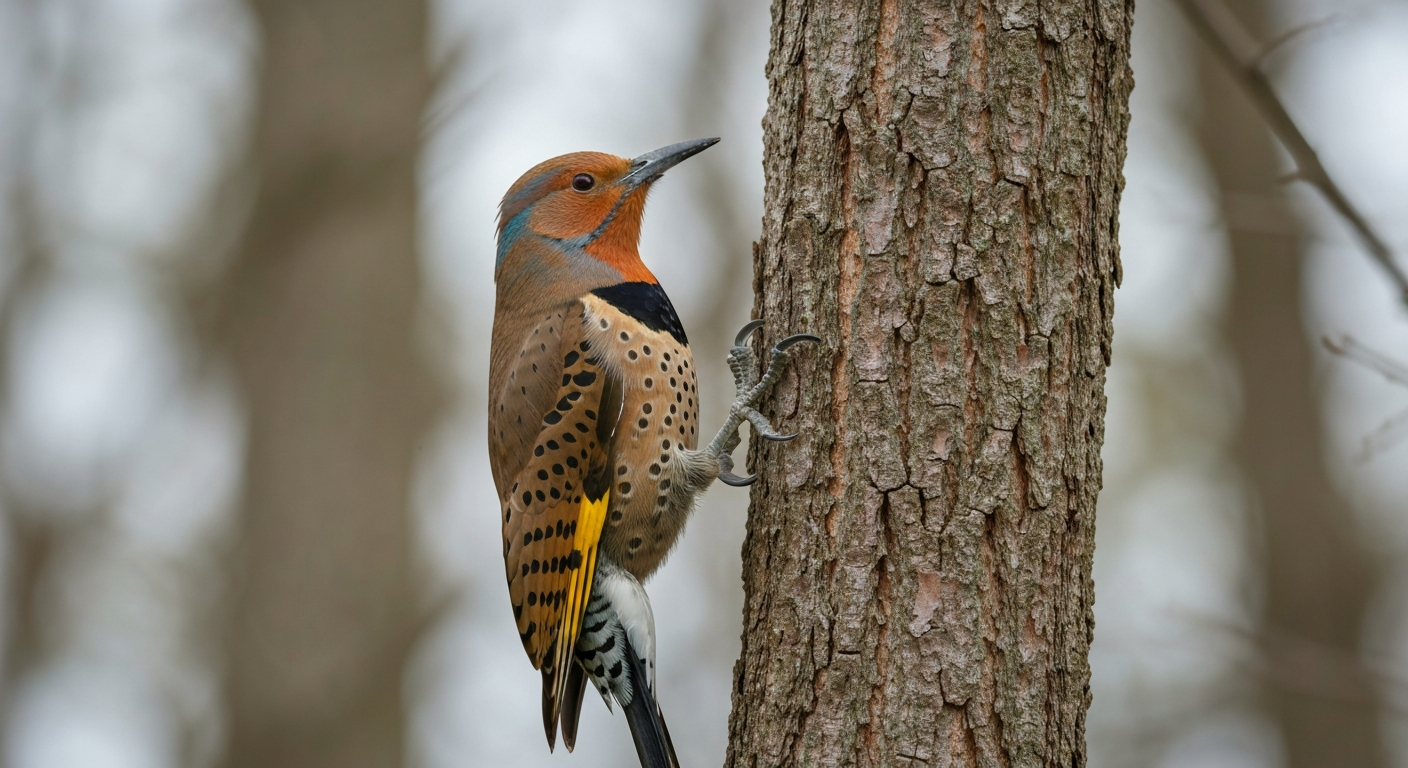
A large, brown-barred woodpecker with a spotted belly, bold black breast crescent, white rump flash, and brightly colored (yellow or red) wing-shaft undersides that catch the eye instantly in flight.
Size at a Glance
The Northern Flicker sits noticeably larger than a robin but a bit smaller than a crow. Here are the standard measurements you can use to mentally size it up when you spot one in the field, whether it is perched on a tree trunk or working across your lawn. Audubon’s field guide gives standard measurements of length 11–12 in (28–31 cm), wingspan 17–20 in (43–51 cm), and weight roughly 4–6 oz (113–170 g) Northern Flicker — Audubon Field Guide lists length 11–12 in, wingspan 17–20 in, and weight about 4–6 oz..
| Measurement | Range (Imperial) | Range (Metric) | Quick Field Reference |
|---|---|---|---|
| Length (tip of bill to tail tip) | 11.0–12.2 in | 28–31 cm | Slightly longer than an American Robin |
| Wingspan | 16.5–20.1 in | 42–51 cm | About the span of a standard sheet of paper laid end to end twice |
| Weight | 3.9–5.6 oz | 110–160 g | Feels substantial in the hand, heavier than it looks perched |
You will notice right away that this is not a dainty bird. It lands heavily, hops with a deliberate gait on the ground, and takes up a generous chunk of a fence post or tree limb. Some individuals are on the heavier end of the weight range, particularly well-fed birds before migration.
Shape, Posture and Silhouette
In silhouette, the Northern Flicker has a slightly chunky body that tapers toward a longish, stiff, pointed tail. That tail is not just for show. Like other woodpeckers, the flicker props itself against tree bark with it, giving the bird a characteristic upright posture when clinging to a trunk. The head is rounded and fairly slim relative to the body, and the bill is noticeably long, slightly down-curved, and pointed. It does not have the heavy, chisel-like profile of a Pileated or Hairy Woodpecker. Think of it as sleeker and more tapered overall.
On the ground, which is where you will often find it, the flicker stands more horizontal and hops steadily rather than waddling. Its wings are broad and slightly rounded at the tips, which gives it a strong, undulating flight path with deep wingbeats followed by brief glides. That roller-coaster flight pattern, combined with the white rump flash, is one of the easiest ways to identify it at a distance.
Key Field Marks to Look For
There is a lot going on visually with this bird, so it helps to work through the marks from head to tail. Once you know what to look for, you will be able to nail the ID quickly from almost any angle.
- Head: Tan or brownish face with a gray crown on yellow-shafted (eastern) birds; mostly brown-gray face and crown on red-shafted (western) birds
- Bill: Long, slightly curved, pointed; dark gray to black; used for probing soil, not heavy chiseling
- Crown: Gray cap on yellow-shafted males and females; more uniformly brownish-gray on red-shafted birds
- Nape crescent: A bright red crescent or patch on the back of the head, present on yellow-shafted birds of both sexes; absent on red-shafted birds
- Eye ring / eye area: A dark eye set in a plain tan or brownish face; no dramatic eye stripe or ring, giving it a clean, open-faced look
- Malar stripe (mustache): Black mustache on yellow-shafted males; red mustache on red-shafted males; females of both forms lack any colored mustache
- Throat: Pinkish-tan to warm buff on yellow-shafted birds; similar warm tone on red-shafted birds
- Breast bib: A bold, wide, black crescent or necklace across the upper chest — the single most distinctive mark at rest
- Belly and flanks: Pale cream to buff, densely spotted with neat round black spots running all the way to the vent
- Back: Warm brown with tight, regular black horizontal bars across the entire back and wing coverts — looks almost scalloped from a distance
- Rump patch: Brilliant white; large and oval; visible even when the bird is perched but unmistakable when it flies away
- Wing shafts (underwing): Bright yellow on eastern yellow-shafted birds; salmon-red or pinkish-red on western red-shafted birds — best seen in flight or when a wing is spread
- Tail shafts (undertail): Same color as the wing shafts; yellow or red depending on form
- Tail pattern: Dark barred above, with the colored shaft linings visible from below; tail tip looks blackish from above
- Overall shaft color note: Lighting and feather wear can slightly affect how vivid the shaft color appears; always confirm with head and face pattern and consider your location
Labeled Images to Look For
When browsing photos to confirm your identification, these specific shots will give you the most diagnostic information. Seek out all of them if you are trying to separate subspecies or age classes.
- Side profile at rest: Shows the full barred back, breast crescent, spotted belly, bill shape, and crown color all at once — the single most useful starter shot
- Head close-up (front or three-quarter angle): Reveals the malar stripe (or lack of one), crown color, red nape crescent presence or absence, and the face tone; critical for sexing and separating yellow-shafted from red-shafted
- Underwing or wing-spread view: The shaft color — yellow or red — is clearest here; look for this when the bird flushes or fans a wing while bathing
- Tail spread in flight (from below): Confirms shaft color on the tail feathers and shows the white rump patch in its full glory; this angle often clinches the ID at a distance
- Foraging on the ground: Shows the upright posture, the length of the bill probing into soil, and the contrast between the barred back and white rump when it walks away
- Juvenile vs. adult side-by-side: A juvenile has softer, more scalloped-looking edges to its feathers, paler or less-defined breast markings, and a less crisp malar stripe — comparing the two makes the differences immediately obvious
- Yellow-shafted vs. red-shafted comparison (underwing): Placing both forms side by side in underwing view makes the shaft color difference unmistakable and shows the associated head pattern changes at the same time
Males, Females, Juveniles and the Two Main Forms
Adult Male vs. Adult Female
The easiest way to tell the sexes apart is the mustache. Adult males have a distinct malar stripe on the side of the face that angles back from the base of the bill. On eastern (yellow-shafted) males this stripe is black; on western (red-shafted) males it is red or reddish-brown. Females of both forms are clean-faced with no mustache at all. Everything else about the plumage pattern is broadly similar between sexes, so if you can see the face clearly, you have your answer. Females are not significantly smaller or duller overall, which makes the mustache the reliable go-to mark.
Juvenile Plumage
Young Northern Flickers fresh from the nest look a bit rougher and softer around the edges compared to crisp adults. The feathers on the back and breast have scalloped or fringed tips rather than the clean-cut bars and spots of adults, giving juveniles a slightly blurry appearance up close. The breast crescent is usually present but may look fuzzier and less sharply defined. The malar stripe on juvenile males is there but often paler and less bold than on a breeding adult. By late summer or early fall, juveniles begin molting into first-winter plumage and progressively look more like adults, so the window for seeing classic juvenile plumage is fairly short.
Yellow-Shafted (Eastern) vs. Red-Shafted (Western)
These two forms were once classified as separate species, and the differences between them are real enough that they are worth learning separately. The yellow-shafted form dominates east of the Great Plains. Its shaft linings glow bright lemon-yellow, the face is warm tan or buff, the crown is gray, and there is usually a red crescent on the back of the head. The red-shafted form, found west of the Great Plains, replaces yellow with salmon or pinkish-red on the shaft linings, has a browner face and crown with no red nape crescent, and the male's mustache is red rather than black.
Across a relatively narrow hybrid zone running through the Great Plains, you will find birds that are a mixture of both forms. Some hybrids show orange shaft color partway between yellow and red, a partial mustache in the wrong color, or a faint nape crescent combined with red-shafted wing linings. Interestingly, research published in 2022 found that this hybrid zone has been slowly shifting westward over the past 60 years, so the exact line between forms is not fixed. If you are birding anywhere from the Dakotas down to eastern Colorado or New Mexico, expect some variation and do not try to force a hybrid into one category. Use shaft color, face pattern, and geography together rather than relying on any single feature.
| Feature | Yellow-Shafted (East) | Red-Shafted (West) | Hybrid Zone Birds |
|---|---|---|---|
| Wing/tail shaft color | Bright yellow | Salmon to pinkish-red | Orange or intermediate |
| Crown color | Gray | Brownish-gray | Variable |
| Face color | Warm tan/buff | Grayish-brown | Variable |
| Red nape crescent | Present (both sexes) | Absent | Sometimes faint or partial |
| Male malar stripe | Black | Red/reddish-brown | Mixed or absent |
What It Looks Like in Flight and on the Ground
One of the best things about identifying a Northern Flicker is that it often gives you multiple looks from different angles. In flight, watch for the white rump patch that pops against the brown back, the bouncy undulating flight pattern, and the flash of yellow or red under the wings each time it beats them. The underwing color is almost impossible to miss on a sunny day. The tail, spread slightly on landing, also shows off the shaft color nicely.
On the ground, flickers are surprisingly comfortable. They specialize in eating ants, so you will regularly see them walking across lawns, meadows, or forest edges, probing the soil with that long curved bill. They cock their tail slightly upward when standing, and the spotted belly and barred back are clearly visible from a standing distance. Watching a flicker on the ground is actually one of the most relaxed ways to study all its markings without needing binoculars at full power.
Where and When You Are Likely to See One
Northern Flickers are one of the more widespread woodpeckers in North America, found in open woodlands, forest edges, parks, suburbs, and even semi-open desert areas with scattered trees. Many birds in the central and southern United States are year-round residents. Northern breeders, especially those nesting in Canada and the northern tier of states, move south in fall and return in spring, so you may notice an uptick in flicker activity at your feeders or in your yard in October through November and again in March and April. eBird seasonal charts for your specific state or region will give you the sharpest picture of when they peak locally. See eBird Status and Trends, Northern Flicker (Colaptes auratus) for fine-scale seasonal abundance maps and interactive charts showing breeding, non-breeding, and migratory patterns eBird Status and Trends — Northern Flicker (Colaptes auratus).
How to Tell It Apart from Similar Birds
People sometimes confuse the Northern Flicker with other woodpeckers or, less commonly, with smaller yellow birds like goldfinches or finches. The confusion with small yellow birds usually happens when someone sees the yellow shaft flash in flight and has not yet connected it to a woodpecker. For a compact, yellowish comparison, see what does a firecrest bird look like. Once you get a clear look, the size alone rules out any finch-sized bird. Goldfinches and yellow finches are sparrow-sized and entirely different in shape. For more on the smaller yellow species, see what does a yellow finch bird look like for size and plumage comparisons. For direct woodpecker comparisons, here is how the flicker stacks up against the birds most likely to cause confusion.
| Bird | Size vs. Flicker | Key Distinguishing Features | Shaft/Wing Color |
|---|---|---|---|
| Northern Flicker (yellow-shafted) | Baseline | Brown barred back, black breast crescent, white rump, spotted belly, tan face | Bright yellow |
| Northern Flicker (red-shafted) | Same size | Same marks but gray-brown face, no red nape crescent, red male malar | Salmon-red |
| Gilded Flicker (Southwest) | Similar | Similar structure; yellow shafts like eastern form but chestnut crown, found only in Sonoran Desert | Yellow |
| Pileated Woodpecker | Much larger | Bright red crest, solid black body, no brown barring, completely different silhouette | No colored shaft flash |
| Red-bellied Woodpecker | Smaller | Bold black-and-white back barring, red cap, no breast crescent, no white rump flash | No colored shaft flash |
| Hairy/Downy Woodpecker | Much smaller (Downy) or smaller (Hairy) | Bold white back stripe, black-and-white head, no barring or breast crescent | No colored shaft flash |
| American Goldfinch | Much smaller | Bright yellow body (male), compact finch shape, tiny bill, completely different silhouette | Not applicable |
If someone mentions seeing a yellow flash in a bird about the size of a robin with a barred back, that is a Northern Flicker and not a goldfinch or yellow finch. The size and the breast crescent are decisive. If you are exploring other colorful birds in this family and want a broader comparison, the general flicker identification guide covers the wider flicker group in more detail, and the goldfinch and yellow finch pages walk through those smaller yellow birds step by step. For a quick visual comparison, see what does a goldcrest bird look like to contrast size and color. For more on identifying finches like goldfinches and yellow finches, see what does finch bird look like for tips on size, shape, and plumage differences.
Best Photo Angles to Confirm Your ID
If you are trying to document a Northern Flicker for a checklist or to confirm a subspecies, a few specific shots are worth prioritizing. A clear side profile at rest captures the most ID information in a single frame. If the bird is on the ground facing you, try for a front-on shot of the face and breast to show the malar stripe and breast crescent clearly. When it flushes, aim for a shot from below or behind to capture the rump patch and the underwing shaft color in the same frame. If you can manage a spread-wing or landing shot, the shaft color will be completely unambiguous. For juveniles, compare the feather edges on the back and the definition of the breast band, side by side with an adult photo if possible, to see the age difference clearly.
One practical tip: flickers are less skittish than many woodpeckers when they are foraging on the ground. You can often approach closer than you expect before they flush, which gives you extra time to get a steady, well-lit shot of the belly, face, and back all in one patient moment. Early morning light from the side is ideal for bringing out the warm brown tones and making the shaft color pop when the bird lifts a wing.
FAQ
Search-friendly title and meta description
Title: What Does a Northern Flicker (Colaptes auratus) Look Like? — Visual ID Guide Meta description: Clear visual ID guide to the Northern Flicker: size, shape, field marks, sexes, ages, subspecies, behavior, and comparison tips (≤160 chars).
Quick visual summary — what are the most obvious field marks?
The Northern Flicker is a medium-large woodpecker with a slim rounded head, long slightly down-curved bill, long tapered tail, and spotted underparts. Key marks: black crescent on the breast, barred brown back, conspicuous white rump in flight, and brightly colored flight-feather shafts (yellow or red). Males usually show a colored malar (mustache) stripe.
Size, weight, and wingspan (measurement table)
Typical adult measurements: length 11.0–12.2 in (28–31 cm); wingspan 16.5–20.1 in (42–51 cm); weight ~3.9–5.6 oz (110–160 g). (Sources: Cornell Lab, Audubon; small variation across guides.)
How does overall shape and posture help identify it?
Shape cues: long tail and long bill for a woodpecker, slim rounded head, and a relatively long body. Posture: often perches vertically on trunks with tail braced; on the ground it walks and forages with an upright, slightly crouched stance and frequent tail-cocking.
What differences indicate sex and age?
Sex: adult males typically show a malar (mustache) stripe—black in yellow-shafted (eastern) males, red in red-shafted (western) males; females lack the malar. Age: juveniles have fresher, scalloped feather edges, paler and less-contrasted face and breast markings, and a weaker or absent malar.
What are the yellow-shafted vs red-shafted forms and why do they matter?
Yellow-shafted (eastern) birds show bright yellow underwing/undertail shafts and often a tan face; red-shafted (western) birds have salmon-red shafts and different facial tones. They represent regional forms that hybridize across a central Great Plains zone; shaft color is diagnostic but can be affected by lighting, wear, and hybrid genetics, so use with facial/head pattern and location.
Next Article
What Does a Flicker Bird Look Like? Field Marks Guide
See what a flicker bird looks like with field marks, color patterns, and look-alikes to ID confidently in photos or in p