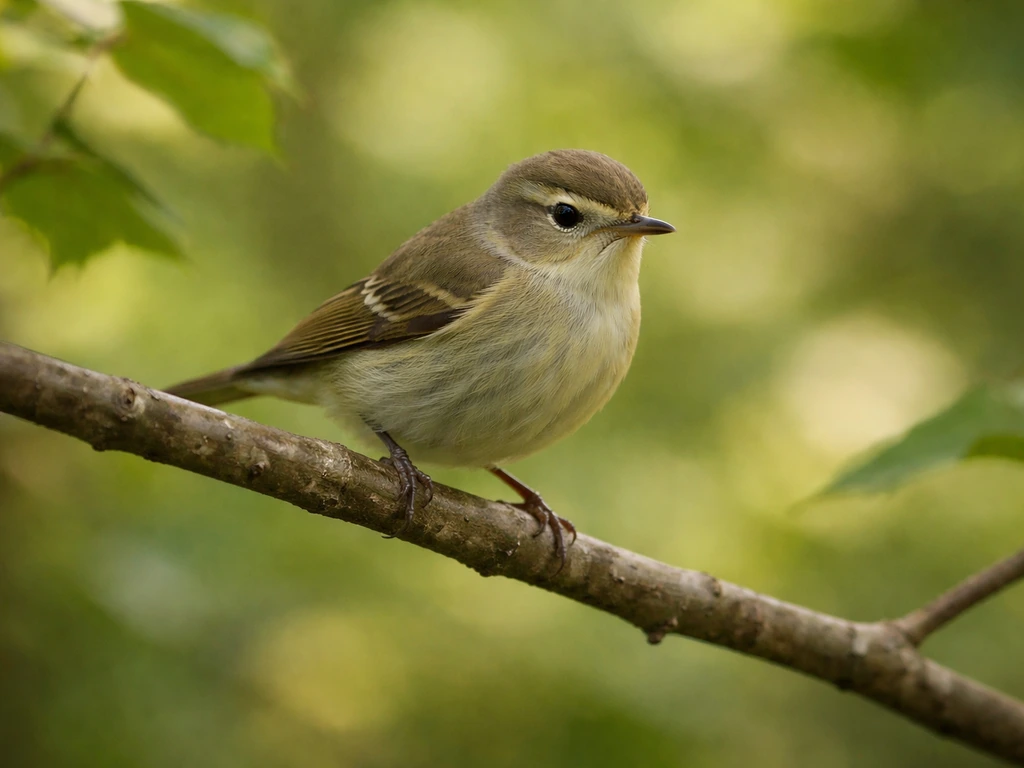
A waxwing is a sleek, crested songbird with soft brownish-tan plumage, a bold black mask edged in white, and a short square tail tipped in bright yellow. If you’re also wondering what a whip-poor-will bird looks like, look for its mottled brown and gray, camouflaged look and its low, ground-hugging posture what does a whip-poor-will bird look like. The most distinctive details are the waxy red spots on the wing feathers (which give the bird its name) and a clean yellow band across the tail tip. Once you see those features together, the ID clicks immediately.
What Does a Waxwing Bird Look Like? ID Guide by Species

Marcus Whitley
30 Jun 2026
What is a waxwing bird (and which one you're probably seeing)
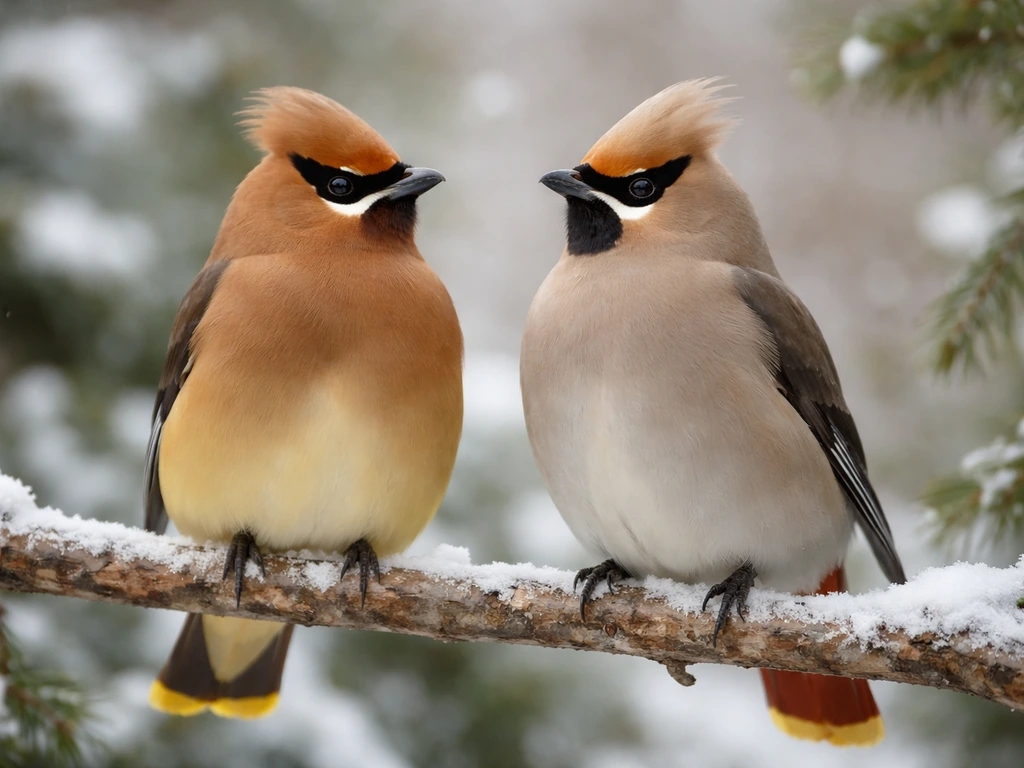
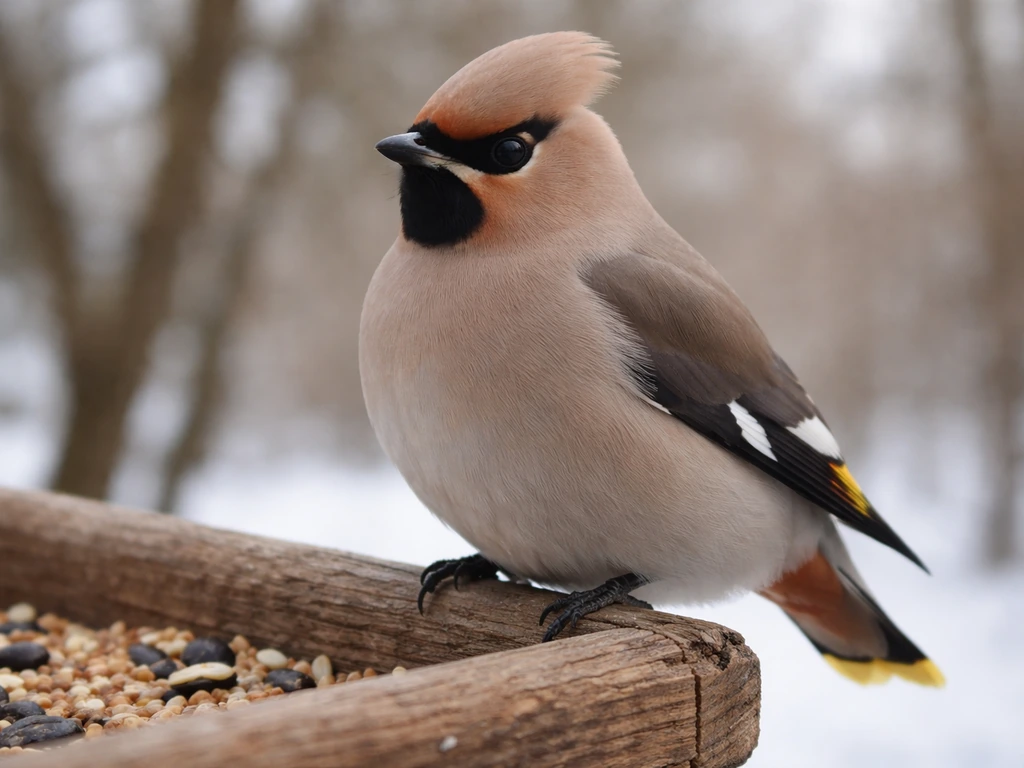
Waxwings are a small group of songbirds with only three species in the world: the Cedar Waxwing, the Bohemian Waxwing, and the Japanese Waxwing. If you're in North America, you're almost certainly looking at either a Cedar or a Bohemian. Cedar Waxwings are by far the most commonly encountered. They're widespread across the U.S. and Canada year-round, and you'll often spot them in large, chattering flocks raiding fruit trees, berry bushes, or ornamental shrubs. Bohemian Waxwings breed farther north and only push into more southern areas during irregular winter irruption years. Northern Woodlands notes that Bohemian Waxwings breed farther north and typically show up farther south only during irregular winter irruption years Bohemian Waxwings breed farther north and only push into more southern areas during irregular winter irruption years. Japanese Waxwings are an Asian species and essentially a non-factor unless you're birding in Japan or happen to see a rare vagrant.
So for practical purposes: if you're looking up this article because you spotted a crested bird with a yellow tail tip in your backyard or a park, you're most likely dealing with a Cedar Waxwing.
Overall look: size, shape, and color palette
Cedar Waxwings run about 6 to 7 inches long (roughly 15 to 18 cm) and weigh just around 1 ounce (28 to 32 g). Cedar waxwings are among the best-known birds people spot, and their look can be summarized in a few key size and color cues 6 to 7 inches long. Think of them as slightly larger than a house sparrow but noticeably smaller and more slender than a robin. The body shape is what first catches your eye: large, rounded head, a short thick neck, and a short wide bill that gives the whole bird a slightly front-heavy look. The tail is square-cut at the end, which is a useful shape cue in flight.
The overall color palette is warm and silky. The head and upper breast are a rich tan or buffy-brown. The back fades into grayish-brown. The belly transitions to a soft pale yellow, almost lemon-toned. The wings and tail are gray, but the tail has that unmistakable bright yellow terminal band. From a distance, in a winter flock, they can look like fairly plain, dun-colored birds, which is why getting a closer look at the face and tail is so important.
Face and head: the crest, mask, and eye details
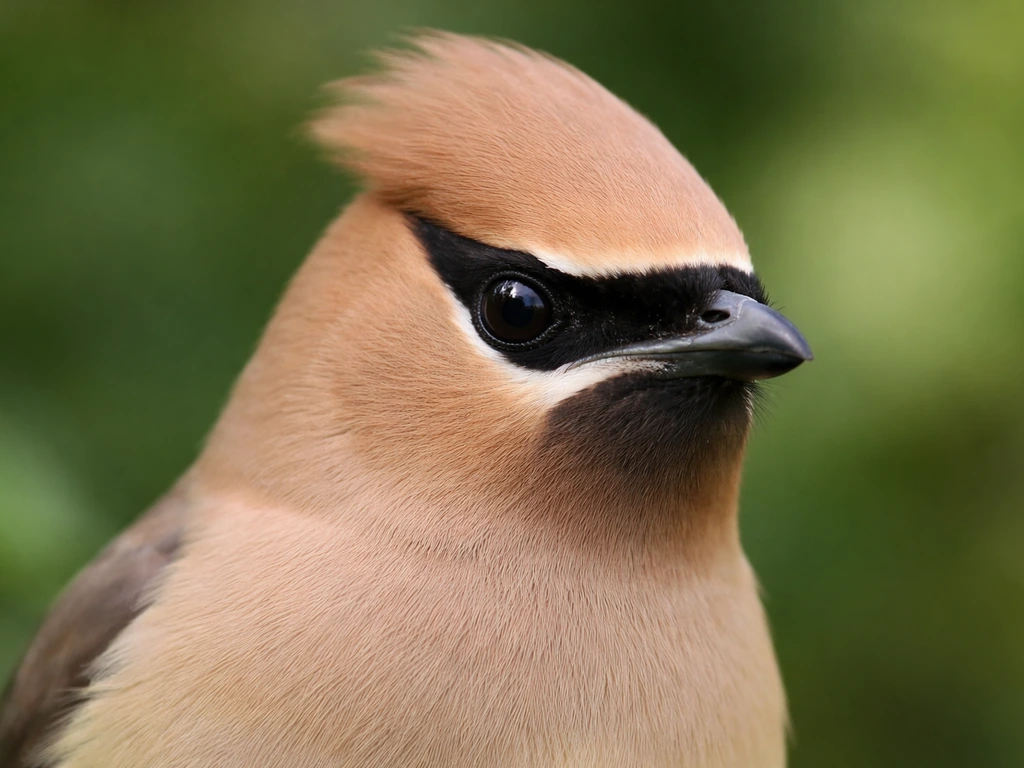
The head is where waxwings really stand out. Every waxwing has a pointed crest on top of the head. On Cedar Waxwings, this crest often lies fairly flat and droops slightly over the back of the head rather than standing bolt upright like a cardinal's. When the bird is excited or alert, it raises the crest noticeably. On a pale brown head, the drooping crest gives the bird a slightly sleek, almost streamlined silhouette.
The black mask is the most striking feature on the face. It runs from the base of the bill, through and around the eyes, and is neatly bordered by a thin white line on both the top and bottom edges. That white outline is crisp and clean, making the mask look almost painted on. Below the mask, the chin and throat are also black. You might notice a faint extension of the black line running just behind the eye. The rest of the face behind the mask is that warm tan-brown, blending smoothly into the neck and breast.
Wings and tail: the field marks that seal the deal
This is where waxwings get their name, and it's worth knowing exactly what to look for. The secondary wing feathers (the inner flight feathers closer to the body) have small, hard, waxy-looking red tips. These look like tiny drops of red sealing wax stuck to the feather ends. Not every bird shows them equally, and younger birds often have fewer or none, but adult Cedar and Bohemian Waxwings typically display them clearly when perched. You don't need to see them to confirm a waxwing, but if you do spot them, the ID is locked.
The tail is short and square-tipped, and it has a bright yellow band across the very end. This yellow tip is one of the easiest things to spot, even in flight. Look for it as the bird fans its tail while landing or taking off. Combined with the crest and the mask, that yellow tail band is usually enough to confirm you're looking at a waxwing rather than anything else.
The undertail coverts (the feathers underneath the base of the tail) are white on Cedar Waxwings. This detail becomes important when comparing to Bohemian Waxwings, as you'll see below.
How Cedar and Bohemian Waxwings differ in appearance
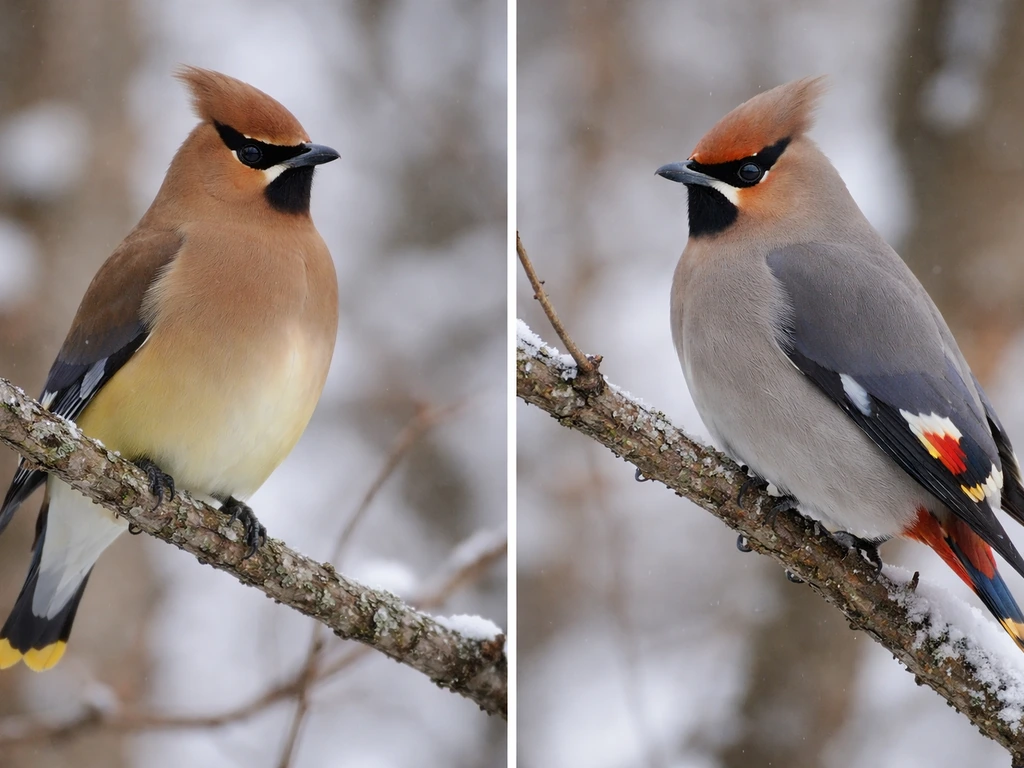
If you're in an area where Bohemian Waxwings might appear in winter, it helps to know the visual differences so you can tell them apart. Both share the same basic template: crest, black mask, waxy red wing tips, and yellow tail band. But there are reliable ways to separate them once you know what to look for.
| Feature | Cedar Waxwing | Bohemian Waxwing |
|---|---|---|
| Size | 6–7 in (15–18 cm) | About 8.25 in (21 cm), noticeably larger |
| Overall color | Warm tan-brown with yellow belly | Grayer, less warm tones overall |
| Undertail coverts | White | Chestnut/rusty-brown |
| Wing pattern | Red waxy tips on secondaries | Red waxy tips plus bold white and yellow wing markings; two white rectangles visible on perched birds |
| Belly | Pale yellow to lemon | Grayish, less yellow |
| Face mask | Black, neatly outlined in white | Black mask on a peachy/blushing face; white stripe below the eye |
| When you'll see them | Year-round, widespread across North America | Irregular winter visitor, northern regions; irruption years push them south |
The single quickest separator is the undertail coverts: white means Cedar, chestnut means Bohemian. When you can't see that clearly, go for the overall color tone. Bohemians look noticeably grayer and bulkier. Their wings also show much bolder patterning, with those two white rectangular blocks clearly visible when the bird is sitting still. Cedar Waxwings have a warmer, softer look by comparison.
The Japanese Waxwing, for completeness, has a red-tipped tail (not yellow), rusty-red undertail coverts, and blank" rel="noopener noreferrer">a reddish-brown bar across the wing coverts. It's unlikely to appear unless you're birding in East Asia.
Confirming your ID: a practical checklist and common lookalikes
When you're out in the field or reviewing a photo, work through these checks in order. The first two are usually enough for a confident ID, but the rest help you nail down the exact species.
- Check the tail tip: is there a bright yellow band? If yes, you're almost certainly looking at a Cedar or Bohemian Waxwing.
- Look at the face: is there a bold black mask neatly edged in white? That combination is distinctive.
- Look for a crest: even if it's lying flat, waxwings have a pointed crest that gives the head a slightly peaked shape.
- Scan the wing tips for small red waxy spots on the secondary feathers. They may not be visible at a distance or on young birds.
- Check the undertail coverts: white points to Cedar Waxwing; chestnut/rusty points to Bohemian.
- Assess overall color and size: warm tan-brown with yellow belly is Cedar; grayer and bigger with bold wing markings is Bohemian.
Birds that get confused with waxwings
The most common mix-up is the female Northern Cardinal. She also has a prominent crest and warm brownish-yellow plumage, so at a glance or in poor light, the two can fool you. The key differences: cardinals have a thick, orange-red seed-cracker bill (much heavier than a waxwing's short wide bill), no black mask outlined in white, and no yellow tail tip. Cardinals also lack the waxy red wing spots entirely.
In winter flocks, waxwings can also get lost among starlings or other medium-sized gray birds at a distance. From far away, a flock of waxwings can look like a nondescript gray-brown cloud. Getting even a few seconds of closer observation to spot the yellow tail tip and crest shape will clear that up quickly.
Some birders initially confuse waxwings with warblers, especially in poor light or when only seeing part of the bird. If you're also trying to ID small songbirds in the same size range, the wren and warbler families look noticeably different up close. If you are wondering what a wren bird look like, the quickest way is to compare its smaller, chunkier body and the lack of a waxwing-style mask and crest the wren and warbler families. Wrens tend to be smaller, chunkier, with short cocked tails and no mask or crest. Warblers are similarly small but lack the crest and bold mask of a waxwing, and they don't have the yellow tail band.
Tips for tricky lighting and distance
In flat winter light or against a bright sky, waxwings can look almost entirely pale and featureless. If you're having trouble picking out the mask or wing marks, focus on silhouette first: that large-headed, crested, short-tailed shape is distinctive even when colors wash out. Then wait for the bird to turn or fan its tail, which often flashes the yellow tip even in low light. If you're looking at photos, zoom into the undertail area and the trailing edge of the wing to find the color details that confirm the species.
Waxwings are social birds, often moving in flocks of dozens to hundreds, so if you spot one, look around because there are usually more nearby. That can give you multiple angles and postures to work with, making the ID much easier than trying to chase down a single bird. A bird that looks like a wren but is bigger is a common question when people are trying to compare small-bodied lookalikes to a larger songbird.
FAQ
What does a waxwing bird look like from far away in a winter flock?
From a distance, waxwings often read as a dull gray-brown group with a chunky, big-headed look. The most reliable “far-field” clue is to watch for the short square tail and the flash of the yellow terminal band when the birds fan their tails during landing or takeoff.
Are waxwings hard to see because their colors fade in bright sun or flat winter light?
Yes, their face and wing markings can wash out. In those conditions, ID by shape first (crested head, short wide bill, and square-cut short tail), then confirm with the black mask outline and the yellow band at the tail tip when the bird turns.
Do juvenile waxwings look different from adults?
They can. Red waxy tips on the wing feathers are sometimes faint or missing on younger birds, so if the red wing “sealing wax” spots are unclear, rely more on the black-and-white mask plus the yellow tail terminal band.
If I only see the tail, how can I confirm it is a waxwing?
A yellow band across the very end of the short, square-tipped tail is the key. If the yellow band is present but you cannot see the mask, still look for crest shape or the drooping crest profile when the bird settles.
How can I tell Cedar vs Bohemian waxwing when the bird is moving and the undertail coverts are hidden?
If you cannot see the undertail coverts, use body tone and wing pattern contrast. Cedar tends to look warmer and softer overall, while Bohemian typically looks grayer and bolder, with more obvious rectangular-looking wing patterning when it holds still.
What if I can’t get a clear view of the undertail area on my photo?
Try to capture the bird as it lands, hops, or turns sideways. The undertail coverts are easiest to see when the tail is slightly fanned or the bird is partially turned, then you can compare white (Cedar) versus chestnut (Bohemian).
Can waxwings be mistaken for cardinals, and what’s the quickest visual fix?
Yes, especially in poor light, because both can show a crest and warm tones. The quickest fix is to check for the black mask outlined in white and the yellow tail tip, plus the lack of any thick, heavy orange-red cardinal bill and the absence of the waxwing’s waxy red wing spots.
What other birds commonly get confused with waxwings besides cardinals?
In winter flocks, waxwings can be mixed up with medium gray birds at distance, including starlings. The quickest solution is to wait for a tail fan or a head turn that reveals the black mask outline and the yellow terminal band.
Are waxwing wing red tips always obvious?
No. They are variable, and they are more consistently visible in adults when the secondary wing feathers are exposed. If you cannot see them, do not force the ID, instead confirm with crest plus mask plus yellow tail band.
How do I describe what a waxwing looks like for a blurry photo review?
Use three “anchoring” features: (1) crested head silhouette (often drooping slightly on Cedar), (2) black mask with a clean white border, and (3) short square tail with a bright yellow terminal band. Mentioning these in that order usually leads to the correct ID even from low-detail images.
Next Article
What Does a Warbler Bird Look Like? Field Marks Guide
Learn warbler field marks: body shape, wing bars, head patterns, throat and tail traits to ID common look-alikes.