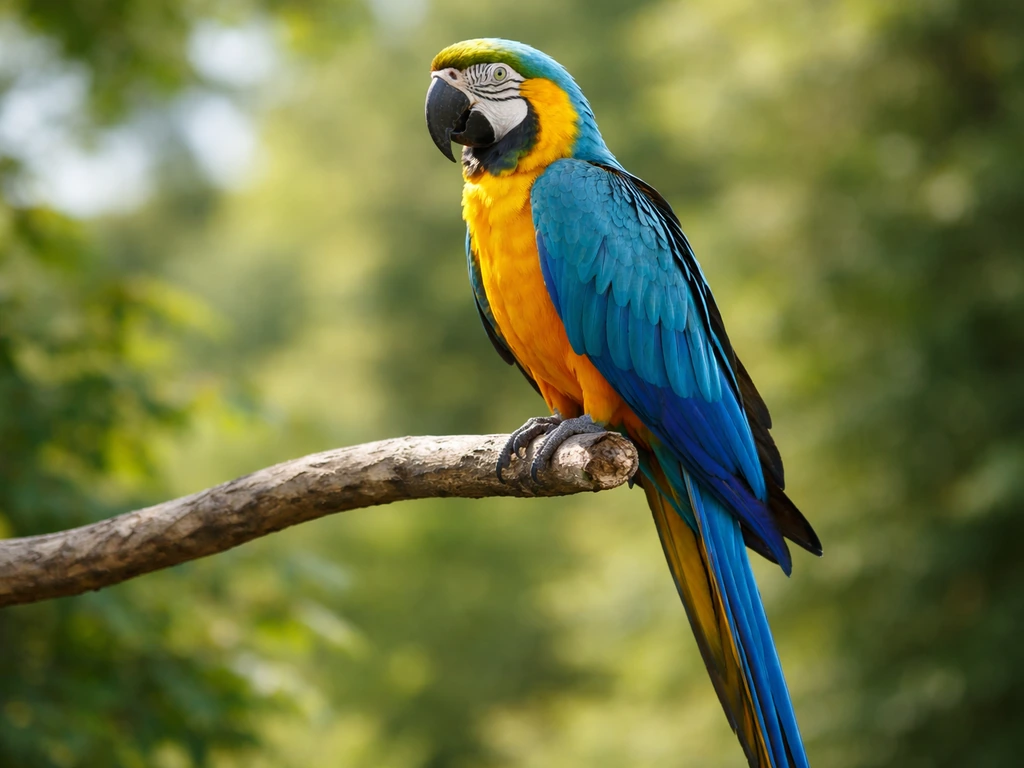
A macaw is hard to miss. You're looking at one of the largest parrots in the world, built like a jewel-bright rocket ship: massive curved beak, bold blocks of vivid color, and a tail so long it makes the bird look like it's trailing a kite. The combination of that oversized beak, bare facial patch, and sweeping pointed tail is unique to macaws and sets them apart from every other parrot you're likely to see in a photo or in the wild. If you want a different example of bird spotting by appearance, check out what does a cuckoo bird look like.
What Does a Macaw Bird Look Like? Key Traits by Species

Marcus Whitley
27 Jun 2026
Macaw at a glance: the appearance checklist
Before diving into individual species, here's the core checklist for recognizing any macaw at a glance. If you can tick most of these boxes, you're almost certainly looking at a macaw and not some other large parrot.
- Very long, pointed tail that often equals or exceeds the bird's body length
- Large, strongly hooked beak, noticeably bigger than an Amazon parrot's or conure's beak
- Bare, pale facial patch around and below the eye (sometimes with fine feather lines running through it)
- Vivid, high-contrast coloration in blues, reds, greens, or yellows depending on species
- Stocky, streamlined body that tapers into that long tail
- Zygodactyl feet (two toes forward, two back) visible if perching close up
- Size ranging from about 12 inches (mini macaws like the noble) up to 40 inches (hyacinth) including the tail
- Upright, confident perching posture with the chest held forward
The key features to zero in on first
The beak
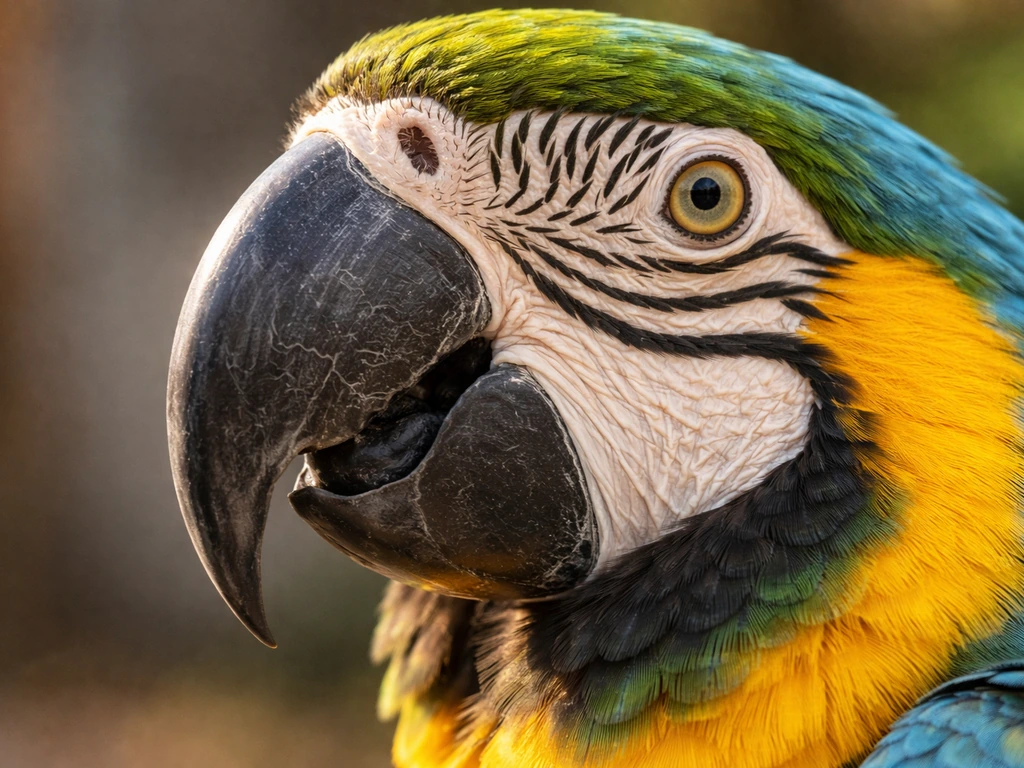
The beak is your single fastest ID clue. Macaws have large, strongly curved beaks built for crushing hard nuts and seeds, and from the side they look almost disproportionately powerful compared to the face. The upper mandible hooks down over the lower in a deep arc. Beak color varies by species: the scarlet macaw has a pale, horn-colored upper mandible with a darker lower mandible, while the hyacinth macaw has a dark charcoal-black beak that contrasts sharply with its blue feathers. If the beak looks small or modestly curved, you're probably not looking at a macaw.
The face and head
Look for the bare facial patch. Every macaw has an blank" rel="noopener noreferrer">area of bare, unfeathered skin around the eyes and cheeks, ranging from a small teardrop to a broad white or yellow expanse depending on the species. In many species like the scarlet and blue-and-gold, you'll see fine lines of tiny feathers running across this bare patch like a fingerprint. That bare skin is one of the most reliable macaw-specific traits you can spot. The eye itself is typically pale yellow or white in adults, which pops brightly against the colorful head.
The wings
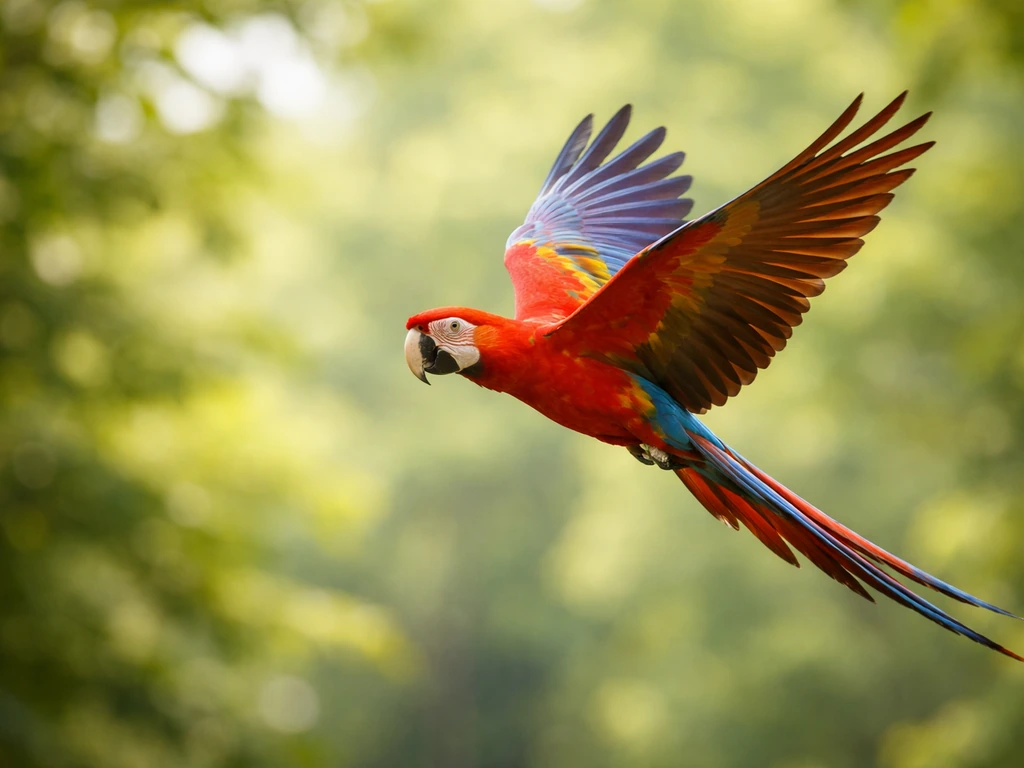
Macaw wings are broad and pointed, designed for long, sweeping flight through forest. In flight, the wing shape looks tapered and streamlined rather than rounded. The upper wing surface often shows off the bird's dominant body color, while the underwing can reveal contrasting hues: the scarlet macaw shows bright yellow-green wing coverts on top, for example. When folded, the wings sit tight against the body and contribute to that sleek silhouette.
The tail
The tail is the macaw's most dramatic physical feature. It's long, graduated (the central feathers are the longest), and comes to a pointed tip. In flight it streams out behind the bird, and even perched, the tail extends well below the perch. Tail color often mirrors or contrasts with the body: the hyacinth's tail is deep blue, the scarlet's is a blue-tipped red, and the blue-and-gold shows blue on top with yellow underneath. If the tail looks short or blunt, reconsider whether you're looking at a macaw.
Size and posture
Most macaws are large, crow-sized to much bigger. A blue-and-gold macaw is roughly 33 inches from beak tip to tail tip, which is about the length of a standard ruler doubled. The hyacinth macaw, the largest, reaches 40 inches and is genuinely comparable to a small hawk in wingspan. Even the mini macaws (noble, severe) are larger than a conure when you account for their tails. On a perch, macaws sit upright with a proud, forward-leaning chest posture. They don't hunch or cling sideways the way smaller parrots sometimes do.
Species color guide: what each macaw looks like
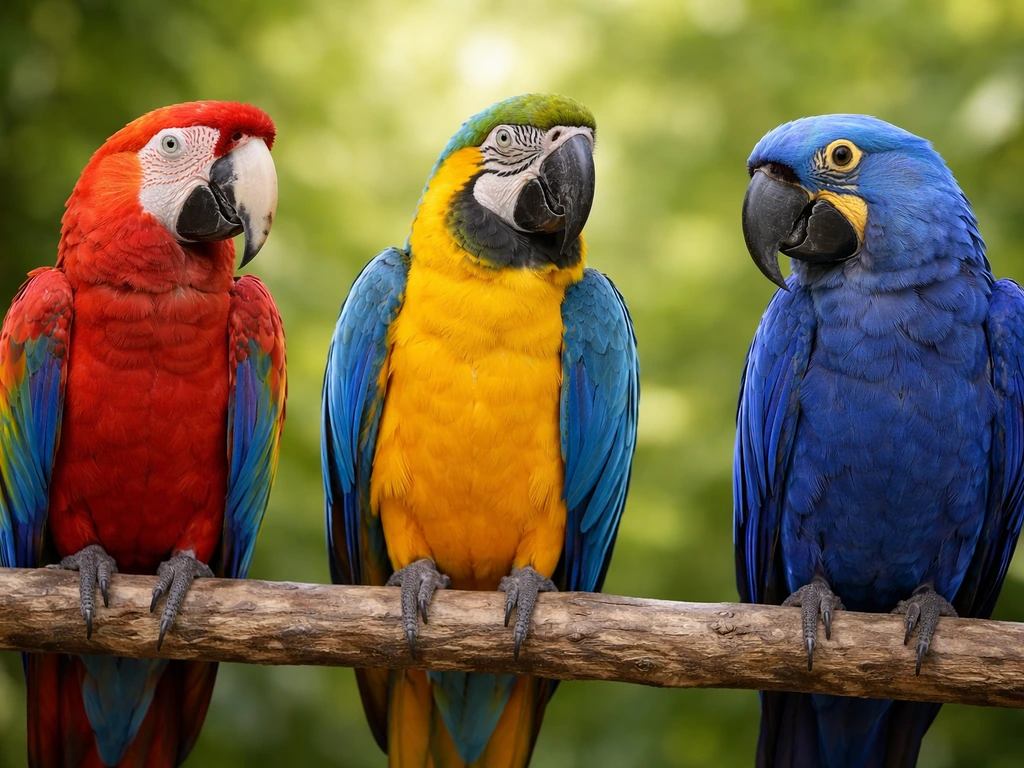
Macaws split into a handful of easy visual categories based on their dominant color scheme. Here's a practical rundown of the most commonly encountered species and the specific marks that separate them.
| Species | Dominant Colors | Key Distinguishing Marks | Bare Facial Patch |
|---|---|---|---|
| Scarlet Macaw | Red body, yellow-green wing band, blue flight feathers and tail tips | Clean yellow-green band across mid-wing; no red on facial patch area | White or pale pink, plain (no feather lines) |
| Blue-and-Gold (Blue-and-Yellow) Macaw | Bright blue above, golden yellow below, black chin strap | Black chin bar under the beak; green forehead band | White with fine dark feather lines |
| Green-Winged Macaw | Deep red body, green mid-wing band, blue outer wings and tail | Red lines of tiny feathers across white bare face patch; green band between red and blue on wing | White with distinctive red feather lines |
| Hyacinth Macaw | Solid cobalt blue overall | Bright yellow bare skin ring around eye and along lower beak base; entirely blue with no other color | Yellow (orbital ring and lappet at lower beak) |
| Military Macaw | Mostly green, red forehead patch, blue flight feathers | Red forehead stripe; otherwise green and blue | White or pale, with fine feather lines |
| Severe (Chestnut-fronted) Macaw | Mostly green, chestnut/dark brown forehead, red and blue in wings | Small size for a macaw; chestnut-brown forehead patch | White, relatively small |
| Noble (Red-shouldered) Macaw | Green overall, red shoulder patch, blue flight feathers | Smallest macaw; red bend of wing visible at rest or in flight | Pale, narrow |
| Red-and-Green (Green-winged) Macaw | Often used as another name for green-winged; see above | See green-winged row above | See above |
A quick shortcut: if the bird is mostly blue and huge, think hyacinth. If it's red with a yellow-green wing stripe, think scarlet. Red with a green mid-wing band and feather lines on the face means green-winged. Blue above and yellow below with a black chin bar is the blue-and-gold. Mostly green with a red forehead is military.
Macaw vs lookalike parrots: what's actually different
Macaws share parrot family traits with cockatoos, Amazon parrots, and conures, and it's easy to mix them up in a photo. Conures have a different overall look, so checking size, tail length, and body color can help you tell them apart what does a conure bird look like. Here's what actually separates macaws from the most common lookalikes.
| Feature | Macaw | Amazon Parrot | Cockatoo | Large Conure |
|---|---|---|---|---|
| Tail | Very long, pointed, graduated | Short, squared-off or slightly rounded | Medium, often fanned; rounded | Medium, pointed but much shorter than macaw |
| Facial bare skin | Large bare patch, always present | Fully feathered face | Fully feathered face; crest present | Fully feathered face |
| Beak size | Very large, deeply hooked | Large but less extreme hook | Large, deeply hooked but narrower | Smaller, modestly hooked |
| Crest | None | None | Prominent moveable crest (key difference) | None |
| Body size | Large to very large | Medium to large | Medium to large | Small to medium |
| Color style | Vivid, high-contrast multi-color blocks | Greens with yellow/red accents | White, pink, or grey with yellow or red crest | Green with red/yellow head accents |
The fastest way to rule out a cockatoo is to look for a crest. Cockatoos have one; macaws never do. The fastest way to rule out an Amazon parrot is the tail: Amazon tails are short and blunt, while a macaw's tail streams out dramatically. Conures are worth comparing to mini macaws like the severe or noble, but even then, the macaw's bare facial patch and proportionally larger beak give it away. If you're interested in how cockatoos compare in more detail, they share some visual overlap in beak shape but diverge sharply in every other feature. Conures are another frequent source of confusion, especially in captivity where both species appear in similar settings.
Identifying a macaw from photos or limited views
Working with different angles
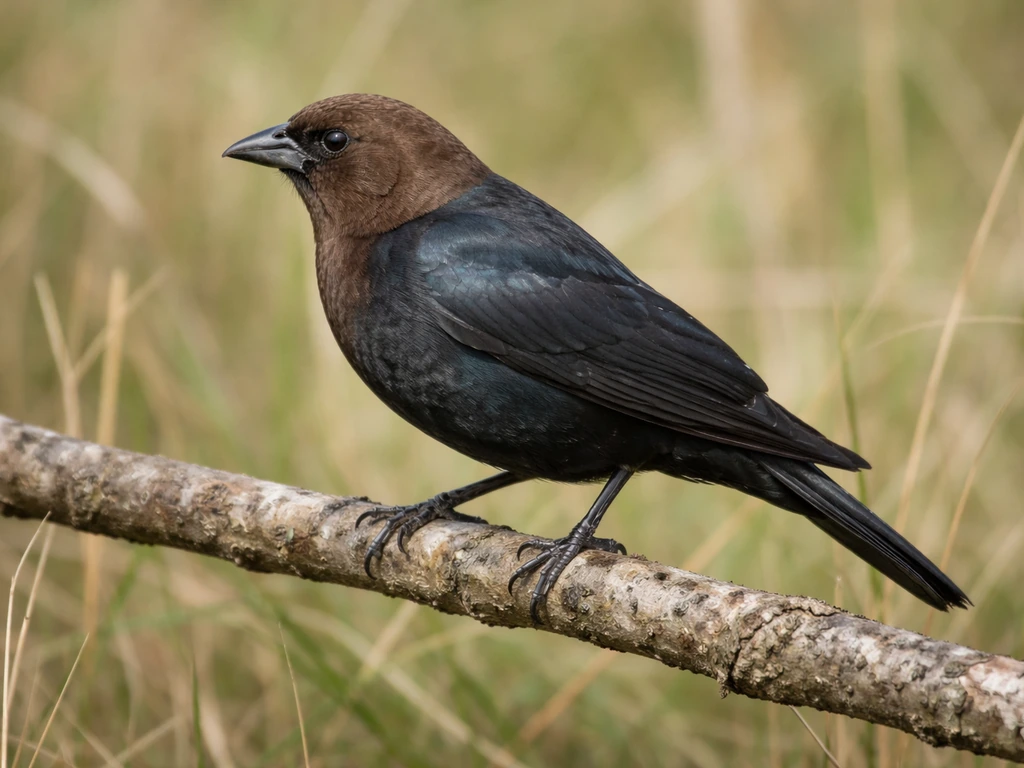
A head-on photo gives you the bare facial patch and beak shape most clearly. A cowbird is a different type of bird, and its look can be mistaken for other species unless you focus on the key field marks bare facial patch. A side profile shows you the tail length, body proportions, and the degree of beak curve. A top-down or in-flight shot reveals wing color patterns and the overall silhouette, where the long tail and pointed wings are unmistakable. If you only have an underside view (common in flight photos), look for body color, tail length, and any contrasting bands. The blue-and-gold, for example, glows bright yellow below against a blue upper wing, making it easy to ID from below.
Dealing with tricky lighting and color distortion
Reds can look orange or brownish in warm evening light, and blues can look green in strong overcast. When color seems off, rely on structure more than hue. The bare facial patch, beak size and shape, and tail length don't change with lighting. A red macaw photographed in golden hour light will still have that oversize hooked beak and bare white facial skin with fine feather lines, even if the red reads as orange in the image.
Juveniles vs adults
Young macaws are noticeably different from adults in a few key ways. Juvenile hyacinth macaws, for instance, have a much shorter tail than adults and much paler, less vivid yellow bare facial skin. Across species, juveniles typically show duller, less saturated colors, a shorter tail, and sometimes a less strongly developed beak hook. The bare facial patch is usually present from a young age but may be smaller or paler. If a bird looks like a macaw but with muted colors and a shorter tail, lean toward juvenile rather than ruling out the species entirely.
Distant or partial views
At distance or when only part of the bird is visible, prioritize the tail and overall silhouette. A long, pointed tail streaming behind a large colorful bird in flight is a near-certain macaw indicator. If you can only see the head, look for the combination of a massive hooked beak and bare facial skin. If you're trying to identify a different species like a canary, you'll want to compare its distinct coloring and markings rather than relying on macaw-like head and beak features what does a canary bird look like. Even a partial wing view can help: the yellow-green mid-wing bar of a scarlet macaw or the green band of a green-winged macaw are distinctive enough to clinch the ID.
Step-by-step: confirm the species using visual markers
Use this sequence when you're looking at a photo or a real bird and want to nail down the species. Work through each step in order and you'll narrow it down quickly.
- Confirm it's a macaw: Check for the long pointed tail, large strongly hooked beak, and bare facial patch. All three together? You have a macaw.
- Gauge the size: Is it enormous (hyacinth territory at 38-40 inches) or more modest (severe or noble at 12-20 inches)? This immediately narrows the field.
- Identify the dominant body color: Mostly blue (hyacinth), mostly red (scarlet or green-winged), mostly green (military, severe, noble), or blue above and yellow below (blue-and-gold)?
- Check the wing pattern: Look for a mid-wing color band. Yellow-green band on red body means scarlet. Green band between red and blue means green-winged. No band on blue body means hyacinth.
- Look at the face patch: Is it plain white (scarlet), white with red feather lines (green-winged), white with dark feather lines (blue-and-gold), or bright yellow (hyacinth)?
- Check the beak color: Pale upper mandible with dark lower (scarlet and green-winged) or uniformly dark beak (hyacinth and blue-and-gold)?
- Look for any additional marks: Black chin bar (blue-and-gold), red forehead patch (military), chestnut forehead (severe), red shoulder patch (noble).
- Account for age and lighting: If colors seem dull or the tail is shorter than expected, consider juvenile. If color looks off, recheck structure (tail, beak, bare patch) rather than color alone.
Once you've run through that sequence, you should be able to confidently name the species or at least narrow it to two candidates. From there, a side-by-side comparison of those two specific species (scarlet vs green-winged is the most common confusion, for example) will close the gap. The green-winged's red feather lines across its bare facial patch versus the scarlet's plain bare patch is a reliable final test. With practice, you'll start skipping straight to the key mark for whichever species is most likely in the context you're seeing.
FAQ
How can I tell if it is a juvenile macaw or a different species if the colors look dull?
Treat tail length and beak shape as your primary clues. Juveniles often have muted colors, a less pronounced beak hook, and a shorter tail than adults, but the oversize hooked beak and the bare facial patch pattern should still be present. If the tail is also broad and blunt like some other parrots, reconsider the ID even if the head looks similar.
What if the photo only shows the head, no full tail or wings?
Look for the combination of a very large, strongly curved beak plus a bare facial skin patch around the eye and cheek. If possible, check the adult eye color tendency (pale yellow to white) against the bright head. Without the tail, a crest-less parrot shape helps, but you will usually need at least partial body context to be fully certain.
Can lighting or camera filters make a macaw look like a different color species?
Yes, warm or cool lighting can shift reds toward orange or make blues appear greener. Use structure over hue: the consistent bare facial patch, the overall proportion of the hooked beak, and the long graduated tail are much less affected by lighting. If you have two candidates, pick the one whose wing band or underside color pattern matches the lighting-corrected view.
How do I tell a macaw from an Amazon parrot when the tail is hard to see?
If you cannot clearly see the tail length, look at the beak proportion and the facial skin. Amazon parrots often have a shorter, squarer tail silhouette, while macaws typically show a more dramatic long-streaming tail overall. In tight framing, the macaw’s larger curved beak and the bare facial patch can still separate them, but confirm with any view that includes wing or tail edges.
What should I do if I see a crest, does that rule out a macaw completely?
Generally yes, a visible crest strongly argues against a macaw. Macaws do not have a crest, while cockatoos do. If the image is blurry or the bird is mid-motion, check multiple frames or a higher-resolution view before concluding, but crest presence is usually the deciding feature.
Do macaws always sit upright and forward-leaning, or can posture change the identification?
Posture can vary with activity, but macaws commonly look proud and upright on a perch with a forward chest lean. If the bird is perched low, partially obscured, or grooming, posture may mislead, so use the more stable field marks first (beak size and curve, bare facial patch, tail length when visible).
If I only have an underside or flight-from-below view, what features should I prioritize?
Prioritize the long tail stream and the underside wing color pattern. Even when you cannot see the facial patch, a broad, tapered wing look plus a dramatically extended, pointed tail tip supports a macaw ID. For certain species, the contrast between upper and lower wing colors (like yellow on the underside under a darker top) can clinch it.
How close in size do mini macaws need to be before I mistake them for a macaw?
Mini macaws are often smaller parrots overall, but the tail can make them look macaw-like in photos. The key separator is still the bare facial patch and the proportionally larger, more powerfully curved beak that macaws show. If you can compare tail length to body size, macaws typically show a more extreme long, graduated tail even in simple silhouettes.
What are the most reliable “single field marks” for quick identification?
Beak size and strong curve, plus the bare facial skin patch, are the fastest head-based markers. For a distance or partial-body view, the long pointed, graduated tail silhouette is the most reliable overall. Wing band patterns help distinguish close species once you have the macaw confirmed.
What mistake do people commonly make when identifying macaws in the wild or in captivity?
Relying only on color in a single image. Similar-looking parrots can share vivid hues, and editing or shadow can shift apparent color. Use the combination approach, confirm at least two stable features (beak plus facial patch, or facial patch plus tail), then narrow the species using wing and facial line details.
Next Article
What Does a Cow Bird Look Like? Identify Cowbirds
How to identify cowbirds: looks, field marks, and quick photo checklist, plus how to confirm the right species.