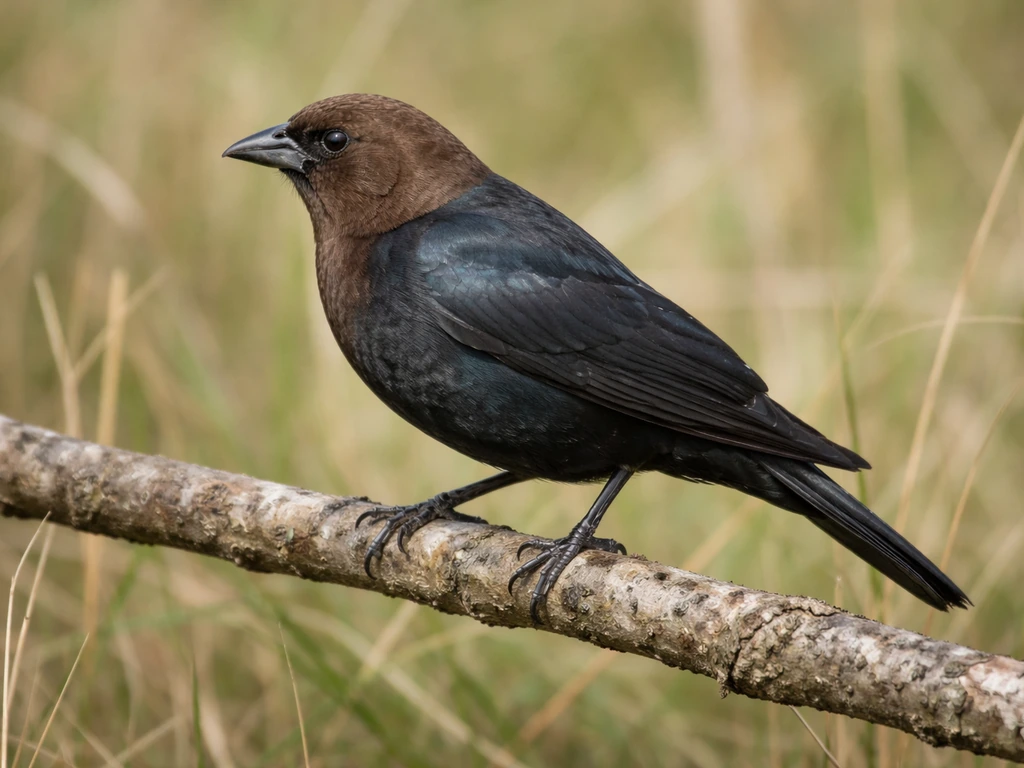
When most people search for 'cow bird,' they're looking at the Brown-headed Cowbird, a stocky little blackbird common across North America. A cockatoo bird has a very different look, with a large curved beak, strong crest, and bold feather coloration Brown-headed Cowbird. The male is hard to miss once you know what you're looking for: glossy black body, chocolate-brown head, short tail, and a thick conical bill that looks almost too heavy for its face. The female is much plainer, a soft dusty brown all over with faint streaking on the belly. If that matches what you're seeing, you've almost certainly got a Brown-headed Cowbird.
What Does a Cow Bird Look Like? Identify Cowbirds

Marcus Whitley
3 Jun 2026
Which 'cow bird' are people usually talking about?
The phrase 'cow bird' (sometimes written as one word, sometimes two) almost always refers to the Brown-headed Cowbird (Molothrus ater) in a North American context. That's the species listed under that name in U.S. Fish & Wildlife Service records, eBird, Cornell Lab's All About Birds, and Audubon's field guide. The name comes from the bird's old habit of following cattle herds to catch insects stirred up by hooves, so the 'cow' connection is genuine.
Outside North America, the word 'cowbird' can refer to other related species in the same Molothrus family, including the Bronzed Cowbird in the American Southwest and Mexico, the Shiny Cowbird in South America and parts of the Caribbean, and the Giant Cowbird in tropical regions. If you're outside the continental U.S. or Canada and the bird you're looking at doesn't quite match the description below, one of those regional relatives could be your bird. The quickest way to confirm is to check a range map for your location, which eBird and All About Birds both offer for free.
Size, shape, and silhouette
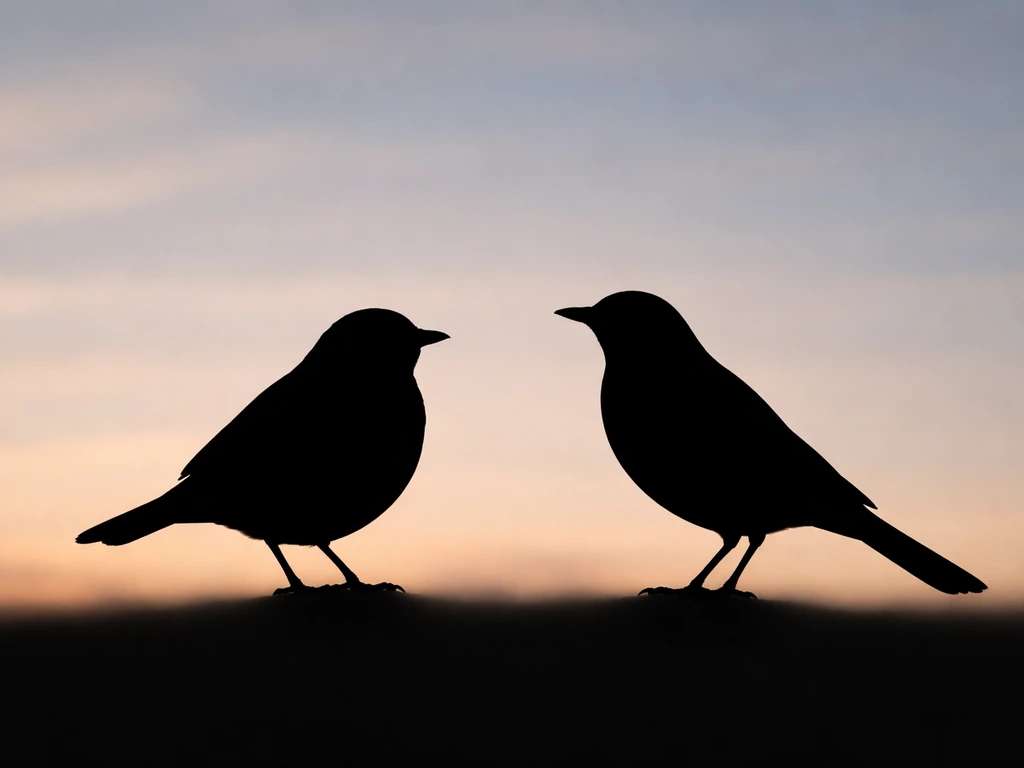
Think of the Brown-headed Cowbird as a compact, slightly chunky blackbird that looks like it was built for function over style. Males measure roughly 7.5 to 8.7 inches long with a wingspan around 14 inches, putting them close to a Red-winged Blackbird in length but noticeably more compact in feel. Females are a bit smaller, running about 6 to 8 inches with a wingspan of 12 to 15 inches. Both sexes weigh well under 2 ounces.
The silhouette is what really sets this bird apart in the field. You'll notice a short tail that gives the bird a stubby, blunt rear end compared to the long-tailed grackles it often hangs out with. The bill is short, thick at the base, and sharply pointed, much more like a finch's bill than a typical blackbird. The wings are fairly long and pointed, so in flight the bird has an almost arrowhead look to it. Put it all together and you get a stocky, short-tailed blackbird with a noticeably heavy bill.
What adult cowbirds look like
The male
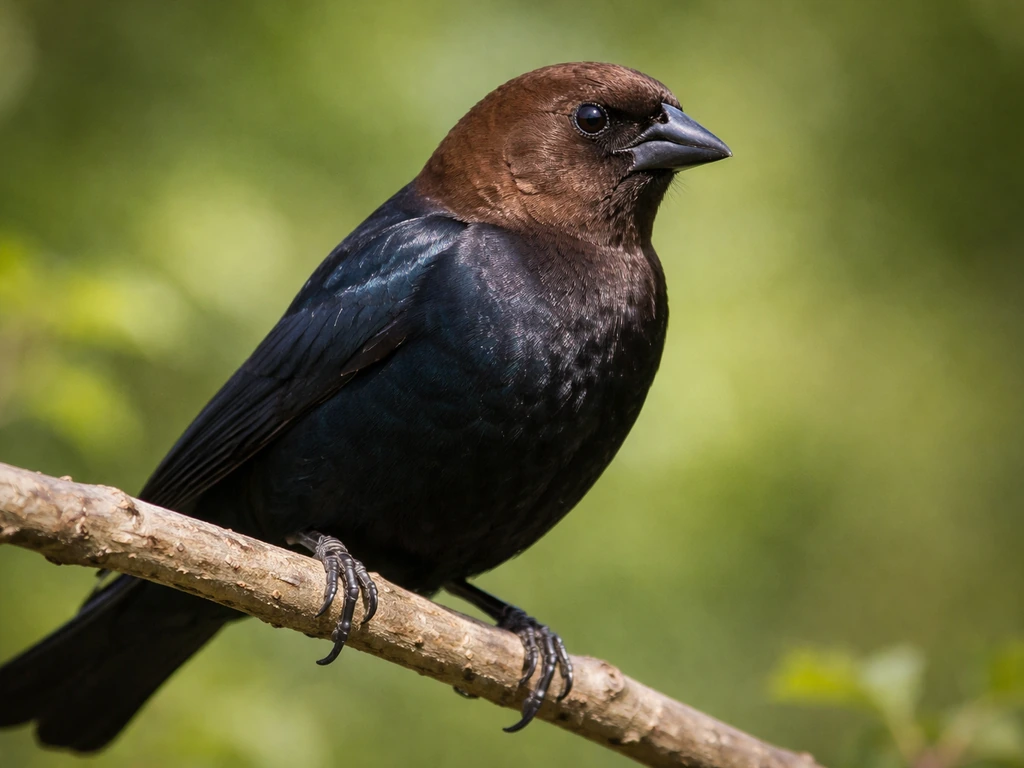
The adult male is one of those birds that's genuinely striking once you've seen it. If you want help spotting one quickly, this guide on what does a conure bird look like can help you compare shapes, colors, and markings at a glance. His body is a deep, glossy black with a strong iridescent sheen, almost like polished metal in good light.
His head is a warm chocolate-brown, and the contrast between that brown hood and the glossy black body is the single most reliable field mark you'll find. The brown doesn't fade gradually into the black; it's a fairly clean division at the neck. Look for that combination and you won't confuse him with anything else in the yard. If you were actually hoping to identify a canary instead, compare your bird to what a canary bird looks like.
The female
Females are genuinely trickier, and even experienced birders flag them as 'confusing.' She's a plain, dull gray-brown all over with no bold patterns to grab your eye. The head and underparts tend to be slightly paler than the back and wings, and if you look closely you'll see fine, faint streaking on the belly. Her eye is dark, her bill has the same thick conical shape as the male, and that bill shape is your best friend when trying to pick her out of a crowd of sparrows or female blackbirds.
Juveniles and seasonal variation
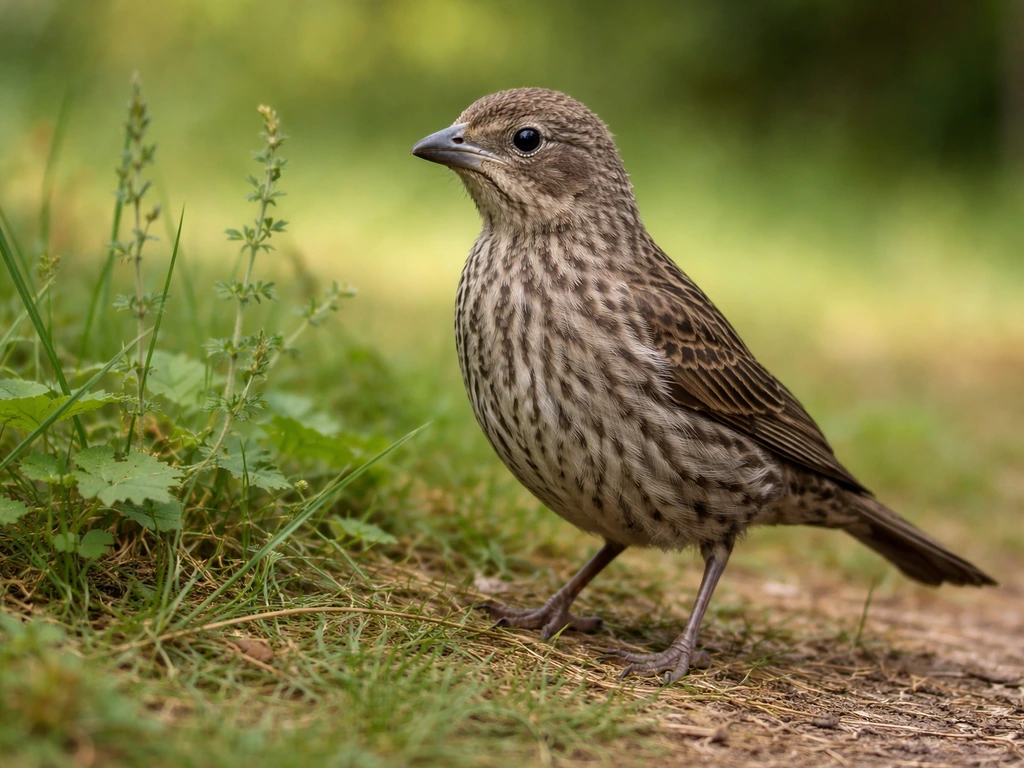
Juvenile cowbirds (most visible from June through September) look a lot like the female but with noticeably more streaking on the breast and belly. The upperparts can look slightly 'scaly' because pale feather edges create a subtle fringed pattern. You won't see any of the adult male's glossy black or brown-head contrast in a juvenile; instead you get a streaky, brownish bird that could easily be mistaken for a large sparrow at first glance. The key tell is still the bill shape: that thick, pointed bill looks out of place on what otherwise resembles a sparrow. Juveniles also tend to be larger than most sparrow species, which helps once you get a size comparison going.
Adult males in fresh fall plumage can look slightly duller than their spring selves, with less obvious gloss on the body feathers. By spring breeding season, the iridescent sheen is at its strongest. Females don't change dramatically across seasons, staying that consistent dusty brown year-round.
Birds that look like cowbirds (and how to tell them apart)
The Brown-headed Cowbird shares habitat with several other dark-plumaged birds, and it's easy to get them confused, especially with females and juveniles in the mix. Here's how to separate the most common mix-ups.
| Species | Size vs. Cowbird | Tail | Bill | Key difference |
|---|---|---|---|---|
| Common Grackle | Noticeably larger | Very long, keel-shaped | Long, slightly hooked | Much longer tail and bill; iridescent purple-blue head on males |
| Red-winged Blackbird | Similar | Medium length | Thin and pointed | Males have red-and-yellow shoulder patch; females are heavily streaked dark brown |
| European Starling | Similar | Short but squared | Long and pointed | Speckled in winter; yellow bill in spring; no brown head contrast |
| House Sparrow (female) | Smaller | Short | Thick but smaller | Buffy eyebrow stripe; streaked back; smaller overall |
| Brewer's Blackbird | Similar | Medium | Thin and pointed | Pale yellow eye on males; no brown head; slimmer build |
The Common Grackle is probably the most frequent mix-up because the two species often flock together. The grackle is noticeably bigger with a dramatically long, boat-shaped tail that fans out in flight. The Brown-headed Cowbird's short, stubby tail is the quickest way to rule it out. With female cowbirds, the toughest confusion is usually with female Red-winged Blackbirds, which are also brown and streaky. The Red-winged female is more heavily streaked and darker overall, often showing a pale eyebrow stripe, while the female cowbird is more uniformly plain with only faint belly streaking.
Where to find them: habitat and range
Brown-headed Cowbirds are found across virtually all of the contiguous United States and Canada during the breeding season, and they stick around in the southern U.S. year-round. They genuinely love open country: blank" rel="noopener noreferrer">fields, meadows, pastures, lawns, forest edges, and anywhere low or scattered trees mix with grassy open areas. You'll rarely find them deep in dense unbroken forest. Suburban backyards with open lawn are a favorite, especially where bird feeders attract mixed flocks.
If you're in the American Southwest or near the Mexican border and your bird has a red eye and a thicker reddish bill, you might be looking at a Bronzed Cowbird instead. And if you're in Florida or the Caribbean and your bird has a strong iridescent sheen without the brown head, the Shiny Cowbird has expanded its range into those areas in recent decades. Checking a current range map on eBird for your exact location will tell you quickly which species are actually expected there.
Quick photo check and next steps
If you've got a photo or you're watching the bird right now, run through this checklist to lock down the ID.
- Check the head color first: does the male have a distinct brown hood contrasting with a glossy black body? That alone confirms an adult male Brown-headed Cowbird.
- Look at the bill: is it short, thick at the base, and sharply pointed? That eliminates most sparrows and grackles right away.
- Check the tail: is it noticeably short relative to the body? A long tail points toward a grackle or Red-winged Blackbird.
- For brown birds (female or juvenile): look for plain, even coloration on the back with only faint streaking on the belly. Heavy dark streaking suggests a female Red-winged Blackbird or a sparrow instead.
- For juveniles specifically: look for breast streaking combined with that thick bill and a lack of any bold eyebrow stripe or back streaking.
- Confirm your location matches the range: open eBird or All About Birds and pull up the Brown-headed Cowbird range map. Enter your location to see if the species is expected there right now.
- Compare side by side: All About Birds has a free species comparison tool where you can put Brown-headed Cowbird next to Common Grackle, Red-winged Blackbird, or Brewer's Blackbird and see the differences laid out visually.
- Upload your photo to Merlin Bird ID (Cornell Lab's free app) for an instant second opinion if you're still unsure.
Once you've confirmed your bird, it's worth knowing that cowbirds are brood parasites: they lay their eggs in other birds' nests and let the hosts do the raising. That behavior is part of why they're so well studied and why they're often the subject of strong feelings among birders.
If you find yourself fascinated by birds that look superficially similar, exploring what cuckoo birds look like makes for an interesting comparison since cuckoos use the same reproductive strategy in the Old World, and the two families arrived at it completely independently. If you're really trying to nail down what a macaw bird looks like, you can compare the look of a macaw against similar colorful parrots using clear visual markers what a macaw bird look like.
Exploring what cuckoo birds look like can help you compare that similar brood-parasite strategy across bird families. If you want another bird comparison, you might also be wondering what a cockatoo bird looks like what does a cockatoo bird look like.
FAQ
What does a cow bird look like at a distance, without being able to see the bill clearly?
Look first for the overall shape, short tail, and compact, thick-bodied “chunky blackbird” look. In flight, the pointed, almost arrowhead wings plus the stubby rear end usually distinguish it from longer-tailed look-alikes even when the bill is hard to see.
If my bird has a brown head, but the body is not glossy black, could it still be a cowbird?
Yes. Male cowbirds can look duller in fresh fall plumage, with less obvious shine than in spring. The clean contrast between the chocolate-brown hood and the darker body is still the key comparison point, not just the intensity of gloss.
How can I tell a female cowbird from a female red-winged blackbird when both are brown and streaky?
Compare the patterning. Female cowbirds tend to be more uniformly plain, with only faint belly streaking, while female red-wings usually show heavier streaking and often a pale eyebrow stripe. If you see a clear eyebrow highlight, lean red-wing.
What about juveniles, are they still called “cow birds” and do they look different than adults?
Yes, juveniles are also cowbirds, but they look much more like the female with extra breast and belly streaking, plus a subtly “scaly” look from pale feather edges. The thick, pointed bill remains the most reliable clue even when plumage is confusing.
I saw a bird with a long tail that looks like it could be a cowbird. Is a long tail ever normal?
A long tail is a red flag for cowbirds. Brown-headed Cowbirds are characterized by a short, stubby tail that creates a blunt rear silhouette. If the tail is clearly boat-shaped or extended, you are likely dealing with a grackle or another species rather than a cowbird.
Can a cowbird be mistaken for a sparrow, and what single feature should I check first?
Juveniles can be mistaken for large sparrows at first glance because of the streaking and overall brown tone. The quickest check is the bill, it should look thick, pointed, and unusually conical compared with typical sparrow bills.
Does location matter for identifying “cow bird,” especially outside the U.S. and Canada?
Yes, “cowbird” can mean different species depending on where you are. If your bird does not match the Brown-headed Cowbird description, check which related Molothrus species are expected in your region using a current range map for your exact country or state.
What should I do if my photo shows a bird but the lighting washes out the brown head or sheen?
Use structural cues that lighting will not change much: stubby tail, thick conical bill, and compact blackbird body. If you can, take note of whether the tail looks blunt and whether the bill looks “finch-like” and heavy, those are more consistent than color intensity.
Are cowbirds common in suburban areas, or is it mostly fields and pastures?
They can be common around suburbs when there is open lawn and edge habitat. Bird feeders can increase the odds of seeing them in mixed flocks, especially in yards near fields, meadows, or forest edges.
Could I be seeing a different species named for “cow,” like bronzed or shiny cowbird?
It’s possible if your location fits. A thicker reddish bill and a redder eye can point toward Bronzed Cowbird in the American Southwest or near Mexico, and stronger iridescence without a brown head can suggest Shiny Cowbird in Florida and nearby Caribbean regions.
Next Article
What Does a Canary Bird Look Like? Identification Guide
See typical canary colors, size, bill, wings and tail, plus male vs female traits and quick look-alike checklist.