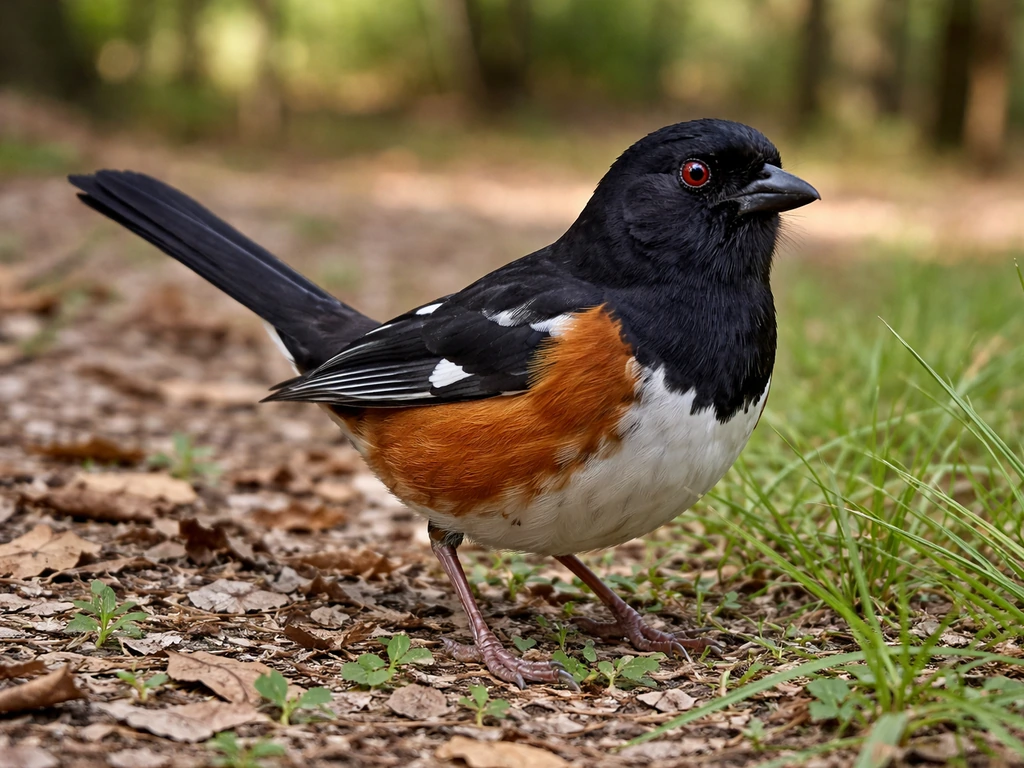
A towhee is a chunky, long-tailed ground bird about the size of a large sparrow or a small robin, roughly 7 to 8 inches long with a wingspan that can stretch close to 11 inches. The most commonly spotted species, the Eastern and Spotted Towhee, share a bold look: jet-black head and back (on males), a clean white belly, and warm rusty-orange sides that practically glow when the bird steps into the light. Flip that mental image into the brush at the edge of a trail, because that is almost always where you will find one. If you are comparing other ground birds too, you might also want to check what a tern bird looks like to avoid mix-ups.
What Does a Towhee Bird Look Like? Key ID Features

Marcus Whitley
14 Jun 2026
What is a towhee bird (and why they don't all look the same)
"Towhee" is not one single bird species. It is a common name shared by a group of ground-dwelling songbirds placed mainly in the genus Pipilo, with a few relatives in Melozone. In North America you will run into four species most often: the Eastern Towhee, the Spotted Towhee, the Canyon Towhee, and the Green-tailed Towhee.
The Eastern and Spotted were once lumped together as the "rufous-sided towhee" because they look so similar, and that still confuses a lot of people today. The Canyon Towhee, on the other hand, looks almost nothing like them, going for an understated brown look rather than bold black and white. The Green-tailed Towhee throws in an olive-green body and a bright rufous crown just to keep things interesting.
The key point: when someone asks what a towhee looks like, the honest answer depends on which species is in front of them. If you want the fastest answer, start by identifying which towhee species you are seeing, since each one has a slightly different look what a towhee looks like. This guide covers all four so you can narrow it down fast.
Body shape and size: what to clock before anything else
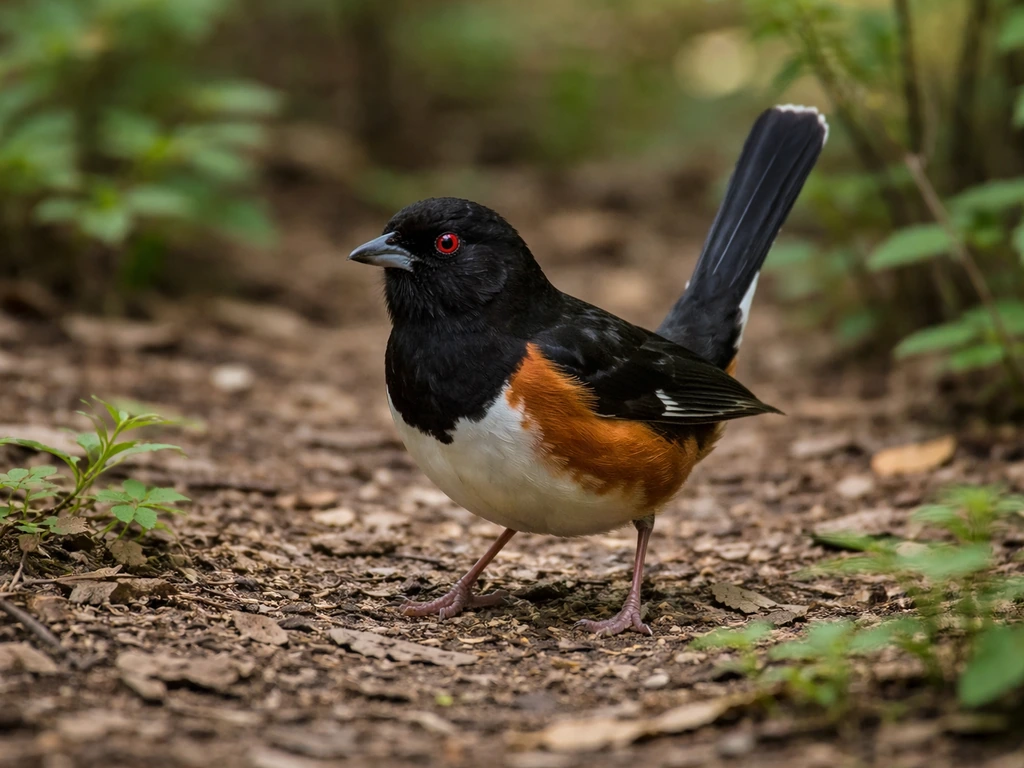
The first thing that will strike you about a towhee is that long tail. These birds carry it like a flag, and it makes them look noticeably longer than a typical sparrow. They are stocky through the chest, with a rounded head and a stout, seed-cracker bill. Think of a sparrow that spent extra time at the gym and grew a dramatically longer tail.
At roughly 8 inches and with wingspans running from about 8 to 11 inches across the most common species, they are noticeably bigger than a house sparrow but still clearly smaller than an American Robin. Their posture is upright when alert but they spend most of their time low, scratching through leaf litter with a two-footed backward hop.
That hop is actually a useful behavior clue: if you see a bird doing an energetic double-foot scratch in the undergrowth, a towhee is high on your list.
Head, wings, belly, and tail: the color pattern broken down
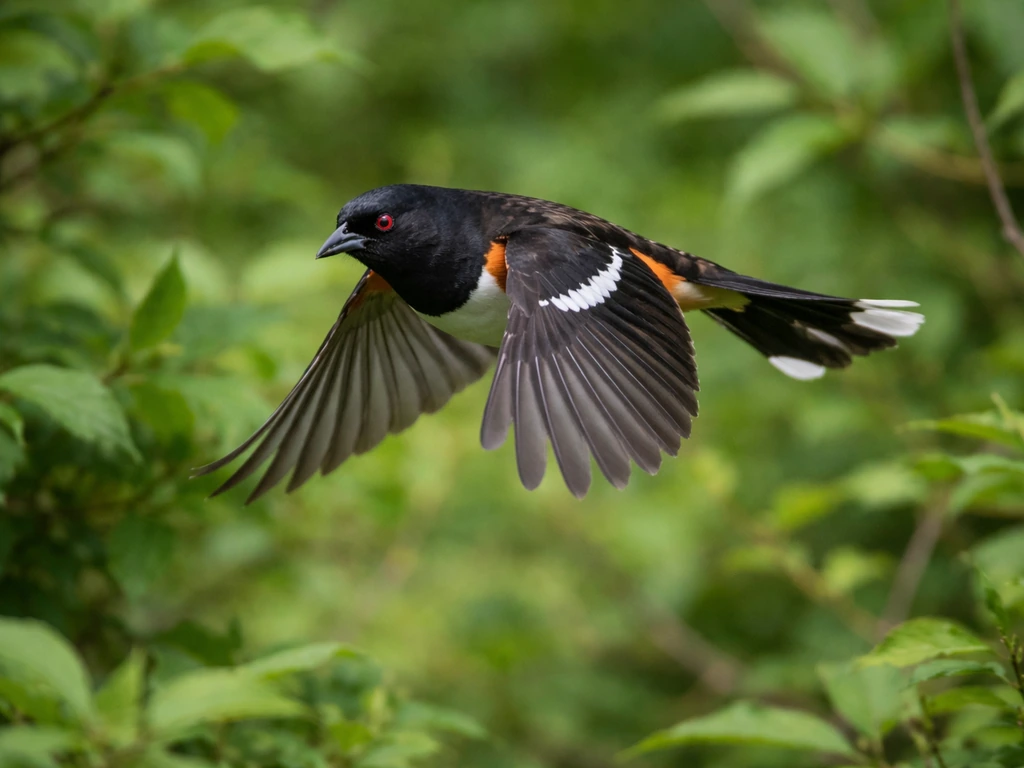
The Eastern and Spotted Towhees share the same basic color formula, which makes them easy to describe together. Males have a solid black hood covering the head, throat, and upper chest, a black back, and black wings. Below that hood, the belly is crisp white, and the sides from chest to flanks are that distinctive rusty-orange (often described as rufous). The tail is long and dark, but critically, the outer corners flash white, which you catch in flight or when the bird fans its tail. Females follow the same pattern but swap the black for a warm brown or grayish-brown, making them look like softer versions of the male.
The Canyon Towhee is a completely different visual experience. All About Birds describes it as "about as plain brown as birds come," and that is accurate. The whole bird is pale gray-brown with a whitish belly, a buffy ring around the eye, and a warm cinnamon patch under the tail. There is a hint of a dark spot or streaking at the base of the throat. No bold contrasts, no flashy rufous sides. If you are expecting the black-and-white drama of an Eastern Towhee and you get a Canyon Towhee instead, you could easily overlook it.
The Green-tailed Towhee is the odd one out in the best way. The body is grayish, but the wings, back, and tail carry a distinct olive-green or greenish-yellow wash. The head is where it really stands out: a bright rufous (rusty-red) crown sits on top, the throat is white, and a dark stripe runs down either side of the throat like a mustache. It is about 7 to 7.
The U. S. National Park Service’s Bryce Canyon guide gives the Green-tailed Towhee an approximate length of about 7, 7. 5 inches (17, 19 cm) [It is about 7 to 7.
](https://www. nps. gov/brca/learn/nature/new-world-sparrows. htm).
5 inches long, slightly smaller and more slender than the Eastern or Spotted, and that olive-green wing color combined with the face pattern makes it unlike anything else you are likely to confuse it with.
The tell-tale features that seal the ID
Every towhee has at least one or two signature marks worth burning into your memory, because these are the ones that confirm the ID even when the bird is half-hidden in a thicket.
- Eastern Towhee: white corners flashing on the tail in flight, plus a white "check mark" visible on the folded wing when the bird is perched. No white spots on the wing beyond that single patch.
- Spotted Towhee: same white tail corners, but look for heavy white spotting scattered across the black wings and back. That spotted pattern is the quickest way to separate it from the Eastern in areas where both occur.
- Canyon Towhee: the buffy eye ring is your first anchor, then check under the tail for the warm cinnamon-rufous patch. Also look for a faint dark spot or streaky "necklace" at the throat base. No bold contrasts anywhere else.
- Green-tailed Towhee: rufous crown plus white throat plus dark mustache stripe. If you see all three on a greenish-winged bird scratching around in mountain shrubs, you have got your answer.
The tail corner flash is worth emphasizing across the board. The U.S. Forest Service even uses outer white tail corners as a rapid field check specifically associated with towhees, contrasting them with juncos. Any time a bird flushes out of brush and you catch white outer tail corners on a dark tail, a towhee should be your first instinct.
Towhee vs look-alike birds: quick comparison checks
The two toughest comparisons are Eastern Towhee vs Spotted Towhee, and Canyon Towhee vs similar plain brown ground birds. If you are also wondering what does a titmouse bird look like, compare it by its shorter tail, smaller size, and more compact posture since towhees have the long tail and ground-scratching behavior. The tufted titmouse is a small bird with a distinct look, so seeing the missing tuft can be a useful clue. Here is a side-by-side breakdown: Eastern Towhee notes that in flight you can identify it by “white corners on tail,” and that it is “most similar to Spotted Towhee,” but Eastern is mostly black above with only a single white patch on a folded wing.
| Feature | Eastern Towhee | Spotted Towhee | Canyon Towhee | Green-tailed Towhee |
|---|---|---|---|---|
| Overall color (male) | Black head/back, white belly, rufous sides | Black head/back with white spots, white belly, rufous sides | Plain gray-brown throughout | Gray body, olive-green wings/tail |
| Wing markings | Single white patch on folded wing | Heavy white spotting across wings and back | None notable | Greenish-yellow wash, no spots |
| Head pattern | Solid black hood (male) | Solid black hood (male) | Buffy eye ring, plain face | Rufous crown, white throat, dark mustache stripe |
| Tail | Dark with white outer corners | Dark with white outer corners | Long, plain brownish | Greenish-olive with no bold corners |
| Under-tail | White/rufous sides | White/rufous sides | Warm cinnamon-rufous patch | Plain |
| Size | ~8 in, up to 11 in wingspan | ~8 in, ~11 in wingspan | Similar, ~8–9 in | Slightly smaller, ~7–7.5 in |
People also sometimes confuse towhees with American Robins (both have rufous coloring and dark backs), but robins are noticeably larger, have a yellow-orange bill, and lack the long tail and ground-scratching behavior. Dark-eyed Juncos share the tail-corner flash but are much smaller and have a different color arrangement, with a pinkish bill and no rufous sides. If the bird in question is the same size as a large sparrow, has that long tail, and is scratching in leaf litter at the edge of thickets or forest margins, you are almost certainly looking at a towhee of some kind.
How to confirm a towhee in real life: field checklist and photo tips
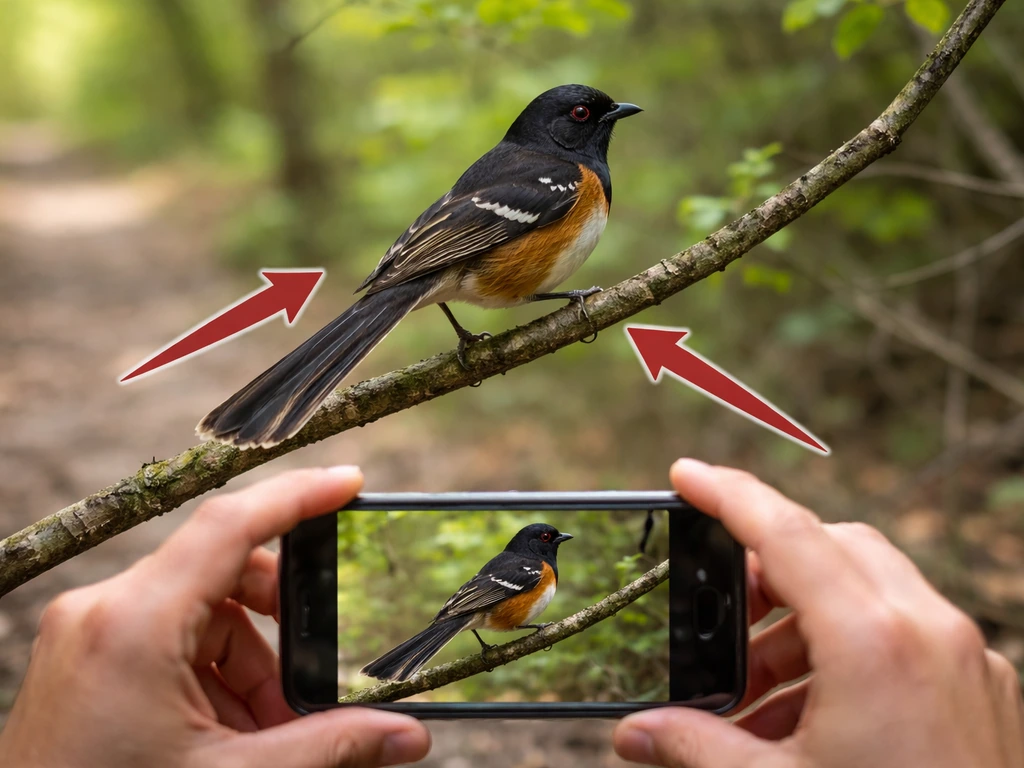
Whether you are in the field right now or working through a photo you took earlier, run through these steps in order. They are built around the highest-confidence visual traits that hold up even when you only get a quick look.
- Check the size and tail length first. Is it noticeably bigger than a house sparrow but smaller than a robin? Does the tail look disproportionately long? That narrows you to the towhee group quickly.
- Watch for the double-foot scratch. If the bird hops backward and kicks through leaf litter on the ground near brush or thickets, that behavior strongly points to a towhee.
- Look at the head. Is it solid black (or brown in females) with no pattern? That is Eastern or Spotted. Does it have a rufous crown and white throat? Green-tailed. Does it have a buffy eye ring and plain face? Canyon.
- Check the wings. Do you see scattered white spots across the wing and back? Spotted Towhee. Just a single white patch or check-mark shape on the folded wing? Eastern Towhee. Greenish wash with no spots? Green-tailed.
- Catch the tail in motion. When the bird moves, flies, or fans its tail, do the outer corners flash white on a dark background? Yes means Eastern or Spotted. Greenish tail with no flash points to Green-tailed. Plain brown tail points to Canyon.
- If the overall bird is plain brown, go straight to the undertail and eye area. A warm cinnamon patch under the tail and a buffy eye ring confirms Canyon Towhee.
- Use habitat as a supporting clue. Eastern Towhees prefer forest edges and brushy thickets in the East. Spotted Towhees favor the West and can climb into shrubs to sing. Canyon Towhees are at home in dry scrubby terrain in the Southwest. Green-tailed Towhees favor mountain shrubs and sagebrush in the West.
- Cross-check with a range map. Many photo apps like Merlin (Cornell Lab) let you enter your location and date to filter which towhee species are actually possible where you are standing, which cuts the guesswork significantly.
If you are working from a photo, zoom in on three spots: the wing surface for spots or patches, the outer tail corners for white flashing, and the face or under-tail for any contrasting color. A featherless bird, like a plucked or fully molting one, will look much more like its bare skin and body shape than its typical color pattern. Those three areas carry enough information to land on the right species in most cases.
Towhees sometimes climb into low shrubs or the edges of dense brush to sing, which gives you a brief clear view, so patience and watching the same patch of habitat for a few minutes often pays off. Once you have the shape, the tail flash, and the wing pattern locked in, you will find towhees surprisingly easy to recognize on repeat visits.
FAQ
Why does the towhee I saw look less bright or more brown than the description?
A towhee’s look can be temporarily misleading when the bird is moulting. In those weeks, patched feather growth can blur the black, rufous, or olive tones, so prioritize structure first (chunky body, long tail, ground-scratching posture) and then check the tail corner flash and wing color once feathers look more complete.
Can a towhee look different in shade or bad lighting?
Yes. In low light, heavy shade, or overcast conditions, the rusty-orange sides of Eastern and Spotted Towhees can appear muted and “washed,” but the long dark tail and the white outer tail corners should still show when the bird flushes or fans its tail.
What if I only see the bird briefly, with the tail mostly hidden?
You can still confirm it from a partial view. If you only catch a glimpse, look for (1) an energetic double-foot scratch in leaf litter, (2) a noticeably long tail compared with similar sparrows, and (3) any white flashing at the outer tail corners when the bird lifts or turns.
How can I tell an Eastern vs Spotted Towhee when the bird is a female?
Not reliably. Female Eastern and Spotted Towhees swap the black hood for brown or gray-brown, which reduces contrast, so don’t use “no black” as your only clue. Instead, use combination traits, especially white belly, overall size, and the tail-corner white flash.
What’s the quickest way to tell an Eastern Towhee from a Spotted Towhee in the field?
Eastern and Spotted Towhees can be tricky because they share the same general black-and-white plus rusty-orange sides pattern in males, and females look softer. The fastest approach is to compare the face and wing pattern in your clearest moments and use the habitat and location of your observation to guide which species is likely there.
Could my bird be an American Robin instead of a towhee?
Compare tail length and movement style. American Robins are larger, more upright, and they don’t do the towhee’s backward, double-foot leaf-litter scratching. Also, robins have a noticeably different bill shape and typically look more “perched” than “scratching.”
What’s the easiest way to identify a Green-tailed Towhee?
Green-tailed Towhees are usually the least confusing because the olive or greenish-yellow wash on the wings and back stands out, plus the bright rufous crown and the throat mustache-like stripe. If those face and wing tones are visible, you can often skip the rest of the comparison.
How do I avoid confusing Canyon Towhees with other plain brown ground birds?
If a “towhee” looks very plain and uniformly brown all over, that’s a clue pointing toward Canyon Towhee. Look for the pale gray-brown overall tone, whitish belly, and the cinnamon patch under the tail, and be cautious if you were expecting strong black-and-white contrast.
What order should I check when identifying a towhee from a picture?
To double-check from a photo, use a consistent sequence: zoom first on the outer tail corners for white flashes, then check the wing surface for rufous or olive tones, and finally review the throat and under-tail for color patches. Avoid relying on the belly color alone because angle and lighting can wash it out.
Is it worth waiting after a towhee flies away, or should I assume the ID from one glimpse?
Yes, but timing matters. Towhees often give the clearest confirmation right after they flush from dense cover, when the tail flashes and their body silhouette becomes fully visible. Waiting in the same patch of habitat for a few minutes improves your odds of getting that confirmatory view.