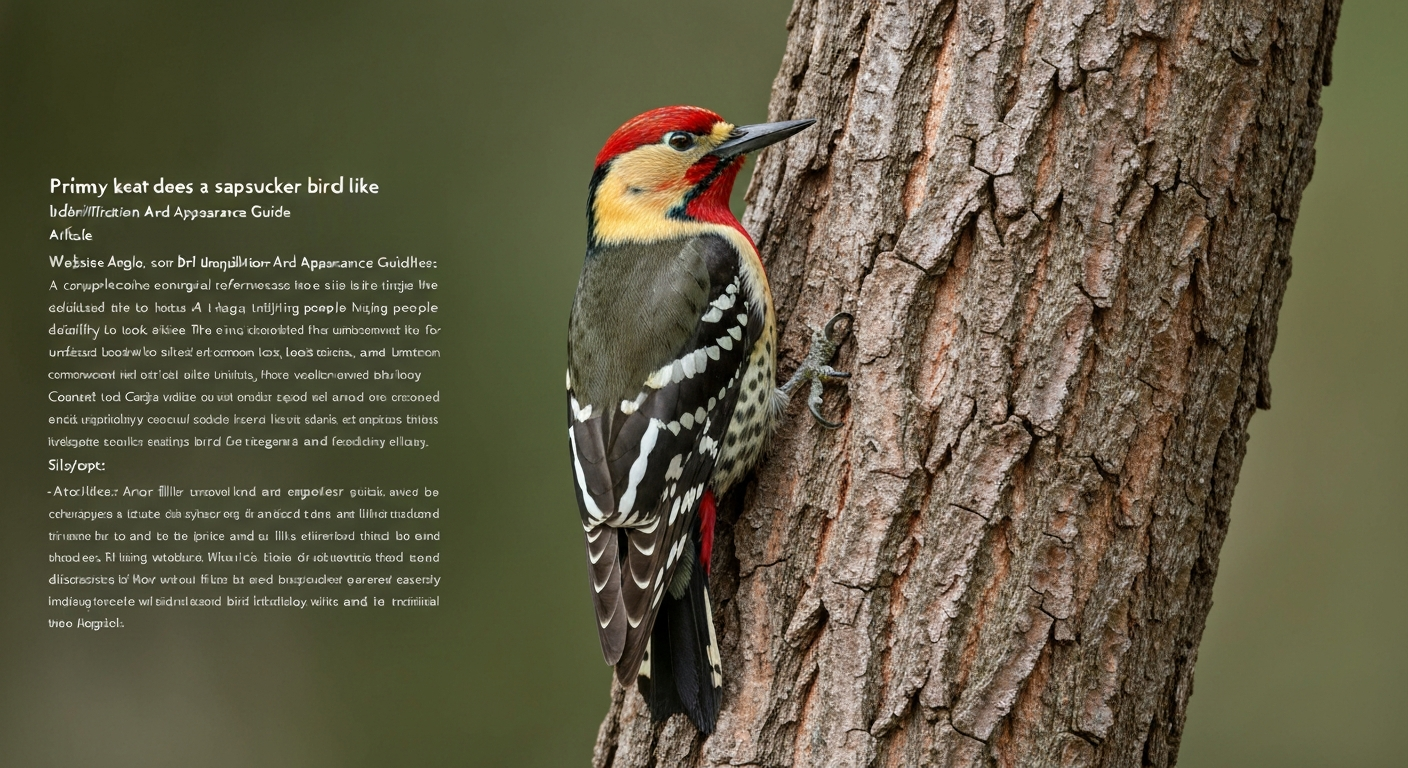
A sapsucker is a medium-sized woodpecker with a bold vertical white wing patch, a black-and-white patterned back, and a habit of drilling neat rows of small holes in tree bark. There are three main species in North America, and once you know what to look for, each one is pretty recognizable. The Yellow-bellied Sapsucker has a red forehead and a pale yellowish belly. The Red-breasted has an almost entirely red head and upper chest. The Red-naped looks a lot like the Yellow-bellied but has a red patch on the back of its neck. All three are roughly robin-sized, and that tidy white wing stripe is your single best field mark across the board.
What Does a Sapsucker Bird Look Like: Quick ID Guide for Birders

Marcus Whitley
21 Jul 2026
What a sapsucker actually is
Sapsuckers belong to the woodpecker family, but they have a feeding trick that sets them apart from most other woodpeckers. Instead of hammering deep into wood for insects, they drill rows of shallow wells into living tree bark, then return again and again to lap up the sap that flows out, along with any insects that get stuck in it. You might have seen the evidence without knowing what made it: a neat grid or ring of small, evenly spaced holes on a birch or aspen trunk. That is the work of a sapsucker. The behavior is so distinctive that it doubles as a field mark, even when you cannot see the bird directly. Their sap wells also attract hummingbirds, warblers, and other small birds that come to drink, so a busy sap well tree is always worth a longer look.
The three North American sapsuckers at a glance
All three species belong to the same genus and share a family resemblance, but their ranges barely overlap for the most part, which makes geography one of your first clues. Here is a quick breakdown before we dive into the details.
| Species | Head color | Throat (male) | Belly | Range |
|---|---|---|---|---|
| Yellow-bellied Sapsucker | Red forehead, black-and-white face | Red | Pale yellow wash | Eastern North America, winters in Southeast/Central America |
| Red-breasted Sapsucker | Mostly red, entire head and breast | Red (same as head) | Streaked with yellowish wash | Pacific Coast from Alaska to California |
| Red-naped Sapsucker | Red crown and throat, red nape patch, black-and-white face | Red (male), white chin (female) | Pale yellow wash | Interior West, Rocky Mountains, Great Basin |
Overall shape, size, and silhouette
All three sapsuckers are compact, blocky woodpeckers. Think of a small American Robin, but stockier and shorter-tailed, with a thicker, straight bill. The Yellow-bellied is on the smaller end, measuring roughly 7 to 9 inches long with a wingspan of about 13 to 16 inches and weighing in at 1. Museum specimen metadata (iDigBio specimen record (Sphyrapicus varius), museum specimen metadata) include measurements such as total length 202 mm, wing chord ~134 mm, and weight ~43.6 g iDigBio specimen record (Sphyrapicus varius) — museum specimen metadata. 5 to 1.9 oz. The Red-breasted is noticeably heavier, at 1.9 to 2.2 oz and 8 to nearly 9 inches long, with a wingspan up to 16 inches. The Red-naped sits right in the middle size-wise, about 7.5 to 8.3 inches, though it can vary quite a bit in weight (1.1 to 2.3 oz depending on condition and time of year).
On a tree trunk, a sapsucker clings vertically with its stiff tail propped against the bark for support, just like other woodpeckers. In flight, they move in the classic woodpecker undulating pattern: a few quick wingbeats, then a short glide, then more wingbeats. That white wing patch flashes very clearly during the flap-and-glide sequence, which is often the first thing you notice when one flies between trees. If you see a woodpecker-sized bird with a bright vertical white stripe on the wing, sapsuckers should jump straight to the top of your list.
Head and throat patterns: the fastest way to tell them apart
The head is where the three species diverge most clearly, and it is the first place to look once you have confirmed the white wing patch.
Yellow-bellied Sapsucker head pattern
On a Yellow-bellied, the face is boldly striped in black and white. There is a red patch on the forehead, a black crown behind it, and two white stripes that frame the face on each side: one runs above the eye and another below. Between those stripes on the male, the throat is a deep, vivid red, surrounded by a black border that extends across the upper chest like a bib or shield. That black chest patch is a great field mark on its own. The female has the same black-and-white face pattern, the same red forehead, but her throat is white rather than red.
Red-breasted Sapsucker head pattern
The Red-breasted is the easiest of the three to recognize at a glance. The entire head and upper breast are a rich, deep red, with very little black or white patterning on the face. It almost looks like someone dipped the front half of the bird in red paint from the bill down to the mid-chest. There may be a faint whitish spot near the bill and a subtle dark patch near the ear, but do not expect clean stripes here. The sexes look nearly identical, which is unusual for this group, making this the easiest species to sex in the field (you basically cannot, without close study).
Red-naped Sapsucker head pattern
The Red-naped looks superficially similar to the Yellow-bellied, with the same bold black-and-white face stripes and a red crown. But here is the feature that gives the species its name: flip your view to the back of the head and you will see a red patch on the nape (the back of the neck). The Yellow-bellied does not have this. On the Red-naped male, the throat is also red, and in good light you can sometimes see that the red of the throat bleeds slightly through the black border around it. Females typically show a white chin patch within the red throat area, a useful detail when you can get a clean view.
Body plumage, wings, and tail
Below the head, all three species share a broadly similar body plan. The back is a mottled or barred pattern of black and white, giving it a scaled or ladder-backed appearance depending on the angle of light. The underparts are paler, ranging from a clean off-white to a soft yellowish wash, and on the Yellow-bellied and Red-naped this yellowish tint on the belly is a consistent and helpful field mark.
The standout mark on the wing is that vertical white patch. It runs lengthwise down the folded wing like a bold stripe, and it is visible both when the bird is clinging to a tree and when it is in flight. On the Red-breasted, this patch is sometimes described more as a shoulder slash than a full wing stripe, but it is still prominent and obvious. The tail is mostly black with some white barring on the outer feathers, and the rump area can show white as well. You will notice the rump flash when a sapsucker takes off.
Male, female, and juvenile: how plumage differs
For the Yellow-bellied and Red-naped sapsuckers, the quickest sex difference is throat color. Males have red throats; females have white (or largely white) throats. Both sexes share the red forehead and the same general face striping, so if you get a clear look at the throat, you have your answer. The Red-breasted is the exception since males and females look almost identical, both with that fully red head and breast.
Juveniles are a different story. Young sapsuckers in their first few months look noticeably duller and browner than adults. A juvenile Yellow-bellied, for example, has a brownish wash replacing the crisp black-and-white of the adult, a finely spotted crown instead of clean red, and much less defined face stripes. The white wing patch is still visible, which helps confirm the family, but the overall effect is a muted, streaky bird that can be tricky to pin down. By late fall and into the first winter, juveniles begin molting into a more adult-like plumage, but the transition can be gradual and messy-looking.
How seasons and molting change their appearance
Adult sapsuckers go through a complete molt once a year, typically in late summer after the breeding season. This means that by the time they arrive on wintering grounds (or as residents in winter), they are in fresh, crisp plumage. The red patches are brighter, the black-and-white contrast is sharper, and the white wing stripe looks cleaner. As the year goes on and feathers wear, some of that crispness fades. Red areas can appear slightly duller or more orange-tinted on worn feathers, and the white parts can look dingy.
Juveniles complicate things further in late summer and fall because they have not yet completed their first molt into adult-like plumage. You might encounter a young bird that looks brownish overall with a faint hint of red on the forehead just starting to come in. If you see a muted, brownish woodpecker with that telltale white wing stripe and you are in sapsucker country during fall, lean toward a juvenile sapsucker rather than an unknown species. The structure and white wing patch will still point you in the right direction even when the colors are not cooperating.
Field marks and behaviors that clinch the ID
Beyond plumage, sapsuckers have behavioral and habitat signatures that are genuinely unique and incredibly helpful. Other woodpeckers, nuthatches, and even some small flycatchers can share tree-trunk habitats, but none of them leave behind the same physical evidence that sapsuckers do. For comparison with smaller, tree-trunk and flycatcher-like species, see what does a flycatcher bird look like to note differences in silhouette and behavior.
Sap wells: the calling card you can find without seeing the bird
Sap wells are small, evenly spaced holes drilled in neat horizontal rows or rings around a tree trunk. Sap‑feeding behavior is diagnostic: sapsuckers excavate neat rows or rings of shallow holes (‘sap wells’), often in aspen, birch, willow and other species, and repeatedly return to lap sap and trapped insects, with well orientation, spacing and tree selection documented in multiple studies blank" rel="noopener noreferrer">Yellow‑bellied Sapsucker (behavior & sap wells) — All About Birds (Cornell Lab). They are usually shallow, not the deep excavations of a Pileated Woodpecker, and they are spaced with a regularity that looks almost deliberate, because it is. Yellow-bellied Sapsuckers often work on birch, aspen, maple, and pine trees, and the wells can cover a significant section of trunk. Research has confirmed that the birds choose trees based on sap flow and sugar content rather than species alone, which is why you can find wells on a wide variety of trees. Once you spot a well-drilled trunk, you know a sapsucker has been working that area, and returning at dawn or dusk often rewards you with a sighting.
Feeding posture and drilling behavior
When a sapsucker is at its wells, it clings vertically and laps at the holes with its brush-tipped tongue, making quieter, more methodical movements than a woodpecker hammering for insects. The bird may visit the same tree dozens of times a day. You might also notice it hovering briefly or shifting sideways along a trunk in a way that looks less frenetic than a Downy or Hairy Woodpecker drilling for grubs. The sap wells also attract hummingbirds, Yellow-rumped Warblers, and other small birds, so a tree with active wells becomes a little hub of activity worth watching. For a look at a different family of ground- and brush-loving songbirds, see what does a thrasher bird look like. If you’re curious about similar small, agile birds, see what does a swallow bird look like to learn how swallows differ with streamlined bodies, long pointed wings, and forked tails.
Drumming and calls
Sapsuckers have a distinctive drumming pattern that can help confirm your ID even without a visual. Their drum is irregular and halting, often described as a stuttering rhythm: a few rapid taps, a pause, a few more taps, another pause. It sounds distinctly different from the long, even rolls of a Downy or Hairy Woodpecker. Their call is a nasal, cat-like mewing sound that, once you have heard it, is hard to mistake.
Sapsuckers vs. look-alike woodpeckers
In the field, the birds most likely to cause confusion are the Downy Woodpecker and the Hairy Woodpecker, both of which share the black-and-white back and tree-trunk habitat. The key differences come down to wing pattern and head color. Neither the Downy nor the Hairy has that vertical white wing stripe that runs lengthwise down the folded wing; instead, they have a white patch on the back between the wings. Sapsuckers also have a more distinctly patterned face and, of course, the red markings. The Downy is noticeably smaller than any sapsucker, about the size of a large sparrow, while the Hairy is closer in size but still lacks the red throat and bold wing stripe. If you spend much time watching tree-creeping birds, the comparison is worth studying. Nuthatches, for example, creep headfirst down trunks and have very different proportions entirely. For comparison with non-woodpecker species and to see how a brown thrasher differs in shape and coloration, see what does a brown thrasher bird look like. For a brief visual guide, see what does a nuthatch bird look like.
| Bird | White wing pattern | Red on head? | Size (approx. length) | Sap wells? |
|---|---|---|---|---|
| Yellow-bellied Sapsucker | Vertical stripe down folded wing | Yes, forehead and throat | 7–9 in | Yes |
| Red-breasted Sapsucker | Bold shoulder/wing slash | Yes, entire head and breast | 8–9 in | Yes |
| Red-naped Sapsucker | Vertical stripe down folded wing | Yes, crown, throat, and nape | 7.5–8.3 in | Yes |
| Downy Woodpecker | White patch on back (no wing stripe) | Red nape patch (male only) | 5.5–7 in | No |
| Hairy Woodpecker | White patch on back (no wing stripe) | Red nape patch (male only) | 7–10 in | No |
Where and when to find them
Geography does a lot of the heavy lifting with sapsucker ID. If you are in the eastern half of North America, from the boreal forests of Canada down through the Appalachians in summer and across the Southeast in winter, you are almost certainly looking at a Yellow-bellied Sapsucker. If you are anywhere on the Pacific Coast from Alaska down through California, the Red-breasted is the expected species. If you are in the Rockies, Great Basin, or interior mountain West, the Red-naped is your bird. There is a zone in the Pacific Northwest and northern California where Red-breasted and Red-naped sapsuckers overlap and interbreed, producing hybrids that can look like blends of both species. If you spot something in that region that seems like it does not quite fit either description cleanly, hybrid ancestry is a real possibility and not a sign you have done anything wrong.
In terms of habitat, look for sapsuckers in forests with a mix of deciduous and coniferous trees. Aspen groves, birch stands, and mixed woodlands near water are particularly productive. In winter, Yellow-bellied Sapsuckers turn up in suburban areas, parks, and even gardens with fruit trees or ornamental cherries, so they are not strictly wilderness birds.
Quick field checklist for sapsucker ID
When you think you have a sapsucker in front of you, run through these points quickly:
- Check for the vertical white wing stripe on the folded wing — this is your most reliable family marker
- Look at the head: is it mostly red (Red-breasted), or black-and-white with red patches (Yellow-bellied or Red-naped)?
- If the face is striped black-and-white, check the back of the head for a red nape patch (Red-naped) or the absence of one (Yellow-bellied)
- Look at the throat: red means male Yellow-bellied or Red-naped; white means female Yellow-bellied or Red-naped
- Check the belly for a yellowish wash, which supports Yellow-bellied or Red-naped over Red-breasted
- Note your location and habitat — geography narrows the options dramatically
- Look at nearby tree trunks for rows of evenly spaced sap wells to confirm a sapsucker has been active in the area
- Listen for the stuttering, irregular drum or the nasal mewing call
Tips for photographing sapsuckers
Sapsuckers can be surprisingly patient birds when they are working a sap well, which makes them more photo-friendly than many woodpeckers. Once you find an active sap well tree, position yourself where the light falls on the bird rather than behind it, and give yourself a clear sightline to the trunk. Early morning light is ideal for bringing out the red tones on the head and the contrast of the black-and-white back. Aim for shots that capture the head pattern and the wing stripe in the same frame, since those are the two features that will make your photo genuinely useful for ID. If you can get a shot of the nape (back of the head), that will help separate Yellow-bellied from Red-naped when the two could otherwise look similar.
FAQ
What is a sapsucker and what makes it distinctive?
Sapsuckers are medium‑sized woodpeckers in the genus Sphyrapicus that specialize in feeding on tree sap and the small insects attracted to it. They excavate organized series of shallow holes called sap wells, return repeatedly to lap sap, and often show a vertical white wing patch, barred or mottled backs, and bold head patterns. The sap‑feeding behavior and neat rows of wells are diagnostic field signs.
Overall shape and size—what should casual birders expect to see?
Sapsuckers are stocky woodpeckers roughly 18–22 cm (7–8.5 in) long with wingspans ~34–43 cm (13–17 in). They have a straight, chisel‑like bill, short tail, and a robust head. In flight they show a broad white wing patch and a somewhat undulating woodpecker flight.
How does the Yellow‑bellied Sapsucker look? Key field marks.
Adults: black‑and‑white barred back, bold vertical white wing patch, red forehead, and a black breast patch (males) or white throat (females). Belly has a pale to yellowish wash (gives the species its name). Juveniles are browner with finer spotting. Length ~18–22 cm, weight ~43–55 g.
How does the Red‑breasted Sapsucker look? Key field marks.
Adults: much red on the head and upper breast, a bold white shoulder/wing slash, and a black‑and‑white mottled back. Underparts are streaked and can show a faint yellow wash. Sexes are similar in plumage. Length ~20–22 cm, weight ~53–64 g. The overall impression is a strong red head/upper chest with contrasting white wing mark.
How does the Red‑naped Sapsucker look? Key field marks.
Adults: black‑and‑white patterned back and face with red on the crown and throat and a distinctive red nape (back of the head). Males usually have an entirely red throat/chin; females often show a small white chin patch. Back pattern and the red nape distinguish it from the other species. Length ~19–21 cm.
Quick visual rules to separate the three species in the field
- Red‑breasted: mostly red head and upper breast; white wing/shoulder patch; coast/montane West. - Red‑naped: red crown plus a red nape patch (back of head) often with a patterned face; interior West. - Yellow‑bellied: red forehead but paler/yellowish belly wash and typically a black breast patch (male) or white throat (female); widespread boreal/northeast. All show a vertical white wing patch and sap‑well behavior.