A scissor-tail bird is one of the most instantly recognizable birds in North America once you know what to look for: a slender, pale gray flycatcher with an impossibly long, deeply forked black tail that it opens and closes like a pair of scissors in flight. The species most people mean when they say 'scissor-tail bird' is the Scissor-tailed Flycatcher, a showstopper of the southern Great Plains that pairs that dramatic tail with flashes of salmon pink along its sides and underwings.
What Does a Scissor Tail Bird Look Like: ID Guide for Birdwatchers

Marcus Whitley
24 Jul 2026
What 'scissor-tail' actually means, and what this guide covers
The name 'scissor-tail' describes any bird whose long outer tail feathers cross and splay in flight, mimicking the action of a pair of scissors. In North America, the Scissor-tailed Flycatcher (Tyrannus forficatus) is the go-to species behind that name, and it's the main focus of this guide. But a handful of other birds share the forked, streamer-style tail that earns the label, most notably the Fork-tailed Flycatcher, a South American relative that occasionally turns up as a rare vagrant farther north. Where useful, this guide also touches on barn swallows, kingbirds, and other fork-tailed look-alikes that can cause confusion in the field. If you've already explored what a barn swallow looks like, you'll have a useful baseline for appreciating just how much longer and more dramatic the Scissor-tailed Flycatcher's tail really is.
At-a-glance ID: the fastest way to recognize a scissor-tail
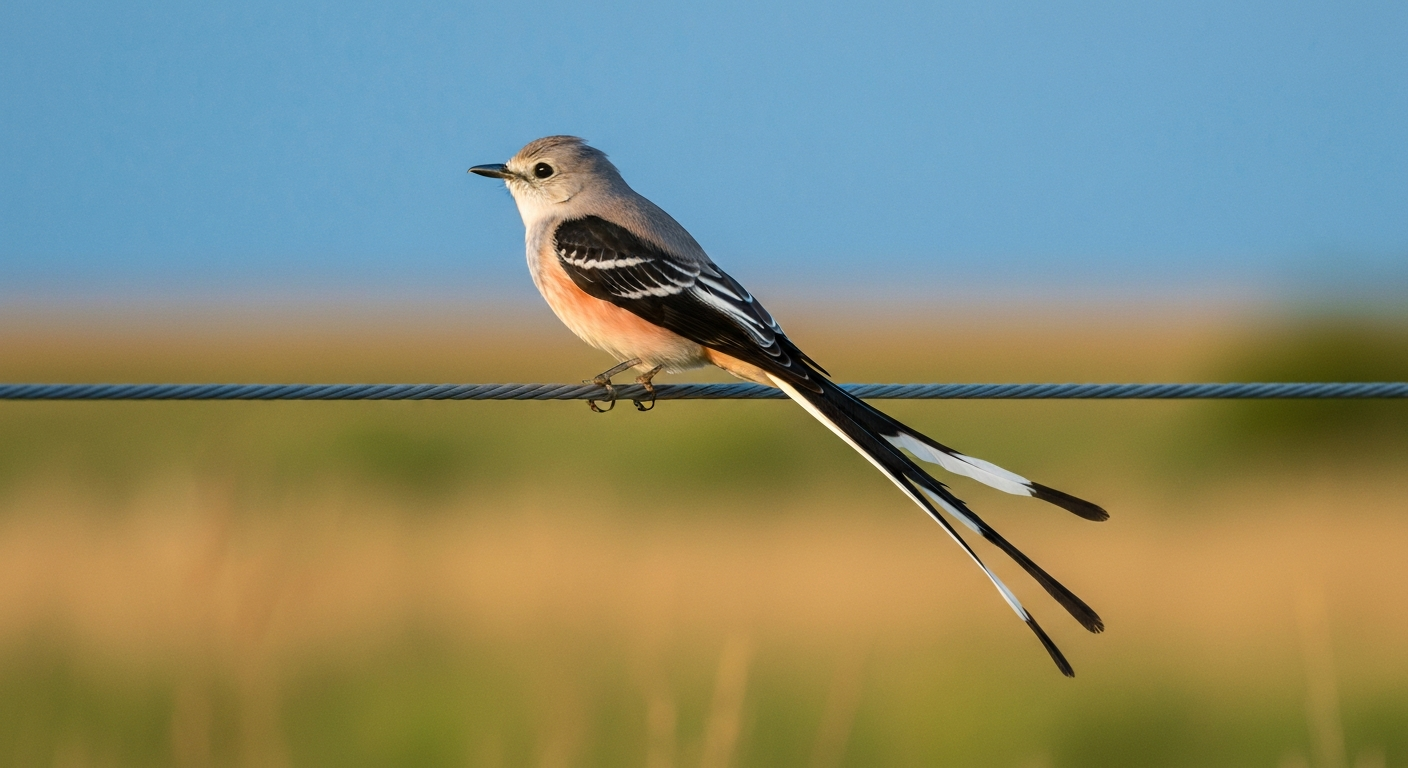
You don't need to be an expert to nail this bird. If you're scanning a fence line or a cluster of roadside wires in Texas or Oklahoma on a spring or summer day and you see something with a freakishly long, dangling forked tail perched upright, you've almost certainly found your Scissor-tailed Flycatcher. Here are the four things to lock onto immediately:
- Extremely long, deeply forked black tail with white outer edges, making up a big portion of the bird's total length
- Pale gray head and back, much paler than most other flycatchers sitting on that wire
- Salmon-pink flush on the flanks and underwings, visible even at a modest distance, especially when the wings are spread
- Upright, conspicuous perch posture on wires, fence posts, or exposed treetops, combined with quick darting flights out to catch insects
Size, shape, and that legendary tail
The Scissor-tailed Flycatcher measures anywhere from 8.7 to 14.6 inches (22 to 37 cm) in total length, with a wingspan of roughly 15 to 17 inches (about 38 to 43 cm). It weighs between 1.3 and 2.0 ounces (36 to 56 g), which puts it in a similar weight class to a large sparrow. But those raw numbers are almost misleading, because the bird feels much larger in the field. A significant chunk of that total length is pure tail, and when an adult male spreads those streamers in flight, the effect is genuinely jaw-dropping.
The body itself is slim and elongated, with a relatively large, flat head and a straight, medium-length bill typical of a flycatcher. The wings look somewhat short relative to the tail, which creates an oddly front-heavy silhouette when the bird is perched. That long tail hangs down below the perch like a dangling ribbon, swaying gently in the wind. It's one of those sights that, once you've seen it, you simply don't forget.
The tail itself is the real story. The outermost feathers are the longest, creating the deep fork, and they're black with white outer edges that flash when the tail opens. In adult males the mean tail length runs to around 217 mm (roughly 8.5 inches), with some older males pushing past 226 mm. That's a tail longer than many small birds' entire bodies. Female tails average closer to 147 mm, which is still impressively long but noticeably shorter than the males you'll see alongside them.
Plumage colors, bill, legs, and face
Look at the bird from the back or above and you'll see a clean pale gray across the head, nape, and back, contrasted by blackish wings. There's no bold eye stripe or mask on adults, which keeps the face looking fairly plain and open. The eye is dark, the bill is short and slightly hooked at the tip (classic flycatcher build), and the legs are dark and fairly slender.
The underside is where the color really lives. The throat and chest are whitish or very pale gray, clean and unstreaked. Then, from roughly the belly down through the flanks, you pick up a warm salmon-pink wash that deepens under the wing. When the bird lifts off or spreads its wings, those salmon-pink underwing linings light up like neon against the pale underside. It's one of the best long-distance field marks the species has. Adult males tend to show a richer, deeper salmon tone than females, and some older males show an almost orangey-red patch in the axillaries (the armpit area under the wing).
How it looks in the air
Watching a Scissor-tailed Flycatcher in flight is one of the genuinely great experiences of birding in the southern U.S. The bird sallies out from its perch in a quick, buoyant dash, often with the tail held closed and trailing behind like a long ribbon. When it banks or changes direction, those outer tail feathers splay open into the full scissor shape, and you can see the white outer edges flashing. During a hover (they do hover briefly while targeting prey) the tail spreads wide, acting almost like a stabilizer.
The overall flight silhouette is distinctive from a distance: a pale, slim body with a disproportionately long, forked tail trailing behind, and periodic flashes of salmon pink underneath. The wingbeats are fairly rapid and the bird gives a sense of lightness and agility. Between sallies, you'll often see it return to roughly the same perch, which is classic flycatcher behavior. You might also notice it gliding or drifting briefly with wings held out flat before dropping onto a perch.
Males, females, and juveniles: what changes and what doesn't
Male vs female
Adult males and females share the same basic color scheme, so at first glance they look similar. The reliable differences are tail length and the depth of the salmon color. Males carry tails roughly 1.4 to 1.5 times longer than females, and older males (those in their second year and beyond) show the most exaggerated streamers of all. The salmon-pink on male flanks and underwings is also richer and more saturated. In mixed pairs at the nest, the male's tail will often drag noticeably as he perches.
Juveniles and young birds
Juveniles are noticeably duller overall. They lack the clean salmon-pink wash entirely, showing much paler, washed-out flanks. The tail is significantly shorter (first-year birds haven't yet grown the full streamers), and the wing coverts show a slightly scaly or fringed look from fresh feather edges. The upperparts have a brownish tinge compared to the clean gray of adults. A first-year bird with a short, blunt-ish tail and no pink on the flanks can genuinely puzzle you if you're expecting the full adult look, so it's worth knowing these duller juveniles exist. If you're trying to identify dull, brownish juveniles, see a short guide on what does a brown bird look like for quick tips on distinguishing worn or brown-tinged plumage. As the bird ages through its first complete molt into its second year, the tail grows noticeably longer and the salmon wash develops. Regosin & Pruett‑Jones 2001, The Auk (Scissor‑tailed Flycatcher tail‑length study) found that tail growth is age‑dependent: juveniles and second‑year birds have substantially shorter tails than after‑second‑year birds, and repeated measurements of recaptured individuals showed mean tail length increases between years Regosin & Pruett‑Jones 2001 — The Auk (Scissor‑tailed Flycatcher tail‑length study).
Seasonal changes
The Scissor-tailed Flycatcher doesn't change dramatically between seasons the way some birds do, but breeding-season adults tend to look their freshest and most colorful in spring and early summer. By late summer, before migration, feathers can show some wear, and the tail streamers may look slightly frayed or thinner at the tips. The birds you see gathering in large premigratory flocks in late summer and early fall are still recognizable, but not always at peak plumage condition.
Where and when to go looking
The Scissor-tailed Flycatcher breeds across the south-central United States, with the heart of its range in Texas and Oklahoma. Kansas, the southern edges of Colorado and Nebraska, Missouri, Arkansas, and parts of Louisiana also host breeding birds. If you're in Texas between late April and August, this bird is genuinely hard to miss along any open rural road lined with fences and utility wires.
The species is strongly tied to open country: grasslands, pastures, scrubby savannas, roadsides, and agricultural edges with scattered trees or shrubs for nesting. It avoids dense forest. After breeding, birds head south to winter in Mexico and Central America, passing through the Gulf Coast states on migration. During fall migration in September and October, sometimes hundreds or even close to a thousand birds can gather in pre-migratory roosts, which is an astonishing sight if you happen to find one.
The best time of day to find them is morning or late afternoon when they're most actively hunting from perches. On a warm sunny day, scan fence lines and power lines along open roads in the Texas Hill Country, the Oklahoma plains, or similar habitats. The long tail hanging below the wire is your first giveaway even before you raise your binoculars.
Look-alikes and how to tell them apart
Once you know the Scissor-tailed Flycatcher well, you won't confuse it with much. For a contrasting example of a plain-colored passerine with a stout bill and different proportions, see what does a nutcracker bird look like. For comparisons with compact, water-associated species, see what does a dipper bird look like. But a few species do cause genuine hesitation, especially for newer birders, so here's how to work through the confusion quickly.
The Fork-tailed Flycatcher is the most structurally similar bird, a close South American relative that occasionally wanders into North America as a rare vagrant. It also has extremely long black tail streamers, but its head is noticeably darker (a gray to blackish cap) compared to the pale gray head of the Scissor-tailed. It also lacks the salmon-pink underwing, showing white or very pale underparts throughout. If you're in the U.S. and you see a long-tailed flycatcher, the Scissor-tailed is by far the expected species; any Fork-tailed would be a notable rarity worth double-checking carefully.
Barn swallows are a common point of confusion for beginners because they also have a forked tail with long outer streamers. But put them side by side and the differences are obvious: barn swallows are much smaller, much darker (deep blue-black above, rufous-orange on the throat and chest), and they fly in a swooping, erratic style low over water or fields rather than sallying from a high perch. If you've looked into what a barn swallow looks like in detail, those darker colors and smaller build are the first things that separate them from a scissor-tail in the field. For a detailed comparison and identification tips on size, color, and flight style, see what does a barn swallow bird look like.
Eastern Kingbirds are in the same genus and share the flycatcher habit of perching on wires, but they look completely different up close: dark charcoal to black above, white below, and they have a square-ended tail with a bold white terminal band, not long forked streamers at all. Tropical Kingbirds show olive-gray upperparts and yellowish underparts, again with a notched but not deeply forked tail. Neither has anything resembling the salmon-pink underwing or streaming tail of the Scissor-tailed. Size, tail shape, and underpart color will sort out any of these quickly.
| Species | Tail shape | Upperparts | Underparts / underwing | Size vs Scissor-tail | Where you'd see it |
|---|---|---|---|---|---|
| Scissor-tailed Flycatcher | Very long, deeply forked black with white edges | Pale gray | White with salmon-pink flanks and underwing linings | — | South-central U.S., spring to fall |
| Fork-tailed Flycatcher | Very long black streamers, similar depth | Pale gray back, dark gray-black cap | White below, no salmon wash | Similar | South America; rare vagrant to N. America |
| Barn Swallow | Forked with long outer streamers | Deep blue-black | Rufous-orange throat, pale buff belly | Much smaller | Widespread across N. America |
| Eastern Kingbird | Short, square with white terminal band | Dark charcoal to black | Clean white below | Shorter overall (no tail streamers) | Widespread across N. America |
| Tropical Kingbird | Notched, not deeply forked | Olive-gray | Yellowish underparts | Similar body size, much shorter tail | Southern Texas, Mexico, Central America |
Practical tips for your next outing
If you're heading into scissor-tail country for the first time, the single most useful habit you can build is scanning fence lines and utility wires at medium distance before you raise your binoculars. The long tail hanging below the wire is visible from surprisingly far away, and it's the first thing that will catch your eye. Once you spot that silhouette, raise your binoculars and watch for the salmon-pink flash when the bird lifts off or stretches its wings.
- Start in open agricultural country or roadsides in Texas or Oklahoma between late April and August for your best chances
- Scan wires and fence posts at mid-morning, when birds are actively sallying and the light is good for seeing the pink underwing
- Watch for the 'scissors' action in flight: the tail opening and closing as the bird maneuvers
- In late summer, look for flocks gathering before migration, sometimes along tree lines near water
- If the tail looks short and the bird is dull overall with no pink on the flanks, consider that you may be looking at a juvenile first-year bird rather than a different species
The Scissor-tailed Flycatcher rewards patience and open country. It's the kind of bird that makes a casual roadside stop unforgettable, and once you've seen that tail scissoring open against a blue sky, you'll understand exactly why it's the state bird of Oklahoma.
FAQ
At a glance: What does a 'scissor‑tail' bird look like (quick ID summary)?
Quick ID (at a glance): Scissor‑tailed Flycatcher — medium‑sized flycatcher with very long, deeply forked black tail (outer tail streamers often much longer than body), pale gray head and back, blackish wings, and distinctive salmon‑pink wash on the flanks and underwing linings visible in flight. Perches openly on wires/trees and makes short sallies to catch insects. Overall length 22–37 cm (8.7–14.6 in) including long tail; wingspan ≈38–43 cm (15–17 in).
Detailed visual description useful in the field (size, plumage, bill, legs, tail)?
Field‑usable visual description: - Size & proportions: Total length 22–37 cm (8.7–14.6 in) including tail; body appears slim with a long neck and a disproportionately long forked tail that creates the "scissor" profile. Wingspan ~38–43 cm (15–17 in). - Plumage (adult): Pale gray head and upperparts, blackish wings and flight feathers, white throat and belly with a faint salmon‑pink wash on the flanks and lower breast and underwing linings that shows in flight. Tail is black with narrow white edges on the outer rectrices in many views. - Tail: Deeply forked; males typically have much longer tail streamers than females (males’ breeding tails often ~1.4–1.5× longer). Tail is the single most diagnostic feature. - Bill & legs: Bill short, broad at base (flycatcher type), dark; legs relatively short and dark, used for perching rather than walking. - Juveniles: Duller overall, browner gray above, shorter tails and lacking the strong salmon‑pink underwing/side wash; tail streamers much reduced until after first molts.
How does the scissor‑tailed silhouette and flight behavior help recognition?
Silhouette & behavior cues: - Silhouette: In profile or head‑on, the extremely long, deeply forked tail creates a distinctive scissor shape. In flight the tail can be closed or widely spread into long streamers. - Flight pattern: Alternating quick wingbeats and glides, frequent turns and aerial maneuvers when hawking insects. Often makes short sallies from an exposed perch (wire, fencepost) then returns. - Field marks in flight: Pale gray upperparts, salmon‑pink underwing/shoulder patch, and the long black forked tail are visible. Occasional hovering with tail spread is another distinctive behavior. - Social/seasonal behavior: Conspicuous perching, sometimes forming large roosts and flocks before migration.
What are the differences between males, females and juveniles (sex and age variation)?
Sex and age variation: - Adult males: Usually have the longest tail streamers, especially during breeding season; salmon‑pink flank wash often more noticeable. - Adult females: Shorter tails on average, still forked but less extreme; plumage similar but sometimes slightly browner or less pink on flanks. - Juveniles/first‑year birds: Much shorter tails, more brownish/duller plumage, reduced or absent salmon‑pink underwing/side wash; feather edges may appear scaly. Tail length increases after first complete molt; tail length is age‑dependent.
Range and habitat: where and when are scissor‑tailed birds found?
Range & habitat cues: - Breeding range: South‑central United States — especially Texas and Oklahoma, extending across the southern Great Plains in spring–summer. - Winter range: Migrate to Mexico and Central America for winter. - Habitat: Open country — grasslands, pastures, savanna, agricultural edges, roadsides, fence lines and utility wires. They favor open perches for hunting insects. - Timing: Most visible in breeding areas in spring and summer; large pre‑migration flocks may form in late summer/early autumn. Vagrants can appear outside normal range during migration.
Which similar long‑tailed species are most likely to be confused with scissor‑tails, and how can I tell them apart?
Common look‑alikes and key separations: - Fork‑tailed Flycatcher (Tyrannus savana, vagrant in N. America): Both have long forked tails, but Fork‑tailed Flycatcher (South American species) often shows darker head/body tones, different tail streamer structure (long, flexible black streamers) and lacks the pale gray + salmon pink combination typical of Scissor‑tailed Flycatcher. Geographic context helps (Fork‑tailed is vagrant). - Barn Swallow: Smaller, more streamlined with deeply forked tail and rufous throat/breast; wings and flight are swifter. Barn Swallow lacks the pale gray upperparts and salmon‑pink underwing and has a different tail shape and size. - Eastern/Tropical Kingbirds: Kingbirds have broader, more square tails (Eastern Kingbird shows a bold white terminal band), bulkier body and different behavior (more aggressive aerial chases). Tropical Kingbird is olive/gray above and yellowish below — not salmon‑washed. - Other Tyrant flycatchers (e.g., other Tyrannus species): Check overall size, head contrast, underpart color, and tail length; Scissor‑tailed’s extreme tail length and salmon underwing are diagnostic in its normal range.