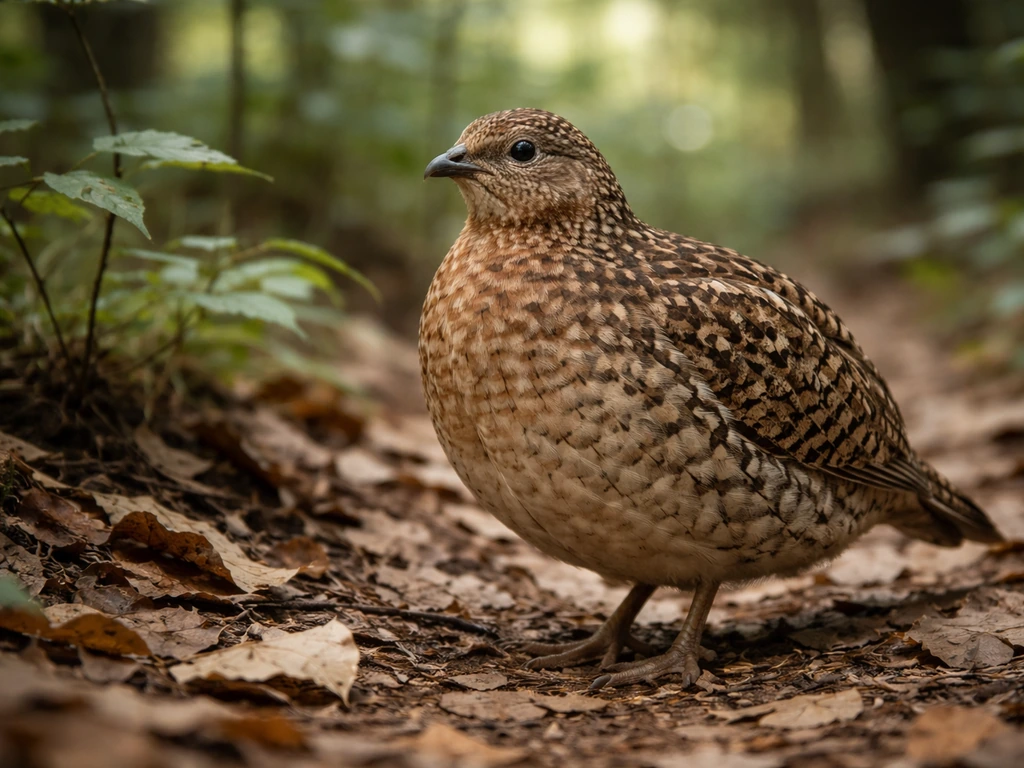
Quail are small, plump, round-bodied ground birds that look a bit like a tennis ball with legs. The phoenix bird is also described by its overall look, so it helps to compare shape, size, and standout features first when you’re wondering what it resembles look a bit like a tennis ball with legs. They sit low to the earth, carry their heads forward on a short neck, and have compact wings they rarely use unless startled. Most quail land between 8 and 11 inches long, roughly the size of a chunky fist. Their tails are short and squared-off, and the overall silhouette is so rounded and low-slung that once you've seen one, you won't mix it up with a larger bird like a pheasant again. If you're wondering about a different small ground bird, you may also like this guide on what a pee wee bird looks like what does a pee wee bird look like.
What Does a Quail Bird Look Like? ID Guide by Species

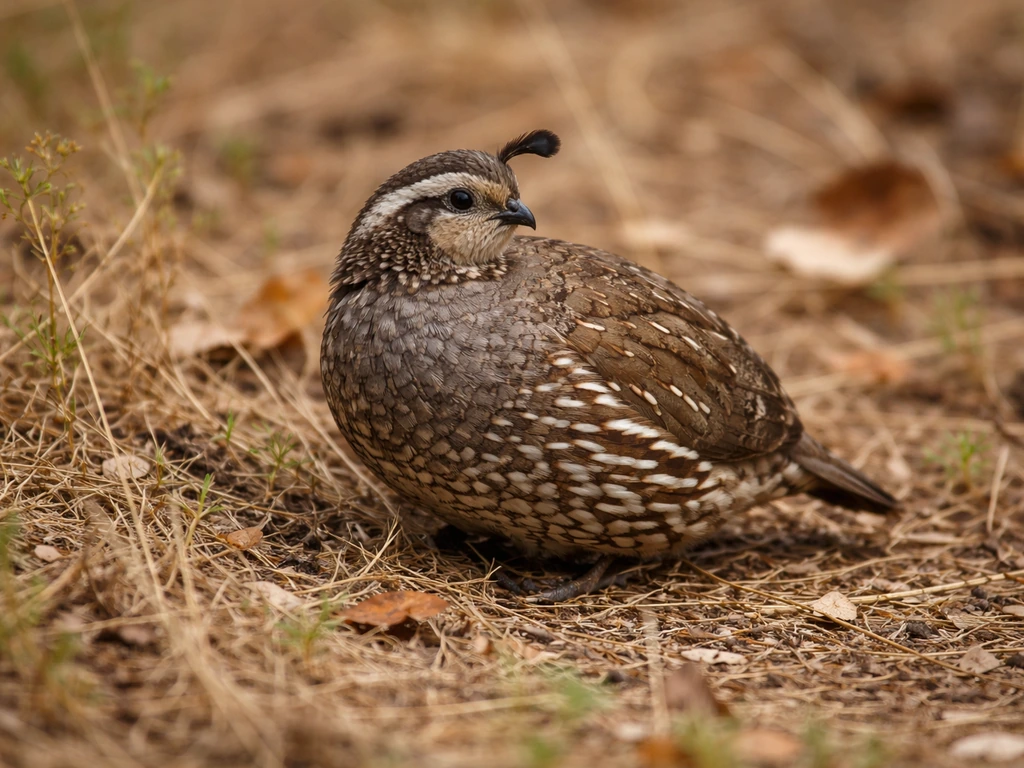
The quail shape at a glance
The first thing to lock onto is the body plan. Quail are stocky and short-necked, with a rounded back and a belly that nearly grazes the ground when they walk. The wings are short and rounded, built for explosive short bursts of flight rather than distance. When they flush, they rocket upward with a loud wing-beat and then glide back down into cover almost immediately. Outside of that moment, though, they are strictly ground birds: walking, scratching, and running through low vegetation rather than perching in trees.
Size-wise, a California (valley) quail runs 9. California (valley) quail are about 9.4, 10.6 inches (24, 27 cm) long, with a 12.6, 14.6 inch (32, 37 cm) wingspan and a weight of 4.9, 8.1 ounces (140, 230 g) blank" rel="noopener noreferrer">Size-wise, a California (valley) quail runs 9.. 4 to 10.6 inches long with a wingspan of about 12.6 to 14.6 inches and a weight of 4.9 to 8.1 oz. Northern bobwhites are similar, measuring roughly 9.4 to 11 inches in length. Think somewhere between a large sparrow and a small pigeon, but much rounder and more compact than either. The tail in most species looks square and fairly short, which is a useful detail when you're trying to rule out other birds.
Plumage patterns: what you'll actually see
Quail don't usually flash bold single colors. Instead, look for layered patterns: streaking, scaling, barring, and mottling that help them blend into leaf litter and dry grass. The exact combination depends on the species, but a few broad rules hold across almost all of them.
- Scaled or scalloped underparts: California quail males show a distinctive scaled belly pattern, where each feather has a dark border that creates an almost fish-scale effect across the chest and belly.
- Barring and streaking on the back and wings: the upperparts are typically warm brown, gray-brown, or olive-brown with fine streaks or barring that break up the outline.
- Chestnut or rusty tones on the sides: both California and Gambel's quail carry rich chestnut-red patches on the flanks, visible from the side.
- Contrasting pale edges on wing coverts: look for fine pale edging on the wing feathers when the bird is at rest.
- Gray or grayish-blue tones on the upper breast and neck in males of several species.
- Females and juveniles are noticeably plainer, with muted brown tones and less contrast overall.
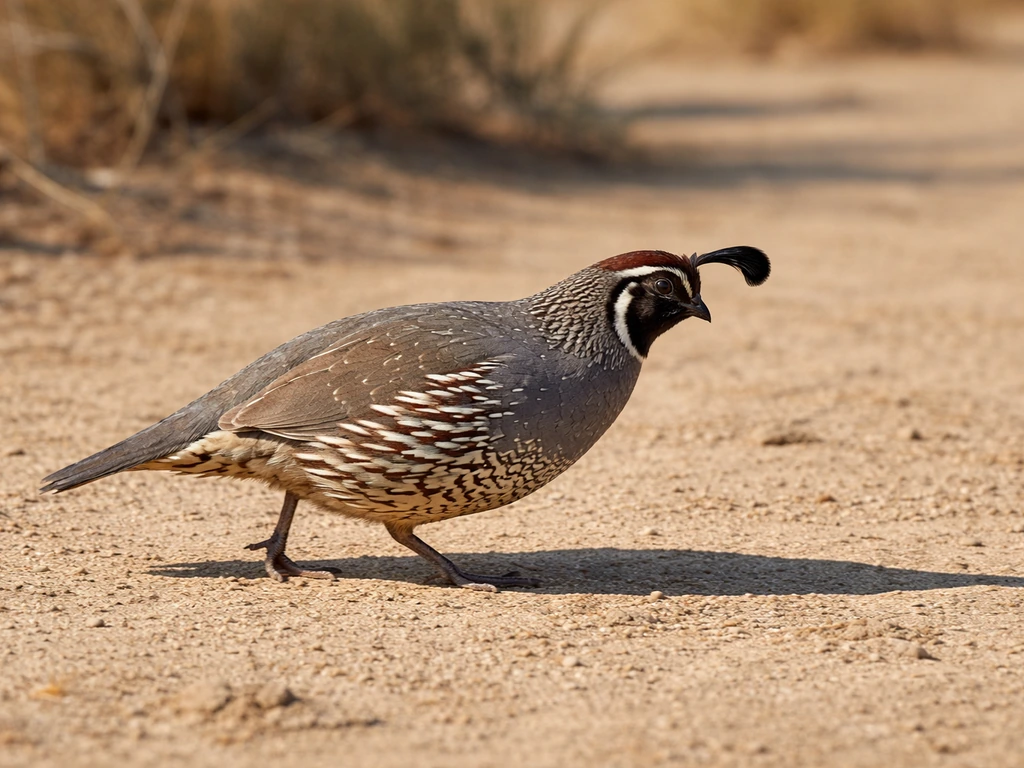
The belly is worth studying when you can. A California quail male has that scaled belly with a chestnut patch. A Gambel's quail male has a bold black patch centered in a yellow belly. A northern bobwhite shows warm reddish-brown and white streaking across the underparts. Getting a look at the underside, even briefly, will usually confirm which species you're watching.
Head and face markings: the fastest ID clues
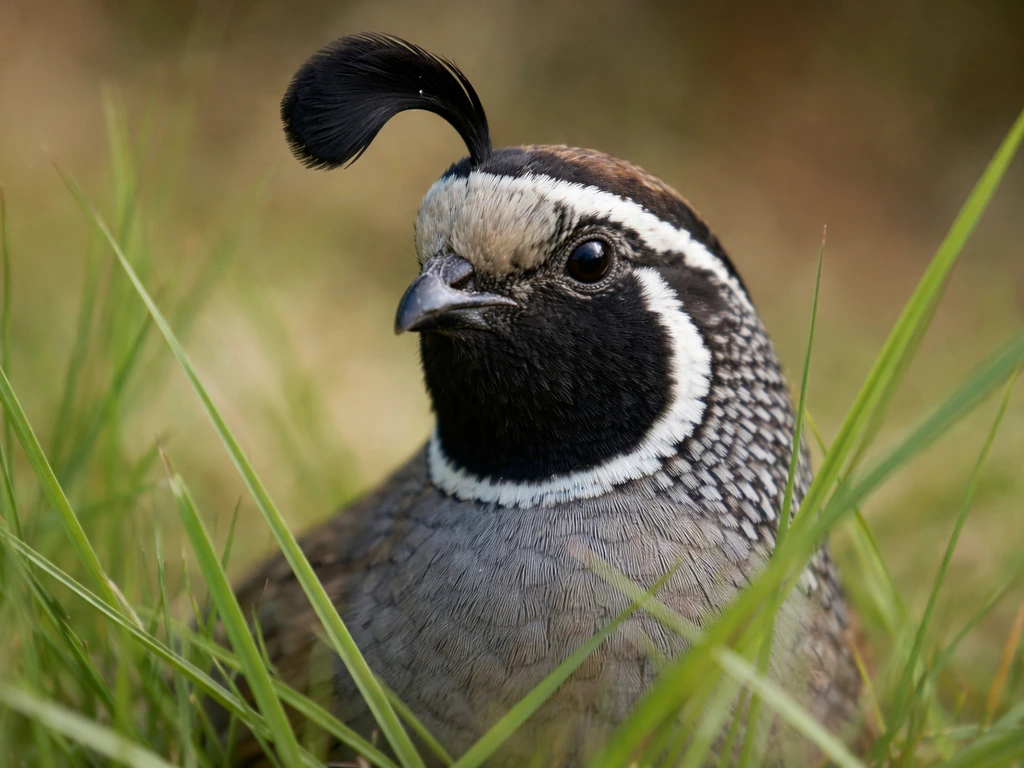
The head is where quail ID really comes together. Most species have bold, contrasting facial markings that you can spot even when the bird is half-hidden in grass. Here's what to look for on the three most commonly seen species.
California quail
The standout feature is the comma-shaped topknot, a forward-curving plume of feathers that juts out from the forehead like a little antenna. Males carry a larger, more dramatic version of this crest. The male also has a black face and throat, a white stripe running above and below the eye, and a dark brown cap. Females have a shorter, plainer topknot and much more washed-out facial markings, mostly gray-brown on the head without the sharp black contrast.
Gambel's quail
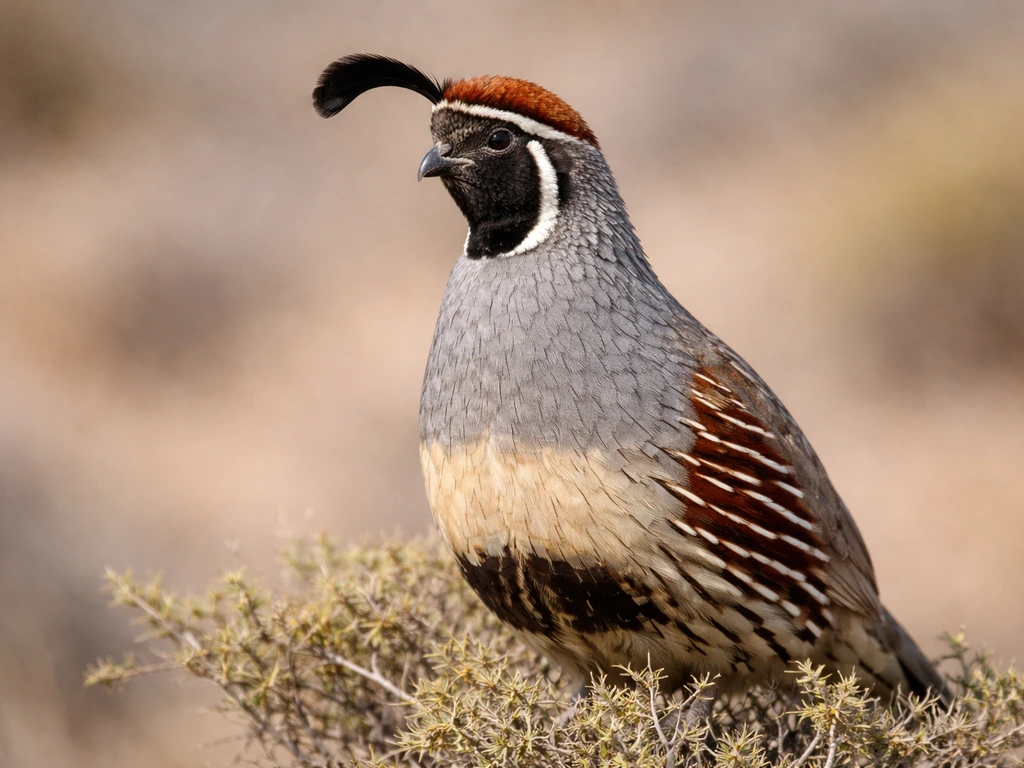
Gambel's quail also has a curving topknot, which can cause confusion with California quail at first glance. The male's head is more boldly patterned: a chestnut-red crown, a black forehead, and a black throat. The cheeks are a paler gray. Females lack the black throat entirely and have a smaller topknot. The overall head look is slightly more colorful on top (that rusty crown) compared to the California quail's brown cap.
Northern bobwhite
No topknot here. Instead, look for a strongly striped face: males have a crisp white eyebrow stripe and a white throat, both outlined by dark brown and black, making the face look almost masked. All About Birds describes the Northern bobwhite as having a strong black-and-white striped face, with males showing crisp white throat and eyebrow stripes outlined by dark brown and black, and females showing softer buffy throat tones and the same striped pattern blank" rel="noopener noreferrer">strongly striped face. The crown is dark brown. Females swap the white markings for buffy or tan tones, so the contrast is softer but the same striped pattern is still there. That bold black-and-white face on the male is one of the most distinctive quick-glance marks of any North American quail.
On the bill: quail have short, stout, slightly curved bills suited for picking seeds from the ground. The bill is small relative to the head and won't stand out the way a woodpecker's or heron's does, but it's noticeably different from the thin, pointy bills of sparrows and other seed-eating songbirds you might confuse them with at a distance.
Quail species compared: how to tell them apart
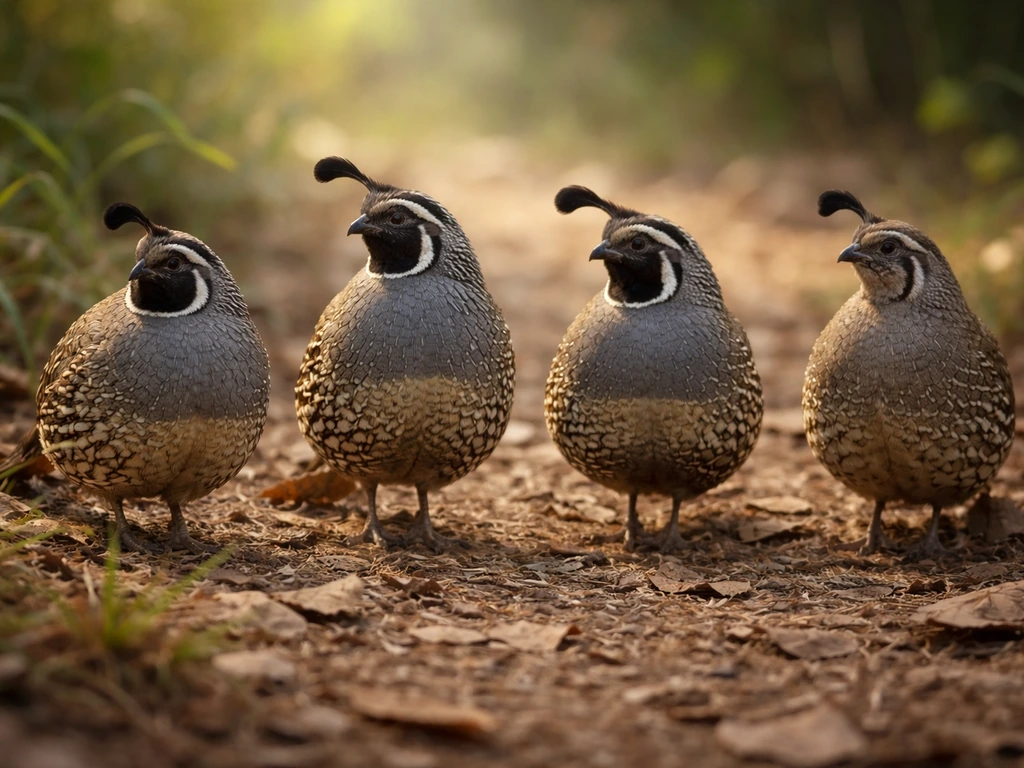
If you're in North America, you'll most likely encounter one of four species depending on where you are. Here's a side-by-side look at the key visual differences.
| Species | Topknot/Crest | Key belly mark | Key head mark | Main range |
|---|---|---|---|---|
| California quail | Forward comma-shaped plume (males larger) | Scaled pattern with chestnut patch (males) | Black face/throat, white stripes (males); plain gray-brown (females) | Pacific Coast, western states |
| Gambel's quail | Curving forward plume (similar to California) | Black patch centered in yellow belly (males) | Chestnut crown, black forehead and throat (males) | Sonoran/Mojave/Chihuahuan deserts, SW USA |
| Northern bobwhite | No topknot | Reddish-brown and white streaking | Bold white eyebrow and throat (males); buffy on females | Eastern and central USA, grasslands |
| Scaled quail | Short white-tipped crest (no forward plume) | Scaled pattern across chest and belly | Gray head with white-tipped crest, no bold stripes | Arid grasslands and scrub, SW/central USA |
| Montezuma quail | No topknot; bold harlequin face | Spotted underparts | Striking black-and-white face pattern (males) | Higher-elevation oak woodlands, SW USA |
The easiest confusion is between California and Gambel's quail, since both have the forward-curving topknot and both live in the western US (with some range overlap). The fastest check: look at the belly. If you see heavy scaling across the underparts, it's almost certainly California quail. If you see a bold black patch sitting in the middle of a yellowish belly, that's Gambel's. The Gambel's also tends to look a bit more colorful on top of the head due to that chestnut crown.
People sometimes mix quail up with young pheasants or with partridges. Phoebe birds have a different look from quail, with a slender body and plain, muted colors that you can spot by their shape and head pattern. Pheasants, even juveniles, are noticeably longer-tailed and more elongated overall. Pheasants are generally more elongated and longer-tailed than quail, so their overall look is easier to separate once you know what to check Pheasants, even juveniles. Partridges share the round, ground-hugging shape but are generally larger and lack the topknot. If you enjoy sorting out related ground birds, a partridge is worth comparing directly since both share that plump, low-slung silhouette and similarly mottled plumage. Partridges are also ground birds, but their look is generally larger and less topped or patterned than most quail.
Behavior and setting clues that confirm it's a quail
What a bird is doing and where it is doing it can be just as useful as plumage. Quail are almost always on the ground. If you see a plump, short bird walking steadily through low grass, scratching at the soil, or trotting ahead of you on a dirt path rather than flying away, that ground-bound behavior is one of the strongest quail cues you have.
- Running instead of flying: quail will jog quickly through brush to escape before they ever flush. Watching something plump and round run like it's late for a meeting is a classic quail moment.
- Explosive flushing: when they do fly, it's sudden and loud, a rapid burst of wingbeats followed by a short glide back to the ground. They almost never fly long distances.
- Dust bathing: if you see a group of small round birds crouched and wriggling in a dry, dusty patch of dirt, that's communal dust bathing. California quail do this daily and it's one of the most charming and unmistakable quail behaviors.
- Covey grouping: quail typically move in groups called coveys, sometimes a dozen or more birds walking together. Seeing a cluster of small, low birds moving through the same habitat is a useful cue.
- Low posture at rest: even when still, quail crouch and look compressed, rarely standing tall the way a robin or thrush might.
Gambel's quail have notably short back toes that don't fully touch the ground when walking, which gives their leg movement a slightly different look in profile if you're watching closely. It's a subtle clue but worth knowing if you're in the Southwest desert and trying to pin down the species.
How to photograph and observe quail for a solid ID
Quail are not shy birds exactly, but they are skittish and fast. The good news is that a patient approach almost always works better than trying to chase them down. Here's what helps most for getting a useful look or photo.
- Approach slowly from the side rather than straight on. Head-on movement reads as a predator approach and will trigger a flush. A slow, angled walk gives the covey time to adjust.
- Get low. Quail live at ground level. If you crouch or sit, you're much less threatening and you'll get a better angle on the belly and head markings that matter most for ID.
- Go for side-profile shots first. The silhouette, topknot shape, and belly pattern are all most visible from the side. Once you have a clean side view, try for a front angle to catch the facial markings.
- Shoot in early morning light. Quail are most active in the first two hours after sunrise when they're feeding. The soft, low-angle light also makes plumage colors and patterns far more visible than harsh midday sun.
- Focus on the head. The topknot, eye stripe, and throat color are the fastest ID features in photos. A sharp head shot will tell you more than a blurry full-body image.
- Watch from a fixed position. If you find a spot where quail are active (a dusty clearing, a seed-rich edge between grass and brush), stay still and let them come to you rather than following them.
When you're reviewing photos later, use the four-key framework: size and shape, color pattern, behavior, and habitat. A single blurry photo won't always give you a confident ID, but if you can match the plumage to the habitat and behavior you observed, you'll usually nail it. The belly pattern and the presence or absence of a topknot are the two features worth zooming in on first.
Where to find quail and which species to expect
Location is one of the strongest clues you have before you even raise your binoculars. Quail are highly regional, and knowing roughly where you are will immediately narrow your options.
- Pacific Coast and western states (California, Oregon, Washington, Nevada, Baja): California quail is the default. You'll find them in chaparral, brushy hillsides, suburban parks with native plantings, and open oak woodlands. They're common in backyards with seed feeders in western neighborhoods.
- Sonoran, Mojave, and Chihuahuan deserts (Arizona, New Mexico, southern Nevada, west Texas): Gambel's quail is the bird to expect. River valleys and desert washes are particularly good spots. They tend to follow drainages and congregate near any water source in dry conditions. Elevation below about 5,500 feet is the typical zone.
- Eastern and central USA (from Kansas and Nebraska east to the Atlantic): Northern bobwhite is the quail to look for. Grasslands, agricultural edges, roadsides with brushy margins, and early-successional shrubby fields are the best habitat. Bobwhite populations have declined significantly, so good spots are more limited than they once were.
- Arid grasslands and scrub from Texas to Arizona (central and southwestern USA): Scaled quail inhabit open, semi-arid grassland and scrub. Their pale gray-blue color and white-tipped crest are distinctive once you know what to look for.
- Higher-elevation oak and pine-oak woodlands in the Southwest (southeastern Arizona, southwestern New Mexico, and south into Mexico): Montezuma quail occupy a smaller, more specialized habitat. The bold harlequin face of the male is unmistakable but you have to be in the right mountain-woodland habitat to find them.
If you're somewhere that two species' ranges overlap, like parts of the California-Nevada border where California and Gambel's quail share territory, habitat becomes your first filter. California quail favor denser chaparral and cooler coastal zones. Gambel's quail push into hotter, drier, more open desert terrain. If you're standing in a creosote flat in 100-degree heat, it's almost certainly Gambel's. If you're in coastal scrub or a California oak woodland, bet on California quail.
Once you've got location, habitat, and the basic body shape locked in, a good look at the head will seal the deal almost every time. The topknot shape, the throat color, and the belly pattern are the three things to focus on, and between those three details, every common North American quail species becomes straightforward to identify with a bit of practice.
FAQ
What does a quail bird look like from far away, before you can see the details?
From a distance, quail usually read as a very low, round-bodied bird that sits close to the ground, with short wings and a short, squared tail. If you can only see silhouette, the “tennis ball with legs” look, low posture, and ground-walking style are more reliable than plumage color.
Can I tell quail from other small ground birds if the bird is mostly hidden in grass?
Yes. Prioritize the head and underside. Even when the body is obscured, the topknot (comma-shaped and forward-curving in many species) and the pattern on the belly often show through gaps in vegetation. If you cannot see the belly, use the face pattern, especially eyebrow and throat markings on males.
Why does the quail I saw look different in color than the description here?
Lighting and individual variation can change how streaking and mottling appear, especially in early morning or late afternoon glare. Also, females typically show softer, less high-contrast facial markings than males, so a “blander” head and less dramatic topknot can still be normal.
What if the topknot is hard to see, or it looks different?
Topknots can be partially hidden by angle, feathers being held differently, or brief head movements. If the crest is unclear, fall back to belly pattern first (scaled underparts versus a bold black patch on yellow) and then the face contrast on males (black-and-white masked look versus washed-out facial tones on females).
How can I distinguish California and Gambel’s quail when they look very similar?
Use two quick checks in order: belly pattern, then overall head color. Heavy scaled underparts strongly point to California quail, while a bold black patch centered in a yellowish belly points to Gambel’s. Gambel’s also often looks more colorful on top due to a chestnut crown.
How do I tell if it is a quail or a juvenile pheasant/partridge?
Quail are shorter-tailed and more compact, even as juveniles, while juvenile pheasants generally look longer-bodied with a more obvious elongated tail line. Partridges may share the ground-hugging body shape, but they are typically larger and lack the quail-style topknot and crisp facial contrast cues.
What quail behaviors give the strongest visual ID clues?
Quail are usually on the ground and tend to walk, scratch, and run through low cover rather than perch. If they flush, they often rocket upward with a loud wingbeat and then drop back into cover quickly, instead of flying extended distances.
Is there a reliable field cue for Gambel’s quail legs in profile?
If you can get a side view, Gambel’s quail often shows shorter back toes that do not fully touch the ground during walking, which can change the leg movement look. It is subtle, so pair it with head and belly markings rather than relying on it alone.
What should I do if I only have a blurry photo of a suspected quail?
Use a structured review: size and shape first, then color pattern, then behavior. In blurry images, zooming in on the belly pattern and checking presence or absence, shape, and forward curve of the topknot usually gives the highest confidence. If location was recorded, use it as a tiebreaker because these birds are highly regional.
Does location really matter for what quail bird looks like identification?
Yes, because the most common confusion species overlap in some areas. Habitat can quickly narrow the options, for example denser coastal scrub and chaparral often point toward California quail, while hotter, drier, more open desert terrain points toward Gambel’s.
What Does a Partridge Bird Look Like? Key ID Features
Learn how to identify a partridge by size, colors, head pattern, wing and tail markings, and key lookalikes.