
A whip-poor-will looks like a chunk of dead bark or crumpled leaf litter that suddenly sprouted wings. It's a medium-sized nocturnal bird, roughly 9 to 10 inches long, covered from bill to tail in intricate gray-brown mottling that makes it nearly invisible against the forest floor. The easiest field marks are the very wide, flat head, enormous dark eye, almost comically short bill hiding a massive gape, and, on males, bright white corners at the tip of the tail. You will almost certainly hear this bird long before you ever see it.
What Does a Whip‑poor‑will Bird Look Like: Visual ID Guide

Marcus Whitley
22 Jul 2026
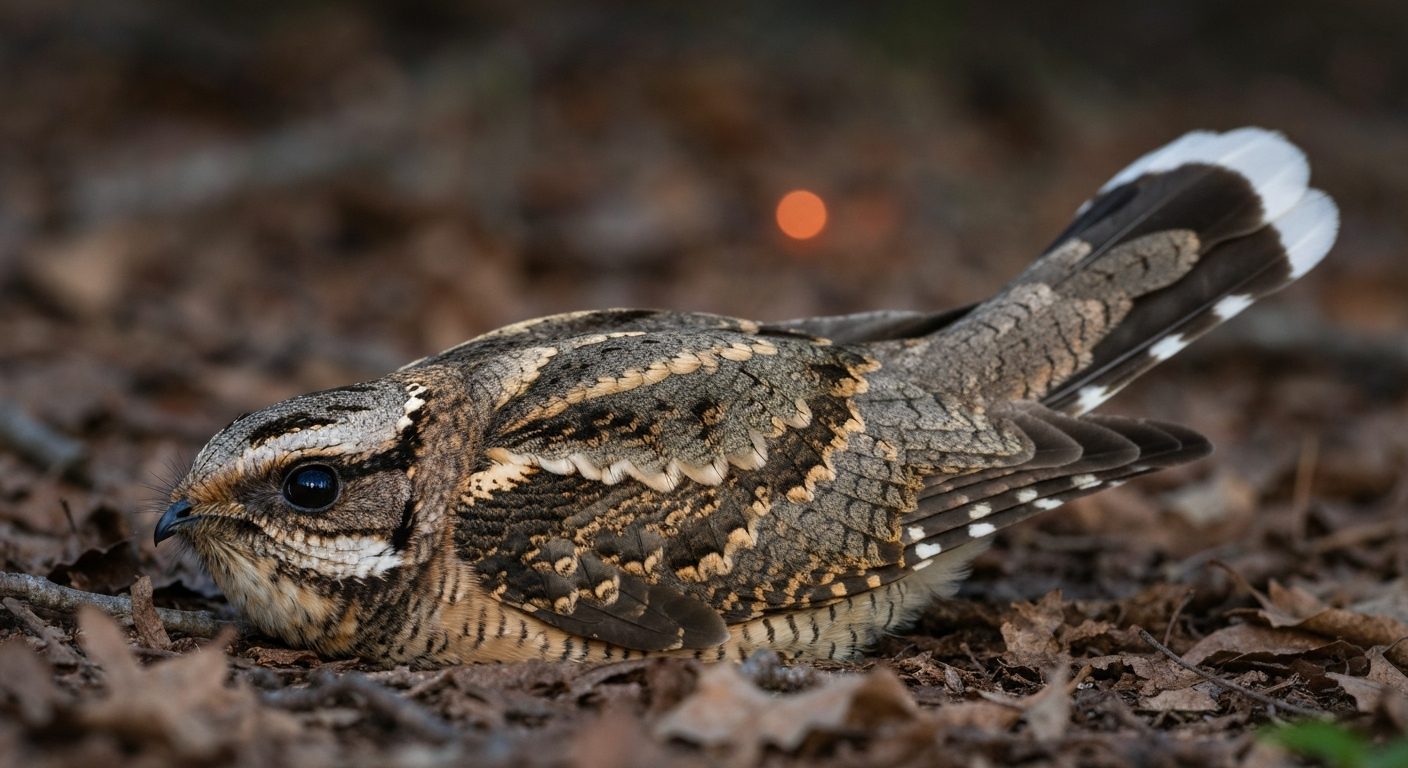
Quick visual summary: instant ID at a glance
One sentence: the whip-poor-will is a cryptically mottled gray-brown nightjar the size of a small thrush, with a round flat head, huge dark eye, long rounded wings, and white tail corners on the male. Three photo callouts tell the whole story at a glance.
- Photo callout 1 — HEAD CLOSE-UP: Look for the flat, wide head, enormous reflective eye that glows orange-red in torchlight, the tiny hooked bill, and the white throat band that separates the dark face from the mottled chest.
- Photo callout 2 — TAIL PATCHES: A male flushing or displaying shows bold white tips on the outer tail feathers, flashing like small flags. A female shows the same corners in warm buffy cream rather than white.
- Photo callout 3 — FULL-BODY CAMO: A roosting bird on the forest floor or along a horizontal branch is essentially invisible — a wash of gray, brown, tan, and black streaks that mirrors dead leaves perfectly.
Photo and illustration callouts: the details worth zooming in on
If you're trying to confirm an ID from a photo, these are the three areas worth enlarging on your screen. The head shot is the most revealing: the flat crown, huge liquid eye, and the subtle white band across the lower throat are all visible even in dim photos. The tail shot is your best sex-identification tool, so if the bird flushes and you get a rear view, look immediately at the outer tail corners. And the full-body camo shot is worth studying just to train your eye, because until you've consciously looked at a whip-poor-will's camouflage pattern, your brain will keep filing it under 'dead leaf' and moving on.
Key photo angles to seek out
- Dorsal (top-down) view: shows the full cryptic pattern of the upperparts, the flat posture against a branch, and the long tail extending beyond the wingtips
- Lateral (side-on) view: best angle to appreciate the stubby bill, rictal bristle fringe around the gape, and the way the large eye dominates the face
- Flush/flight view from below: reveals the rounded wingtips, plain underwing with no white wing bar, and the tail-corner flash on males
- Roosting portrait: a horizontal branch or leaf-litter shot showing how seamlessly the bird disappears into its background
Size, shape, and the way this bird holds itself
The whip-poor-will sits right in the middle of the nightjar family in terms of size. Measured from bill tip to tail tip it runs 8.7 to 10.2 inches (22 to 26 cm), which puts it roughly in the same ballpark as an American Robin, though it feels more compact and horizontal. The wingspan stretches 18 to 19 inches (46 to 48 cm) and the bird weighs only about 1.5 to 2.3 ounces (43 to 65 g), so it's surprisingly light for its bulk. The proportions are unusual: the head is very wide and flat, the tail is long and square-ended, and the wings reach almost to the tail tip when folded. When a whip-poor-will roosts it presses itself flat and parallel to whatever surface it's sitting on, creating a low, elongated silhouette with almost no vertical profile, which is a big part of why it's so hard to spot.
Plumage patterns and that extraordinary camouflage
The whole bird is a mosaic of gray, brown, tan, and black. The upperparts are the most complex: think of a fine weave of dark streaks and pale spots layered over a base of warm brown and cool gray, producing a texture that reads exactly like dried oak leaves or rough tree bark from any distance greater than a few feet. The underparts are slightly paler but still heavily barred, with a brownish-buff wash. The face is a slightly darker, plainer brown, with a narrow whitish-buff supercilium above the eye and a clear white throat band that creates a small but useful contrast point on an otherwise busy bird. There are no wing bars, no bold stripes, and no flashy patches anywhere on the body except those tail corners. The whole design is pure concealment.
Distinctive field marks: the ones that clinch the ID
Once you know what to look for, a whip-poor-will has several marks that lock in the identification quickly. The tail corners are the headline feature: on males, the outer three tail feathers have bright white tips that are visible both when the bird is perched (if you can see the tail) and spectacularly obvious when it flushes or displays. Females show the same pattern in buffy cream. The wing shape in flight is the second key mark: long and rounded, with blunt wingtips and no white patches anywhere on the wing. This immediately separates it from the Common Nighthawk, which has pointed wings and a bold white bar. The gape is remarkable up close and worth understanding even if you can't always see it: the bill is tiny but opens into a huge, bristle-fringed mouth designed for scooping insects out of the air at night. The eye, when caught in a flashlight or car headlights, reflects a vivid orange-red, which is actually one of the most reliable ways to locate a roosting bird on a night walk.
Field mark checklist at a glance
- Tail corners: white (male) or buffy cream (female) on outer tail feathers
- Wing shape: long, broad, rounded tips — no white wing bar
- Bill: tiny and hooked, surrounded by rictal bristles
- Eye: huge, dark, reflects orange-red in artificial light
- Throat band: thin white stripe across lower throat
- Overall color: gray-brown cryptic mottling, no bold contrast patterns on body
Male vs female: the differences you can actually use in the field
The most useful difference between the sexes is the one mark you can often catch even briefly: tail corner color. Adult males have clean, bright white outer tail tips that flash clearly in low light. Adult females have the same pattern but the color is buffy or creamy white rather than pure white, a subtler, warmer tone. Beyond that, the two sexes are very similar in overall size and pattern, so a distant or fleeting view won't always let you call the sex. If the bird is perched and well-lit, males may appear very slightly more contrasting overall, with bolder black streaking on the crown and back, but this is a tricky call without a direct comparison. When a male is actively displaying during breeding season, the tail difference becomes unmistakable: he will hover nearly vertical, fan his tail wide open, and the white corners glow. Eastern Whip-poor-will, All About Birds (behavioral note) notes males hover nearly vertical and fan their tail to display the broad white tips of the outer tail feathers in territorial or defensive displays blank" rel="noopener noreferrer">Eastern Whip-poor-will — All About Birds (behavioral note).
Juvenile vs adult and what changes as the bird ages
Young whip-poor-wills fresh out of the nest resemble adults closely enough that a quick look won't separate them. The key difference that researchers and experienced banders use is in the primary coverts: juvenile birds retain feathers with warm buff tips on these coverts, while adult birds have worn or replaced those feathers and lack that buff fringing. In the field this is a subtle distinction, and most casual observers won't catch it. What you might notice in late summer is that some birds look slightly duller or more washed-out than others, with less crisp pattern definition. That 'dull' impression is a reasonable sign you may be looking at a bird from the current year's breeding season. Molt in this species follows the standard pattern for migratory songbirds, with most primary replacement happening after the breeding season before or during migration southward.
Flight silhouette: what you see when the bird takes to the air
Seeing a whip-poor-will in flight is often a brief, ghostly experience. At dusk, a flushed bird rises from the ground with a buoyant, slightly erratic wingbeat and glides on slightly bowed wings before dropping back into cover. The silhouette against the sky shows a long, broad-winged shape with a noticeably long tail and blunt, rounded wingtips. There are no white patches on the wings, which is critical for separating it from the Common Nighthawk. The flight style alternates between quick, soft wingbeats and short glides, and the bird often twists and banks when pursuing insects, giving it an almost bat-like quality in very low light. The overall impression is a medium-sized, soft-winged bird with a big head and a long tail, moving quietly and purposefully at the forest edge.
Roosting behavior and the poses that help (or hinder) your ID
The whip-poor-will's daytime behavior is basically an exercise in maximum invisibility. It roosts on the forest floor among dead leaves, or lengthwise along a horizontal branch, pressing its body flat and closing its eyes to slits to eliminate the reflective shine that would give it away. This posture is almost perfectly adapted for disappearing: the mottled back facing upward matches the leaf litter below, and the bird holds completely still unless approached closely. If you do find a roosting bird, you will almost always notice the eye first, as even a half-closed eye catches the light. At night, males call persistently from exposed perches, which is often your best locating strategy. During display, males hover nearly upright with the tail fanned to show the white corners, a very different posture from the usual flat crouch and one of the few times this bird makes itself conspicuous on purpose.
Where to find one and when to look
The whip-poor-will breeds across eastern North America, favoring open deciduous and mixed woodlands, forest edges, and areas with a mix of open ground for foraging and leafy forest floor for roosting. Eastern Whip‑poor‑will, eBird Status & Trends (range map & seasonal timing) models the species' breeding range across eastern North America and lists estimated breeding‑season weeks Eastern Whip‑poor‑will — eBird Status & Trends (range map & seasonal timing). It's a migratory species, wintering from the southern United States through Central America. In breeding range, birds arrive in spring and are most vocal and active from late April through July, calling most intensely in the hour after sunset and the hour before sunrise, and also on bright moonlit nights when insect hunting is productive. The best strategy for a visual sighting is to drive or walk slowly along woodland roads at dusk, watching for the orange-red eye-shine in your headlights or flashlight beam. Road edges are productive because birds often forage and call from the verge. Listen for the loud, rhythmic 'whip-poor-WILL' call and move toward it slowly.
How the whip-poor-will compares to similar birds
The species most likely to cause confusion are other nightjars and nighthawks, plus the occasional large brown perching bird seen poorly in low light. The table below compares the key visual points, followed by specific bullet callouts for the most important differences.
| Feature | Whip-poor-will | Chuck-will's-widow | Common Nighthawk | Poorwill |
|---|---|---|---|---|
| Length | 8.7–10.2 in (22–26 cm) | 11.0–12.6 in (28–32 cm) | 8.7–9.4 in (22–24 cm) | ~7.5 in (19 cm) |
| Wingspan | 18–19 in (46–48 cm) | 22.8–24.0 in (58–61 cm) | 20.9–22.4 in (53–57 cm) | ~11 in (28 cm) |
| Wing shape | Long, broad, rounded tips | Long, broad, rounded tips | Long, pointed tips | Short, rounded |
| White wing bar | None | None | Bold white bar across wing | None |
| Tail corners | White (male) / buffy (female) | White (male), less distinct | No tail flash | White corners, very small |
| Overall size feel | Medium, thrush-sized | Large, noticeably bigger | Slim, falcon-like silhouette | Small, sparrow-sized |
| Active period | Dusk, dawn, moonlit nights | Dusk and night | Dusk, dawn, open sky | Dusk and night |
- vs Chuck-will's-widow: The 'Chuck' is meaningfully larger — if you see a nightjar and think 'that's big,' lean toward Chuck-will's-widow. The overall pattern is similar but warmer brown overall, and the white on the tail is distributed differently, appearing on the inner webs of the outer feathers rather than as broad tips.
- vs Common Nighthawk: This is the easiest comparison. Nighthawks have pointed, falcon-like wings with a prominent white bar roughly two-thirds of the way out, and they fly high, erratically, in open airspace. Whip-poor-wills have rounded wings, no wing bar, and fly low along woodland edges.
- vs Poorwill: The Poorwill is a western species, noticeably smaller than the whip-poor-will — closer to a large sparrow. It has the same general cryptic patterning but smaller white tail corners and a shorter, stubbier overall shape.
- vs brown passerines (thrushes, large sparrows, nightjars seen poorly): A roosting whip-poor-will on a branch can be mistaken for a lump of bark at first glance, but the flat head, huge eye, and lack of any visible upright posture or bill shape distinguishes it immediately from any songbird.
Tips for photographing and observing whip-poor-wills
Getting a good look at a whip-poor-will takes patience and the right timing. The single most productive window is roughly 20 to 40 minutes after sunset on a calm, warm night in May or June when males are calling actively. Drive slowly along woodland roads with your window down and listen. When you hear the call, stop, turn off the engine, and scan the road surface and verge with a low-powered flashlight or red-light torch. The eye-shine is your target: a small, warm orange-red glow close to the ground. For photography, bring a fast telephoto in the 400 to 500mm range, shoot at a high ISO (expect ISO 3200 to 6400 in available moonlight) and use a wide aperture. A white flashlight pointed directly at the bird will give the clearest feather detail but will also disturb the bird fastest, so take a few frames and move on. Dawn is the second-best window: birds often call briefly before light and may still be on accessible perches. Daytime roosting birds can be photographed in more comfortable light, but finding them requires searching likely habitat systematically and moving very slowly.
Watching responsibly: keeping the bird's wellbeing first
Whip-poor-wills are ground-nesters and daytime roosters, which makes them unusually vulnerable to disturbance. A few straightforward rules make a real difference. Never approach a roosting bird closely enough to cause it to flush, especially during the breeding season from May through July: eggs and chicks laid in open leaf litter have essentially no protection from predators once flushed. Keep flashlight use brief and avoid shining a bright white light directly at a bird for more than a few seconds. Do not use call playback to attract birds repeatedly in the same area, as this forces males to respond energetically to a phantom rival and can interrupt natural breeding behavior. Stick to established paths and roads rather than pushing through forest floor where nests could be underfoot. The species has experienced long-term population declines across parts of the eastern range, with a global population estimated around 1.8 million birds, so every low-disturbance visit matters.
Portable ID checklist: print or save to your phone
Run through this checklist when you think you're looking at a whip-poor-will. A confident yes on three or more of the first five marks, combined with the right habitat and time of day, is a solid identification.
- Size about robin-sized (roughly 9–10 inches) with a very flat, wide head
- Overall color: complex gray-brown mottling, no bold body markings
- Tail corners: white (male) or buffy cream (female) on outer tail feathers
- Wings: long and rounded with no white bar or patch
- Eye: very large, dark; glows orange-red in artificial light
- Bill: tiny, hooked, almost hidden, with visible bristles at the gape
- Throat: thin white band across lower throat
- Posture: flat and pressed lengthwise against branch or ground
- Behavior: flushing from leaf litter or ground at dusk/dawn in wooded edge habitat
- Sound (bonus): loud, emphatic 'whip-poor-WILL' repeated rapidly at dusk or dawn
Related species worth exploring
Once you've got the whip-poor-will down, the rest of the nightjar family starts to make more sense as a group. If you're curious about other distinctive passerines, see our short guide on what does a waxwing bird look like for a clear visual comparison. The Chuck-will's-widow is the next natural comparison: it shares the forest edge habitat across the southeastern US but is unmistakably larger and warmer brown. The Common Nighthawk is the species most observers accidentally confuse with whip-poor-wills in flight, so sharpening the pointed-wing versus rounded-wing distinction pays off quickly. If you're birding in the western US, the Poorwill fills a similar ecological niche at smaller scale. Beyond the nightjars, the cryptic brown plumage of the whip-poor-will is sometimes compared to completely unrelated birds like warblers, wrens, and other small brown species seen in low light. Spending time with comparison guides for those groups, including warblers and wrens, helps reinforce just how distinctive the nightjar body plan really is once you know it. For a quick visual contrast, see what does a warbler bird look like, warblers are compact, upright, and brightly patterned compared with the whip-poor-will's muted, long-winged profile. If you're asking what bird looks like a wren but is bigger, check comparisons with nightjars like the Chuck-will's-widow for similar, larger, wren-like profiles.
FAQ
Search-friendly title and meta description
Title: What Does a Whip-poor-will Bird Look Like? A Visual ID Guide Meta description: Visual ID guide to the whip-poor-will: size, plumage, male/female differences, key field marks, flight silhouette, behavior and photo tips. (≤160 chars)
Quick visual summary (direct answer)
A whip-poor-will is a medium-sized, nocturnal nightjar with a mottled gray-brown, leaf-litter camouflage pattern, long rounded wings, a wide gape, and—on adult males—distinct white outer tail tips visible in flight or display.
Size and proportions
Length 22–26 cm (8.7–10.2 in); wingspan about 46–48 cm (18–19 in); weight roughly 43–65 g (1.5–2.3 oz). Body is compact with a relatively large head, long rounded wings and a fairly short tail except for the outer tail feathers that show diagnostic tips.
Plumage patterns and overall color
Upperparts heavily mottled with gray, brown, tan and black streaks and spots that mimic dead leaves; underparts are buffy to gray with fine streaking and spotting. Face and throat are relatively plain compared with the body’s cryptic patterning.
Male vs female differences
Adult males have bright white tips on the outermost tail feathers (conspicuous during display or flight); adult females have buffy/cream tips instead of white. Females may appear slightly duller overall; other plumage differences are subtle.
Juvenile vs adult and molt notes
Juveniles resemble adults but are generally duller. Juvenile primary coverts and some flight covert tips show buffy tips that help age birds; these juvenile feather tips are used in banding and molt studies to identify first-year birds. Adults replace juvenile coverts in later molts, producing molt limits useful for aging.