The birds most commonly mistaken for penguins are puffins, murres, razorbills, and other members of the alcid family. These are real, living seabirds with that classic black-back, white-belly tuxedo look that screams penguin at first glance. If you spotted something inland or in your yard, a black-and-white duck like a bufflehead or a loon in winter plumage could also be the culprit. The right answer depends a lot on where you are and what exactly you noticed, so let's work through it.
What Bird Looks Like a Penguin? Top Lookalikes

Marcus Whitley
9 Jun 2026
Quick shortlist: penguin-like birds to consider first
Before diving into the details, here are the most likely candidates depending on your situation. Most people searching this question fall into one of a few camps: they saw something at the coast, they're browsing a photo online, or they caught a glimpse of a black-and-white bird and did a double-take.
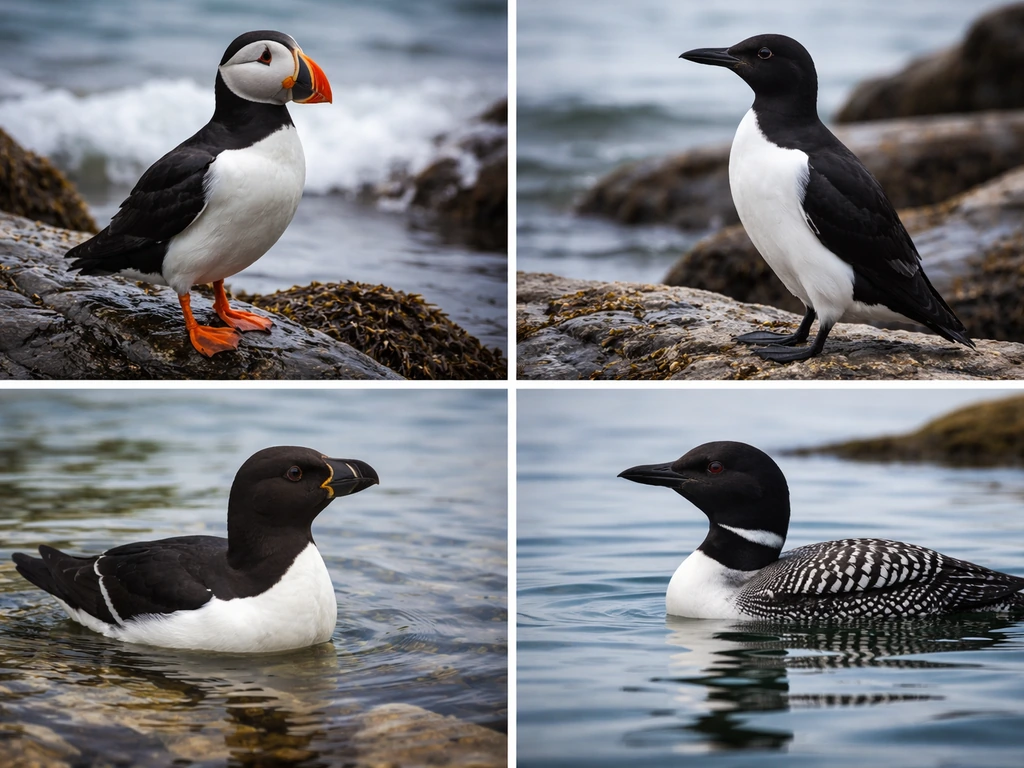
- Atlantic Puffin: chunky, black-and-white seabird with an oversized triangular colorful bill; found in the North Atlantic; the number one penguin lookalike people encounter
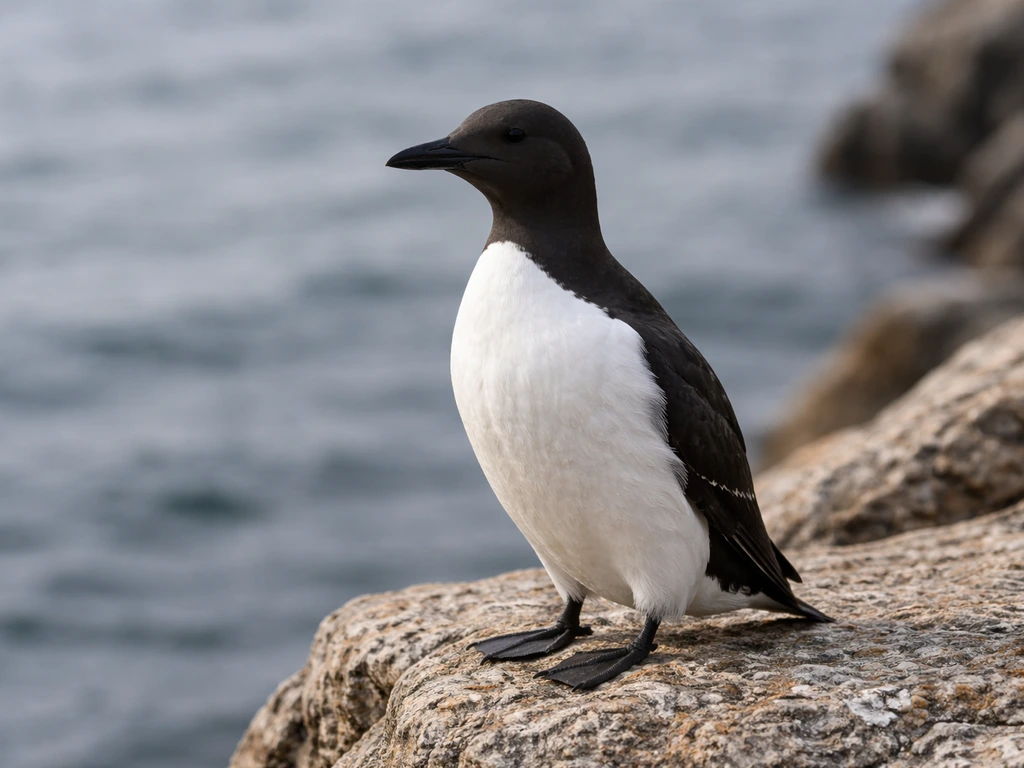
- Common Murre: upright, slender, black-and-white alcid about the size of a duck; stands very penguin-like on rocky ledges
- Razorbill: thick-necked alcid with a deep, blunt black bill crossed by a white line; stockier and more penguin-shaped than a murre
- Thick-billed Murre: nearly identical to the Common Murre but with a shorter, thicker bill and a white line along the gape
- Little Auk (Dovekie): tiny, round, black-and-white alcid; like a pocket-sized penguin; found in Arctic and North Atlantic waters
- Common Loon (winter): loses its spotted breeding colors and goes plain gray-black above, white below; confuses people inland and on coasts
- Bufflehead (male): small diving duck with a bold black-and-white pattern; seen on lakes and bays in winter
- Great Auk (extinct): the original bird called a penguin by sailors; flightless, about 30 inches tall, with a large grooved black bill — worth knowing historically even though you won't see one today
Visual ID checklist to separate 'penguin look' from lookalikes
When you're trying to figure out if what you saw is genuinely penguin-like or just a bird that shares a few colors, run through this quick checklist. The more boxes you can check, the closer you are to an alcid or penguin-style seabird.
- Black or dark back, white front: the core tuxedo pattern; if you see this, you're on the right track
- Upright posture: does it stand more vertically than most birds? Penguins and murres both hold themselves nearly bolt upright
- Compact, torpedo-shaped body: rounded head, short neck, thick body — not long and lanky like a heron
- Short legs set far back on the body: this causes the waddling walk and upright stance; visible when the bird is on land or a rock
- Small or stubby wings: if the bird can fly but the wings look almost too small for the body, that's a classic alcid trait
- Distinctive bill shape: is the bill thick and colorful (puffin), blunt and deep (razorbill), or pointed and thin (murre)?
- Behavior on water: does it sit low and dive beneath the surface rather than tipping up like a dabbling duck?
- Location: is this a coastal, ocean, or cliff environment? Penguin-lookalikes are almost always seabirds
Key distinguishing features by candidate
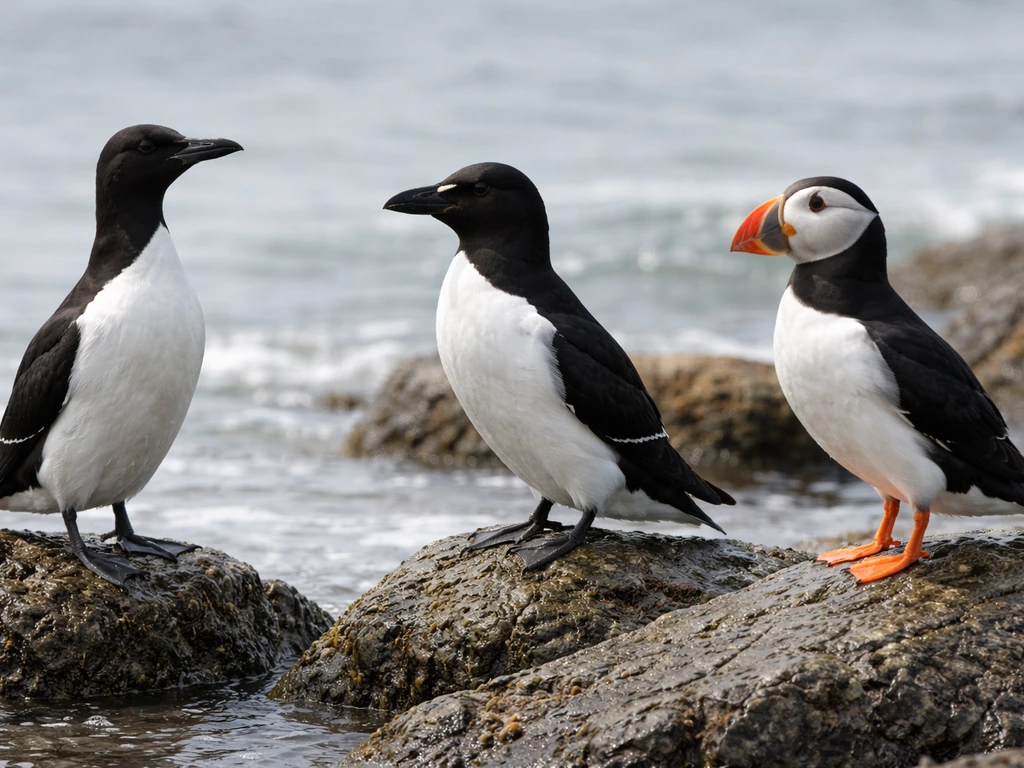
Once you know you're looking at a black-and-white seabird, the next step is pinning down the exact species. Here's how each one differs in the features you can actually spot.
| Bird | Size | Bill | Face / Head | Posture / Movement |
|---|---|---|---|---|
| Atlantic Puffin | About robin-to-pigeon sized, very compact | Large, triangular, tricolored (orange, yellow, blue-gray) in breeding season; duller in winter | White face with orange-red eye ring in summer; gray face in winter | Upright on land, whirring fast wingbeats in flight, dives underwater |
| Common Murre | Duck-sized, slender build | Long, thin, pointed dark bill | Dark brown-black head and back, white underside; thin white eye-ring in some | Very upright stance on cliffs; flies with rapid wingbeats; dives deep |
| Razorbill | Slightly smaller than murre, stockier | Deep, blunt, laterally compressed black bill with a vertical white stripe | All-black head; white line from bill to eye | Holds head tilted up, giving a particularly penguin-like profile |
| Thick-billed Murre | Similar to Common Murre | Shorter, thicker bill with a pale line along the gape | Black head, slightly darker than Common Murre | Very similar to Common Murre in behavior |
| Little Auk (Dovekie) | Starling-sized, very round and tiny | Very small, stubby black bill | Black head and throat; white below | Looks like a miniature penguin bobbing on the water |
| Common Loon (winter) | Large, about goose-sized but lower profile | Long, dagger-like gray bill | Plain gray head, white throat and underparts | Sits very low in the water; rarely seen on land |
| Bufflehead (male) | Small diving duck | Small blue-gray bill | Glossy dark green-purple head with a large white patch behind the eye | Bobs on water, dives quickly; much smaller than a penguin |
Using location and habitat to narrow the species fast
Geography is one of the fastest filters you have. Penguins themselves are only found naturally in the Southern Hemisphere, so if you're in the Northern Hemisphere and outside a zoo, you're definitely looking at something else. Here's how to use your location as a shortcut.
North Atlantic coast (Eastern US, Canada, UK, Iceland, Norway)
This is prime puffin, murre, and razorbill territory. If you're on a whale-watching boat, visiting a coastal cliff, or anywhere from Maine to Newfoundland, an Atlantic Puffin or Common Murre is the most likely match. Puffins nest on islands and sea cliffs; murres pack onto rocky ledges in enormous colonies that genuinely look like a crowd of miniature penguins from a distance.
North Pacific coast (Alaska, Pacific Northwest, Japan)
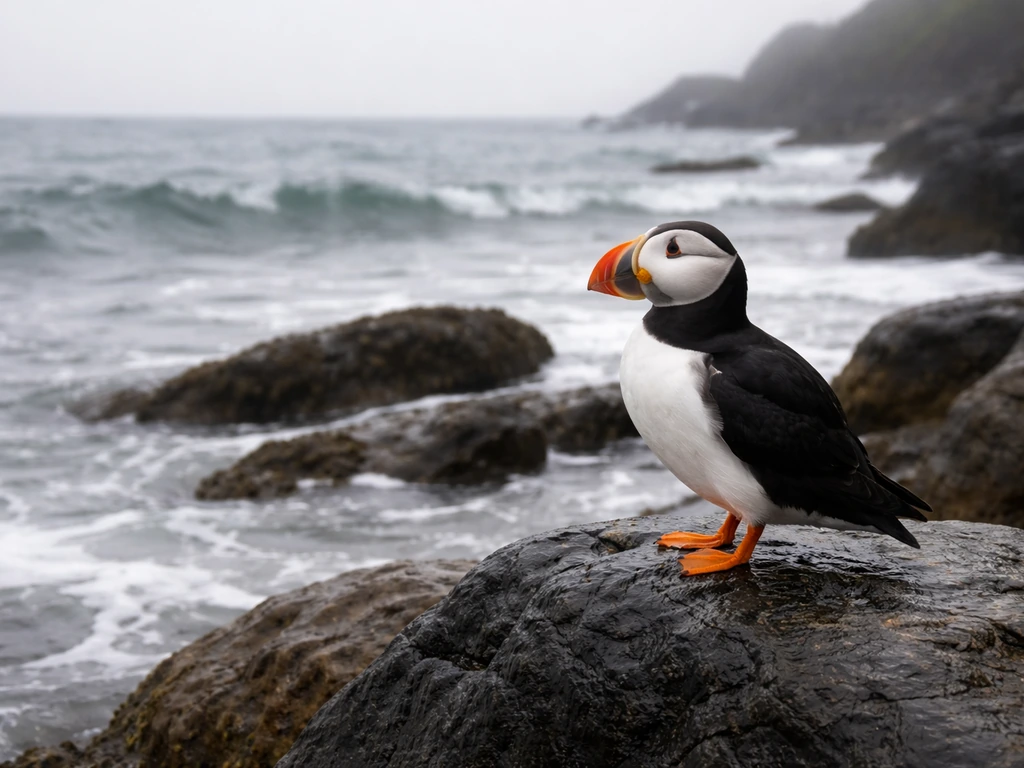
Out here you'll swap the Atlantic Puffin for the Tufted Puffin and Horned Puffin, and you'll also run into Marbled Murrelets and Ancient Murrelets. The tuxedo pattern is the same, but the Tufted Puffin has golden head plumes in summer that make it unmistakable once you know what you're looking at.
Inland lakes and rivers
If you're nowhere near the ocean, the penguin-like bird is almost certainly a loon or a bufflehead. Common Loons in winter plumage are a frequent source of confusion because they lose their dramatic spotted pattern and go dark above, white below. They also sit very low in the water, which adds to the penguin vibe.
Zoo or aquarium
If you're at a zoo or aquarium and genuinely unsure whether you're looking at a penguin or something else, check the exhibit signage first. Many aquariums house both penguins and alcids like puffins. Puffins in captivity are surprisingly often confused with penguins by visitors because they stand similarly upright and share the same color scheme. The giveaway: puffins have those vivid colored bills and can fly.
How to identify from a photo
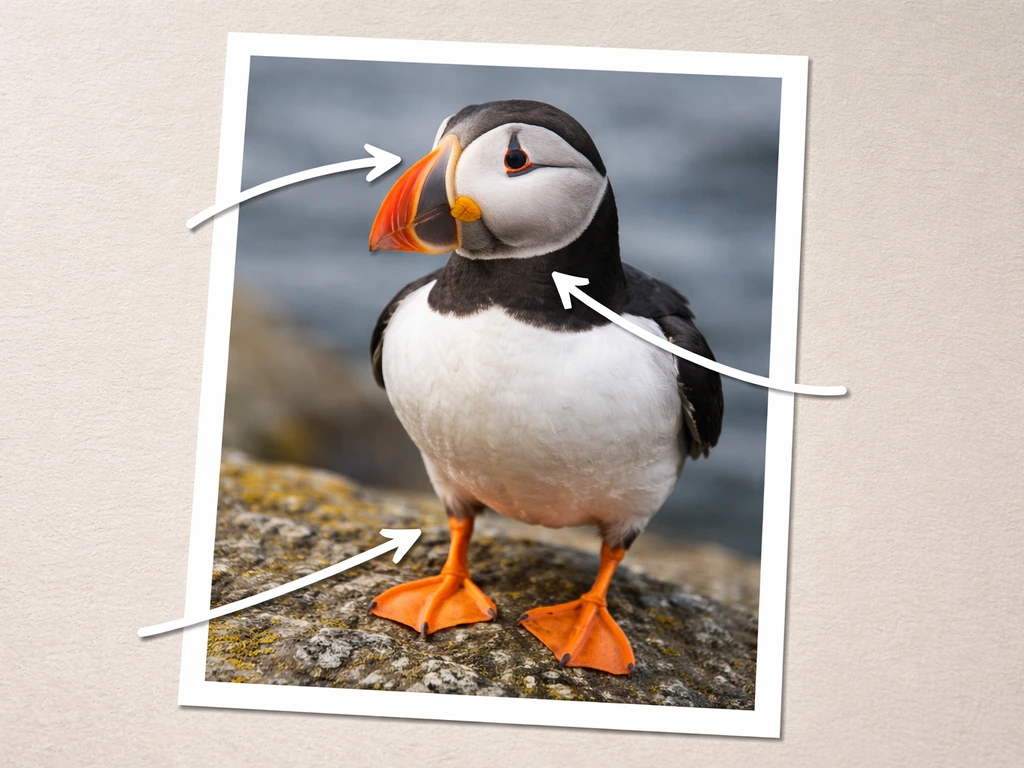
If you're working from a photo rather than a live sighting, you have a real advantage because you can zoom in and study details at your own pace. Here's what to look for in the image itself.
- Check the bill first: a colorful, triangular bill points straight to a puffin; a deep, blunt bill with a white stripe is a razorbill; a long, thin pointed bill is a murre or loon
- Look at the wing shape: if you can see the bird in flight and the wings look comically small and whirring fast, that's an alcid; penguins' wings are flipper-like and never used for flight
- Note the leg and foot position: alcids have legs set far back, making them awkward on land but efficient in water; you'll often see them standing at an angle or waddling
- Look for scale cues in the photo: is the bird next to a person, a boat railing, a rock? Murres are duck-sized; puffins are closer to a large pigeon; if it looks goose-sized or larger, you might be looking at a loon
- Check the water line: alcids ride low and float compactly; a bird sitting low with its body nearly at the waterline and minimal neck visible is a diving seabird, not a dabbling duck
- Motion blur in wings: puffins and murres beat their wings extremely fast for their body size, so motion photos often show blurred wings even at moderate shutter speeds, which can look odd and add to the penguin confusion
Common misidentifications and how to correct them
A few mix-ups come up again and again when people search for penguin-like birds. Here's where most people go wrong and how to get it right.
Puffin mistaken for a penguin
This is by far the most common one. The tuxedo colors and upright stance are nearly identical at a glance. The correction: puffins can fly (and do so with rapid, almost bumblebee-like wingbeats), while penguins cannot. Puffins also have that unmistakable large, colorful bill that no penguin shares. The Stellwagen sanctuary bird guide describes the Atlantic puffin as a “chunky, black and white alcid” with white cheeks and a large triangular tricolored bill, which helps explain why people mistake it for a penguin Atlantic puffin’s chunky black-and-white look with white cheeks and a large triangular tricolored bill. If it flew, it's not a penguin.
Murre mistaken for a penguin
On a cliff ledge packed with thousands of Common Murres standing upright side by side, the resemblance to a penguin colony is genuinely striking. But murres are slimmer, have long pointed bills, and again, they fly. Watch for a moment and you'll see them take off or land with wings spread.
Loon in winter plumage mistaken for a penguin
People see a large, dark-backed, white-bellied bird sitting low in a lake and assume it must be a penguin. Common Loons are genuinely large and have that two-toned look in winter. The correction: loons have long dagger bills, a much longer neck profile, and they're found on freshwater lakes across North America and Europe in winter.
Razorbill overlooked in favor of murre
Razorbills and murres share habitat and coloring, so people often lump them together or misidentify one as the other. The easiest fix: look at the bill. A razorbill's bill is deep, blunt, and almost parrot-like in profile, with a clear white vertical stripe. A murre's bill is long and pointed like a dagger. Once you've seen both side by side, you won't mix them up again.
Mistaking a male bufflehead for something more exotic
A male bufflehead on a winter pond is boldly black-and-white and dives repeatedly, which can trigger the penguin association in someone who isn't used to seeing ducks. But buffleheads are much smaller than any penguin lookalike, have a rounded head with a big white patch, and ride higher on the water.
Next steps: record details and confirm the species
If you're still not certain after working through the checklist above, here's exactly what to do next to pin it down with confidence. You may also be wondering what bird looks like a woodpecker, which can be another common lookalike question.
- Write down where you saw it: specific body of water, coastline, type of habitat (open ocean, cliff, freshwater lake, bay), and the date and time of year
- Note the size relative to something nearby: a boat, a person, another bird you recognized, or even a rough comparison like 'smaller than a duck' or 'about pigeon-sized'
- Describe the bill in as much detail as you can: color, length, shape (pointed, blunt, triangular, hooked), and any markings like stripes or color bands
- Note whether it flew: if it took flight, it is not a penguin and is almost certainly an alcid; notice how fast it flapped and whether the wingbeats were rapid and shallow
- Note the posture and movement on water: did it sit low and dive cleanly, or did it tip forward and splash? Diving seabirds disappear cleanly beneath the surface
- If you have a photo, zoom into the bill, feet, and face before searching; these three features alone will eliminate most of the candidates
- Cross-reference your notes against a field guide app like Merlin Bird ID (free from Cornell Lab), which lets you filter by region, color pattern, and size to match your description to a species
- If the sighting was coastal, check recent eBird reports for your exact location to see which alcids or seabirds have been spotted nearby by other birders
The penguin question is one of those fun ones because it means you've seen something genuinely striking. If you are wondering about the separate question of what bird looks like a peacock, that ID also comes down to spotting the distinctive markings and posture. If you are also wondering what bird looks like an eagle, the best approach is to compare size, head shape, and flight style. Whether it turns out to be a puffin on a rocky Atlantic island, a colony of murres on a Pacific sea stack, or a loon gliding across a winter lake, all of these birds are worth knowing by name. If what you saw looked like a turkey, it could be a loon or another black-and-white bird with a similar silhouette, so use the ID cues above to sort it out. If you are actually trying to figure out what bird looks like a bald eagle, that search has a different set of common lookalikes and clues to check puffins. The more you look, the faster the ID clicks, and you'll never confuse a razorbill for a puffin again once you've spotted that blunt grooved bill up close.
FAQ
If I’m seeing this bird inland, does it still count as a penguin lookalike?
No, puffins and penguin-like seabirds are real birds, not “winter” or “seasonal” penguins. Penguins are only found in the wild in the Southern Hemisphere, so if you are far from a zoo or aquarium, the safest assumption is an alcid (like a murre or puffin) or a North American lookalike such as a loon or bufflehead, depending on habitat.
What is the fastest way to tell if it is actually a penguin versus an alcid?
Use behavior, not just colors. Murres and razorbills both fly, puffins can fly too, while true penguins are flightless, so in any live sighting where you can confirm sustained flapping or a takeoff, you can usually rule out penguins. Also, puffins tend to look more “upright,” then launch quickly with rapid wingbeats.
What should I zoom in on in a photo to identify it correctly?
In photos, the bill shape is often clearer than the body pattern. A razorbill’s bill is thick and blunt with a clean white stripe, a murre’s bill is longer and dagger-like, and a loon’s bill looks long and narrow with a more prominent neck-to-bill line. If the image has enough resolution, zooming on the bill usually resolves the top three confusions.
Can puffins be mistaken for penguins even when they are standing still?
Not always, and this is a common mistake. Coastal videos can show a puffin standing very upright, which mimics a tuxedo silhouette. The correction is to look for either a colorful bill (often vivid in puffins) or flight capability, and to avoid judging only from a single still moment.
How reliable are exhibit signs when comparing penguins to lookalikes?
Yes, especially at zoos and aquariums where exhibits may mix species. If the enclosure has both penguins and puffins or similar alcids, rely on signage or ask staff, then cross-check with the most practical visual cues: puffins have a bright, chunky bill and can fly, while penguins will not.
What habitat clues should I use if I only saw it briefly?
Start with the two environmental questions: are you at the coast or on a lake, and what direction is it facing relative to the water? Loon and bufflehead sightings are tied to freshwater (ponds and lakes) and sitting low, while murres and razorbills are tied to rocky ledges and coastal cliffs. If you tell yourself “freshwater” or “coast,” the candidate list narrows quickly.
Why do loons look so penguin-like in winter photos?
Loons and some ducks can create a penguin-like silhouette because of contrast, and winter plumage can make patterns less obvious. Check for the loon's long dagger-like bill and the way it holds the neck, it often looks more stretched than an alcid, plus it is usually on freshwater rather than saltwater ledges.
How do I avoid mixing up murres and razorbills?
If you suspect murres versus razorbills, don’t rely on distance. Up close or in sharper images, the bill profile is the decision point. Razorbills look “parrot-like” with a deep blunt bill, murres look like they have a thin dagger bill, and murres often appear more slender overall.
What if the bird doesn’t behave like any of these lookalikes?
Sometimes the bird is neither an alcid nor a loon. If it is in your yard on land for long periods, that raises the odds of a different species or a misread silhouette. In that case, focus on whether it is actively swimming and diving (bufflehead style) or whether it is consistently tied to ocean cliffs or rocky shorelines, then confirm with clear photos.
Next Article
What Bird Looks Like an Eagle? Quick Look-Alike ID Guide
Learn which raptors mimic eagles and use a quick checklist for wing, tail, head, bill, and flight to ID fast.