Several birds can fool you into thinking you've spotted a hummingbird. Sunbirds in Africa and Asia are the most common mix-up worldwide, with their curved bills and iridescent plumage looking strikingly similar at a glance. In the Americas, flowerpiercers and a handful of small passerines cause similar confusion. In Australia it's honeyeaters. And if you're in Europe or Asia, you may have actually been watching a hummingbird hawk-moth, an insect that hovers so convincingly most people never suspect it isn't a bird at all. The key to sorting them all out is knowing exactly what a true hummingbird looks and behaves like, so you can spot where each lookalike falls short.
What Bird Looks Like a Hummingbird: ID Tips & Lookalikes

Marcus Whitley
29 Jul 2026
What a true hummingbird actually looks like
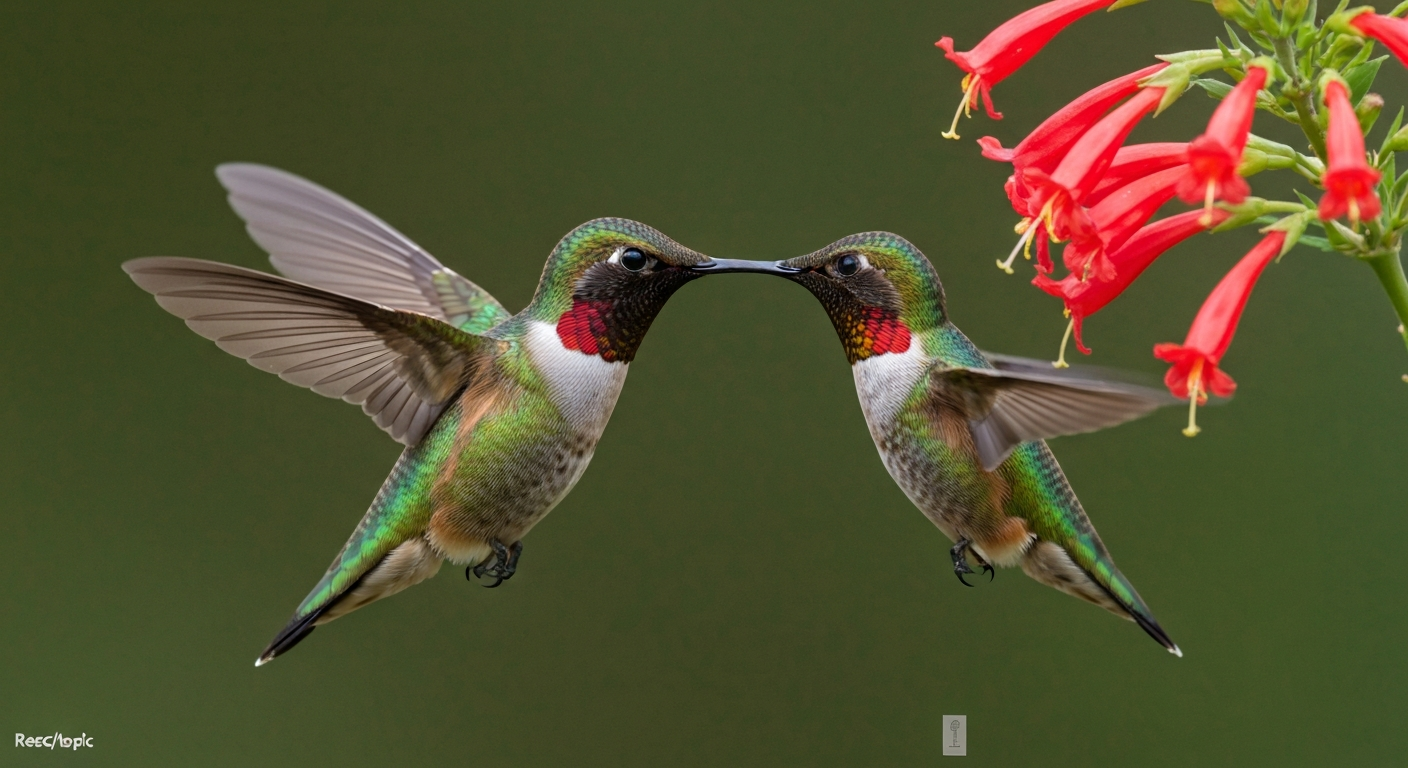
Hummingbirds belong to their own family, Trochilidae, and they're unlike anything else in the bird world when you see them up close. The smallest species, the bee hummingbird, is roughly 5–6 cm from bill tip to tail and weighs around 2 grams, about the same as a large paperclip. The biggest, the giant hummingbird of South America, stretches to around 20–23 cm and weighs up to 20 grams. Most of the species you're likely to encounter in North America fall somewhere in the middle, around 8–12 cm long.
The bill is one of the first things you'll notice. It's long, straight or gently curved, and perfectly proportioned for probing deep inside tubular flowers. It's not hooked, not thick, and not short. The body is compact and torpedo-shaped, and the wings are short and pointed rather than broad and rounded. In flight, those wings become almost invisible because they beat so incredibly fast. Medium-sized hummingbirds like the rufous hummingbird hover at around 42 wingbeats per second. The tiniest species can push close to 80–100 beats per second, and even the giant hummingbird at its slowest still manages around 12 per second. That speed is what creates the distinctive buzzing or humming sound that gives the family its name.
The iridescent colours you see on many hummingbirds, especially the glittering throat patches called gorgets, are structural rather than pigment-based. Hummingbird plumage color diversity exceeds the known gamut of all other birds, Communications Biology (2022) Hummingbird plumage color diversity exceeds the known gamut of all other birds — Communications Biology (2022). Microscopic nanostructures in the feather barbules bend and reflect light, which means the colour literally shifts depending on the angle you're viewing the bird from. A ruby-throated hummingbird's gorget can look deep red from one angle and nearly black from another. This angle-dependent flash is one of the most reliable visual clues that you're looking at a true hummingbird rather than a similarly coloured lookalike. Hummingbirds are only found in the Americas, ranging from Alaska all the way south to Tierra del Fuego, with the greatest diversity in the Andes and tropical regions of Central and South America.
Quick ID checklist: 6 things to look for in the field
When you think you've spotted a hummingbird, run through this quick mental checklist before committing to an ID. These are the features you can actually observe in a few seconds of watching.
- Size and shape: Is it tiny (roughly thumb-sized to sparrow-sized) with a compact, torpedo-shaped body and a long, straight or gently curved bill?
- Hovering: Is it sustaining a stable hover in mid-air for more than a second or two, not just fluttering briefly between perches?
- Wing blur: Are the wings moving so fast they're nearly invisible, creating an audible hum or buzz?
- Iridescence: Does the colour on the throat or back shift or flash when the bird moves? Does it seem to switch between bright and dark depending on the angle?
- Feeding posture: Is it feeding while hovering, inserting its bill directly into a flower or hovering at a feeder, rather than perching and leaning in?
- Location: Are you in North, Central, or South America? Hummingbirds don't naturally occur in Africa, Asia, Europe, or Australia, so if you're outside the Americas, it's almost certainly something else.
A quick look at the most common confusions
Before we go region by region, here's a side-by-side comparison of the main groups that get mixed up with hummingbirds. This covers the most useful visual and behavioral differences at a glance.
| Bird group | Where found | Typical size | Bill shape | Hovering? | Iridescence? |
|---|---|---|---|---|---|
| True hummingbirds | Americas only | 5–23 cm | Long, straight or gently curved | Yes, sustained and consistent | Yes, structural/angle-dependent flash |
| Sunbirds | Africa, Asia, some Pacific | 9–27 cm (some with long tails) | Curved, often strongly downcurved | Occasionally, but mostly perches | Yes, but often more matte or patch-based |
| Spiderhunters | South and Southeast Asia | 14–22 cm | Very long and strongly curved | Rarely | Mostly plain olive/brown, minimal |
| Honeyeaters | Australia, Pacific | 10–30 cm (varies widely) | Variable, often curved and brush-tipped | Occasionally | Mostly absent or limited |
| Flowerpiercers | Central and South America | 11–15 cm | Short, slightly hooked at tip | No, typically perches | Some blue-black sheen, not iridescent |
| Hummingbird hawk-moth | Europe, Africa, Asia | 4–5 cm wingspan 40–55 mm | Long proboscis (not a bill) | Yes, very convincing hover | No, brownish wings with orange hindwings |
Lookalikes in the Americas: flowerpiercers and small Neotropical birds
If you're birdwatching in Central or South America and something small and fast catches your eye near a flower, there's a reasonable chance it's a real hummingbird, but a few other birds do a convincing impression.
Flowerpiercers (Diglossa species)
Flowerpiercers are part of the tanager family, and they're probably the most frequently confused non-hummingbird in the highlands of the Andes and Central America. At a quick glance, especially a male masked flowerpiercer or slaty flowerpiercer, the dark blue-black plumage and association with flowers can momentarily suggest a hummingbird. But look more carefully and a few things stand out immediately. They measure roughly 11–15 cm, which overlaps with smaller hummingbirds, but their bill is completely different: short, slightly upturned, and with a small hook at the tip. That hook is their signature feature, used to pierce the base of flower corollas and steal nectar without entering the flower from the front. They don't hover to feed. They perch on or beside a flower, grip it, and jab in from the side. The wing shape is also broader and more rounded than a hummingbird's pointed wings.
Other small passerines near flowers
Several other small Neotropical birds, including some warblers, small tanagers, and bananaquits, visit flowers regularly and can catch your eye as a potential hummingbird. The bananaquit in particular has a slightly curved bill and feeds on nectar, but it's a small, chunky bird with a distinctive yellow belly, white eyebrow stripe, and dark back. It perches to feed and makes short fluttering hops rather than sustained hovering. None of these birds have the rapid wingbeat, the hovering ability, or the iridescent structural colour of true hummingbirds.
Lookalikes in Africa and Asia: sunbirds and spiderhunters
Sunbirds are by far the most convincing hummingbird lookalikes in the world, and if you've ever been to sub-Saharan Africa, India, or Southeast Asia and thought you glimpsed a hummingbird, a sunbird is almost certainly what you saw. The resemblance is a genuine case of convergent evolution: both groups fill the nectarivore niche, and both developed long curved bills, bright iridescent plumage, and a relationship with tubular flowers independently.
Sunbirds (family Nectariniidae)
Male sunbirds are often brilliantly coloured, and many species have metallic green, blue, or purple plumage that genuinely does flash in sunlight. The olive-backed sunbird, common across South and Southeast Asia into the Pacific, measures around 9–11 cm and has an iridescent blue-green throat that can look surprisingly hummingbird-like in a photograph. The malachite sunbird of eastern and southern Africa is even more striking, and in breeding plumage the male can measure up to 24–27 cm including its long, elongated central tail feathers. That tail length is actually a useful ID clue: no common North American hummingbird has a proportionally that long a tail. Compiled data shows sunbirds average around 9.5 grams in body mass compared to hummingbirds averaging closer to 5 grams, so many sunbirds will look noticeably chunkier.
The most reliable way to separate a sunbird from a hummingbird is to watch how it feeds. Sunbirds almost always perch while feeding, gripping a branch or stem beside the flower and leaning in with that curved bill. Some species do hover briefly, especially when visiting certain flower types, but it's a short, fluttery flutter rather than the rock-steady, mechanically powered hover that hummingbirds sustain effortlessly. The bill is also more strongly downcurved than a typical hummingbird's bill, which is usually straight or only gently curved. And again, geography is your first and best clue: if you're in Africa or Asia, you're not looking at a hummingbird.
Spiderhunters (also Nectariniidae)
Spiderhunters are the larger, plainer cousins of sunbirds, found mainly in South and Southeast Asian forests. They're mostly olive, brown, and yellow with streaked underparts, and their most distinctive feature is an extremely long, strongly curved bill that looks almost oversized for the bird's body. They measure around 14–22 cm. The lack of iridescent plumage, the perching feeding style, and the dramatic bill curvature make them fairly easy to separate from hummingbirds once you know what to look for. They're more likely to be confused with a large sunbird than with a hummingbird, but the hovering association occasionally causes mix-ups.
Lookalikes in Australia and the Pacific: honeyeaters and nectar-feeding parrots
Australia has no native hummingbirds, but it has honeyeaters, and a fast-moving honeyeater at a bottlebrush or grevillea can fool a visitor who doesn't know the local birds. Honeyeaters (family Meliphagidae) are a hugely diverse group with over 180 species ranging from tiny to crow-sized, and many of them are active, fast-moving nectar feeders.
Honeyeaters
A species like the New Holland honeyeater is one that newcomers most often flag as a hummingbird look-alike. It's a striking bird, black and white with a yellow wing patch and a small yellow patch at the base of the tail. It's around 17–21 grams and about 17–19 cm long, noticeably larger and heavier than a typical North American hummingbird. See the morphological dataset: Rainfall and phenotypic variation in the New Holland Honeyeater, PLOS/PMC (example morphological dataset) Rainfall and phenotypic variation in the New Holland Honeyeater — PLOS/PMC (example morphological dataset). The bill is medium length and slightly curved, but the overall body shape is much more like a small songbird than a hummingbird. It perches to feed almost all the time, and its flight is a direct, swooping style rather than a hovering one. Occasionally a honeyeater will briefly hover at a flower, and that momentary flutter is what triggers the confusion. But sustained hovering simply isn't how they feed.
Nectar-feeding parrots (lorikeets)
Rainbow lorikeets and similar species are sometimes mentioned alongside hummingbirds because of their brilliant multi-coloured plumage and their habit of visiting flowering trees. They're clearly parrots when you see them properly, with blunt, hooked bills and a stocky parrot build, but in a dense flowering tree seen briefly through leaves, the bright colours can trigger an initial double-take. They don't hover, and they're generally much larger than any hummingbird you'd mistake them for.
The non-bird mimic: hummingbird hawk-moths and other hovering insects
This one genuinely surprises people. The hummingbird hawk-moth (Macroglossum stellatarum) is a diurnal moth found across Europe, North Africa, and Asia, and it is one of the most convincing mimics of hummingbird behavior you'll ever encounter. It hovers with a steady, buzzing whir while extending a long proboscis into flowers, and it moves rapidly from flower to flower exactly the way a hummingbird would. Its wingspan is around 40–55 mm, which puts it in the size range of smaller hummingbirds, and its wingbeat frequency is genuinely high, estimated at 60–80+ beats per second. People who have never seen one before almost universally describe it as a tiny hummingbird.
Here's how you tell them apart from a bird. The hummingbird hawk-moth has a thick, furry-looking body, brownish forewings, and distinctive orange-brown hindwings that flash when it's in flight. It has no feathers, no visible bill, and no legs dangling below (as some small birds show when hovering). The proboscis it uses to feed is very long but thread-thin, nothing like a bird's solid, structured bill. If you can get within a few meters, the insect body shape is clear. The antennae are also visible if the light is good. It most often visits lavender, honeysuckle, and red valerian in gardens across Europe during summer months. Other hawkmoth species in the Americas and Asia also hover at flowers, so the same logic applies if you're elsewhere.
A few other insects, including some sphinx moths in the Americas and certain large bumblebees, occasionally get flagged as hummingbirds. The same principles apply: look for antennae, a segmented insect body, and the absence of feathers. If you can hear a slightly different pitch to the wing buzz compared to a bird, that's also a useful cue, but honestly the body shape is usually enough to settle it within a second or two of focused looking.
How to nail a confident ID in the field
If you see something small and fast near a flower and you're not sure what it is, the most useful things you can do in the moment are: note your geographic location first (that alone rules out most false positives outside the Americas), watch how it feeds for at least 5–10 seconds, and look at the bill shape and body proportions. If you can take a photograph, aim for a shot that captures the bill profile and the wing position. A blurred wing in a photo actually helps confirm a high wingbeat frequency, which is a genuine hummingbird characteristic. A bird that's clearly perched while feeding, or one with a strongly downcurved bill, or one with a broad rounded wing shape in flight, is almost certainly not a hummingbird.
Community identification platforms like iNaturalist and eBird are excellent next steps if you're still unsure. Uploading a photo and location gets you an expert opinion quickly. Field guides specific to your region will also give you the visual comparison pages that make separating these groups much more intuitive over time. If you enjoy visual bird comparisons like this one, you might also find it useful to look at guides on what other commonly confused birds look like, including birds that resemble robins, mockingbirds, and other familiar species that often have surprising lookalikes of their own. For examples and identification tips on what bird looks like a mockingbird, see the related species comparison. For an in-depth comparison, see the guide on what bird looks like a robin. For related comparisons, see the guide what bird looks like a seagull (internal reference ac6c91c1-37ab-43f0-9ec2-30c43bb8b128). For another common comparison, see what bird looks like a flamingo for a concise look at species people often mistake for flamingos. See our quick guide on what does a robin bird look like for an example of another commonly confused species and how to spot the differences.
FAQ
What bird looks like a hummingbird?
True hummingbirds are in the family Trochilidae (New World). Birds that commonly look like hummingbirds at a glance include Old World sunbirds (Nectariniidae), some honeyeaters (Meliphagidae) in Australasia, certain small Neotropical passerines such as flowerpiercers (Diglossa spp.), and brief hovering insects like the hummingbird hawk‑moth. These lookalikes share small size, nectar‑feeding behavior, bright colors or rapid movement, but differ in key details (see ID cues below).
How can I tell a true hummingbird from a lookalike?
Key ID cues: size (many hummingbirds are very small, often 5–12 cm total length), bill shape (long, straight or slightly decurved and often slender), sustained hovering with very high wingbeat frequency (often tens of Hz), rapid directional agility and ability to feed while hovering, and iridescent/structural gorget feathers. Lookalikes often perch to feed, have different bill shapes (shorter, hooked, or thicker), larger body mass, different wing/flight rhythm, or in the case of moths — six legs and antennae visible on close view.
Which behavioral traits are most reliable for identification?
Most reliable behaviors: sustained stable hovering while feeding (typical for hummingbirds), feeding while hovering at a feeder or tubular flower, extremely rapid wingbeats creating a distinctive hum, and rapid, acrobatic hovering maneuvers (backwards flight or sudden lateral moves). Lookalikes often perch to feed, make short flutter‑hovers only occasionally, or approach flowers differently (e.g., piercing corollas).
What visual features separate hummingbirds from sunbirds and honeyeaters?
Differences to watch for: sunbirds and honeyeaters usually perch to feed (though some can hover briefly), are on average larger and heavier, and often have different bill proportions (sunbirds often have thinner curved bills but longer overall bodies). Hummingbird iridescence is produced by specialized feather nanostructures and often appears intensely angle‑dependent (gorgets). Flight style and size are usually the best separators in the field.
Which non‑bird animals are frequently mistaken for hummingbirds?
The most common non‑bird mimic is the hummingbird hawk‑moth (Macroglossum spp.), a diurnal sphingid moth that hovers and probes flowers with a long proboscis. Its wingbeat and size can mimic a small hummingbird in poor light or at a distance. Key differences on close view: six legs, antennae, a furry (moth) body, and wing shape/beat pattern that look insect‑like rather than avian.
Top regional examples of lookalikes to watch for
Americas: flowerpiercers (Diglossa spp.), small tanagers and some warblers that visit nectar; Old World (Africa/Asia): sunbirds (Cinnyris, Nectarinia spp.); Australasia: honeyeaters (Phylidonyris, Myzomela spp.); Europe/Asia/Africa: hummingbird hawk‑moth (Macroglossum stellatarum and relatives). Knowing your region helps narrow candidates quickly.