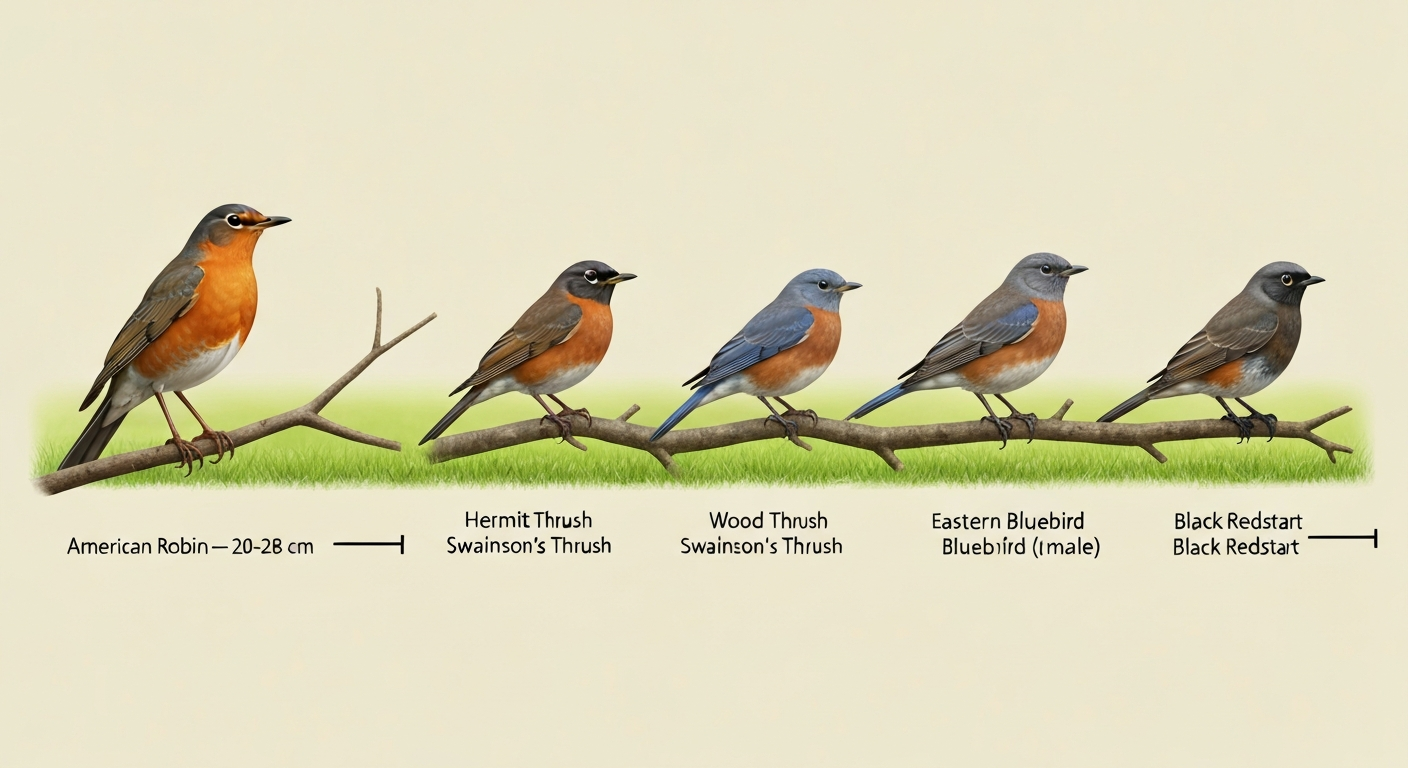
If you spotted a bird that looked like a robin but noticeably smaller, the most likely candidates are the Hermit Thrush, Swainson's Thrush, Wood Thrush, or Eastern Bluebird in North America, and the Black Redstart in Europe. All of them share that round-bellied, upright posture and warm-toned breast that make your brain say 'robin,' but each one is meaningfully smaller and carries a few tell-tale differences once you know what to look for. On the flip side, if the bird seemed bigger than a robin, you were probably looking at a Brown Thrasher or a Northern Mockingbird.
What Bird Looks Like a Robin but Smaller: Quick ID Guide

Marcus Whitley
11 Aug 2026
Why people keep asking this question
The robin is a great mental anchor for bird identification. Most people have seen one, know roughly how big it is, and recognize that warm orange-red breast. So when a bird pops up in the yard or on a trail and triggers that same impression, the natural reaction is 'that looks like a robin, but something's off.' Usually what's off is the size. The bird is either noticeably smaller and more compact, or it's bigger and a bit scruffier. This guide uses the robin as a fixed reference point and walks you through the species you're most likely to have actually seen, ranked by how often they get confused with robins. I'll cover the visual details that separate them, behavioral clues you can use on the spot, and notes on juveniles and females that make the ID even trickier. If you're also curious about other common lookalike questions, the same ID logic applies to birds that get confused with crows, owls, or pigeons.
Your baseline: what a robin actually looks like
Before you can say something is 'smaller than a robin,' you need a firm picture of the robin itself. The two robins people most commonly mean are the American Robin and the European Robin, and they're actually quite different birds despite sharing a name.
American Robin
The American Robin is a large, round-bellied thrush. It measures 7.9 to 11.0 inches (20 to 28 cm) long, weighs 2.7 to 3.0 oz (77 to 85 g), and has a wingspan of 12.2 to 15.8 inches (31 to 40 cm). Think of it as roughly the size of a starling or a small pigeon. The most obvious feature is that deep warm-orange breast, which covers the whole underside from chin to belly. The back is gray-brown, the head is darker (almost blackish in adult males), and in flight you'll notice a white patch on the lower belly and undertail. It stands very upright on the lawn, runs a few steps, freezes, then stabs at the ground for worms. That run-stop-tilt posture is one of the most reliable robin ID clues there is.
European Robin
The European Robin is much smaller, measuring about 5.5 inches (14 cm) long and weighing only 0.5 to 0.9 oz (14 to 25 g). It's plump and almost spherical when fluffed up, with a vivid orange-red face and breast, whitish belly, and olive-brown upperparts. It stands upright on fairly long legs and tends to lurk near dense cover in gardens and woodland edges. Compared to the American Robin, it's roughly half the weight and gives a much daintier impression overall.
| Feature | American Robin | European Robin |
|---|---|---|
| Length | 7.9–11.0 in (20–28 cm) | ~5.5 in (14 cm) |
| Weight | 2.7–3.0 oz (77–85 g) | 0.5–0.9 oz (14–25 g) |
| Wingspan | 12.2–15.8 in (31–40 cm) | Not widely cited; proportionally small |
| Breast color | Deep warm orange, covers full underside | Vivid orange-red, face and breast only |
| Back color | Gray-brown | Olive-brown |
| Head color | Dark gray to near-black (male) | Olive-brown with orange face |
| Belly | White patch on lower belly/undertail | Whitish below the orange breast |
| Posture | Large, upright, long-legged | Small, round, upright, long-legged |
| Range | North America | Europe, western Asia |
Smaller birds most often mistaken for a robin
These are ranked by how frequently they come up in 'I saw a robin but smaller' reports. Region notes are included because range is often your fastest filter.
1. Hermit Thrush (North America, most likely)
The Hermit Thrush is the bird I'd bet on first if someone in North America tells me they saw a small robin. It has that same chunky, round-bellied thrush shape, a spotted breast, and a reddish-brown tail that it has a distinctive habit of slowly raising and then lowering. Length is 5.5 to 7.1 inches (14 to 18 cm), weight 0.8 to 1.3 oz (23 to 37 g). No orange breast like a robin, though: the underside is white with dark brown spots. The back is olive-brown and the rusty tail is the single best field mark. It's found across most of North America and is one of the few thrushes that winters in the southern US, so you can see it year-round depending on your location.
2. Wood Thrush (eastern North America)
The Wood Thrush gives a strong 'scaled-down robin' impression because it shares that pot-bellied profile and a reddish-brown back. It measures 7.5 to 8.3 inches (19 to 21 cm) and weighs 1.4 to 1.8 oz (40 to 50 g), so it's only slightly smaller than a robin but noticeably lighter. The key difference is the underside: white with bold, round black spots rather than a solid warm-orange wash. Look for that rufous-brown head and back fading to a more olive-brown rump. It's a forest bird of eastern North America, present in summer and gone by fall.
3. Swainson's Thrush (North America, widespread in migration)
Swainson's Thrush is most often seen during spring and fall migration across much of North America, and that's when most of the robin mix-up reports happen. It measures 6.3 to 7.5 inches (16 to 19 cm) and weighs 0.8 to 1.6 oz (23 to 45 g). The standout feature is a bold buffy eye ring that gives it a 'spectacled' look, plus a buffy wash on the upper breast fading to white with spotted streaking below. The back is uniformly olive-brown. You might see it hopping through shrubby edges or forest understory, and it tends to look over its shoulder nervously, which can briefly suggest a robin's alert posture.
4. Eastern Bluebird (eastern North America)
At about two-thirds the size of a robin, the Eastern Bluebird has a compact thrush shape and a rusty-orange breast that can genuinely read as 'small robin' to a new birder, especially on females. Measurements: 6.3 to 8.3 inches (16 to 21 cm), weight 1.0 to 1.1 oz (28 to 32 g). Males have that vivid blue back and wings that immediately separate them once you get a good look, but females are grayer-blue and the orange breast is the most prominent feature. Bluebirds also have a more delicate, thin bill and tend to perch on fence posts or wires, dropping down to the ground to catch insects, which is a different style from the robin's steady worm-pulling walk.
5. American Redstart (North America, much smaller)
The American Redstart is a warbler, so it's genuinely tiny at 4.3 to 5.1 inches (11 to 13 cm) and 0.2 to 0.3 oz (6 to 9 g). It only comes up in the 'looks like a robin' conversation because adult males have bold orange patches on the wings and tail that can catch the eye in the same way a robin's breast does. Up close, though, it's obviously a very different bird: slender, hyperactive, constantly fanning its tail and drooping its wings. Female and immature redstarts replace the orange with yellow. If the bird was flitting constantly through tree canopy, this is probably your answer.
6. Black Redstart (Europe)
In Europe, the Black Redstart is described by the RSPB as 'a small robin-sized bird' and that's exactly how it gets confused. RSPB's Black Redstart, RSPB species page (measurements & ID) lists key facts: length about 14.5 cm, wingspan 23–26 cm, and weight 14–20 g Black Redstart — RSPB species page (measurements & ID). It measures about 14.5 cm (roughly 5.7 inches) with a wingspan of 23 to 26 cm and weighs 14 to 20 g. Males are dark gray to almost black on the face and chest with a rusty-red tail, while females are a more uniform sooty brown with the same rufous tail. That constantly quivering rusty tail is the best field mark. It turns up in urban areas, rocky habitats, and industrial sites across Europe, and it has the upright stance that makes the brain ping 'robin.'
Larger birds sometimes confused with robins
These are less common confusion cases but worth knowing, especially if the bird felt too big and too long-tailed to be a robin. If the bird looked vulture-like rather than robin-like, see what bird looks like a vulture for species that resemble vultures and tips to tell them apart.
1. Varied Thrush (western North America, very close in size)
The Varied Thrush is genuinely robin-sized, at 7.5 to 10.2 inches (19 to 26 cm) and 2.3 to 3.5 oz (65 to 100 g), and it carries an orange wash on the breast and eyebrow stripe. From a distance it can look remarkably like a robin. The difference is a dark gray or black breast band cutting across the orange underparts, and a more intricate orange-and-gray patterning on the wings. It's a bird of dense, wet coniferous forests in the Pacific Northwest and only turns up in gardens in winter when mountain food sources run out.
2. Northern Mockingbird (North America, similar size)
Mockingbirds are listed as 'robin-sized' in most field guides and measure 8. See Northern Mockingbird, All About Birds (Cornell Lab of Ornithology), Measurements & ID for these measurements blank" rel="noopener noreferrer">Northern Mockingbird — All About Birds (Cornell Lab of Ornithology) — Measurements & ID. 3 to 10.2 inches (21 to 26 cm), weighing 1.6 to 2.0 oz (45 to 58 g). They share the upright posture and ground-foraging habit that people associate with robins, but the color scheme is completely different: pale gray overall with white wing patches that flash in flight. If the bird you saw was doing dramatic wing-raising displays on a fence post or singing an endless medley of other birds' songs, it was almost certainly a mockingbird.
3. Brown Thrasher (North America, clearly larger)
The Brown Thrasher is bigger than a robin at 9.1 to 11.8 inches (23 to 30 cm) and 2.1 to 3.1 oz (61 to 89 g), but its rufous-brown coloring and rounded body sometimes prompt a second look from people half-expecting a giant robin. The differences are obvious once you focus: a long, decurved bill, a very long tail, bold dark streaking on a white breast, and bright yellow eyes. It tends to stay close to dense shrubs and flicks leaves aggressively with that curved bill rather than probing the ground for worms.
Side-by-side visual ID features
Here's a closer look at the specific features that matter most when you're trying to separate these species in the field. Use this as a mental checklist when you're watching the bird.
| Species | Length | Breast | Back/Upperparts | Eye ring/stripe | Bill | Tail |
|---|---|---|---|---|---|---|
| American Robin | 7.9–11.0 in | Solid warm orange, full underside | Gray-brown, dark head | None | Medium, yellow | Dark gray-brown, white corners below |
| European Robin | ~5.5 in | Vivid orange-red, face and breast only | Olive-brown | None | Fine, dark | Brown, often cocked |
| Hermit Thrush | 5.5–7.1 in | White with dark brown spots | Olive-brown, rusty tail | Faint pale eye ring | Fine, dark | Reddish-brown, raised and lowered slowly |
| Wood Thrush | 7.5–8.3 in | White with bold round black spots | Rufous-brown head, olive-brown rump | None | Medium, dark | Olive-brown |
| Swainson's Thrush | 6.3–7.5 in | Buffy wash, spotted | Uniform olive-brown | Bold buffy eye ring | Fine, dark | Olive-brown |
| Eastern Bluebird | 6.3–8.3 in | Rusty orange (male and female) | Blue (male) or gray-blue (female) | None | Short, thin | Blue, medium length |
| American Redstart | 4.3–5.1 in | Orange patches (male) or yellow (female) | Black (male) or gray-olive (female) | None | Tiny, flat | Fanned, orange/yellow patches |
| Black Redstart | ~5.7 in | Dark gray to black (male) | Dark gray/sooty brown | None | Fine, dark | Rusty-red, constantly quivered |
| Varied Thrush | 7.5–10.2 in | Orange with dark band across chest | Blue-gray with orange wingbars | Orange supercilium | Medium, dark | Dark, squared |
| Northern Mockingbird | 8.3–10.2 in | Pale gray-white | Gray with white wing patches | None | Medium, slightly curved | Long, white outer feathers |
| Brown Thrasher | 9.1–11.8 in | White with dark streaks | Rufous-brown | Yellow eye (bright) | Long, decurved | Very long, rufous-brown |
Behavioral clues that help you nail the ID
Appearance gets you most of the way there, but behavior can close the deal when the light is bad or the bird won't sit still.
Feeding style
The American Robin has a very distinctive feeding walk: it runs a short distance across the lawn, stops dead, tilts its head, and yanks a worm out of the ground. That run-stop-tilt is unique. Thrushes like the Hermit and Wood Thrush are more likely to forage by turning over leaf litter in shadier spots rather than running open lawns. The Eastern Bluebird drops from a perch to snatch insects on the ground and rarely walks the lawn the way a robin does. The Brown Thrasher digs and flicks with that long curved bill in a way that looks nothing like a robin.
Posture and movement
Robins stand very upright and look confident. The Hermit Thrush shares that posture but adds its slow tail-raising habit, a dead giveaway once you've seen it. The Swainson's Thrush tends to look more hunched and shy. The European Robin is famously bold and will often stand very close to you in a garden, cocking its head to one side. The Black Redstart has a constant shivering or quivering motion in its tail that no other bird on this list does in quite the same way.
Flight pattern
Robins fly with fairly direct, powerful wingbeats and show that white undertail patch as they land. Thrushes tend to fly in a bounding undulating pattern through woodland. Bluebirds have a light, fluttery flight and often glide down from a perch. The American Redstart is constantly flitting and darting through foliage, nothing like a robin's deliberate ground-to-branch flights. The Varied Thrush makes long direct flights low through forest and is rarely seen in the open except in winter gardens.
Song and calls
The American Robin's song is a rolling, liquid series of phrases that sounds like 'cheerily, cheer-up, cheerio,' repeated from high in a tree, often at dawn and dusk. If the bird was singing something that complex and musical from a treetop, it was probably a robin. The Wood Thrush sings one of the most beautiful flute-like songs in North American birding, often described as 'ee-oh-lay.' The Hermit Thrush's song is similarly ethereal and spiraling. The Eastern Bluebird has a soft, burbling warble. The Northern Mockingbird will run through dozens of different song patterns in rapid succession, which no thrush or robin does. The European Robin sings a thin, wistful, slightly melancholy warble year-round, including in winter.
Juvenile and female plumage: the biggest source of confusion
Young birds and females can look genuinely different from what you'd find in a field guide illustration, and this trips up a lot of people. Here's what to watch for with each species.
American Robin juveniles
Juvenile American Robins are one of the most commonly misidentified birds in North America. They don't have a clean orange breast at all. Instead, they have a heavily spotted chest and a spotted back, which makes them look like an entirely different, thrush-like bird. They appear from late spring through summer and gradually molt into adult plumage by fall. If you see a spotty-chested bird in June or July that seems 'wrong' for any thrush species, check whether it's just a young robin in juvenile plumage.
American Robin males vs females
Adult males have a darker, near-black head that contrasts sharply with the orange breast. Adult females have a gray-brown head that blends more softly into the breast. The female's orange is also slightly paler and less saturated. In dim light, a female robin can look unexpectedly washed-out compared to the vivid males most people picture.
European Robin juveniles
European Robin juveniles completely lack the orange face and breast. They are covered in bold pale buffy spots on both the back and breast, giving them a distinctly thrush-like, almost speckled appearance. This spotted juvenile plumage is worn through the first summer and replaced by the adult orange bib in late summer and fall during the post-juvenile molt.
Eastern Bluebird females and juveniles
Female Eastern Bluebirds are grayer and less vivid than males, with a muted blue-gray on the wings and a softer rusty wash on the breast. Juveniles are spotted gray-brown on the breast and back, and the faint blue tones in the wings are the only hint of the adult plumage to come. A spotted juvenile bluebird in summer can be genuinely puzzling.
Thrush juveniles (Hermit, Wood, Swainson's)
All young thrushes go through a spotted juvenile phase similar to their parents but with buffier, less defined markings. Young Wood Thrushes are especially easily confused with adult Hermit Thrushes and vice versa until you pin down the tail color and spotting pattern. The key thing to remember is that spotted underparts in a chunky, round-bellied bird in summer or early fall are very often a young thrush or a young robin, not an unusual spotty species you've never heard of.
Seasonal molting and what it changes
Many of these species look their sharpest in spring, right after their complete winter molt. By late summer, feathers are worn and faded, colors look drabber, and some field marks like wingbars or eye rings appear less crisp. A worn Wood Thrush in August can look puzzlingly plain compared to a fresh spring bird. Robins themselves can look quite faded by late summer, with the orange breast appearing paler and the back looking scruffier. If a bird seems dull and hard to pin down, try to account for feather wear before deciding it's something unusual.
Quick field checklist: five things to note in the moment
When you spot a potential robin lookalike, run through these five questions quickly before the bird disappears.
- Size relative to a known bird: Is it noticeably smaller than a starling, roughly robin-sized, or closer to a pigeon? This one filter rules out most species immediately.
- Breast color and pattern: Is the breast solid warm orange, rusty-orange but limited to the chest, spotted on white, or streaked on white? Solid orange and spotted are completely different birds.
- Back and tail color: Is the tail rusty-red (Hermit Thrush, Black Redstart) or the same color as the back? A contrasting tail is a fast ID shortcut.
- Eye markings: Is there a bold eye ring (Swainson's Thrush), a colored supercilium stripe (Varied Thrush), or nothing notable around the eye?
- Behavior: Is the bird running and stopping on a lawn, perching and dropping to the ground, flicking leaves, or darting through canopy? Each of those points to a different species.
Narrowing it down by region and season
Your location does a lot of the work for you. In the eastern United States in summer, a smaller robin lookalike is almost certainly a Wood Thrush or Hermit Thrush. In the Pacific Northwest in winter, add Varied Thrush to the top of your list. During spring and fall migration across North America, Swainson's Thrush becomes a strong candidate because it moves through areas where it doesn't breed. In Europe, the Black Redstart is the first call for a small 'robin type' in urban or rocky habitats, particularly on the continent, while the Common Redstart (a related species with a vivid rusty breast and tail) turns up in woodland and scrub in summer. The Eastern Bluebird is a year-round bird in much of the eastern US but is most visible in winter when it forms loose flocks around berry-bearing shrubs.
Practical next steps for your ID
If you're still not sure after working through this guide, the best next step is a free ID app like Merlin Bird ID from the Cornell Lab of Ornithology. If you have a different question, for example, identifying what bird looks like an owl, see the dedicated guide for that topic for targeted tips. You can answer five quick questions (size, color, behavior, location, date) and it will generate a ranked shortlist of likely species with photos and recordings. For Europe, the RSPB's online bird identifier works the same way. If you heard the bird sing or call, Merlin's Sound ID can often get you a match within seconds just from a recording. For a physical reference, a regional field guide covering your specific area will always be more useful than a global one because it cuts the species list down to what you could actually be seeing. And if you enjoy working through these lookalike puzzles, the same ID approach applies to sorting out birds that resemble sparrows, crows, owls, or pigeons, all of which have their own sets of commonly confused lookalikes worth knowing.
FAQ
Which specific species should I research for "what bird looks like a robin but smaller" and "but bigger" questions?
North America (primary): American Robin (Turdus migratorius) as baseline; likely smaller lookalikes: Hermit Thrush (Catharus guttatus), Swainson’s Thrush (Catharus ustulatus), Wood Thrush (Hylocichla mustelina), Eastern Bluebird (Sialia sialis), American Redstart (Setophaga ruticilla). Larger or similar‑sized species often called “bigger robins”: Northern Mockingbird (Mimus polyglottos), Brown Thrasher (Toxostoma rufum), Varied Thrush (Ixoreus naevius) (west). Europe/UK: European Robin (Erithacus rubecula) baseline; lookalikes and comparisons: Black Redstart (Phoenicurus ochruros), Common Redstart (Phoenicurus phoenicurus), small wagtails and flycatchers where relevant. Include juvenile and female versions of each species because plumage can differ.
What authoritative sources should I use for measurements, plumage notes, behavior, and range?
Priority (tier‑1) field authorities: Cornell Lab of Ornithology — All About Birds (species pages and identification sections); Royal Society for the Protection of Birds (RSPB) for UK/Europe species; British Trust for Ornithology (BTO) and BirdLife International for range/status. Additional reliable sources: National Audubon Society species guides, Handbook of the Birds of the World / BirdLife (HBW Alive), regional field guides (Sibley, Peterson), and peer‑reviewed papers for specific plumage/ageing studies. Use these to verify measurements, juvenile/sex plumage, seasonal movements, and behavior.
What exact measurements should be compiled and presented for each species?
Length (cm and in), weight (g and oz), wingspan (cm and in). Where possible provide ranges for both sexes and note sexual size dimorphism. Also include relative-size statements (e.g., “~2/3 the length of an American Robin” or “about the same size as an American Robin”) and typical posture/shape descriptors (compact, long‑tailed, pot‑bellied, upright).
What visual ID features are essential to list and compare side‑by‑side?
Breast/underpart color and pattern (solid orange, spotted, streaked, buffy); face and head pattern (eye ring, eye line, cap, throat contrast); bill shape and color (thin fine insectivore bill vs. thicker thrush bill); back and wing color/pattern; tail length and shape; overall posture/proportions (stocky thrush vs. upright robin); distinctive field marks (wing bars, bold breast band, white undertail/vent patches, bold eye ring). Include measurement cues (bill length relative to head) that are visible in photos.
What behavioral cues should be documented to help separate robins from lookalikes?
Feeding method: ground‑probing/pulling worms (American Robin) vs. hopping and gleaning in leaf litter (thrushes) or sallying for insects from perches (flycatchers/warblers). Movement/posture: running across lawns (Robin) vs. still, upright on low perches (European Robin) or flicking wings/tail (American Redstart, Varied Thrush). Flight: direct flapping with shallow wingbeats (robins) vs. undulating or quick flutters (some thrushes, bluebirds). Voice: short, clear phrases and robin song vs. high thin warbler notes or thrush flute; include links to audio resources (Macaulay Library/Cornell All About Birds sound files).
What juvenile and sex‑plumage notes must be included to avoid misidentifications?
Describe juvenile patterns for each species: American Robin juveniles are spotted on chest/back and duller overall; European Robin juveniles are heavily spotted buff with no orange breast. Note female vs. male differences where relevant: female American Robins paler head and duller orange; male Varied Thrush and Redstart males show stronger contrast. Explain how spotting, streaking, or dulling in juveniles can mimic other species (e.g., juvenile robin vs. spotted thrush) and include visual examples or photo captions.
Next Article
What Bird Looks Like an Owl? Visual ID Guide & Lookalikes
Quick guide to birds that look like owls: ID features, top lookalikes (frogmouths, potoos, nightjars).