Several birds are regularly mistaken for owls, and the most common culprits are tawny frogmouths (Australia), potoos (the Americas), nightjars and nighthawks (found almost worldwide), and occasionally perched herons or certain hawks. All of them share one or more of the owl's most recognizable features: a broad, rounded head, large forward-angled eyes, mottled brown camouflage, and a habit of sitting stone-still in low light. Once you know what to look for, though, you can tell them apart quickly.
What Bird Looks Like an Owl? Visual ID Guide & Lookalikes

Marcus Whitley
9 Aug 2026
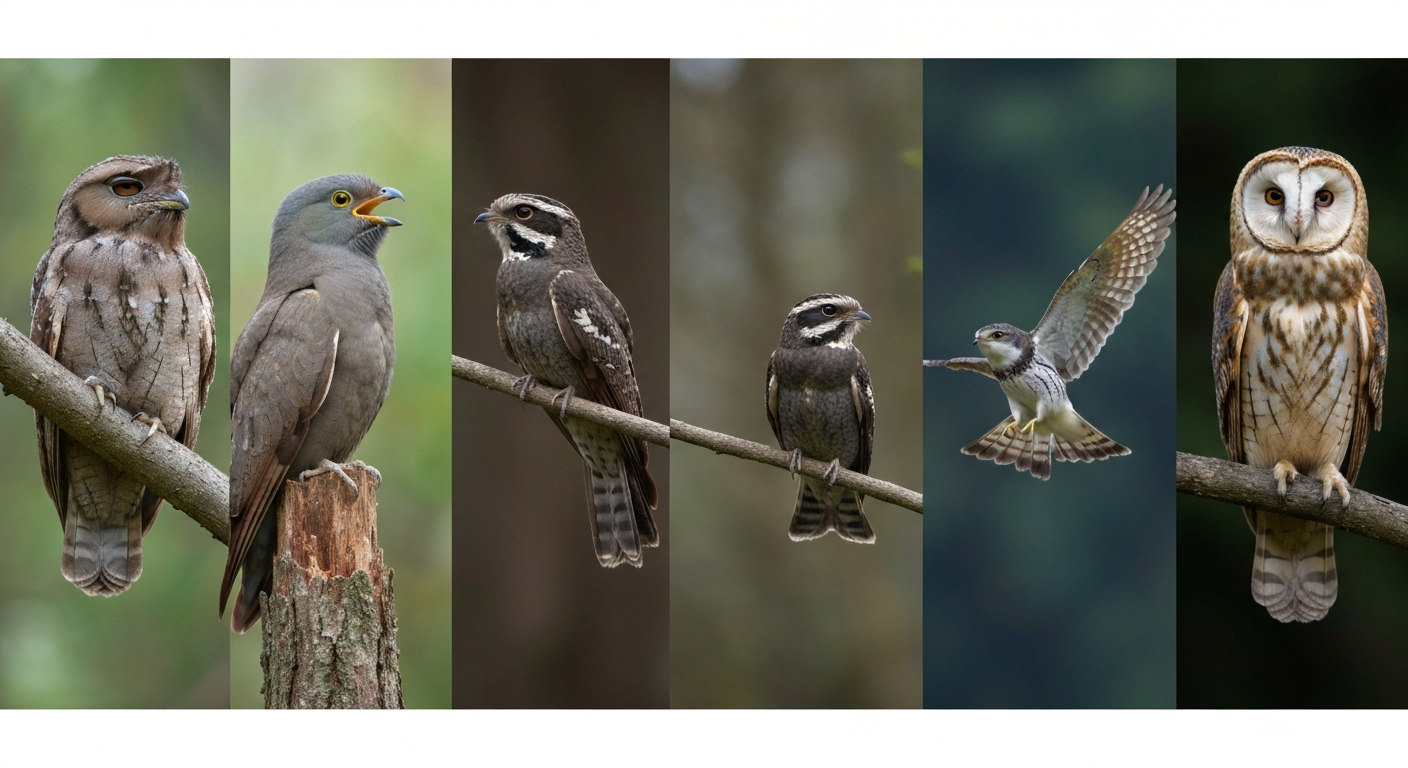
Why some birds look so much like owls
The classic owl look comes down to a handful of features that evolution has handed to a few other bird groups as well. The most striking is the facial disc: that flat, heart- or moon-shaped ring of feathers framing an owl's face. It actually works like a satellite dish, channeling sound toward the ears, and it is one of the clearest signs you are looking at a true owl rather than an imposter. Owls also have tubular eyes that point almost straight forward, giving them a wide binocular field and the depth perception they need to nail a mouse in the dark. Add upright posture, ear tufts on many species, and a chunky silhouette, and you have a very recognizable package.
Frogmouths, potoos, and nightjars do not have a real facial disc or the owl's unusual ear asymmetry (where one ear sits higher than the other to pinpoint sounds in three dimensions). They look owl-like mostly because of big eyes, broad heads, and cryptic brown-and-grey patterning adapted for hiding on bark or stumps during the day. The resemblance is a coincidence of camouflage and lifestyle rather than a close family connection. Knowing this distinction is the first step to a confident ID in the field.
Quick visual checklist: owl lookalike field cues
Before you go deeper, run through these fast checks whenever you spot a suspicious stocky bird at dusk or in low light: Field‑ID metrics commonly used to separate owls from lookalikes (overall length, wingspan, bill length/shape, eye orientation, facial disc, head posture, and flight silhouette) are summarized in Caprimulgiformes family accounts and species biometrics, Oiseaux.net (field metrics & silhouettes) Caprimulgiformes family accounts and species biometrics — Oiseaux.net (field metrics & silhouettes).
- Facial disc: is there a clear, defined ring of feathers framing the face? Present on owls, absent on frogmouths, potoos, and nightjars
- Eye direction: do the eyes face almost straight forward (owl), or are they set slightly more to the sides of the head (nightjar, potoo)?
- Bill shape: owls have a short, sharp, down-curved hook; frogmouths have a wide, frog-like gape; nightjars and potoos have a tiny visible beak but a massive concealed mouth opening
- Ear tufts: small feather tufts on top of the head appear on some owls (great horned, long-eared) and not on lookalikes
- Posture: is the bird bolt-upright with its beak angled skyward (potoo or frogmouth in camouflage mode) or upright but head-swiveling (owl)?
- Time of day: did you spot it before dusk or is it broad daylight? Many frogmouths and potoos are visible roosting by day
- Habitat and region: are you in Australia (frogmouth likely), tropical America (potoo possible), or open farmland at dusk worldwide (nightjar or nighthawk likely)?
The main owl lookalikes by region
Australasia: tawny frogmouth and its relatives
If you are in Australia and you spot what looks like a small owl roosting on a branch in broad daylight, there is a very good chance you are looking at a tawny frogmouth. These birds are around 35 to 53 cm long (roughly the size of a small to mid-sized owl), covered in streaky silver-grey and brown plumage that mimics bark almost perfectly. The giveaway is the bill: instead of the owl's neat downward hook, the tawny frogmouth has a wide, triangular bill with a slightly hooked tip that looks almost frog-like and is much bigger relative to the face than an owl's beak. When alarmed, it points its bill straight up and freezes, becoming nearly invisible against a branch. You might also notice the absence of any facial disc ring and eyes that catch the light orange-yellow rather than the typical deep amber-yellow of most owls.
Other frogmouth species live across South and Southeast Asia (including the large Hodgson's frogmouth and several Batrachostomus species), and they follow the same general pattern: broad head, big gape, perching motionless, and looking uncannily owl-like at first glance.
The Americas: potoos
Potoos are arguably the most convincing owl mimics of all. Found from Mexico through Central and South America, they perch upright on dead snags or stumps with their eyes mostly closed during the day, turning themselves into an almost perfect continuation of the stump itself. Authoritative range and seasonality data for the Common Potoo can be found via eBird Status & Trends, Common Potoo range map (example of authoritative range/seasonality source) eBird Status & Trends — Common Potoo range map (example of authoritative range/seasonality source). The common potoo is about 35 to 41 cm long, while the great potoo stretches up to 60 cm with a wingspan of over 70 cm, which pushes it into genuine owl size territory. Look closely and you will notice the tiny, almost comically small visible beak, which conceals a huge mouth capable of snagging moths in mid-air. Their eyes, when open, are enormous and yellowish, positioned on a large, rounded head, which is exactly what triggers that owl response in our brains. No facial disc, though, and the wings are longer and more pointed than a typical owl's.
Worldwide: nightjars and nighthawks
Nightjars and nighthawks are the most widespread of the owl lookalikes, found on every continent except Antarctica. They are smaller and sleeker than the others, but a nightjar sitting on a fence post or low branch at dusk can stop you in your tracks. The common nighthawk of North America is about 21 to 25 cm long with a wingspan of 51 to 61 cm, and the European nightjar comes in around 24 to 28 cm with a wingspan up to 59 cm. Both have that characteristic flat head, huge eye, and mottled brown plumage. In flight, they look nothing like an owl: nighthawks and nightjars have long, pointed or falcon-like wings and a buoyant, erratic flight style, completely unlike the broad, silent wingbeats of a hunting owl. On the ground or perched along a branch, though, the resemblance can genuinely fool you.
Occasional look-alikes: perched herons and some hawks
At certain times of year or in poor light, a few other birds can trigger that 'is that an owl?' moment. A black-crowned night heron roosting hunched up in a tree has the same stocky shape and forward-staring yellow eye that reads as owl-like from a distance. Get a better angle and the long bill, striped head, and overall heron shape give it away. Harriers, a group of hawks that hunt low over fields, are worth mentioning because they are one of the rare non-owl birds to have developed a partial facial ruff that actually helps them hear prey in grass, similar in function (though not identical in anatomy) to the owl's disc. A juvenile harrier perched can genuinely look owl-like in profile until you see it move.
Step-by-step field ID: how to confirm what you are seeing
Working through the following checks in order will get you to a confident ID even in low-light conditions, which is exactly when you are most likely to encounter these birds.
- Check size first. Hold it against something you know: a house sparrow is about 15 cm, a common pigeon about 32 cm. If the bird is in the 20 to 35 cm range, you are probably looking at a nightjar or small frogmouth rather than a large owl. A bird over 45 cm with a rounded head starts to look very owl-like indeed.
- Look at the face shape. A true owl has a distinct disc: a flat, framed face with eyes set into an obvious ring of shorter feathers. Frogmouths and potoos have big rounded heads but lack this defined ring.
- Check eye direction. Owl eyes sit almost at the very front of the skull for maximum binocular overlap. Nightjar and potoo eyes are large but set slightly more to the side, giving the face a slightly different, less intense forward stare.
- Look at the bill. This is often the quickest giveaway. A short, sharp, downward-curved hook means owl. A wide, gaping, triangular bill means frogmouth. A tiny visible nub hiding a huge mouth opening means nightjar or potoo.
- Watch the posture. Owls sit upright and swivel their heads actively. Potoos and frogmouths freeze in a rigid, branch-imitating tilt with the bill pointed upward, rarely turning the head.
- Watch it fly. Owls flap with broad, silent, rounded wings. Nighthawks and nightjars show long, pointed wings and erratic, buoyant flight. Potoos, when flushed, show long wings and a direct but slightly fluttery flight.
- Listen. Owls hoot, screech, or bark in characteristic patterns. Tawny frogmouths produce a low, repetitive 'oom-oom-oom' boom. Potoos give eerie, descending wails. Nightjars produce churring, purring mechanical sounds. Recordings on sites like Macaulay Library and xeno-canto are excellent free resources for training your ear.
- Note the time of day. Seeing a large 'owl-like' bird in full daylight roosting motionless on a branch is classic frogmouth or potoo behavior. A true owl in that position in midday sun is much less common.
- Consider your habitat and location. You will not find a tawny frogmouth outside of Australasia, or a potoo outside of the Americas. Regional context alone narrows the list dramatically before you check anything else.
Top owl lookalikes compared at a glance
| Bird | Length | Wingspan | Facial disc | Bill shape | Eyes | Typical posture | When active | Region |
|---|---|---|---|---|---|---|---|---|
| Tawny Frogmouth | 35–53 cm | 65–98 cm | None | Wide, frog-like gape | Orange-yellow, forward-angled | Rigid 'stump' pose by day | Crepuscular/nocturnal | Australia |
| Common Potoo | 35–41 cm | ~60–70 cm | None | Tiny visible beak, huge gape | Very large, yellowish | Upright 'broken branch' by day | Nocturnal | Mexico to S. America |
| Great Potoo | 48–60 cm | 70–80+ cm | None | Tiny visible beak, huge gape | Very large, yellowish | Upright 'broken branch' by day | Nocturnal | C. and S. America |
| European Nightjar | 24.5–28 cm | 52–59 cm | None | Tiny beak, wide gape | Large, dark | Flat perch along branch or ground | Crepuscular/nocturnal | Europe, Africa (migrant) |
| Common Nighthawk | 21–25 cm | 51–61 cm | None | Tiny beak, wide gape | Large, dark | Flat perch; active in flight | Crepuscular | Americas |
| True Owl (e.g. Tawny Owl) | 37–43 cm | 81–96 cm | Distinct ring present | Short, hooked | Large, fully forward-facing | Upright, head-swiveling | Nocturnal | Worldwide (varies) |
Photo gallery: seeing the differences side by side
The comparison below describes what to look for in field photos and why each image helps lock in the ID. Use these descriptions as a guide when reviewing your own photos or browsing online image libraries.
Owl vs. tawny frogmouth
Suggested image: A tawny frogmouth perched on a branch beside a similarly sized owl (e.g., a southern boobook or barn owl). Caption: 'Tawny frogmouth (left) and barn owl (right): note the frogmouth's wide, triangular bill, lack of facial disc, and mottled bark-like plumage compared to the owl's clean white disc and hooked beak.' Alt text suggestion: 'Tawny frogmouth perched on a branch next to a barn owl showing the difference in bill shape and facial disc.' The key feature to flag in the image is the bill and the face ring (or absence of one). The frogmouth's camouflage pattern also tends to look more randomly streaked and wood-like, while owl plumage patterns tend to be more symmetrical and face-framing.
Owl vs. common potoo
Suggested image: A common potoo on a dead stump, eyes open, beside a similarly sized owl. Caption: 'Common potoo (left) roosting on a stump in classic upright camouflage posture, compared to a perched owl (right). The potoo's enormous eye and tiny visible beak are the key ID points.' Alt text suggestion: 'Common potoo with open yellow eyes perched upright on a stump, compared to a perched owl with visible facial disc.' Look for the potoo's striking open eye: it is enormous and almost perfectly circular, and the tiny beak above it gives the face a very different structure from the owl's down-curved hook sitting inside its disc.
Owl vs. nightjar
Suggested image: A European nightjar or common nighthawk perched flat along a branch or fence rail, beside a small owl. Caption: 'European nightjar (top) perched flat along a branch, showing its small size, long wings, and absence of a facial disc, versus a little owl below it with a clear disc and upright posture.' Alt text suggestion: 'European nightjar perched lengthwise along a branch compared to a small owl with upright posture and facial disc visible.' The most useful thing in a nightjar comparison photo is the posture: nightjars almost always sit parallel to a branch or flat on the ground, while owls sit fully upright. The nightjar's wings are also visibly longer relative to the body.
Owl vs. nighthawk in flight
Suggested image: A common nighthawk in flight (showing the white wing bar) alongside a small owl in flight. Caption: 'Common nighthawk in flight (top) showing pointed wings and the distinctive white bar across the primary feathers, compared to the broad, rounded wings of a barn owl below.' Alt text suggestion: 'Common nighthawk in flight with pointed wings and white wing bar compared to a barn owl showing broad rounded wings.' Flight shape is the single clearest difference once the bird is in the air: the nighthawk's narrow, swept-back wings look nothing like an owl's wide, buoyant flight silhouette.
Owl vs. perched heron or harrier
Suggested image: A black-crowned night heron in hunched roosting posture beside a similarly sized owl. Caption: 'Black-crowned night heron (left) hunched in roost with yellow eye visible, compared to a short-eared owl (right). The heron's long bill becomes visible as soon as it raises its head.' Alt text suggestion: 'Black-crowned night heron hunched on a branch showing its yellow eye, beside a short-eared owl with visible facial disc.' This comparison works best in images where the heron's neck is partially extended, revealing the long, dagger-like bill that immediately rules out owl. Photo-use note: freely licensed comparison images for all the species above are available via Wikimedia Commons. Always check license terms before publishing. For personal field-ID reference, screenshots from eBird media, Macaulay Library, or xeno-canto recordings give excellent real-world examples with habitat and time-of-day context.
Common mistakes and how to avoid them
The single most common error is calling a roosting tawny frogmouth an owl, especially for visitors to Australia who have not encountered frogmouths before. The size and mottled grey plumage are convincing, but the bill gives it away every time: that wide, gaping, triangular shape is nothing like an owl's neat hook. A second common mix-up is mistaking the 'ear tufts' on owls like the long-eared or great horned for a diagnostic feature shared by lookalikes. None of the main lookalike groups have ear tufts, so if you can clearly see those feather horns, you have an actual owl.
Poor light is responsible for most misidentifications. A nighthawk seen at dusk against a grey sky will show a rounded silhouette in between wingbeats that reads as owl-like. The moment it flaps again and those long, pointed wings come out, the illusion breaks. If you can, wait for the bird to move before committing to an ID.
Using the same method for other lookalike questions
The approach here, starting with overall size and silhouette, then moving to face shape, bill, posture, behavior, and sound, works for any 'what bird looks like X' question. For a similar identification guide, see what bird looks like a robin but smaller. See the related guide 'what bird looks like a vulture' for applying this method to vultures. See our guide on what bird looks like a pigeon for the same stepwise ID approach applied to common pigeon lookalikes. For another common comparison, see our guide on what bird looks like a crow for the same stepwise ID approach applied to crow lookalikes. The same logic applies when you are trying to figure out if a small brown bird is a sparrow, or whether that big dark bird overhead is a crow or something else entirely. For a focused guide, see what does a sparrow bird look like, which summarizes the key features, size, streaking, bill shape, and behavior, to separate sparrows from similar small brown birds. Building up from the most visible feature (size, shape, color) to the more subtle ones (bill detail, wing pattern, call) keeps the process manageable in the field, where you rarely have perfect conditions or unlimited time.
FAQ
Search‑ready title and meta description for the article
Title: What Bird Looks Like an Owl? A Visual ID Guide for Casual Birdwatchers. Meta description: Learn which birds commonly look like owls (frogmouths, potoos, nightjars, and mistaken raptors), how to spot key visual and behavioral differences, and step‑by‑step ID checks to confirm what you saw.
Short direct answer to the core question
Several nocturnal or crepuscular birds can look like owls at a glance—most notably tawny frogmouths and other frogmouths (Australasia), potoos (the Americas), and nightjars/nighthawks worldwide. They share large eyes, cryptic plumage and upright perches but lack the owl’s built facial disc, ear asymmetry and hooked bill—use posture, face shape, bill shape, flight and calls to tell them apart.
Which visual and behavioral traits make a bird look “owl‑like”
Common “owl‑like” traits: a rounded or flattened head with large forward‑looking eyes; mottled, bark‑like plumage; a stocky, compact silhouette when perched; tendency to sit motionless and cryptic during the day; and nocturnal or crepuscular activity. However, owls usually show a distinct feathered facial disc, true forward‑tubular eyes and ear‑opening asymmetry for hearing—traits often absent in lookalikes.
Region‑specific groups and species commonly mistaken for owls
Australasia: Tawny Frogmouth (Podargus strigoides) and other Podargus/Podargus‑related frogmouths. Americas: Potoos (Nyctibiidae), e.g., Common Potoo (Nyctibius griseus) and Great Potoo (Nyctibius grandis). Worldwide/temperate regions: Nightjars and nighthawks (Caprimulgidae), e.g., Common Nighthawk (Chordeiles minor) and European Nightjar (Caprimulgus europaeus). Occasional one‑off confusions: perched herons, some raptors or perched corvids seen at dusk can look owl‑like at a distance.
Key anatomical differences (why they’re not true owls)
True owls (Strigiformes) typically have a muscular feathered facial disc that funnels sound, ear‑opening asymmetry for vertical sound localization, tubular forward‑facing eyes, and a strongly hooked bill for slicing prey. Frogmouths, potoos and nightjars lack a true facial disc and ear asymmetry, have different bill shape (broad gape in frogmouths/nightjars), and show adaptations for sit‑and‑wait or aerial‑insectivory rather than owl‑style hearing‑guided strikes.
Step‑by‑step field ID checks to distinguish lookalikes from owls
1) Size: estimate length and wingspan against known references (e.g., tawny frogmouth 35–53 cm). 2) Face shape: look for a rounded feathered facial disc (owls) vs flattened/cryptic face (frogmouth/potoo). 3) Eye direction: true tubular/very forward eyes suggest an owl; more lateral or less tubular eyes point to a lookalike. 4) Bill shape: hooked raptor‑like bill = owl; broad frog‑like gape or short wide bill = frogmouth/potoo. 5) Posture: owls often perch in exposed forks and pivot the head; potoos/frogmouths hold rigid stump‑like or broken‑branch poses. 6) Flight silhouette: owls usually show broad rounded wings and silent flight; nighthawks/nightjars have long pointed or swept wings and erratic aerial habits. 7) Vocalizations and timing: check call type and time of day—many lookalikes call at dusk/dawn or night but vocal timbre differs (consult audio libraries). 8) Habitat: compare to species’ typical habitats and range maps.
Next Articles
What Bird Looks Like a Vulture? Visual ID Guide & Tips
What bird looks like a vulture? Quick visual ID, common look-alikes, and field tips to tell them apart.
What Bird Looks Like a Pigeon: Quick ID Guide to Lookalikes
Quick visual ID guide: which birds look like pigeons, key features, regional lookalikes and photo tips.
What Bird Looks Like a Crow? Quick Field ID Guide
Identify the bird that looks like a crow fast with traits, look-alikes, and a step-by-step comparison checklist.