Suggested SEO Title: What Bird Looks Like a Vulture? 10 Species Commonly Mistaken for Vultures Meta Description: Saw a large dark bird soaring overhead? This visual guide shows exactly which birds look like vultures and how to tell them apart in the field.
What Bird Looks Like a Vulture? Visual ID Guide & Tips

Marcus Whitley
8 Aug 2026
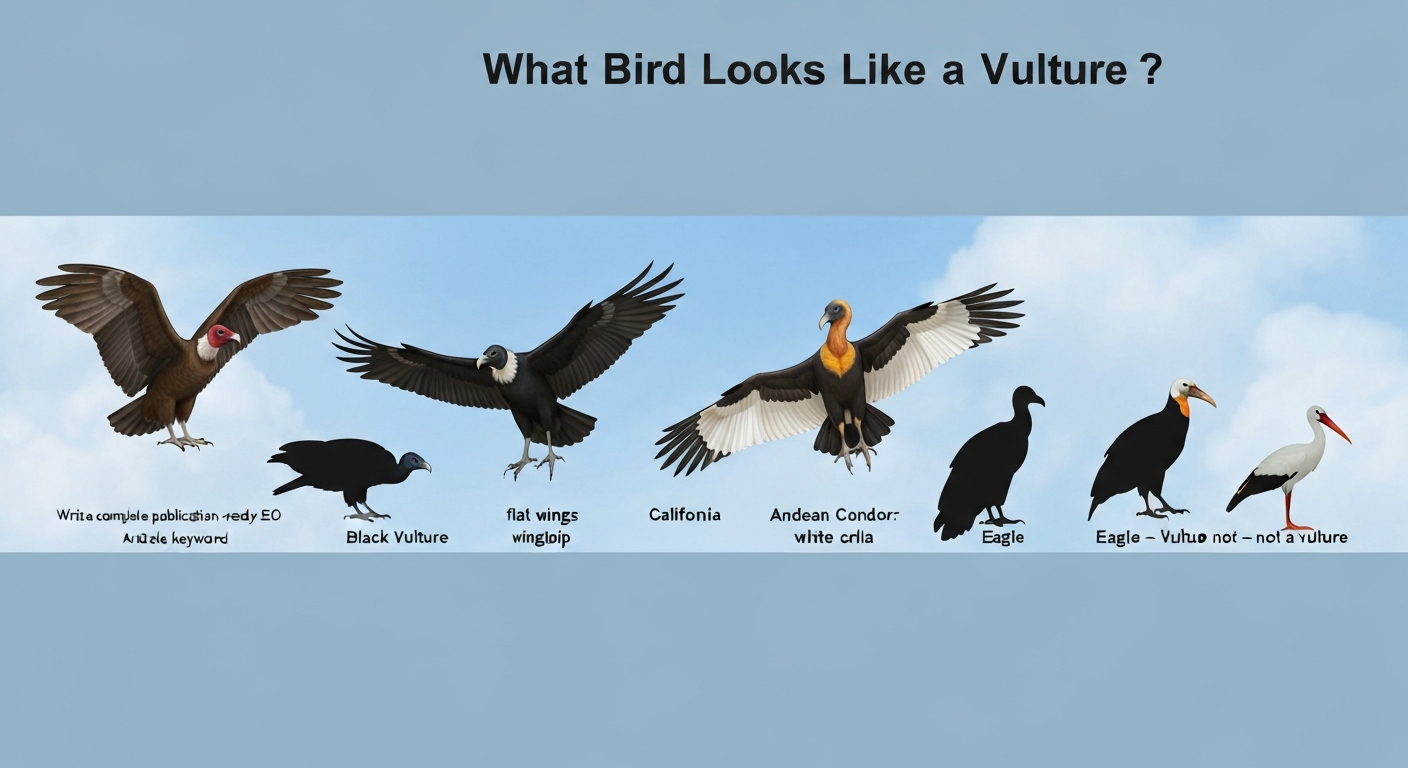
Several large birds get mistaken for vultures all the time: Turkey Vultures and Black Vultures are the ones most North American observers actually see, but eagles, condors, storks, large hawks, and even big gulls can fool you at a distance. The fastest way to separate a true vulture from a lookalike is to watch how it holds its wings in flight. Turkey Vultures lock their wings into a shallow V shape (called a dihedral) and rock side to side as they soar. Black Vultures hold their wings flat and flap more often. Almost nothing else soars that way. Once you lock onto the wing posture, the rest of the ID falls into place quickly.
At-a-Glance ID: You Saw a Large Dark Soaring Bird
If you spotted a big, dark bird circling high overhead and wondered whether it was a vulture, here are the three fastest checks you can do even without binoculars:
- Wing posture: Are the wings held in a V shape and rocking? That is almost certainly a Turkey Vulture. Wings held flat with short, frequent flaps? Probably a Black Vulture.
- Head size and color: Vultures have noticeably small, bare heads compared to their body. A red or pink bare head on an adult Turkey Vulture is visible at surprisingly long range in good light. Eagles and hawks always have fully feathered, relatively large heads.
- Tail length and shape: Vultures have a fairly long, rounded tail that fans out during soaring. Storks have very long trailing legs. Eagles and condors look bulkier with a broad tail.
If all three clues point to a large dark bird with a small bare head, V-shaped or flat wing posture, and a long rounded tail, you almost certainly have a vulture. Keep reading to nail down exactly which one, or to confirm it is not one of the common lookalikes.
How to Use This Guide
Start with the visual checklist below so you know which features to look at first. Then jump to the flight silhouette section for the fastest in-field clue. After that, check the species profiles to match your bird to a specific vulture, or head straight to the mistaken-identity section if you think it might not be a vulture at all. The comparison table near the end pulls everything together into one quick reference. If you are dealing with a juvenile bird or tricky lighting, the age and angle section will help you avoid the most common pitfalls.
Visual Checklist: What to Look at When You Spot a Possible Vulture
Work through these features in roughly this order. Size alone is unreliable at a distance, so flight style and head appearance will serve you better in most situations.
Size
Turkey Vultures are large birds: body length 64 to 81 cm (about 25 to 32 inches) with a wingspan around 170 to 178 cm (roughly 67 to 70 inches). Black Vultures are slightly smaller, running 60 to 68 cm long with a wingspan of 137 to 150 cm. Both are noticeably bigger than a Red-tailed Hawk but smaller than a Bald Eagle. Size is easiest to judge when the bird is alongside another species you recognize.
Silhouette
The overall shape is your best long-distance clue. Vultures look almost cross-shaped from below when soaring: long, broad wings, a longish tail, and a strikingly small head that barely pokes out in front. The small-head look is the feature that surprises most first-time observers.
Head and Neck
Adult Turkey Vultures have a bright red, completely bare head. Adult Black Vultures have a wrinkled, bare black or dark gray head. Both species have a bare, unfeathered neck adapted for reaching inside carcasses without matting feathers. Eagles, hawks, and other lookalikes always have a fully feathered head that looks proportionally larger.
Bill
Vulture bills are hooked at the tip but relatively slender and pale or ivory-colored compared to the heavy, dark bills of eagles. The hook is designed for tearing soft tissue, not for catching live prey, so it looks a little less powerful than a raptor's bill at close range.
Plumage
Turkey Vultures are overall dark brownish-black, but look for the two-toned underwing: the flight feathers along the trailing edge and wingtips look silvery or pale gray from below, while the wing lining (the front part of the underwing) stays dark. Black Vultures are solidly black except for small white patches at the very tips of the outer wings, like little white stars at each wingtip.
Wings and Tail
Both North American vultures have long, broad wings with noticeably spread, finger-like outer primary feathers. The Turkey Vulture's tail is fairly long and rounded. The Black Vulture's tail is shorter and more squared. Old-World vultures like the Griffon have extremely broad wings with deeply fanned primaries, making them look almost like flying doors from directly below.
Flight Style
This is the single most reliable clue. Turkey Vultures soar for long periods on thermal updrafts, tilting and teetering as they go, wings held in that clear V shape. They look slightly unsteady, almost tipsy in the air. Black Vultures soar more stiffly with flat wings, flap in short bursts more frequently, and look more stable and purposeful. Both spend far more time soaring than flapping compared to hawks or crows.
Behavior
Vultures circle in rising thermals, often with other vultures. On the ground they hunch forward and walk with a slow, awkward gait. They frequently gather at carcasses. You might see groups of them roosting together in large dead trees, especially in the morning with wings spread to warm up in the sun, which is a distinctive vulture behavior called sunning.
Sounds
New World vultures (Turkey and Black Vultures) are almost completely silent. They lack a fully developed syrinx, the bird equivalent of a voicebox. If you hear anything, it is a low hiss or grunt at very close range, usually only at a nest or when threatened. A bird that is making loud calls while it soars is not a Turkey Vulture. Hawks and eagles regularly call in flight, which is a useful negative ID clue.
Quick Silhouette and Flight-Style ID
These bullet cues work well when you only have a few seconds to look before the bird drifts out of sight:
- V-shaped dihedral wings, rocking and teetering: Turkey Vulture
- Flat wings, short bursts of flapping, shorter tail: Black Vulture
- Extremely broad wings, deeply fanned finger-like primaries, very short tail: Old-World Gyps or Cinereous Vulture (Europe, Asia, Africa)
- Massive wingspan, broad rectangular wings, slow deliberate soaring, white patches on wing linings: California Condor or Andean Condor
- Stiff flat wings with no teetering, large feathered head, loud calls in flight: eagle or large hawk, not a vulture
- Long neck and legs trailing behind, stiff flapping with glides: stork, not a vulture
- White body with black wingtips and heavy wing beats between glides: large gull or Northern Gannet, not a vulture
Common Vulture Species Profiles and Where to Find Them
Turkey Vulture (the most-seen vulture in North America)
Range: Breeds across most of the continental United States, southern Canada, Mexico, Central America, and much of South America. A year-round resident in the south; migratory in the north. You can find them over open country, roadsides, farmland, and forests. Look for them high on thermals from late morning onward on warm days.
Key ID marks: Red bare head on adults. Two-toned underwing with a silvery trailing edge and wingtip. Long tail. Wings in a V with constant teetering. Wingspan around 170 cm. Almost completely silent.
Black Vulture (increasingly common in the eastern US and southward)
Range: Year-round resident from the southeastern United States south through Central America and most of South America. Their range has expanded northward in recent decades.
Key ID marks: All-black plumage with a black bare head. White star-shaped patches at each outer wingtip. Shorter tail than a Turkey Vulture. Wings held flat, not in a V. More frequent flapping. Wingspan around 137 to 150 cm. Slightly smaller and stockier than a Turkey Vulture.
California Condor (localized but unforgettable)
Range: Historically across North America; now confined to reintroduction sites in California, Arizona, Utah, and Baja California after a catastrophic decline to just 22 wild birds in the 1980s. Now over 200 free-flying individuals exist thanks to intensive recovery efforts.
Key ID marks: North America's largest flying land bird. Massive wingspan. Adults show large white triangular patches on the wing linings (the underside front part of the wing). Orange-yellow bare head. Tagged birds carry numbered wing tags. Soars very high with minimal flapping.
Andean Condor (South America's giant)
Range: The Andes mountains from Venezuela south to Tierra del Fuego, plus Pacific-facing coastal areas. Prefers high-altitude open terrain and coastal cliffs.
Key ID marks: One of the world's largest flying birds, with a wingspan reaching up to 3.2 to 3.3 meters and body length of 100 to 130 cm. blank" rel="noopener noreferrer">Andean Condor measurements and status: body length about 100–130 cm, wingspan commonly reported up to ~3.0–3.3 m, and mass typically 7.5–15 kg; see the Animal Diversity Web species account for details. Males weigh 7.5 to 15 kg. Adults show a large white collar ruff and white wing patches. The male has a fleshy caruncle (a bump) on top of the head. If you see a condor-sized bird over the Andes, this is almost certainly it.
King Vulture (Central and South America's colorful scavenger)
Range: Lowland tropical forests from Mexico south through Central America and across South America to northern Argentina.
Key ID marks: Body length 67 to 81 cm, wingspan 1.2 to 1.9 meters. The bare facial skin is wildly colorful: orange, red, yellow, and purple patches around a heavy, hooked bill. The body plumage is mostly white with black flight feathers. Impossible to confuse with other vultures once seen clearly.
Griffon (Eurasian) Vulture (Europe, North Africa, and western Asia)
Range: Mountains of southern Europe (Spain, France, Balkans, Caucasus), North Africa, and across to Central and South Asia. Soars over open steppes, gorges, and mountains.
Key ID marks: Very long, broad wings with deeply fanned finger-like primaries. A short tail. Pale brown body contrasting with darker flight feathers. A white or pale downy ruff around the neck base. The head looks tiny for such a large bird.
Cinereous Vulture (Europe and Asia)
Range: Iberia through the Balkans into Central and East Asia. Often found in the same areas as Griffon Vultures.
Key ID marks: Overall dark sooty brown, almost black. Extremely broad rectangular wings with very long, spread primaries. Very short tail. One of the heaviest Old-World vultures. At rest, shows a distinctive pale grayish-blue bare face and a dark 'beard' of wispy feathers at the chin.
Birds That Get Mistaken for Vultures (and How to Tell Them Apart)
Bald Eagle and Golden Eagle
Both species are large, dark, and soar on thermals, which is where the confusion begins. Eagles hold their wings horizontally flat or very slightly upward, but they do not teeter the way a Turkey Vulture does. More importantly, eagles have a large, fully feathered head that makes them look thick-necked and powerful from a distance. Their tails are broad and square-ended. In flight, eagles look more deliberate and less wobbly. Bald Eagles call regularly in flight with a high, chattering whistle. Golden Eagles soar with a slight upward tilt but are much more stable than a Turkey Vulture.
Condors (vs other large vultures)
If you are in condor country (California, Arizona, Utah, the Andes), a condor is orders of magnitude bigger than a Turkey Vulture. If you can see the white wing lining patches and the large orange or yellow bare head, it is a condor. California Condors also carry numbered wing tags that are visible through binoculars.
Buzzards (Common Buzzard in Europe)
In Europe, many people call Griffon Vultures 'buzzards' casually, but Common Buzzards (Buteo buteo) are medium-sized raptors much smaller than vultures. They have a fully feathered head, a broader and shorter wing relative to their body, a prominent barred tail, and make loud, mewing calls in flight. Common Buzzards and Turkey Vultures are genuinely similar from a distance, so focus on the bare head and the teetering flight style.
Storks (White Stork, Wood Stork)
Storks are large, mostly white birds with black wingtips that soar on thermals in a similar way to vultures. The easiest separator is the body shape: storks hold their long neck stretched forward and their long legs trailing behind in flight, creating a very different cross-shaped silhouette compared to a vulture's small-headed, compact profile. Wood Storks in the southeastern United States are fairly common and get mixed up with Black Vultures, but the Wood Stork's white body, black wingtips, and trailing legs are clear differences.
Large Gulls
Great Black-backed Gulls and some other large dark gulls can look superficially vulture-like over coastal areas, especially in poor light. Gulls have a distinctive strong, horizontal flight with regular wingbeats and glides. They do not teeter or soar in long spiraling thermals. Their bills are heavy but blunt-tipped, not hooked, and their heads are fully feathered and proportionally larger.
Corvids (Crows and Ravens)
Common Ravens are large enough to briefly suggest a vulture to someone who is not expecting them. Ravens can soar briefly on thermals, but they flap much more frequently, have a proportionally large head and heavy bill, a distinctive wedge-shaped tail, and they call loudly and often. A group of corvids circling together at a carcass can easily be mistaken for vultures from a distance, so check for the larger body size, small bare head, and teetering flight to separate them. For more on corvid ID, take a look at a guide dedicated to what bird looks like a crow.
Side-by-Side Comparison: Vultures vs Common Lookalikes
| Feature | Turkey / Black Vulture | Condor | Eagle (Bald/Golden) | Stork | Large Gull | Raven / Crow |
|---|---|---|---|---|---|---|
| Head | Small, bare (red or black skin) | Small, bare (orange or yellow) | Large, fully feathered | Large, fully feathered | Medium, fully feathered | Large, fully feathered |
| Wing posture in soar | V (Turkey) or flat (Black) | Flat, very broad rectangle | Flat or very slight upward tilt | Flat with long neck/legs extended | Flat, regular wingbeats/glides | Flat, frequent flapping, brief soars |
| Teetering / rocking | Yes, pronounced (Turkey) | No | No | No | No | No |
| Underwing pattern | Two-toned silvery trailing edge (Turkey); white wingtip stars (Black) | Large white wing lining patches | Dark with pale inner primary windows | White body, black wingtip | Varies; white body with black wingtips common | All black or black/gray |
| Tail shape | Long, rounded | Broad, rounded | Broad, square to rounded | Short (legs extend beyond) | Square to rounded | Wedge-shaped (Raven) |
| Typical flight sounds | Silent | Silent | Loud whistling calls | Silent or bill clattering | Loud calls | Loud croaks and calls |
| Size (wingspan approx.) | 137–178 cm | Up to 320 cm (Andean) | 180–230 cm | 155–215 cm | Up to 165 cm | 100–140 cm |
| Bare skin on face/neck | Yes | Yes | No | Bare facial skin on some species | No | No |
| Flapping frequency | Very low; long soaring glides | Very low | Low to moderate | Moderate; alternates flaps and glides | Moderate to high | High |
Juvenile vs Adult Plumage and Tricky Viewing Conditions
Young Turkey Vultures look noticeably different from adults in one important way: their heads. Juvenile Turkey Vultures have a dark grayish or blackish bare head rather than the bright red of an adult. See Turkey Vulture, Juvenile vs Adult notes (All About Birds) for details on head color change from dark-gray juveniles to bright-red adults blank" rel="noopener noreferrer">Turkey Vulture — Juvenile vs Adult notes (All About Birds). This means if you see a large dark soaring bird with a dark head, you should not rule out a Turkey Vulture just because the head is not red. Watch for the teetering V-shaped soar and the two-toned underwing, both of which are present at all ages.
Old-World vultures also change with age. Young Griffon Vultures are darker overall with a browner neck ruff, while adults develop a paler, more cream-colored ruff. Juvenile Cinereous Vultures tend to look slightly paler than adults. In all cases, wing shape and flight style are more reliable age-independent clues than head or body color.
Lighting makes a huge difference. A Turkey Vulture seen against a bright sky can look entirely black, hiding the two-toned underwing completely. Try to position yourself so the sun is behind you, which puts the bird in front of a relatively darker background or illuminates its underside. Late-afternoon backlit birds are the hardest to identify and are responsible for most misidentifications.
Viewing angle matters too. A vulture seen head-on as it flies toward you can look like a completely different bird: the V posture may not be obvious, the tail disappears, and only the small head and two broad wings are visible. If the bird banks and you catch a side view, the long tail, small head, and wing posture snap into place immediately.
Photo and Illustration Guide: What Images Work Best for This ID
If you are building out this article visually, these are the shots that do the most identification work:
- Turkey Vulture soaring: a clear underside view showing the two-toned wing (dark lining, silvery trailing edge). Suggested caption: 'Turkey Vulture from below showing the pale silvery trailing edge on the flight feathers, a key ID mark.'
- Turkey Vulture in flight showing the V-shaped (dihedral) wing posture: a front-on or slightly angled shot where the V is unmistakable. Suggested caption: 'The rocking V-shaped wing posture is the single fastest way to identify a Turkey Vulture at a distance.'
- Black Vulture showing flat wings and white wingtip stars: an underside soaring shot. Suggested caption: 'Black Vulture underside: note the flat wing posture and small white patches at the outer wingtips.'
- Adult Turkey Vulture head close-up showing the red bare skin. Suggested caption: 'The bright red bare head of an adult Turkey Vulture is visible at surprisingly long range in good light.'
- Juvenile Turkey Vulture showing dark gray head: placed next to the adult head shot. Suggested caption: 'A juvenile Turkey Vulture has a dark grayish head, not red, which can cause misidentification in the field.'
- Side-by-side silhouette diagram: Turkey Vulture V posture vs Black Vulture flat posture vs Eagle flat posture. Suggested caption: 'Silhouette comparison of Turkey Vulture (left), Black Vulture (center), and Bald Eagle (right): wing posture and head size are the fastest separators.'
- California Condor showing white underwing lining patches and wing tag. Suggested caption: 'California Condors are far larger than any other North American vulture and carry numbered wing tags from conservation programs.'
- Griffon Vulture overhead showing the extremely broad wings and deeply fanned primaries. Suggested caption: 'Griffon Vultures have almost rectangular wings with deeply spread outer feathers, giving them a distinctive soaring silhouette.'
- Wood Stork in flight: showing white body, black wingtips, and trailing legs. Suggested caption: 'The Wood Stork is frequently mistaken for a Black Vulture, but the white body, black wingtips, and trailing legs are clear differences.'
Practical Tips for Identifying Vultures in the Field
Binocular setup
A 8x42 or 10x42 binocular is the sweet spot for vulture watching. You need enough magnification to see the bare head and underwing pattern, but not so much power that finding a high, moving bird becomes frustrating. When a bird is directly overhead, tilt your binocular straight up, find the bird, then lower your arms slightly while keeping your eyes on it: this reduces neck strain considerably.
Best times and locations
Vultures need thermals to soar, which only develop after the ground has been warming for a couple of hours. In most of North America, soaring activity peaks from about 10 a.m. to 3 p.m. on warm, sunny days. Look for them over open farmland, roadsides, forest edges, and river valleys. In the morning, check large dead trees and communication towers: vultures often roost in groups and spread their wings to warm up before taking to the air.
Taking diagnostic photos
If you are trying to document an unusual vulture or confirm a lookalike, aim for the underside of the bird in flight. The underwing pattern, tail shape, and head visibility are all captured in that single angle. Even a blurry phone photo that shows whether the wings are held in a V or flat can be enough to confirm the species. Record a short video clip if you can: flight style is far more convincing in video than in a still image.
Safety around vultures
Turkey Vultures have a defensive behavior where they vomit when threatened at close range: this is unpleasant and the stomach acid can be harmful. Do not approach roosting or feeding vultures closely. Use binoculars or a telephoto lens to observe from a comfortable distance. This is also simply better for getting natural behavior observations.
A Note on Watching Scavengers Ethically
Vultures are protected under the Migratory Bird Treaty Act in the United States and by equivalent legislation in most countries where they occur. It is illegal to disturb, harm, or handle them. If you find a carcass with vultures feeding, observe quietly from a distance and avoid flushing the birds, which wastes energy they need for survival. Do not attempt to move or interfere with a carcass to draw vultures closer: this is both unnecessary and potentially illegal depending on the animal involved. Vultures are doing important ecological work by removing diseased carrion, and keeping your distance ensures they can do it without interruption.
Other Large Birds Worth Identifying
Once you are comfortable with vulture ID, you may find yourself getting curious about other large, striking birds that share similar habitats or get lumped together in casual observation. If you saw a bird resembling a robin but smaller, see what bird looks like a robin but smaller for likely species and quick ID tips. If you have seen a large black bird with a powerful bill and a wedge-shaped tail, it is worth looking into what bird looks like a crow for a closer comparison of corvids. If you spotted a big bird sitting silently and hunched in a tree at dusk or dawn with large forward-facing eyes, a guide to what bird looks like an owl will help you work through the options. For help distinguishing nocturnal silhouettes and forward-facing eyes, see the guide what bird looks like an owl. For smaller brown birds at ground level near your vulture-watching spots, what does a sparrow bird look like is a handy reference. And if you spotted a plump, pale gray bird near urban areas or cliffs on the way to your birding spot, what bird looks like a pigeon covers the most frequently confused dove and pigeon species. For another relevant comparison, see what bird looks like a pigeon.
FAQ
SEO title and meta description (≤160 chars)
Title: What Bird Looks Like a Vulture? A Visual ID Guide Meta description: Saw a large dark bird? Learn quick visual checks, common vulture species by region, key look‑alikes, juvenile differences, photo tips and ethics.
At‑a‑glance ID summary
If you saw a large, dark scavenging bird, look for these quick signals of a vulture: bare or sparsely feathered head/neck, very broad wings, soaring on thermals rather than steady fast flapping, weak or absent vocal calls, and a chunky, slightly hunched body when perched. Combine head/neck, wing silhouette in flight, and behavior (soaring/teetering) to confirm.
Systematic visual checklist to inspect (size, silhouette, head/neck, bill, plumage, wings & tail, flight style, behavior, sounds)
Use this step‑by‑step checklist when identifying a possible vulture: - Size: compare to common landmarks (car, nearby raptors). Turkey Vultures span ~170–178 cm; Black Vultures are slightly smaller (wingspan ~137–150 cm); condors and Old‑World vultures can be much larger. - Silhouette: very broad wings, often long wings relative to the body; many vultures show 'fingered' primaries (splayed outer feathers). - Head & neck: often bare or with sparse down (naked red/gray head in adult Turkey Vulture; black bare head in Black Vulture); presence of feathers to the head usually rules out a vulture. - Bill: heavy, hooked bill for tearing; not as long or dagger‑shaped as some eagles’ bills. - Plumage: typically dark overall for New‑World species; some (King Vulture, Egyptian Vulture) have contrasting colors. Look for two‑toned underwing pattern (Turkey Vulture) or white patches at outer underwings (Black Vulture). - Wings & tail: Turkey Vulture flies with a shallow V (dihedral) and teeters; Black Vulture holds wings flat and flaps more; Old‑World Gyps vultures show very long, broad wings with deeply fingered tips and short tails. - Flight style: soaring/thermalling with minimal flapping; Turkey Vulture rocks/teeters. Frequent strong wingbeats suggest non‑vulture raptors. - Behavior: scavenging near roadsides, carcasses or gatherings; social roosts are common for some species. - Sounds: largely silent in flight; vocalizations are limited to hisses, grunts or low sounds in captivity or at nests (New‑World vultures lack a full syrinx).
Common vulture profiles and where you’re likely to see them (concise region notes)
North America - Turkey Vulture (Cathartes aura): widespread, red bare adult head, dihedral (V) wing posture, two‑toned underwing with paler flight‑feathers; wingspan ~170–178 cm. Common across U.S., Canada (migrant) and Central/South America. - Black Vulture (Coragyps atratus): smaller, black bare head, flat wing posture in flight, white patches at outer underwing tips, more flapping. Common in southern/central U.S., expanding northward. - California Condor (Gymnogyps californianus): very large, reintroduced in CA/AZ/UT and Baja; massive wingspan, pale underwing areas, bare head with colorful skin — localized and rare. Central & South America - King Vulture (Sarcoramphus papa): large colorful bare head (distinctive), heavy white/black pattern in some lighting; range across tropical lowland forests. - Andean Condor (Vultur gryphus): very large, up to ~3.0 m wingspan, Andean highlands. Old World (Europe, Africa, Asia) - Griffon/Cinereous/White‑backed/Rüppell’s etc.: regionally common in southern Europe, Africa and Asia — look for very broad wings with deep fingered primaries and short tails. Range maps (BirdLife/IUCN) indicate where each species occurs.
Which birds are commonly mistaken for vultures and quick distinguishing clues
Common look‑alikes and how to separate them: - Large eagles (e.g., Golden, Bald): eagles have feathered heads, stronger, regular wingbeats, bulkier body, and powerful feet/talons; not typically scavenger‑only posture. - Large buzzards/hawks (Old World buzzards): more regular flapping, shorter wings relative to tail, feathered head. - Storks (e.g., Marabou Stork): similar 'bald head' in some storks, but storks have long legs that project beyond tail in flight and straighter necks; bill shape is straighter. - Large gulls: gulls flap more, show different wingtip patterns, and have webbed feet when seen near water. - Corvids (large crows/ ravens): much smaller, rapid wingbeats, fluffy throat feathers and small bill; silhouette different. - Condors vs large vultures: condors are much larger with broader wings; geographic range helps (California/Andes). Use head feathering, leg/neck posture in flight, wing posture (dihedral vs flat), underwing pattern, and behavior (soaring vs active flapping) to tell them apart.
Comparison table: key field differences (vultures vs common look‑alikes)
Type | Head/neck | Wing posture | Flapping rate | Underwing/wingtip | Flight behavior -----|----------|--------------|---------------|-------------------|----------------- True Vulture (New World) | Bare or sparsely downy | Turkey Vulture: shallow V; Black Vulture: flat | Low/soaring (Turkey: teeter) | Turkey: paler flight‑feathers on underwing; Black: white outer underwing patches | Soaring/thermalling, gliding Eagle | Feathered head | Broad, slightly rounded | Regular strong beats | No silvery trailing edge; evenly dark or patterned | Powerful flapping, agile turns Stork | Often partly bare (some species) but longer neck | Straight, stiff wings with neck extended | Moderate flapping | Long narrow wings, visible primary tips | Flies with legs trailing; straighter flight path Large Gull | Feathered head | Narrower wings, pointed tips | Frequent flapping | Distinct gull wing patterns and white areas | Faster, powered flight near water Corvid (Raven) | Feathered head | Narrower, pointed wings | Fast wingbeats | No fingered primaries like vultures | Active flapping, smaller size (Use size and region to narrow further; juvenile plumage can blur some entries.) Note: Table is a quick field summary — always combine multiple characters (head feathering, wing posture, behavior). References include regional field guides and Cornell Lab species pages.
Next Article
What Bird Looks Like a Pigeon: Quick ID Guide to Lookalikes
Quick visual ID guide: which birds look like pigeons, key features, regional lookalikes and photo tips.