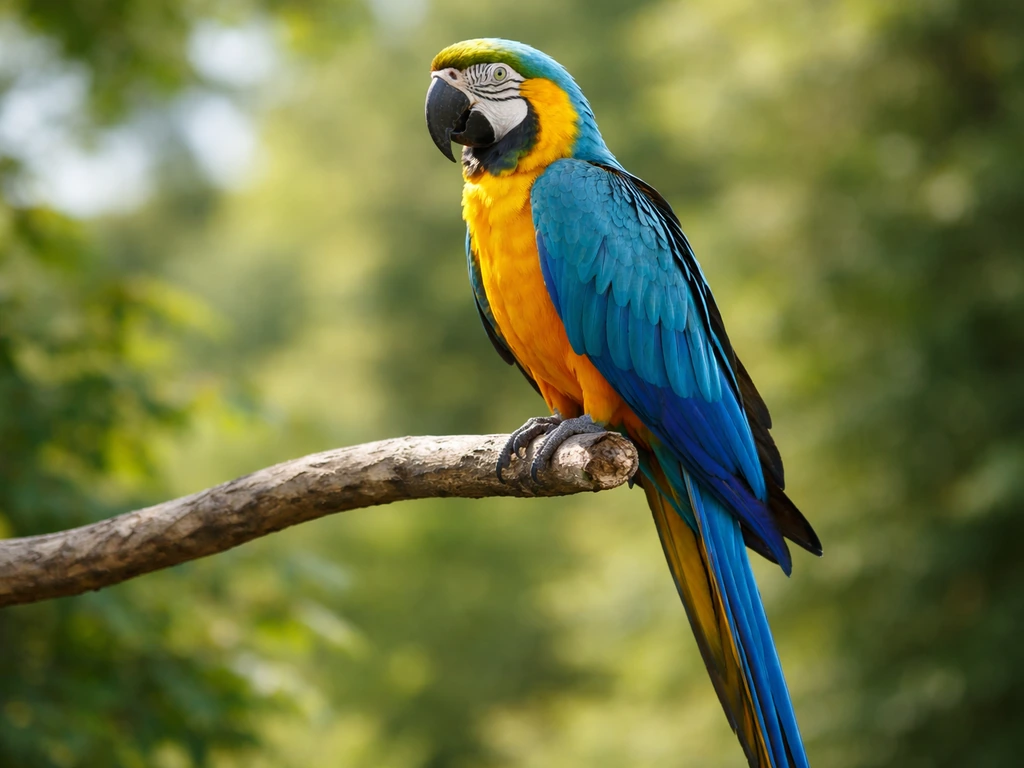
Conures are small-to-medium parrots from Central and South America, and the first thing you notice about most of them is vivid color packed into a compact, long-tailed body. They sit roughly in the same size class as a large budgie or a small cockatiel, with bold facial patches, a sturdy curved beak, and a tail that makes up a significant chunk of their total length. Different species look strikingly different from each other, so knowing which color patterns, eye markings, and proportions to focus on makes identification much faster.
What Does a Conure Bird Look Like: Visual ID Guide, Field Photo Tips

Marcus Whitley
13 Jul 2026
Quick visual summary: one look, one ID
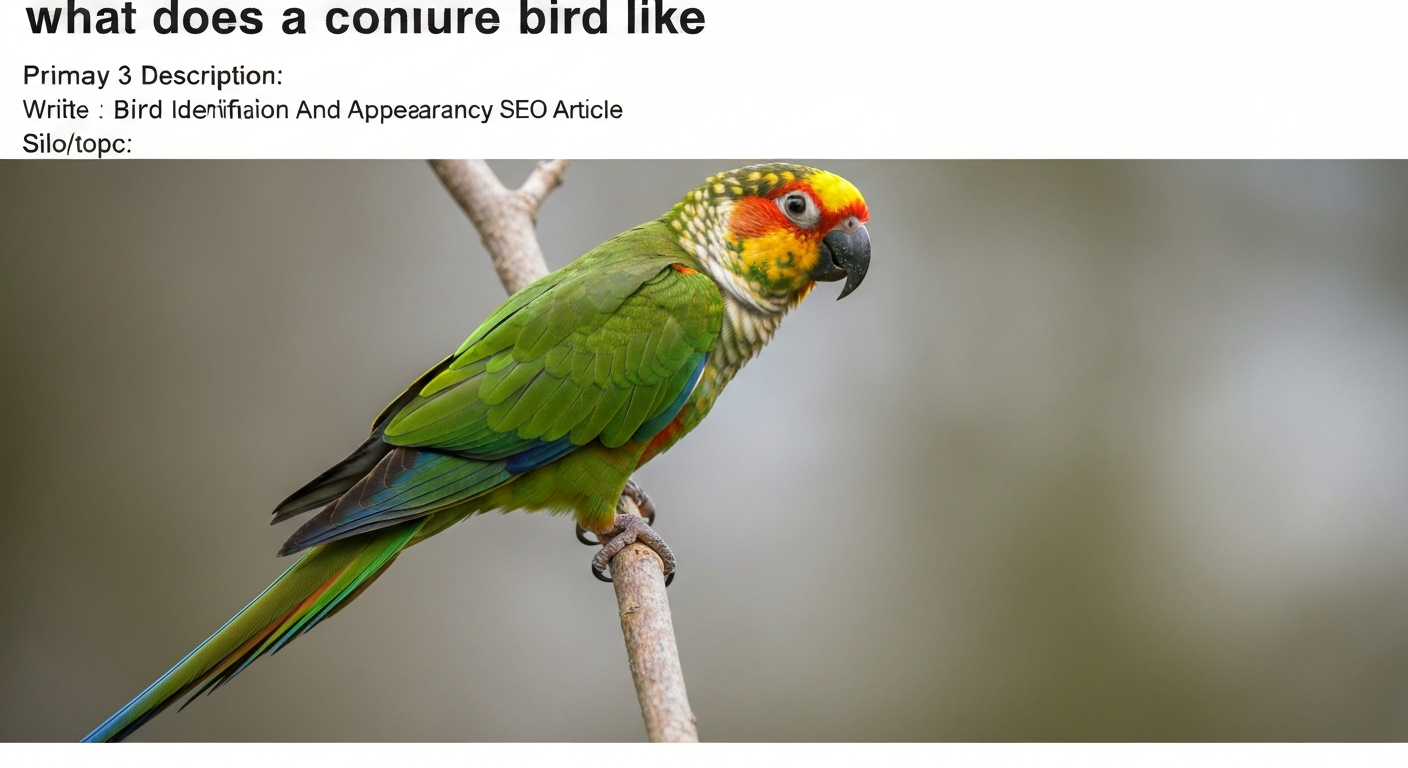
The single most useful thing to look for first is the face. Most conures carry a distinctive facial patch, whether that is a blazing orange-yellow head, a solid black hood, or a subtly scaled green cheek. Pair that face color with tail length and body size and you can usually narrow a conure down to species in seconds. If you see a small-to-medium parrot with a conspicuous bare white ring around the eye and a long, tapered tail, you are almost certainly looking at one of the Aratinga-group conures such as a sun or jenday. If the eye ring is feathered (not bare and white) and the tail is shorter and more graduated, you are likely looking at a Pyrrhura species like the green-cheeked conure.
Quick field ID checklist
- Total body length: small Pyrrhura species around 25–26 cm; medium Aratinga/Eupsittula species 25–30 cm; larger species like the Nanday up to about 35 cm
- Body weight: green-cheeked conure roughly 62–81 g; sun conure roughly 100–130 g
- Tail type: long and tapered in Aratinga-group birds; shorter and graduated (stepped) in Pyrrhura-group birds
- Eye ring: bare white and prominent in sun, jenday, and nanday conures; feathered and inconspicuous in green-cheeked and other Pyrrhura species
- Beak: medium-sized, strongly curved, usually dark grey or black; Aratinga-type birds tend to have a slightly deeper, more prominent culmen
- Flight feathers: look for blue or black on the primary and secondary tips — this is a reliable mark on several species regardless of body color
- Body color base: most conures are predominantly green on the back and wings, with species-specific patches on the head, breast, and belly
Size, silhouette, and proportions
Conures span a modest but noticeable size range. The smallest commonly kept species sit around 25 cm from beak tip to tail tip, while the nanday conure stretches to about 35 cm. To put that in perspective, a green-cheeked conure is roughly the length of a standard pencil, while a nanday is closer to the length of a ballpoint pen plus a few centimeters of tail. Their wingspans are proportional, giving them a fast, direct flight with shallow wingbeats that look purposeful rather than fluttery.
The silhouette is what separates conures from many other small parrots at a distance. They have a slender, laterally compressed body, a relatively small round head, and a tail that adds significant length to their overall profile. In Aratinga-group birds, that tail is long and sharply tapered, almost like a thin wedge when folded. In Pyrrhura birds, the tail is still long relative to body size but has a more graduated, stepped shape where the outer tail feathers are noticeably shorter than the central ones. In flight, conures hold their wings swept back slightly, and the long tail trails behind in a way that immediately distinguishes them from rounder, short-tailed parrots.
Key diagnostic features to inspect up close
Beak shape
All conures share the classic parrot beak: a strongly curved upper mandible that hooks down over a smaller lower mandible. The beak is usually dark grey to black, and in Aratinga-type species it tends to look slightly deeper and more robust at the base. You might notice the beak looks almost too large for the face, which is a useful quick cue. The cere (the fleshy area at the top of the beak) is typically the same dark color rather than brightly colored.
Head markings and eye ring
The eye ring is one of the most reliable structural marks on a conure and it does not change with captive color mutations, which makes it especially trustworthy. In sun, jenday, and nanday conures, the ring is a bare patch of white skin that sits visibly around the eye like a small pale circle. In green-cheeked and other Pyrrhura conures, the area around the eye is fully feathered with no bare ring, so the eye sits flush with the surrounding plumage. Head markings vary by species but are almost always the boldest, most contrasting part of the bird, which is why starting at the face is the fastest identification strategy.
Tail length and shape
Hold a mental ruler against the bird: on most conures, the tail accounts for roughly a third to nearly half of the total body length. The tail feathers are stiff and pointed, not soft and rounded like a dove's. When a conure is perched and you look at it from the side, the long tail often tilts slightly upward or fans just a touch, making the bird look alert even when still.
Leg and feather texture
The legs are short and set back on the body, which gives conures their characteristic upright stance on a perch. Feet are zygodactyl, meaning two toes point forward and two point back, typical of parrots. The feathers on the body have a tight, smooth texture rather than the fluffy look you see on species like cockatiels or cockatoos. On the breast of Pyrrhura conures you will notice the feathers have pale or contrasting edges that create a scalloped or scaled pattern, almost like fish scales on the chest.
Green-cheeked conure: detailed plumage
The green-cheeked conure (Pyrrhura molinae) is one of the most widely kept conures in aviculture, and its appearance is quietly beautiful rather than flashy. At around 25–26 cm and 62–81 g, it is on the smaller end of the conure size range, roughly the size of a large budgie but with a noticeably longer tail.
Start at the top of the head: the crown is a deep brownish-grey to dark maroon-grey, giving the bird a capped appearance. Moving down, the cheeks are bright green, which is where the common name comes from. The throat and upper breast show the diagnostic scalloped pattern: each feather is green or grey-green with a pale, whitish edge, creating a scaled look across the chest. As you move down the belly, you hit a patch of maroon or reddish-brown that contrasts distinctly with the green flanks, and this belly patch is one of the easiest marks to confirm the species.
The back, wings, and most of the tail are bright green. The tail itself shows a reddish-maroon tone on the upper surface when viewed at close range, especially toward the central tail feathers, which grades into green toward the outer tail. There is no bare white eye ring. The beak is dark grey. In captivity, green-cheeked conures come in several color mutations: yellow-sided birds replace much of the green with yellow, pineapple mutations combine yellowish coloring with reddish-orange on the head, and cinnamon mutations shift greens toward warm olive tones. These captive birds can look remarkably different from wild-type birds.
Sun conure: detailed plumage
The sun conure (Aratinga solstitialis) is arguably the most visually striking conure you will encounter, and it is almost impossible to misidentify an adult. At around 30 cm and 100–130 g, it is noticeably heavier and longer than a green-cheeked conure, closer in feel to a small cockatiel in bulk but with a longer, more tapered tail.
An adult sun conure is dominated by brilliant yellow-orange. The head, face, neck, and breast are a saturated golden-orange that looks almost luminous in direct sunlight. The belly and vent region tend to be a deeper orange-yellow. The back transitions from orange-yellow toward green on the lower back and rump. The wing coverts are yellow-green, and the flight feathers (primaries and secondaries) are green with blue tips on the outer edges, which you see clearly when the wing is spread. The tail is green with blue toward the tips of the tail feathers.
The bare white eye ring is prominent and easy to see, sitting like a small white oval around the dark eye. The beak is dark grey-black. Juvenile sun conures look quite different from adults: young birds are predominantly green on the back and have noticeably more green on the face and breast, with the orange-yellow coloring developing gradually through successive molts. A young sun conure can briefly be confused with a jenday conure juvenile, which is why checking for the presence and extent of blue on the flight feathers and the depth of orange tones matters in young birds.
Jenday conure: detailed plumage
The jenday conure (Aratinga jandaya) is closely related to the sun conure and the two birds are sometimes confused at a glance, but once you know what to look for the differences are clear. Jendays are similar in size to sun conures, commonly cited at around 30 cm, and they share the bare white eye ring and overall Aratinga body shape.
The head and face of a jenday are orange-red, somewhat deeper and more saturated than the golden-yellow of a sun conure. The breast is orange, and the belly becomes a rich orange-red. The back is green, not yellow-orange like a sun conure, and this green back against the orange head is the clearest single difference between the two species. The wing coverts are green with yellow-orange on the bend of the wing, and the flight feathers are green with blue tips on the primaries, similar to the sun conure. The tail is green above with blue on the tips.
In aviculture, jendays and sun conures have been hybridized to produce what breeders call the 'Sunday conure,' a bird that blends the traits of both parents and can be difficult to pin to either species purely on looks. If you encounter a conure that seems to fall between jenday and sun coloring, a captive hybrid origin is worth considering. Like the sun conure, juvenile jendays start out greener and develop their orange coloring progressively.
Nanday conure: detailed plumage
The nanday conure (Aratinga nenday) is the easiest conure to identify because of one unmistakable feature: a solid black head. No other commonly encountered conure has a fully black face and crown. At roughly 35 cm, the nanday is also the largest of the four species covered here, and its proportionally long tail makes it look especially sleek.
The entire head, including the face, crown, and throat, is jet black, creating a stark hood effect. This black mask transitions sharply into a bright green body. The breast is green, but the upper breast just below the black hood shows a blue wash or blue-tinted feathers that adds a subtle but visible color layer. Moving down the body, the green continues across the back, wings, and belly, with a reddish or orange-red patch visible on the thighs (the upper leg feathers) when the bird is perched. The flight feathers are green with notably dark blue to black tips on the primaries, which are visible both in flight and when the wing is folded.
Like other Aratinga-type conures, the nanday has a bare white eye ring, though it sits within the black facial mask, so you need to look closely to see it. The beak is dark grey-black, continuous in tone with the black head. The tail is green on the upper surface with blue tips on the outer tail feathers. Juvenile nandays have the same black-hooded pattern as adults, which makes age-related identification easier than in sun or jenday birds, though juveniles show slightly less vivid blue on the breast and flight feathers.
A few other conures worth knowing
The peach-fronted conure (Eupsittula aurea) is a compact bird at around 23–28 cm and 74–94 g, making it one of the smallest Aratinga-type conures. Its most distinctive feature is a bright orange-gold forehead patch that contrasts with an otherwise green head and body. The breast is olive-green and the belly is yellowish, and like other Aratinga-group birds it has a bare white eye ring and a dark beak. It is a useful comparison bird because its limited orange coloring confined to the forehead immediately shows how differently orange can be distributed compared to the full-body orange of a sun conure.
Juvenile vs adult plumage, and captive color mutations
As a general rule across conure species, juveniles are duller and greener than adults. In Aratinga species like the sun and jenday, the vivid orange and yellow face and breast tones are absent or muted in young birds, replaced by more green with hints of the adult colors developing at the feather edges. This greener juvenile phase persists through the first several months and can genuinely confuse identification, especially if you are comparing a juvenile sun conure to a young jenday. The structural marks, especially the bare eye ring, beak profile, and tail proportions, remain reliable regardless of age and are your best tools on a young bird.
Captive color mutations are widespread in the pet trade, particularly in green-cheeked conures, and they can make field marks nearly unrecognizable. Lutino mutations eliminate green pigment entirely, producing yellow-and-white birds. Albino birds are white with red eyes. Pineapple and cinnamon mutations shift color temperatures across the whole body. The reliable non-color identification features, such as the eye ring type (bare versus feathered), beak shape, tail proportions, and body size, hold true even in mutant birds, so always cross-reference those structural marks alongside color.
How to photograph a conure for identification
If you are trying to document a conure for ID purposes, four angles give you everything you need. A direct side profile captures body length, tail length, beak shape, and overall silhouette. A front-facing shot shows the breast pattern, eye ring, and facial color clearly. A dorsal (top-down) view shows back and wing color. A close-up of the head shows beak depth, eye ring detail, and any crown or cheek markings. Individual image pages (example: ML31676861, Green‑cheeked Parakeet photo record (Macaulay Library)) display per-photo metadata (photographer, date, GPS locality, age/sex notes, and camera/EXIF) that authors can cite beneath published plates ML31676861 — Green‑cheeked Parakeet photo record (Macaulay Library). Natural light without flash gives the most accurate color rendering, especially for distinguishing between orange-yellow and orange-red tones that matter when telling sun and jenday conures apart.
- Photograph in natural daylight: artificial light shifts yellows toward white and makes oranges look red
- Include something for scale if possible, such as a hand, a perch of known diameter, or a ruler in frame
- Capture the tail fully extended in at least one shot to assess length and shape
- Get a close shot of the face to confirm whether the eye ring is bare white skin or feathered
- If the bird opens its wings, capture that: blue or black on the flight feather tips is a critical species mark
- Note the beak color: even dark grey vs black can be meaningful across species
How conures compare to similar small parrots
Conures sit in a tricky size zone between parakeets and small macaws, and it is worth knowing the main visual differences. For detailed information on macaw appearance, see what does a macaw bird look like. Cockatoos, covered in detail on a related page, are a completely different profile: larger, crested, and typically white or pale-colored rather than green. Macaws share the long tail and parrot beak but are substantially larger, with bare facial patches that cover a much bigger area of the face than a conure's eye ring. Parakeets (like budgerigars) are noticeably smaller and have a more elongated, slender build with a much smaller beak. Lovebirds are stockier and short-tailed, almost the opposite silhouette of a conure. Canaries are songbirds, not parrots, and have a thin finch-like beak rather than a curved parrot bill. For contrast with passerines, see what does a cow bird look like, cowbirds are chunky, finch-like songbirds with short, conical bills rather than curved parrot beaks. For more detail on canary appearance, see what does a canary bird look like. For a comparison with another slim, non-parrot species, see what does a cuckoo bird look like to review the cuckoo’s slender profile, mottled plumage, and long tail.
| Bird | Typical size | Tail type | Beak | Key visual difference from conures |
|---|---|---|---|---|
| Conure | 25–35 cm | Long, tapered or graduated | Medium curved, dark | Reference bird for this comparison |
| Budgerigar/parakeet | 18–20 cm | Long but very slender | Small curved | Much smaller overall; thinner, more delicate build |
| Cockatoo | 30–60 cm | Medium to long | Large, heavy curved | Prominent crest; typically white, grey, or black; much larger |
| Small macaw | 30–50 cm | Very long, tapered | Large, powerful curved | Larger bare facial patch; bigger beak; noticeably heavier body |
| Lovebird | 13–17 cm | Short, rounded | Medium curved | Stocky, short-tailed body; very compact profile |
| Canary | 12–15 cm | Medium, notched | Short, straight, thin | Songbird beak; no curved parrot bill; much smaller and paler |
The long tail and curved parrot beak are the two features that immediately separate conures from non-parrot birds in the same size range. Among parrots specifically, size and facial markings do most of the work: if it is clearly a parrot, is medium-small, has a long tail, and shows a distinctive facial patch or bold color on the head, you are almost certainly looking at a conure.
Species plumage at a glance
| Species | Total length | Head/face color | Body color | Belly/breast | Eye ring | Key distinguishing mark |
|---|---|---|---|---|---|---|
| Green-cheeked conure | ~25–26 cm | Dark grey-brown cap, green cheeks | Bright green back and wings | Scalloped breast, maroon belly patch | Feathered, not bare | Maroon belly patch + scalloped breast pattern |
| Sun conure | ~30 cm | Brilliant golden-orange | Yellow-orange body, green wings | Deep orange-yellow | Bare white, prominent | All-over golden-orange head and breast |
| Jenday conure | ~30 cm | Orange-red face and crown | Green back (not yellow) | Orange-red belly | Bare white, prominent | Orange-red head against clearly green back |
| Nanday conure | ~35 cm | Solid jet black hood | Bright green body | Green with blue upper breast | Bare white (within black mask) | Unmistakable black head/hood |
| Peach-fronted conure | ~23–28 cm | Green with orange forehead patch | Green throughout | Olive-green to yellowish | Bare white, moderate | Isolated orange forehead patch on otherwise green head |
FAQ
What is a 'conure' and why isn't it a single scientific genus?
'Conure' is an avicultural (common) grouping for several small‑to‑medium New World parrots rather than a single taxonomic genus. It typically includes species from genera such as Pyrrhura, Aratinga (and allied genera like Eupsittula, Psittacara), and a few single‑species genera. The label groups birds by general shape, size and habit—slender bodies, medium‑to‑long tails and parrot‑type curved bills—so expect diversity in exact plumage and measurements between species.
Quick visual summary for identifying any conure at a glance—what should I look for?
Key quick ID traits: small‑to‑medium parrot size (total length roughly 20–35+ cm), slender laterally compressed body, medium to long tail (often tapered), medium curved parrot bill (often dark), and localized facial markings (feathered cheek patterns or a bare white eye‑ring in many Aratinga‑type species). Many conures are predominantly green with colorful head, chest or tail accents; Aratinga‑group species tend to show brighter yellow/orange/red face/breast patches and a bare white eye‑ring; Pyrrhura species tend to be greener with scaled/scalloped breasts and shorter, graduated tails.
What measurable size ranges and silhouette measurements should I use in the field?
Total length (tip of bill to tail tip) is the most practical field measure—common ranges: Pyrrhura (green‑cheeked group): ~24–26 cm; medium Aratinga/Eupsittula types (sun, jenday, peach‑fronted): ~25–30 cm; larger Nanday: ~33–36 cm. Use bill culmen (visible bill length), tail length (proportion of total length) and wing chord where possible. As a rule: Aratinga‑type conures have proportionally longer, tapered tails (tail often >40–50% of total length); Pyrrhura tails are shorter and more graduated (tail proportion <40%).
How do I visually distinguish the most common species (green‑cheeked, sun, jenday, nanday, peach‑fronted)?
Species field marks: - Green‑cheeked (Pyrrhura molinae): ~25 cm, mostly green, scalloped (scaled) chest, maroon/brown belly patch, no bare white eye‑ring, short graduated tail. - Sun Conure (Aratinga solstitialis): ~30 cm, brilliant yellow‑orange head and breast, green flight feathers/wings, conspicuous bare white eye‑ring. - Jenday (Aratinga jandaya): ~30 cm, orange head and upper chest, green back, blue‑tipped primaries, white eye‑ring. - Nanday (Nandayus/Aratinga nenday): ~33–36 cm, distinctive black hood/face (black head), green body, bluish flight feathers, long tapered tail. - Peach‑fronted (Eupsittula aurea): ~23–28 cm, green body with a peachy/orange frontal patch on forehead, often less extensive orange than sun/jenday, moderate tail length. Focus on face/crown color, presence/absence of bare eye‑ring, tail length/shape and wing/primary colors to separate these species.
What non‑color diagnostic features are most reliable (helps with captive color mutations)?
Use structural and pattern features that persist despite captive color mutations: - Eye‑ring type: bare white eye‑ring (Aratinga types) vs feathered face with patterning (Pyrrhura). - Bill profile: relative bill depth and curvature—Aratinga often have larger, deeper culmen. - Tail proportion and shape: long, tapered tail (Aratinga) vs short, graduated tail (Pyrrhura). - Primary/secondary contrast: presence of blue or black on primaries and outer secondaries. - Head shape and hooding: Nanday shows a clear black hood/face regardless of body color. These features help identify species even if an individual has unusual captive color morphs.
How do juvenile and adult conure plumages differ, and how does molt affect ID?
General rules: juveniles are typically duller and greener than adults—Aratinga‑type juveniles often retain more green on face and underparts and gradually gain orange/yellow with successive molts. Pyrrhura juveniles show less distinct scalloping and duller colors. Molting can temporarily blur field marks: new feathers may be fresher/brighter or a bird mid‑moult can look patchy and muted. When in doubt, prioritize structure (eye‑ring, bill, tail shape) and look for retained juvenile cues (duller tones, less saturated face color).
Next Article
What Does a Macaw Bird Look Like? Key Traits by Species
Learn key macaw traits and species color patterns, plus photo ID tips to distinguish macaws from similar parrots.