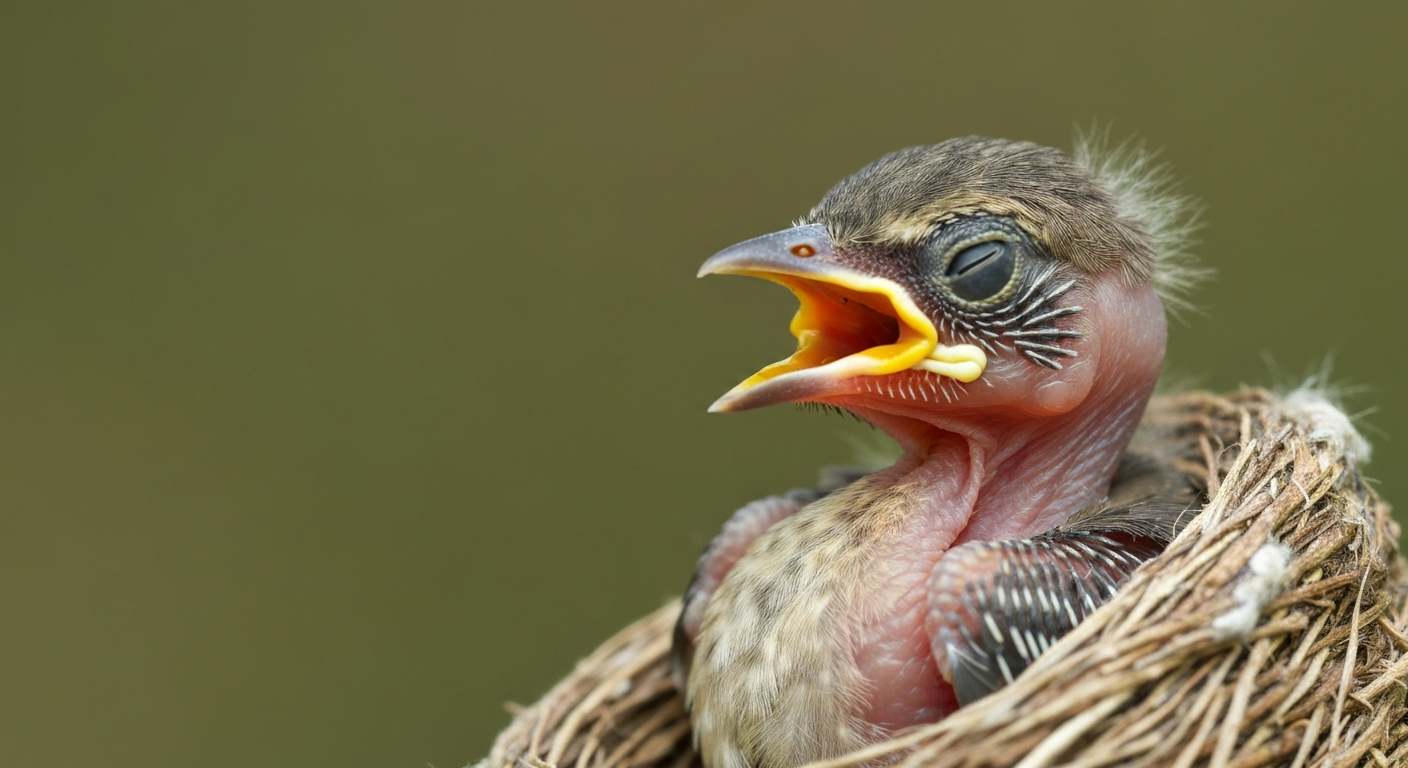
A nestling bird looks essentially helpless and unfinished compared to any adult bird you've ever seen. Most are tiny, mostly or entirely naked, with skin that looks pink or dark and slightly translucent, a few tufts of soft grey or white down, eyes that are sealed shut or just beginning to crack open, stubby little wings with no real feathers yet, and an oversized head dominated by a wide, colorful gape. They can barely lift their heads, let alone walk or fly. If you've found one on the ground and you're asking yourself whether it's a baby bird, the answer is almost certainly yes.
What Does a Nestling Bird Look Like: Visual ID Guide

Marcus Whitley
19 Jul 2026
Spotting a nestling at a glance
Nestlings are one of those things that, once you've seen one, you recognize immediately. They look almost comically underdeveloped. The first thing most people notice is the gape, which is that wide, fleshy, often brightly colored mouth that seems enormous relative to the bird's head. The next thing is the almost total lack of proper feathers. What feathers do exist look more like stubby little quills poking out from the skin, or a sparse dusting of fluffy down that barely covers anything. The skin underneath is visible, usually pinkish, yellowish, or dark grey-black depending on the species.
Nestlings can't hold themselves upright for long. If you watch one in a nest, it either lies flat or wobbles its oversized head upward in a begging posture when a parent arrives. Their eyes are closed for the first few days of life in most common backyard species. They move very little under their own power, which is one of the clearest signs distinguishing them from older baby birds. If the bird you found is hopping around, looking at you, and attempting short flutters, it's almost certainly not a nestling, and that distinction matters enormously for what you do next. The Cornell Lab's I found a baby bird. What do I do?, Cornell Lab of Ornithology (All About Birds) explains that nestlings show limited mobility, persistent gape-begging, and need brooding and immediate parental visits, while fledglings are mobile and often fed by parents on the ground I found a baby bird. What do I do? — Cornell Lab of Ornithology (All About Birds).
Defining the terms: nestling, fledgling, and juvenile
These three words get used interchangeably all the time, but they describe genuinely different stages, and getting them right affects every field decision you make. A nestling is a young bird that has not yet left the nest. It is flightless, largely or entirely dependent on parental feeding, and physically incapable of surviving outside the nest without direct care. A fledgling has left the nest but is still dependent on its parents. It can hop, perch, and make short flights, but it still can't fully fend for itself. It might look almost like a small adult bird, just a bit fluffy and clumsy. A juvenile is the next step up: a young bird in its first set of full feathers, no longer in the nest, and increasingly self-sufficient, though it may still look noticeably different from a fully adult bird of its species.
For anyone who finds a baby bird on the ground, the nestling vs fledgling distinction is the most important call to make. Nestlings genuinely need help if they've fallen from the nest. Fledglings on the ground are often perfectly fine, since many species intentionally leave the nest before they can fly well, and their parents continue feeding them on the ground. Rushing to rescue a fledgling that doesn't need rescuing is one of the most common and well-meaning mistakes people make.
What every nestling has in common: the universal visual traits
Across almost all commonly encountered species, nestlings share a predictable set of visual features. Understanding these lets you confirm what you're looking at even when you have no idea what species it is.
Downy plumage and pin feathers
Very early nestlings are either completely naked or covered in sparse, wispy natal down. This down is soft and fluffy in texture, usually white, grey, or pale buff, and it often makes the bird look like it's wearing a patchy little wig while the rest of it is bare. As the nestling ages, you'll see pin feathers beginning to emerge. These look like tiny dark quills or tubes poking out through the skin, particularly along the wing edges, the back, and the top of the head. Inside each tube is a developing feather still encased in a protective sheath. When the sheath splits, the feather unfurls. By the late nestling stage, these pin feathers have opened out into recognizable juvenile contour feathers, and the bird starts to look considerably more bird-shaped.
The gape: the most visible feature
The gape is the wide opening of the mouth, and in nestlings it looks almost cartoonishly large. Look for two things: the gape flanges (the soft, swollen ridges at the corners of the mouth that make the beak look extra wide), and the interior color. In many species, the inside of the mouth is bright yellow, orange, red, or even pink, and this coloration is a genuine parental signal that triggers feeding responses. Research on barn swallows has shown that the hue and brightness of gape color reflects the chick's health and immune condition, which means parents use it to decide who to feed first. Some species have UV-reflective patches inside the mouth that you can't see with the naked eye. What you can see is a wide, colorful, fleshy mouth opening that seems to take up most of the bird's face.
Eyes
In most altricial species (the helpless-at-hatch type, which covers most songbirds and many others), the eyes are sealed completely shut at hatching and remain closed for the first several days. You'll notice the skin over the eye area looks swollen or slightly bulging. As the nestling develops, the eyes begin to open as narrow slits, then widen to fully open. By the time a bird is approaching fledgling stage, the eyes are fully open and alert. If you look at a bird and its eyes are still closed or only partially open, it's firmly in nestling territory.
Wings and posture
The wings of a nestling are tiny, stubby, and held flat or awkwardly angled. Flight feathers are either absent or just emerging as pin quills. The legs are similarly weak and not reliably weight-bearing in early nestlings. The posture is either flat and prone or, when stimulated by a parent's arrival or any vibration at the nest, instantly upright with the neck stretched and the gape thrown wide open. That sudden upright begging posture is one of the most distinctive behaviors you'll ever see, and it looks almost comic because it comes from a bird that, a second earlier, was lying there completely flat.
Altricial vs precocial: why not all nestlings look the same
Here's the thing that trips a lot of people up: not all baby birds hatch helpless and naked. Birds fall along a developmental spectrum from fully altricial on one end to fully precocial on the other, and this determines almost everything about what a young bird looks like when you encounter it.
Altricial species, which include most songbirds (robins, sparrows, starlings, nightingales), hatch naked or nearly so, with eyes closed, completely dependent on parents for food and warmth. They grow rapidly in the nest and spend weeks there before fledging. These are the birds most people picture when they think of a nestling.
Precocial species, like ducks, geese, shorebirds, and game birds, hatch covered in dense, patterned down, with eyes open, and are mobile within hours. A newly hatched snipe or plover chick running around on the ground might look like a tiny cotton ball on legs, but it's not helpless in the same way at all. Trying to rescue a precocial chick that's trotting around after its mother is usually unnecessary and counterproductive.
There's also a middle ground. Semi-altricial and semi-precocial species fall between these extremes, hatching with some down and open eyes but remaining in or near the nest for a period. Storks, for example, hatch with down and eyes open but still depend heavily on parental feeding and stay in the nest for weeks. Knowing roughly where the species falls on this spectrum changes your whole read of what you're seeing.
| Developmental type | Eyes at hatch | Down at hatch | Mobility at hatch | Nest dependency | Example species |
|---|---|---|---|---|---|
| Altricial | Closed | None or sparse | Essentially none | High, weeks in nest | Robin, starling, nightingale |
| Semi-altricial | Open or partly open | Present | Limited | Moderate, stays near nest | Stork, heron, raptor |
| Semi-precocial | Open | Dense | Limited | Low, leaves nest soon | Gull, tern |
| Precocial | Open | Dense, patterned | Mobile within hours | Very low | Snipe, duck, plover |
Field ID cues you can actually use
When you're crouching over a small bird on the ground and trying to decide what you're looking at, you want fast, observable cues. Here are the ones that matter most.
- Gape flanges present and fleshy: if those swollen, rubbery ridges at the corners of the mouth are visible, you're looking at a nestling or very recent fledgling
- Eyes closed or barely open: almost certain nestling in an altricial species
- Feathers mostly in pin-quill stage (dark tubes visible on wings and back): early-to-mid nestling
- No real flight feathers and wing length obviously short: nestling, not fledgling
- Can't perch or stand reliably: nestling; if it hops and grips a branch, it's likely a fledgling
- Intense begging posture (neck stretched straight up, mouth wide open) triggered by any vibration or approach: strong nestling behavior
- Skin visible through sparse down, especially on belly and back: early nestling
- Eyes fully open and bird tracks your movement visually: likely fledgling or older
- Mobile, attempts to escape when approached: almost certainly fledgling, not nestling
Size alone isn't a reliable cue. Some nestlings are quite large relative to the adult (many songbird nestlings approach adult body weight before leaving the nest), while some adult birds are naturally tiny. Always look at the gape, the feather development, and the movement before reaching for size as a diagnostic.
How nestlings look across different species: starling, nightingale, snipe, and stork
A few sibling species on this site illustrate exactly how much nestling appearance can vary. Here's a quick tour of four that show the range well.
Starling nestlings
Common starlings are fully altricial. Hatchlings are naked, pink-skinned, and have bright yellow gape flanges that are almost luminous. The inside of the mouth is yellow-pink. Within a week, grey down appears, and by around day 12 to 14, pin feathers are pushing through rapidly. Late nestlings start to look dark overall, the beginning of the starling's dark juvenile plumage coming through. The eyes open around day five or six. If you're curious what adult starlings look like in contrast, the fully feathered bird is dramatically different: glossy, spotted, and iridescent. Starling nestlings in nest boxes are the most commonly encountered in urban and suburban areas, and they are loud, producing persistent rasping begging calls.
Nightingale nestlings
Nightingale nestlings follow the typical altricial pattern: hatching naked and helpless, with pinkish skin and sparse pale down, sealed eyes, and yellow-edged gapes. They develop relatively quickly, and by about day 11 are usually fledging. The juvenile plumage that emerges through the nestling stage is warm brown and spotted, bearing little resemblance to the smooth rufous-brown of the adult. Because nightingales nest in dense low vegetation, you're more likely to encounter a fledgling on the ground than a nestling, but the nestling stage follows the same helpless altricial blueprint.
Snipe nestlings (precocial, and easy to misread)
Snipe are near the precocial end of the spectrum, and their chicks look nothing like a typical helpless nestling. A newly hatched snipe chick has dense, cryptically patterned brown and buff down, fully open dark eyes, and is capable of walking and even following its parents within hours of hatching. The long bill is present and obvious from very early on, even in the downy chick. If you encounter what looks like a tiny patterned fluffball running through marsh vegetation, it is almost certainly not a distressed nestling in need of rescue. It's a precocial chick doing exactly what it's supposed to do. The concept of a "nestling snipe" barely applies in the traditional sense, since snipe chicks leave the nest scrape almost immediately.
Stork nestlings (large, semi-altricial, and long-nest-bound)
White stork nestlings are semi-altricial: they hatch with a covering of white down and eyes that open relatively quickly, but they remain in the large platform nest for about 58 to 64 days. Early stork nestlings look surprisingly helpless for such large birds, lying flat on the nest floor, covered in white fluffy down with a pale pinkish bill that darkens over time. As they develop, the characteristic black and white adult pattern begins to emerge through the white juvenile plumage. By the later nestling stage, juvenile storks look like smaller, slightly scruffier versions of the adult, and are visible standing upright in the nest, flapping their developing wings. The sheer size of the nest and the size of the chicks makes stork nestlings easy to observe, since their nests are often on tall structures in open areas. For more on storks' appearance, including adult and nestling stages, see the article what does a stork bird look like.
A sleeping bird vs a genuinely nest-bound nestling: how to tell them apart
This is a genuinely important distinction and one that causes a lot of unnecessary rescues. Birds sleep, rest, and do what looks from the outside like absolutely nothing for large parts of the day. For more on identifying resting or sleeping birds, see our short guide on what does a sleeping bird look like. A nestling resting between feeding visits looks, to an uninitiated observer, a lot like a bird in distress. Similarly, a fledgling hiding under a shrub and doing its very best not to be noticed can look exactly like a bird that's collapsed from exhaustion.
The signs of genuine distress are different from sleep or rest. A nestling or fledgling in real trouble shows labored or open-mouth breathing, unresponsiveness to sounds and vibrations that should trigger a begging response (like you gently tapping near the nest), visible injury such as blood, a drooping or twisted wing, or obvious swelling, hypothermia (limpness, cold to the touch, shivering), or prolonged isolation with no parental visits despite you watching from a distance for at least an hour.
A sleeping nestling, by contrast, breathes slowly and smoothly, responds quickly to vibration or sound (usually by springing into a begging posture), feels warm to a gentle touch, and shows no visible injury. If parents are visiting a nest, chicks will alternate between frantic begging during feeding and complete stillness between visits. That stillness is not distress, it's energy conservation.
The best rule of thumb: watch from a distance for at least an hour before concluding that a bird is in trouble. Many wildlife rehab flowcharts use exactly this one-hour observation period as a first step. If parents haven't returned and you've confirmed the bird is a nestling (not a fledgling that's supposed to be on the ground), then intervention makes sense.
Common misidentifications and pitfalls to watch for
Even experienced birders make predictable mistakes when it comes to young birds. Knowing the most common ones in advance saves a lot of confusion in the field.
Fledgling mistaken for nestling
This is the single most common error. A fledgling on the ground, especially one that's keeping very still, can look helpless. But look for the key differences: fully open, alert eyes; real feathers (even if fluffy and a bit disheveled); the ability to grip a finger or a twig; and mobile attempts to escape when you approach. If any of these are true, it's a fledgling, and unless it's injured, the best thing you can do is leave it alone and keep cats and dogs away while the parents continue feeding it on the ground.
Precocial chick mistaken for lost nestling
As discussed with the snipe example, precocial chicks running around on the ground are not in distress. They're doing exactly what their developmental biology tells them to do. A tiny plover or snipe chick that looks fluffy and lost is almost certainly not lost. Its parent is likely watching you from nearby, waiting for you to leave.
Juvenile plumage causing species confusion
Juvenile birds wear a distinct first set of feathers that often look nothing like the adult plumage you're used to seeing in field guides. Field studies commonly use empirical primary feather growth rates (approximately 5.5 mm per day) to back-calculate age from partial primary emergence in recaptured juveniles (SEAFWA field study) primary feather growth rates (~5.5 mm/day). Young robins, for example, are heavily spotted on the breast rather than showing the classic red-orange. Young starlings are a uniform dull brown. Young nightingales have spotted, thrush-like plumage. If you see a bird you don't recognize and it's a bit smaller, fluffier, or oddly marked compared to the adults nearby, check whether what you're seeing might be a juvenile or late fledgling of a species you actually know well.
Sibling competition making the weakest nestling look like the only one
In multi-chick nests, begging competition among siblings means smaller or weaker nestlings can look underfed and struggling while the larger chick hogs the best position. If you find a nest with several nestlings and one looks much smaller or paler, that's often just the runt of a normal brood, not a separate problem requiring intervention. Removing a nestling from a healthy nest because it looks worse than its siblings is usually the wrong call.
Compact visual comparison table: quick traits to check for ID
| Trait to check | Early nestling | Late nestling | Fledgling | Juvenile |
|---|---|---|---|---|
| Eyes | Sealed shut | Open or opening | Fully open, alert | Fully open, alert |
| Plumage | Naked or sparse natal down | Pin feathers emerging, some down | Mostly feathered, fluffy | Full juvenile feathers |
| Gape flanges | Very pronounced, fleshy | Still visible, less swollen | Fading but may show | Absent or minimal |
| Wing development | Stub-like, no flight feathers | Pin quills visible on wings | Short but feathered | Full-length juvenile primaries |
| Mobility | None, lies flat | Very limited | Hops, grips, short flutters | Flies, perches normally |
| Begging posture | Instant and intense when stimulated | Strong, neck stretched | May beg from parent | Mostly independent feeding |
| Thermal independence | Cannot regulate own temperature | Improving but still needs brooding | Largely independent | Fully independent |
| Where found | Only in or directly below nest | In or just below nest | On ground, in low vegetation | Anywhere adult birds found |
What to do when you find a nestling: practical guidance
Once you've confirmed you're looking at a nestling (not a fledgling, not a precocial chick), the decision tree is fairly simple. If the bird is injured (bleeding, broken limb, obvious trauma) or if both parents are confirmed dead, contact a licensed wildlife rehabilitator. In most countries it's illegal to keep wild birds without a permit, so rehab is the right call, not a shoebox on your counter.
If the bird is uninjured and you can locate the nest, put it back. The widely circulated idea that touching a baby bird will make the parents abandon it is a myth. Birds have a limited sense of smell and will not reject a chick you've handled. Gently return the nestling to the nest and step well back. If the nest is destroyed or unreachable, you can construct a simple replacement from a small container (like a margarine tub with drainage holes punched in the bottom) filled with dry grass, secured as close to the original nest site as possible.
If you're not sure whether parents are present, watch from at least 30 feet away for an hour. Most songbird parents return to the nest every 10 to 20 minutes. If no parent returns in an hour and the nestling is showing signs of distress, that's when you make the call to a rehabilitator. Do not attempt to feed the bird yourself. Baby birds have very specific dietary needs, and the wrong food (especially bread, milk, or water) can cause rapid harm.
FAQ
What is a nestling and how does it differ from a fledgling or juvenile?
A nestling is a young bird that cannot yet leave the nest and depends on parents for feeding and warmth. Nestlings are usually flightless and show early-growth traits (naked skin or down, pin feathers, strong gape display). A fledgling has recently left the nest or is able to make short flights; it is more mobile, has fuller contour feathers, and will hop or flutter on the ground or branches while still being fed by parents. “Juvenile” is a broader term for a young bird after leaving dependence and showing adult-like plumage patterns over time.
What universal visual traits indicate a bird is a nestling?
Common, field-visible nestling traits (especially in altricial species) include: downy or sparsely feathered body and pin feathers; conspicuous gape (open mouth with colored flanges); short, stubby wings with sheathed flight-feather shafts; eyes often closed or only partly open in the first days; limited locomotion and inability to perch or sustain flight; persistent begging posture (neck extended, head-up) and high-rate begging calls.
How does the altricial–precocial spectrum affect what a nestling looks like?
Altricial nestlings (many passerines) hatch helpless: naked or with little down, closed eyes early, slow feather growth, and strong begging. Precocial species (ducks, snipe, many ground-nesters) hatch well-covered in down, eyes open, mobile, and leave the nest quickly. Some species are intermediate or semi-altricial (e.g., storks) — they may be relatively well-feathered yet still require parental care in the nest. Always interpret appearance within the species’ natural history.
Which quick visual cues help distinguish nestling vs fledgling in the field?
Useful, rapid cues: feathering — pinfeathers and bare patches = nestling; fully feathered contour = fledgling. Mobility — cannot perch or hop = nestling; can hop, cling, or flutter = fledgling. Gape — wide, colored gape and frequent begging = nestling (especially in altricial species). Eye state — closed or slow-opening eyes = young nestling. Behavior — strong in-nest begging posture vs independent ground movement.
Can gape color reliably identify a nestling’s age or condition?
Gape color is a useful species-specific signal: bright or patterned gapes often attract parental feeding and can correlate with nestling condition in some passerines. However, gape color changes rapidly with age, can include UV patterns invisible to humans, and varies by species. Use gape color as one cue together with feather development and behavior rather than a sole diagnostic feature.
What species-specific notes should birdwatchers know (starling, nightingale, snipe, stork)?
Starling (altricial passerine): nestlings are largely naked at hatching, then show pinfeathers and a bright gape; by late nestling stage, contour feathers and flight-pin shafts appear. Nightingale (altricial singer): similar pattern — downy/pinfeather stage, closed or partly open eyes early, strong begging. Snipe (precocial ground-nester): hatch fully downy, eyes open, highly mobile soon after hatching and leave the nest quickly — they do not look helpless. Stork (semi-altricial/large waterbird): hatch with down and open eyes but remain in nest for weeks; feathering develops slowly and chicks are large and noisy but not completely helpless.
Next Article
What Does a Sleeping Bird Look Like: Visual ID Guide
Spot sleeping birds: closed eyes, tucked head, fluffed feathers, one-leg perch; ID and ethics tips.